
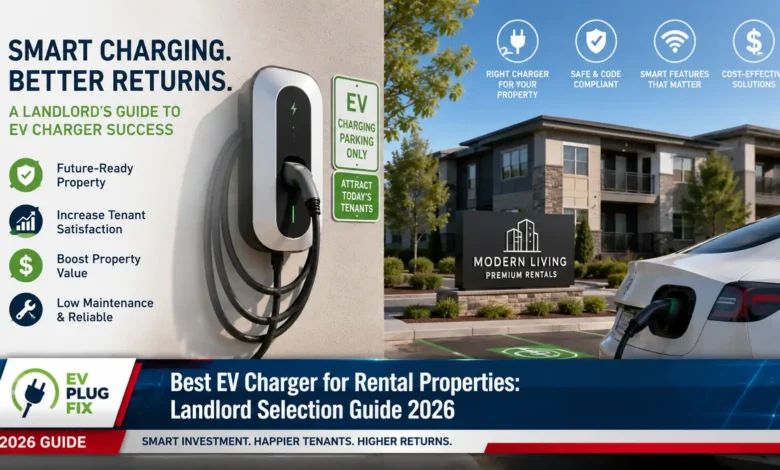
The best EV charger for a rental property is usually a dependable Level 2 unit for a house with dedicated parking, or a networked, load-managed Level 2 system for a multifamily building. The important distinction is not brand or maximum charging speed. It is whether the system fits the property’s electrical capacity, parking arrangement, billing method and likely future number of EVs.
For landlords, that makes scalability and operating responsibility just as important as the charger itself. A wallbox that works perfectly for one tenant can become an expensive dead end if the property later needs ten charging spaces, individual billing or centralized access control.
Quick Answer: Best EV Charging Setup by Rental Type
| Rental situation | Recommended architecture | What matters most |
|---|---|---|
| Single-family home with dedicated garage or driveway | Simple permanently installed Level 2 charger | Reliability, regional connector compatibility, durable cable, suitable outdoor rating and minimal software dependence |
| Duplex or small rental with assigned parking | One or more Level 2 chargers with energy monitoring or power sharing | Electrical capacity, usage records, tenant turnover and expansion |
| Apartment building with assigned spaces | Networked Level 2 chargers with load management | User authentication, energy records, billing, account administration and scalable electrical design |
| Apartment building with shared parking | Shared networked charging stations | Access control, payment rules, parking enforcement, availability and driver support |
| Short-term or vacation rental | Simple fixed Level 2 charger | Easy guest operation, durable hardware and clear charging instructions |
| Property with limited electrical capacity | Lower-current Level 2 charging or managed charging | Adjustable output, power sharing and avoiding unnecessary service upgrades |
Start With the Property, Not the Wallbox
Before comparing chargers, answer four questions: where the vehicles will park, how much electrical capacity is available, who will pay for the electricity and how many charging spaces the property may eventually need.
The U.S. Department of Energy’s multifamily charging guidance similarly highlights parking, electrical infrastructure, payment and property-management considerations. These decisions determine whether a landlord needs a basic residential charger or a managed charging system.
For a Single-Family Rental
If the tenant has a dedicated garage or driveway and the charger can be supplied from that tenant’s electrical service, keep the setup simple. A permanently installed Level 2 charger normally provides the best balance of convenience, charging speed and long-term usefulness.
Commercial payment processing is unnecessary when the tenant already pays the property’s electricity bill. Prioritize certified hardware, a practical cable length, weather suitability where relevant, a strong warranty and controls that do not make basic charging dependent on an app.
For a Multifamily Property
Apartment charging is an infrastructure project rather than a wallbox purchase. Multiple residents may share a common electrical supply, parking spaces can be assigned or unassigned, and several vehicles may charge at the same time. A broader multi-unit dwelling charging strategy can help owners plan these shared electrical, parking and resident-management requirements together.
For these properties, specify the system around the eventual port count. Conduit routes, panel capacity, communications coverage and load management can determine the cost of expansion far more than the price difference between two individual chargers.
How Much Charging Power Is Actually Needed?
Level 2 AC charging is the practical default for most rental properties. In North America it normally operates from a 208- or 240-volt supply; UK and European installations may use single-phase or three-phase AC depending on the property.
Level 1 charging can still work for a North American tenant with modest daily driving and long overnight parking, particularly when electrical capacity is constrained. DC fast charging, by contrast, is generally unnecessary for ordinary residential rentals because its cost and infrastructure demands are designed for much faster vehicle turnover.
The key landlord rule is simple: size charging around dwell time and available capacity, not the largest number printed on the charger. Actual AC charging speed is limited by the building supply, circuit, EVSE and the vehicle’s onboard charger.
In a multifamily property, providing moderate power to more parking spaces is often more useful than dedicating large amounts of capacity to a few high-output chargers.
Use Load Management Before Assuming the Building Needs an Upgrade
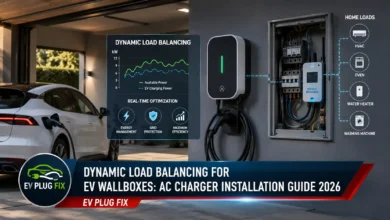
Multiple chargers do not necessarily need their maximum possible output simultaneously. Power-sharing systems allow a defined amount of electrical capacity to be distributed among connected vehicles, while dynamic load balancing can adjust charging in response to other building loads.
This can make a major difference to apartment projects. Instead of designing every future charger as though every vehicle will demand maximum power at the same moment, a properly engineered system can allocate available capacity across the charging population.
Before buying hardware, verify how load management is implemented. Some systems coordinate chargers locally, some depend on cloud services, and others require additional meters, controllers or subscriptions. Also confirm how the system behaves if its internet connection or management service becomes unavailable.
Decide Who Pays for Electricity Before Choosing Software
Billing architecture should be decided before hardware is purchased. When a charger sits downstream of an individual tenant’s utility meter, electricity accounting is straightforward: charging appears on that tenant’s normal electricity bill.
A charger supplied from a landlord’s common-area service creates a different problem. The landlord must decide whether charging is included as an amenity, recovered through an allowed fixed charge, measured by individual usage or handled through a charging-network payment system.
Shared properties may therefore need user authentication, per-account energy records, pricing controls, automated payments and remote administration. Those features are valuable only when the operating model requires them; they add unnecessary cost and complexity to a simple single-family rental.
Local utility, landlord-tenant, metering and consumer-protection rules can affect how electricity costs may be recovered, so billing policy should be checked for the property’s jurisdiction rather than copied from another building or state.
Compatibility Should Survive Tenant Turnover
A landlord is buying infrastructure for a property, not for one tenant’s current vehicle. Connector strategy should therefore account for both today’s residents and the vehicles likely to use the charger over its service life.
North America
North American landlords are operating during a transition in which SAE J1772-equipped vehicles remain common while SAE J3400, widely known as NACS, is increasingly important. Do not choose a permanent rental installation only because it matches one existing tenant.
Check the connector supplied with the charger, the vehicles it can serve directly, approved adapter options where applicable and whether a cable or connector can be replaced economically if market requirements change.
UK and Europe
Type 2 is the standard practical choice for normal AC charging in the UK and much of Europe. The more important question is often electrical power rather than plug shape.
Before paying for an 11 kW or 22 kW wallbox, confirm that the property has the appropriate electrical supply and that likely vehicles can accept the corresponding AC rate. A higher wallbox rating provides no advantage when either the site or vehicle limits charging below that level.
Who Should Own the Charger?
For a long-term rental amenity, landlord-owned fixed equipment is generally the cleaner arrangement. It remains with the property when tenants leave, lets the owner control installation standards and reduces disputes about what happens to charging equipment at the end of a tenancy.
A tenant-owned charger may be appropriate where local right-to-charge law or the lease permits an installation at the tenant’s expense, but ownership, removal, restoration, maintenance and electricity responsibility should be settled before work begins.
Portable EVSE is best reserved for situations where portability has genuine operational value. Plugging into an outlet does not eliminate electrical requirements: the receptacle, wiring and branch circuit still need to be appropriate for the charging load.
Plan for Maintenance and Tenant Turnover
Multifamily charging introduces responsibilities that are easy to overlook during the buying stage. Someone needs to own every operational problem after installation.
- Physical damage: Decide who inspects and replaces worn cables, connectors and damaged enclosures.
- Charger faults: Establish whether maintenance is handled by property staff, an electrical contractor, the hardware vendor or a network provider.
- Network outages: Know whether residents can still charge when internet or cloud services fail.
- Resident support: Determine who handles failed sessions, billing questions, lost RFID credentials and app problems.
- Account turnover: There should be a documented process for removing a departing tenant and activating a new resident.
- Replacement: Check whether cables, communications modules and complete chargers can be replaced without redesigning the entire system.
- Software costs: Include subscriptions, transaction charges and network-service fees in ownership cost rather than comparing hardware prices alone.
For larger buildings, these operational questions deserve as much weight as maximum amperage. A sophisticated charger with weak support can create more work for a property manager than a less glamorous platform with dependable administration and replacement parts.
Smart Chargers: Useful Features Without Excessive Cloud Dependence
Connected charging is valuable when it solves a real management problem. Remote diagnostics, user authentication, billing, energy reporting and coordinated load management can justify networked hardware in a multifamily property.
A consumer Wi-Fi app that schedules one driver’s charging is different from a property-management platform built to administer numerous residents and chargers. Comparing networked and non-networked chargers can clarify which management features justify the extra software and connectivity.
Before committing to connected equipment, establish what remains functional without the internet. Basic charging should not become unnecessarily unusable simply because property Wi-Fi fails or a consumer app cannot reach its cloud service.
Also investigate the commercial relationship behind the hardware. Ask what features require subscriptions, whether fees can change, how long software support is expected to continue, whether another management platform can be used and what happens to installed chargers if the original cloud service is discontinued.
What to Choose for Each Rental Type
| Property type | Best practical choice | Avoid paying extra for |
|---|---|---|
| Single-family rental | Reliable fixed Level 2 charger connected to the tenant’s electrical service where practical | Commercial payment networks and complex resident-management software |
| Short-term rental | Fixed Level 2 charger with straightforward plug-and-charge operation | Guest account creation unless access control is genuinely necessary |
| Duplex or small multifamily property | Level 2 chargers with energy monitoring and a clear path to power sharing | Oversizing each charger before future capacity is planned |
| Apartment building with assigned spaces | Networked Level 2 architecture with authentication, usage records and load management | Standalone residential chargers that cannot be centrally administered or expanded |
| Apartment building with shared parking | Managed shared chargers with access control, billing capability and remote support | Hardware that cannot distinguish users or manage parking turnover |
| Capacity-constrained building | Managed charging with adjustable power allocation | Maximum-power chargers that force unnecessary simultaneous electrical demand |
This is also why there is no responsible single-brand winner for every rental property. The correct product shortlist emerges only after electrical capacity, billing, parking, networking and expansion requirements have been defined.
How to Compare Charger Brands Once the Design Is Set
After the property requirements are known, compare specific products on characteristics that affect ownership rather than decorative features or headline charging rates.
| Requirement | What the landlord should verify |
|---|---|
| Safety and compliance | Appropriate certification or listing for the country and jurisdiction, plus compatibility with the intended installation |
| Physical installation | Cable length, mounting options, environmental rating and operating conditions |
| Tenant turnover | Easy account reassignment, access removal and charger reset procedures |
| Multifamily management | User authentication, energy records, pricing, remote diagnostics and administrator controls |
| Electrical scalability | Power sharing, dynamic load management and support for additional ports |
| Software dependence | Offline charging behavior, subscription requirements and long-term platform support |
| Maintenance | Warranty, service availability, replaceable cables and access to replacement hardware |
| Integration | Supported protocols and whether required third-party functionality is actually enabled on the selected model |
Do not rely on the historic popularity of a charger platform without checking its current support status. The North American JuiceBox ecosystem, for example, underwent major service changes following Enel X Way’s withdrawal from its U.S. and Canadian charging business, making old recommendation lists a poor basis for a new landlord installation.
Do Not Treat a Marketing Certification List as Installation Approval
Verify safety and regulatory status for the exact charger model and market. A manufacturer’s product family can contain different North American, UK, European or other regional versions.
In the United States and Canada, confirm the listing or certification required by the local authority having jurisdiction. In the UK and Europe, confirm the applicable conformity and electrical-installation requirements.
An IP rating, CE marking, FCC statement or safety claim on a marketplace listing does not by itself establish that a charger is suitable for every property or jurisdiction.
Installation Cost Depends More on the Site Than the Charger
A wallbox installed beside a suitable electrical panel is a very different project from supplying ten spaces across an apartment parking structure. Generic installation-price estimates therefore have limited value for landlords.
A project may involve electrical design, permits, conduit, trenching, long conductor runs, distribution equipment, panel changes, utility work, communications, pedestals, signage, parking modifications and recurring software costs. These EV charger installation costs should be evaluated as part of the complete site design rather than as an accessory to the wallbox price.
Get a site-specific electrical assessment before committing to hardware. For multifamily properties, ask the designer to consider the intended future number of charging spaces instead of evaluating only the first charger.
Sometimes EV-Ready Infrastructure Is the Better Investment
Not every parking space needs an active charger immediately. Where EV demand is still developing, the better capital decision may be to install conduit, allocate electrical capacity, prepare communications and design distribution equipment for future chargers.
This is especially attractive during construction or major renovation, when accessing walls, ceilings and parking surfaces is easier. EV-ready infrastructure gives the owner room to add hardware as demand appears without committing every space to today’s charger technology.
U.S. Federal 30C Tax Credit After June 30, 2026
Landlords should disregard older guidance that presents the federal Alternative Fuel Vehicle Refueling Property Credit under Internal Revenue Code Section 30C as generally available through 2032.
The IRS currently states that the credit cannot be claimed for qualifying refueling property placed in service after June 30, 2026.
For qualifying business property placed in service during the applicable period before that cutoff, the IRS states that the credit is generally 6% of qualified cost, or 30% when the prevailing-wage and apprenticeship requirements are met, subject to applicable limits and location requirements.
A landlord commissioning a new installation after June 30, 2026 should therefore not include the federal 30C credit in the project’s expected economics. State, municipal and utility incentives may still apply and should be checked using the property’s exact location.
UK Residential Landlord Chargepoint Grant
As of August 2026, the UK residential landlord chargepoint grant remains available under the current scheme.
The grant covers 75% of eligible purchase and installation costs up to £500 per socket, and eligible landlords can claim support for up to 200 sockets per year across their sites. The maximum increased from £350 to £500 from April 1, 2026.
Current government guidance says the relevant residential landlord scheme is available until March 31, 2027, subject to eligibility and scheme requirements. Landlords should confirm the rules and use the required application and installation process before committing to a project.
EU Building Rules Are Implemented Through National Law
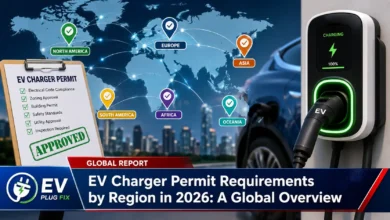
EU building-related EV charging requirements should not be reduced to a claim that every residential landlord must install chargers. Directive (EU) 2024/1275, the recast Energy Performance of Buildings Directive, addresses charging infrastructure and pre-cabling requirements in relevant building situations and also addresses barriers affecting tenants and co-owners seeking charging facilities.
The practical rules facing a landlord depend on national implementation and local building requirements. Owners should therefore check the law in the country and municipality where the property is located rather than assuming one identical installation obligation throughout the EU.
The directive is available through EUR-Lex.
U.S. Right-to-Charge Laws Differ by State
A lease is not always the only document governing a tenant’s request for EV charging. Some states have enacted right-to-charge provisions, but the conditions are not uniform nationwide.
California Civil Code Section 1947.6 establishes rules for qualifying tenant requests to install EV charging equipment in allotted parking spaces, subject to statutory conditions and exceptions. Landlords should consult the current California statutes before applying the rule to a particular tenancy.
Illinois’ Electric Vehicle Charging Act also addresses charging installations requested by renters. Section 35 covers qualifying tenant installations and addresses subjects including costs, electricity reimbursement and safety requirements. The statute is available from the Illinois General Assembly.
Other states and municipalities may impose different requirements, so landlords should check current state and local law before approving, rejecting or conditioning a tenant installation request.
Electrical and Code Compliance
Permanent EV charging equipment must be installed according to the electrical code adopted by the relevant jurisdiction, the charger’s installation instructions and applicable permit requirements.
In the United States, EV charging equipment is addressed by NEC Article 625, although the NEC edition adopted locally varies. A qualified electrical professional should determine circuit and conductor sizing, required protection, applicable continuous-load rules, disconnect requirements and whether the existing service can support the planned charging system.
For multifamily properties, that assessment should include the owner’s expected future charging footprint. Designing solely around one initial charger can make later expansion unnecessarily expensive.
Set the Operating Rules Before Installation
Charging hardware becomes easier to manage when responsibility is established in advance. The lease, charging agreement or property policy should address charger ownership, electricity payment, network charges, maintenance responsibility, cable damage, guest access, parking rules, account transfer and what happens to tenant-installed equipment when the tenancy ends.
For a networked apartment system, also establish who monitors offline chargers, who residents contact when charging fails and how quickly failed equipment is expected to be repaired or replaced.
The Landlord Decision Sequence
- Assess electrical capacity. Determine what the existing service and distribution system can support before choosing charger output.
- Decide who pays for electricity. Establish whether charging sits on a tenant meter, common supply or network-billed system.
- Define the parking model. Separate assigned-space charging from shared or visitor charging because they require different access controls.
- Determine whether authentication and billing are needed. Do not pay for commercial networking when a simple residential installation will do the job.
- Set the future port count. Design conduit, electrical distribution and communications around realistic expansion rather than the first installation alone.
- Choose the charging architecture. Select simple Level 2 charging, power sharing or a fully managed multifamily system according to the previous decisions.
- Select compatible hardware and software. Only now compare charger models, connector options, warranties, certifications, network costs and support.
Essential Questions & Expert Answers
Who normally pays for EV charging electricity in a rental?
When the charger is supplied from the tenant’s own electrical service, the tenant normally pays for charging through the regular electricity bill. Chargers connected to a landlord’s common supply require a separate policy for measuring or recovering charging costs, subject to applicable local rules.
Does an apartment building need the fastest Level 2 charger at every parking space?
No. Apartment vehicles often remain parked for long periods, making power sharing more valuable than maximum simultaneous output. Installing high-power chargers at every space can increase electrical infrastructure requirements without producing a comparable benefit for residents.
Is Wi-Fi necessary for a rental property charger?
No. A simple single-family rental may need no network connection at all. Connectivity becomes important when the owner requires billing, user authentication, remote diagnostics, reporting or coordinated load management.
What happens if a smart charger’s internet connection fails?
That depends on the product and system architecture. Before purchase, verify whether normal charging continues offline, whether authentication still works, how transactions are recorded and whether load-management functions require cloud connectivity. This is especially important when residents depend on the chargers for everyday transportation.
Is a portable EV charger better for an Airbnb or vacation rental?
Not simply because it is portable. A fixed charger is harder to remove, gives the property owner more control over the installation and can be easier for guests to use. Portable EVSE is better reserved for situations where moving the equipment is genuinely useful.
Should a landlord install chargers now or make parking spaces EV-ready?
If present demand is low, preparing conduit, electrical capacity and communications for future chargers can be the better investment. Active chargers can then be added as demand grows without repeating the most disruptive infrastructure work.
Can a landlord still claim the U.S. federal 30C credit for a new installation?
Not for qualifying property placed in service after June 30, 2026. The IRS states that the Section 30C Alternative Fuel Vehicle Refueling Property Credit is unavailable for property placed in service after that date. Other state, local and utility incentives may still be available.
How much is the UK residential landlord EV chargepoint grant?
Under the rules in effect as of August 2026, eligible landlords can receive 75% of qualifying purchase and installation costs up to £500 per socket and can claim for up to 200 sockets per year across their sites. The current scheme is available until March 31, 2027, subject to its eligibility requirements.
Bottom Line
For a single-family rental with dedicated parking, choose a reliable fixed Level 2 charger that works with the property’s electrical service, regional connector requirements and future tenants. Avoid unnecessary commercial networking when the tenant already pays the electricity bill.
For a small multifamily building, add energy monitoring and plan for power sharing before the second or third charger turns electrical capacity into a problem. For a larger apartment property, treat EV charging as managed infrastructure: authentication, billing, load management, account turnover, remote support and future expansion matter more than the maximum output of one wallbox.
The buying order is what prevents expensive mistakes: assess the electrical service, decide who pays for energy, define assigned versus shared parking, determine whether access control and billing are necessary, establish the eventual port count and only then select the hardware and software. That approach produces a charging system that can survive tenant turnover and grow with the property instead of becoming obsolete after the first installation.
Source Transparency
This guide was reviewed against primary and governmental information available in August 2026. U.S. multifamily charging guidance is available from the U.S. Department of Energy Alternative Fuels Data Center. Current federal 30C information, including the June 30, 2026 cutoff, is available from the Internal Revenue Service.
UK grant amounts and current scheme timing were checked against the UK government’s residential landlord chargepoint grant guidance. European building requirements can be reviewed in Directive (EU) 2024/1275.
California and Illinois examples are based on current state statutory sources. Charger specifications, certifications, connector configurations, network subscriptions and software functionality can vary by model and market and should be confirmed before equipment is purchased.