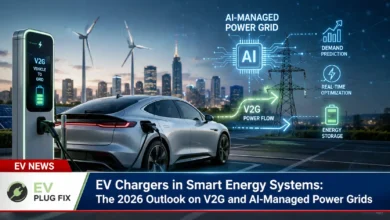

Vehicle-to-Grid (V2G) Technology: Is It Worth It? Costs, Benefits & Compatible EVs

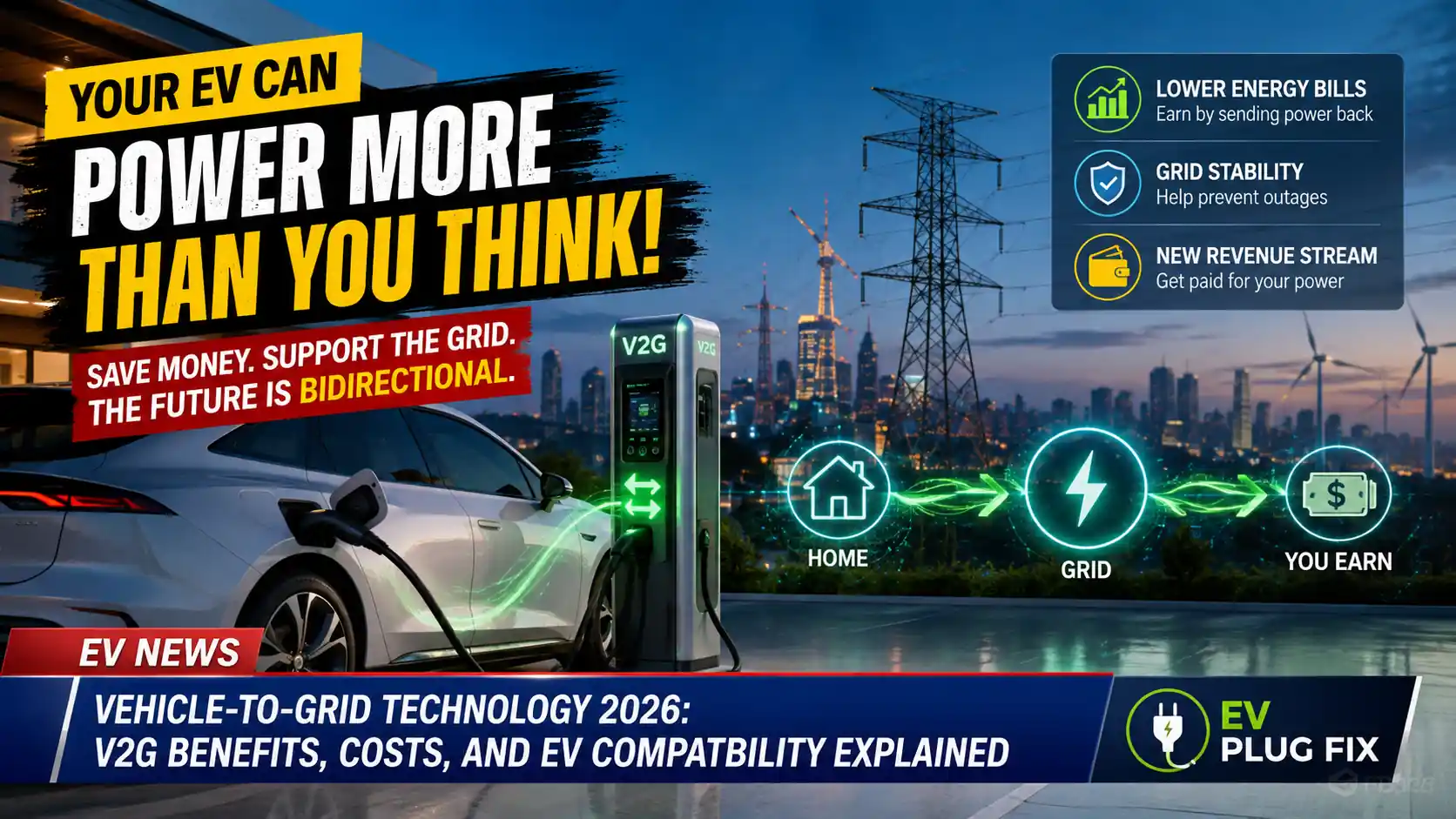
If your electric car spends most evenings parked in the driveway, there is an obvious question: could that large battery be doing something useful while you sleep?
That is the idea behind Vehicle-to-Grid (V2G) technology. Instead of electricity flowing only from the grid into your EV, a V2G-capable setup can also send some of the energy stored in the battery back to the electricity grid when it is useful or valuable.
It sounds simple. In practice, there is an important catch.
Owning an EV with bidirectional charging hardware does not automatically mean you can start selling electricity back to your utility. Your vehicle, charger, software, electricity tariff, local grid rules, and sometimes a specific utility program all need to work together.
That distinction matters because V2G is sometimes discussed as though it were already a plug-and-play feature for EV owners. In many markets, it isn’t.
V2G has moved beyond the purely experimental stage, but it still isn’t a sensible purchase for every EV owner. It makes the strongest case when you already own a compatible vehicle, have access to an approved V2G program, regularly leave your car plugged in, and can install the required hardware without a costly electrical upgrade. If those pieces aren’t in place, ordinary smart off-peak charging may deliver much of the immediate financial benefit with far less complexity.
What Is Vehicle-to-Grid (V2G) Technology?
With conventional EV charging, electricity moves in one direction:
Electricity grid → charger → EV battery
Vehicle-to-Grid adds a second direction:
EV battery → compatible charger → electricity grid
The EV effectively becomes a mobile energy-storage device. It can charge when electricity is cheaper or renewable generation is plentiful, then potentially return part of that stored energy when grid demand and electricity prices are higher.
Many modern EVs carry large batteries, giving a parked vehicle enough stored energy to become useful for more than transportation. But having the battery capacity is the easy part. The harder challenge is getting the vehicle, charger, energy provider and electricity grid to communicate safely and predictably.
Standards are helping solve part of that problem. The official ISO 15118-20 standard defines communication messages and sequence requirements for bidirectional power transfer between an electric vehicle and EV supply equipment.
That does not mean every vehicle using ISO 15118 automatically supports commercial V2G. It is better understood as part of the technical foundation manufacturers and charging companies can use to build compatible systems.
A complete V2G setup will typically require:
- a vehicle capable of bidirectional power transfer;
- a compatible bidirectional charger;
- approved metering and grid-connection equipment;
- energy-management software;
- an electricity tariff or utility program that supports energy export; and
- local grid approval where required.
If you are interested in grid-responsive charging without necessarily exporting electricity from the battery, our guide to EV Demand Response explains another way smart EV charging can help manage electricity demand.
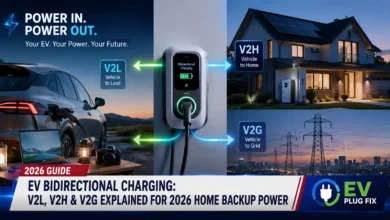
V2G vs V2H vs V2L vs V2B: What’s the Difference?
This is one of the most important distinctions to understand before shopping for a bidirectional EV or charger.
A car can offer V2L—or even be described broadly as “bidirectional”—without being able to participate in a commercial Vehicle-to-Grid program where you live.
| Technology | Meaning | What It Does | Typical Use |
|---|---|---|---|
| V2L | Vehicle-to-Load | Supplies electricity directly to external devices | Tools, appliances and camping equipment |
| V2H | Vehicle-to-Home | Uses the EV battery to supply a home | Backup power and home energy management |
| V2B | Vehicle-to-Building | Supplies electricity to a commercial building | Commercial energy management |
| V2G | Vehicle-to-Grid | Exports electricity from the EV into the public grid | Grid services, energy trading and demand response |
For example, an EV with a V2L outlet may be able to run a refrigerator, laptop or power tool. That is useful, but it does not prove the vehicle can legally and technically export energy into your local electricity grid.
Likewise, V2H may be more useful than V2G for some homeowners. If your priority is keeping essential circuits running during a blackout rather than earning money from grid services, home backup may be the more valuable feature.
Our guide to home EV charging solutions covers the broader equipment choices involved in residential EV charging.
How Does V2G Actually Work?
Imagine arriving home in the evening with 65% battery remaining. You know you only need about 40% for tomorrow’s driving.
Instead of immediately charging your EV to 100%, a smart V2G system could wait until electricity becomes cheaper, recharge the battery during an off-peak period, and later make part of the stored energy available to the grid when demand increases.
The important word here is smart.
A practical V2G system should not require you to sit in an app manually buying and selling electricity. Energy-management software can handle much of the process according to the rules you set and signals received from the grid or energy provider.
Depending on the system, the driver may be able to specify:
- the minimum battery percentage that must remain available;
- the time the vehicle will next be needed;
- whether battery discharge is allowed;
- how much capacity can be used for grid services; and
- when the car should reach its target charge level.
The system can then optimize charging and discharging while preserving the range you need for driving.
AC vs DC Bidirectional Charging
Bidirectional charging can be implemented in different ways.
DC bidirectional charging can place much of the DC-to-AC conversion hardware in the external charger. This approach has been used in early CHAdeMO-based bidirectional systems.
AC bidirectional charging can instead rely more heavily on a compatible bidirectional onboard charger inside the vehicle. This can simplify parts of the external hardware, although actual requirements depend on the vehicle and charging ecosystem.
This is another reason you should not assume that any bidirectional wallbox will work with any bidirectional EV.
Can You Really Make Money With V2G?
Yes—but this is where V2G discussions can become unrealistic.
There is no sensible universal answer such as “V2G earns every EV owner $2,000 per year.” Your result depends on where you live, how the energy market operates, how frequently your vehicle is plugged in, the amount of battery capacity you make available, electricity price spreads, and the compensation offered by your utility or energy provider.
Manufacturer-backed programs provide more useful evidence than generic earnings estimates.
| Program | Published Potential Benefit | Important Limitation |
|---|---|---|
| Volkswagen / Elli – Germany | Potential savings of roughly €700–€900 per year | Requires the supported vehicle and V2G ecosystem |
| Tesla Cybertruck – supported programs | Compensation depends on the specific grid program | Regional, utility, hardware and participation requirements apply |
| BYD / Octopus – UK | Bundle designed around automated V2G and reduced charging costs | Specific V2G-ready Dolphin and program required |
Volkswagen and Elli’s V2G program, for example, is an integrated energy ecosystem rather than simply a feature activated inside the vehicle.
Likewise, the BYD and Octopus Power Pack Bundle combines a V2G-ready BYD Dolphin, compatible charging hardware and smart tariff.
Where Does V2G Revenue Come From?
- Energy-price arbitrage: charging when electricity is cheaper and exporting when it is more valuable.
- Demand response: making stored energy available during periods of high demand.
- Grid-balancing services: helping maintain the balance between electricity supply and demand.
- Virtual Power Plants: aggregating many connected EVs so their batteries operate as one larger energy resource.
- Program incentives: receiving bonuses, bill credits or other compensation for participation.
For many households, simply moving EV charging to cheap off-peak hours may currently provide a faster return than purchasing expensive V2G equipment.
Our guide to Smart EV Charging Costs explains how savings can be captured without exporting electricity from the battery.
How Much Does a V2G Setup Cost?
This is another question without one reliable universal answer.
The total cost is not simply the advertised price of the wallbox. Depending on the system and your home, you may need:
- bidirectional charging hardware;
- professional installation;
- electrical panel upgrades;
- a smart meter;
- gateway or isolation equipment;
- utility interconnection work;
- permits or inspections; and
- possibly an energy-service subscription or compatible tariff.
That makes generic claims such as “V2G costs $3,500” potentially misleading. Two homeowners buying similar hardware can end up with very different final costs if one property requires substantial electrical work.
The emerging trend is toward integrated ecosystems. Volkswagen’s approach in Germany, for example, combines the compatible vehicle, bidirectional charger, smart meter, electricity tariff, software and installation.
If your property requires substantial electrical work, our EV Charging Installation Costs guide explains many of the factors that can increase the cost of advanced charging installations.
Does V2G Damage an EV Battery?
This deserves more nuance than a simple yes or no.
Every time energy moves through a lithium-ion battery, some battery aging occurs. V2G introduces additional energy throughput that would not exist if the car simply remained parked, so additional cycle-related degradation is possible.
But the size of that effect depends heavily on how the battery is used.
A peer-reviewed study published in Applied Energy modeled long-term battery degradation under multiple V2G operational scenarios and user profiles. The researchers found that V2G increased degradation in the scenarios studied, but the results varied with driving profile, participation and operating conditions.
This is why a single degradation percentage should not be treated as a universal prediction for every EV owner.
What Determines V2G Battery Wear?
- Depth of discharge: shallow cycling is generally less demanding than repeatedly using a large portion of the battery.
- State of charge: long periods at extreme charge levels can increase battery stress.
- Temperature: battery temperature strongly influences degradation.
- Charge and discharge rate: power levels can affect heat and battery stress.
- Battery chemistry: different lithium-ion chemistries do not age identically.
- Frequency: occasional grid participation is different from frequent deep cycling.
Good V2G software therefore matters. The goal does not need to be draining an EV from 90% to 10% every evening. Small amounts of energy from a large number of vehicles can still be useful to the grid.
What About Your EV Battery Warranty?
Do not assume that a vehicle being “bidirectional capable” means every possible V2G configuration is automatically covered by its battery warranty.
Warranty treatment can depend on the manufacturer, country, approved charging equipment and specific V2G program.
That is why the safest approach is to use manufacturer-approved equipment and verify the terms for your exact vehicle and market before enabling grid export.
Check the warranty for your exact vehicle, country, charger and energy program. A manufacturer approving V2G in one official program does not automatically establish warranty coverage for every third-party V2G installation worldwide.
Which EVs Actually Support V2G?
This is where careful wording becomes essential.
Some EVs offer V2L. Others can provide home backup. Some have hardware suitable for V2G but are waiting for compatible software or energy programs. Others are already participating in real V2G deployments.
So instead of asking only, “Is this EV bidirectional?”, ask:
“Can this exact version of the vehicle use commercial V2G in my market?”
EV Plug Fix V2G Readiness Check
Instead of judging an EV only by whether the manufacturer uses the term “bidirectional charging,” we use five practical checks to determine how close a vehicle is to useful, real-world V2G.
| What We Check | Why It Matters |
|---|---|
| True grid export | The vehicle needs V2G capability, not simply V2L or home backup. |
| Compatible charger | Vehicle capability is of little practical use without supported bidirectional charging hardware. |
| Commercial program | A laboratory test or pilot is not the same as a service an ordinary owner can join. |
| Utility/grid support | The local electricity system must permit and manage grid export. |
| Warranty clarity | Owners should know whether approved V2G participation affects battery coverage. |
Our buying rule: We would not recommend buying an EV specifically for V2G unless the vehicle, compatible charger and usable local energy program are already confirmed. “V2G-ready” by itself is not enough.
Nissan LEAF
The Nissan LEAF has one of the longest histories associated with bidirectional EV charging through CHAdeMO-based systems. LEAF vehicles have been used in V2H and V2G projects for years, making the model an important part of the technology’s development.
Actual grid-export capability still depends on the vehicle version, compatible charger and local energy program.
Renault 5 E-Tech Electric
The Renault 5 E-Tech Electric is one of the clearer modern examples of an EV developed around bidirectional energy services rather than simply offering a V2L outlet.
Renault has deployed Renault 5 E-Tech Electric vehicles in V2G projects, demonstrating how multiple EV batteries can work together as flexible energy resources.
Availability still depends on the relevant charging and energy ecosystem.
Volkswagen ID. Models
Volkswagen is moving from bidirectional experiments toward a commercial energy product.
According to Volkswagen Group’s V2G information, the ecosystem combines compatible vehicles with an Elli bidirectional charger, smart meter, electricity tariff, software and installation.
This illustrates why vehicle capability alone is not enough.
Kia EV9 and Hyundai IONIQ 9
Hyundai Motor Group has moved beyond simply describing its EV architecture as bidirectional, using vehicles including the Kia EV9 and Hyundai IONIQ 9 in V2G development and deployment.
As with other manufacturers, actual customer availability can depend on the country, charger, utility and energy program.
Polestar 3
Polestar has used the Polestar 3 in V2G development and demonstrations designed to explore how EV battery capacity can support homes and electricity grids.
That should still be treated as market- and program-dependent rather than assuming every Polestar 3 owner can activate commercial V2G.
BYD Dolphin
BYD provides a particularly useful example of why the exact vehicle configuration matters.
BYD and Octopus Energy announced a commercial V2G bundle using a V2G-ready BYD Dolphin in the UK.
The bundle combines the vehicle, compatible charger and smart electricity tariff.
Importantly, this does not mean every Dolphin already on the road automatically supports V2G. BYD says V2G is currently available on a select group of new Dolphin vehicles.
Tesla Cybertruck
Tesla’s Cybertruck demonstrates another form of the expanding bidirectional ecosystem through Powershare and supported grid-service programs.
As with the other vehicles in this guide, regional availability matters. Hardware capability does not automatically mean an owner can export electricity to the grid under every utility or in every location.
A V2G-Ready EV Is Only Half the Equation
You can own a technically compatible EV and still be unable to use V2G.
Common reasons include:
- the required bidirectional charger is unavailable in your country;
- your utility does not allow bidirectional grid interconnection;
- the manufacturer’s software is not enabled in your region;
- the required electricity tariff has not launched;
- your home electrical installation does not meet the program requirements; or
- your specific vehicle configuration does not support the required system.
For that reason, “commercial V2G available in my market” is a much more useful specification than simply “bidirectional capable.”
Is V2G Worth It?
For some EV owners, yes. For others, not yet.
The answer comes down to economics and convenience rather than the technology simply being impressive.
V2G Makes More Sense If You:
- park your EV at home for long periods;
- have predictable driving and departure times;
- live in an area with an active V2G program;
- have a meaningful difference between off-peak and peak electricity prices;
- already use solar or smart home-energy management;
- can install compatible equipment without major electrical upgrades; or
- receive a useful manufacturer or utility incentive.
You May Be Better Off Waiting If:
- there is no V2G tariff or utility program where you live;
- you use most of your EV’s available range every day;
- your property requires expensive electrical upgrades;
- you cannot confirm warranty treatment;
- compatible equipment remains unusually expensive; or
- ordinary off-peak smart charging already captures most of the available savings.
A Simple V2G Payback Test
Before buying expensive hardware, ignore the most optimistic headline earnings figure and calculate your own likely payback:
Total V2G-specific installation cost ÷ realistic annual net benefit = approximate payback period
For example, if V2G adds $3,000 to your charging setup and produces a realistic net benefit of $600 per year:
$3,000 ÷ $600 = approximately 5 years
But the result changes quickly if the annual benefit is smaller.
EV Plug Fix Payback Scenarios
To show how sensitive V2G economics are to local conditions, we created three simple scenarios using the same $3,000 additional V2G cost.
| EV Plug Fix Scenario | Estimated Annual Net Benefit | Simple Payback |
|---|---|---|
| Conservative | $250/year | 12 years |
| Moderate | $600/year | 5 years |
| Strong V2G Market | $900/year | About 3.3 years |
Why the difference? The hardware cost is identical in all three examples. What changes is the value the owner can actually capture from electricity-price differences, grid services, incentives or other program payments.
The conservative scenario may represent an owner with limited export opportunities or modest compensation. The moderate case represents a more useful V2G tariff, while the strong-market example assumes much better economics and regular participation.
These are EV Plug Fix illustrative scenarios, not predictions of actual V2G earnings. Electricity tariffs, export compensation, hardware costs, battery usage and program rules vary substantially by location.
This is also why we would calculate payback using the additional cost of choosing V2G, rather than the full cost of an EV charging installation you needed anyway.
What Could V2G Mean for the Electricity Grid?
The most interesting part of Vehicle-to-Grid may eventually have less to do with one household earning a few hundred dollars and more to do with what happens when thousands of EVs participate together.
One parked EV is a small energy resource. Thousands of connected EVs are a very different proposition.
Energy providers can aggregate compatible vehicles into a Virtual Power Plant (VPP). Instead of relying on one giant stationary battery, software can coordinate smaller amounts of stored energy across many plugged-in vehicles.
This becomes particularly useful as electricity grids add more solar and wind generation. EV batteries can potentially absorb electricity when renewable production is abundant and return some of that energy when production falls or demand rises.
The owner does not necessarily need to think like an electricity trader. A well-designed VPP can automate much of the process while respecting limits such as minimum battery state of charge and expected departure time.
What Should You Check Before Buying a V2G Setup?
Before spending money on a bidirectional charger, this is the checklist we would use.
| Question | What You Want to Confirm |
|---|---|
| Does my exact EV support V2G? | True grid export, not just V2L or V2H |
| Is V2G enabled where I live? | Commercial availability, not a future announcement |
| Which charger works with it? | Manufacturer/program-approved bidirectional hardware |
| Will my utility accept export? | Interconnection and metering approval |
| Which tariff can I join? | Actual compensation and participation rules |
| What is the installed premium? | The extra cost attributable specifically to V2G |
| Can I reserve driving range? | User-selectable minimum state of charge |
| What happens to my warranty? | Written manufacturer terms for approved use |
| How often will the battery cycle? | Expected battery usage under the program |
| Would smart charging be enough? | Compare V2G payback with ordinary off-peak charging |
EV Plug Fix buying advice: If a dealer, installer or energy provider cannot clearly answer the vehicle, charger, utility and tariff questions, we would not pay a large premium for V2G based only on the promise that the system may become useful later.
Frequently Asked Questions About Vehicle-to-Grid
Can every electric car use V2G?
No. The EV needs compatible bidirectional hardware and software, and commercial V2G also requires compatible charging equipment plus a supported utility or energy program.
Does V2L mean my EV supports V2G?
No. V2L lets the EV power external appliances or devices. V2G requires the vehicle and charging system to export electricity safely into the public grid.
Can V2G power my house during an outage?
Not automatically. Backup power is generally a V2H function and requires equipment capable of safely isolating the home from the grid during an outage. Some bidirectional ecosystems can support more than one use case.
Will V2G leave my EV without enough driving range?
A well-designed system can allow the owner to specify a minimum state of charge and departure time, preserving the energy needed for driving.
Does V2G shorten EV battery life?
V2G adds battery cycling, so additional cycle-related degradation is possible. The actual impact depends on battery chemistry, temperature, depth of discharge, state of charge, power levels and how frequently the vehicle participates.
How much money can I earn from V2G?
There is no universal figure. Potential benefits vary with local electricity markets, tariffs, program rules, hardware costs and the amount of battery capacity you make available.
Do I need solar panels for V2G?
No. V2G can operate using electricity purchased from the grid. Solar can make a bidirectional home-energy setup more flexible by providing another source of electricity that can potentially be stored.
Do I need a special charger for V2G?
Yes. A normal one-way EV charger cannot simply start exporting electricity to the grid. You need equipment compatible with the vehicle’s bidirectional system and the requirements of the relevant energy program.
Can I install a V2G charger myself?
Grid-connected bidirectional equipment generally requires professional installation and must comply with electrical safety and utility interconnection requirements.
Is V2G better than a home battery?
Not necessarily. An EV may provide a large battery that you already purchased for transportation, but it is not always parked at home. A stationary battery remains available when your car is away. For some households, the two technologies may eventually complement rather than replace each other.
The Bottom Line
Vehicle-to-Grid has crossed an important line. It is becoming a real consumer energy technology rather than something that exists only in research projects.
But that does not mean every EV owner should rush out and buy a bidirectional charger.
The strongest V2G case is for someone who owns—or plans to buy—a genuinely compatible vehicle, lives in a supported market, has predictable driving habits, and can join an official manufacturer- or utility-backed program without an expensive electrical upgrade.
For everyone else, smart off-peak charging may still deliver much of the immediate financial benefit with far less complexity.
The economics should improve as bidirectional charging becomes more standardized, more utilities allow EV batteries to participate in grid services, and compatible hardware becomes more widely available.
So the question is no longer simply:
“Does V2G work?”
It does.
The better question is:
“Does V2G make financial and practical sense for my car, my electricity tariff and where I live?”
That is the question EV owners should answer before spending money on the hardware.
This guide distinguishes between V2L, V2H, technical bidirectional capability, V2G pilot participation and commercially available V2G service. Vehicle compatibility and program availability can change by country, utility, hardware and software version. Manufacturer, research and standards-body sources are linked alongside important claims. EV Plug Fix payback scenarios and buying criteria are editorial analysis designed to help readers compare V2G options and are not guarantees of future savings.