EV Charger Not Working? 15 Problems and Safe Fixes
EV Charger Not Working? Here's How to Fix 15 Common Charging Problems (2026 Guide)

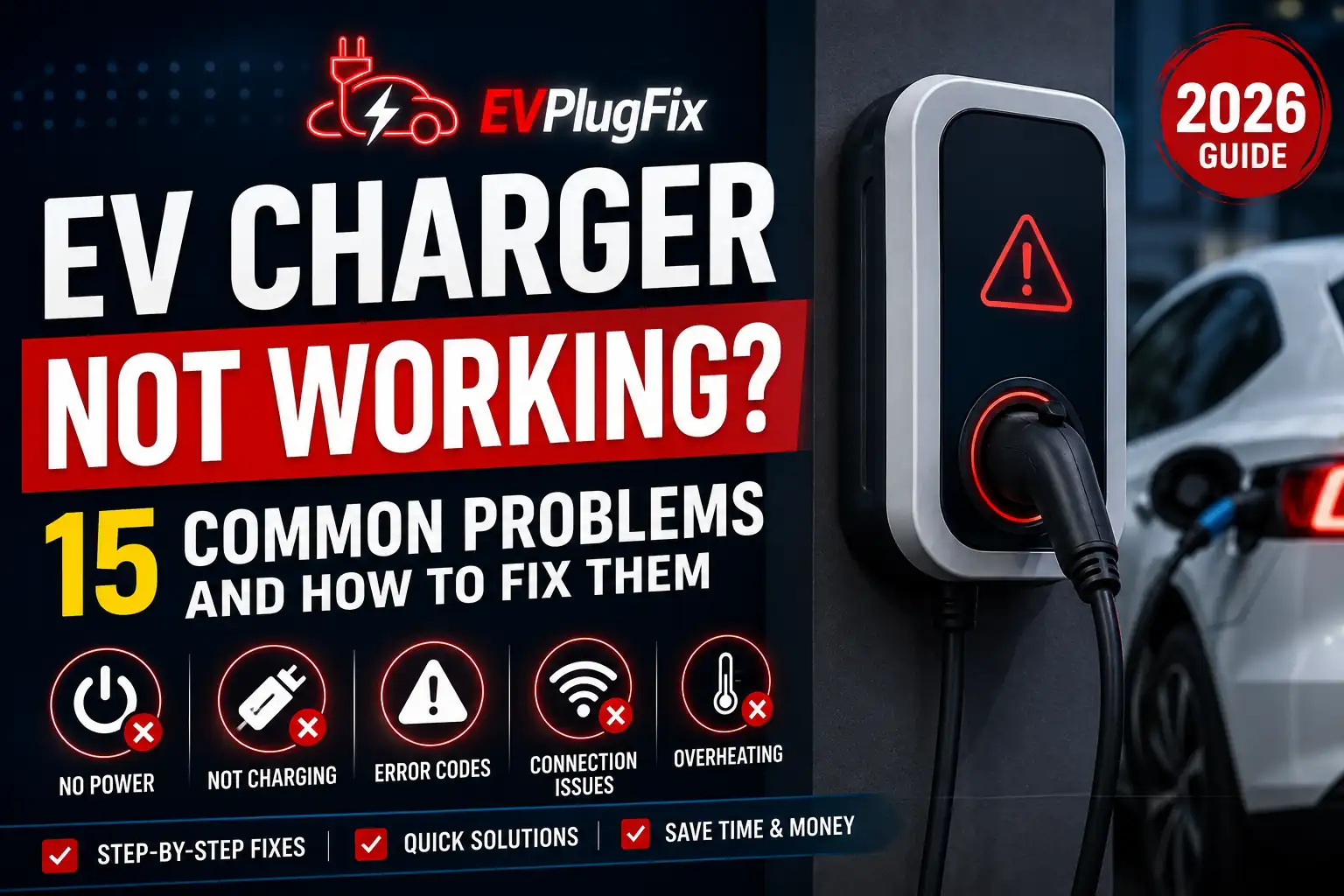
An EV charger that refuses to charge does not automatically mean the charger has failed. The cause may be as simple as a charging schedule, a poorly seated connector or a temporary communication problem. Power-supply faults, overheating and damaged electrical components are more serious and should not be treated with repeated resets.
Electrical safety: Stop using the charger if you see melted or scorched plastic, exposed conductors, damaged pins, smoke, significant water intrusion, a burning smell or repeated breaker trips. Do not open a charger enclosure, remove an electrical-panel cover or perform live electrical tests unless you are qualified to do so.
Quick Answer: Check These Five Things First
- Make sure the vehicle is below its charge limit and is not waiting for a scheduled charging time.
- Unplug the charging handle, inspect it for visible damage and reconnect it fully.
- Read any message on the vehicle, charger or charging app before clearing the fault.
- If the charger is completely dead, check its dedicated circuit breaker.
- If you find abnormal heat, melting, a burning smell or a breaker that trips again after one permitted reset, stop troubleshooting and arrange professional inspection.
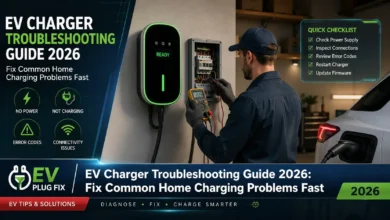
 "EV charger troubleshooting flow from electrical supply to vehicle")
15 Common EV Charger Problems and Safe Fixes
1. The EV Charger Has No Power
A completely dark charging station points first toward the electrical supply or the EVSE itself. Confirm that the property has power, then look at the charger’s dedicated breaker.
If there is no visible damage and the equipment instructions permit it, a tripped breaker can normally be moved fully OFF and then back ON once. If it trips again, leave it off and have the circuit investigated.
A hardwired charger that stays dead while its breaker appears to be on needs further diagnosis. That is the point to involve an electrician or the equipment manufacturer rather than opening the EVSE yourself.
2. The Charger Has Power but Charging Will Not Start
When the station is awake but the car will not charge, look at settings before assuming there is an electrical failure. A departure schedule, off-peak timer, location-based schedule or charge limit can deliberately prevent charging.
Reconnect the handle firmly and make sure nothing is obstructing the vehicle inlet. Smart chargers may also be waiting for authorization through an app, account or RFID credential.
3. Charging Starts but Stops Unexpectedly
An interrupted session can originate in the vehicle, EVSE, connector or electrical supply. Before restarting, note any message shown by the car or charger; a recorded fault is much more useful diagnostically than simply knowing that charging stopped.
Feel only the accessible exterior of the plug, receptacle and connector. If any part is excessively hot, discolored or smells burned, leave the equipment unused until it has been inspected.
4. The Charger Shows a Red Fault Light
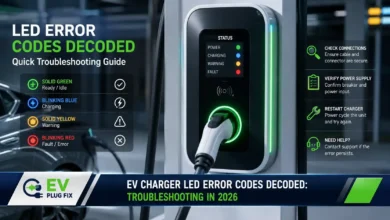
Red LEDs and blink patterns are not standardized across EV chargers. The important clue is the exact pattern on your specific make and model.
Count the flashes or photograph the indicator before rebooting the unit, then compare it with the manufacturer’s manual. This can distinguish a temporary communication error from a temperature, grounding, supply or internal hardware fault.
5. The Charger Says Connected but Is Waiting
“Connected,” “waiting” or a similar status often means the EVSE recognizes the vehicle but the car has not requested energy. Check the vehicle’s charge limit and scheduled-charging settings first.
Then look for a second schedule in the charger’s app. Vehicle and EVSE timers can overlap, making a perfectly functional system appear to be stuck.
6. The Vehicle Does Not Detect the Connector
Remove the handle and inspect the connector and vehicle inlet without inserting anything into the contacts. Look for dirt, foreign material, damaged plastic, recessed or bent contacts and excessive wear.
If the handle uses a mechanical latch or release, it should move normally. Never force a damaged connector into the vehicle or try to straighten electrical contacts with a tool.
7. The Charger Reports a Ground or Leakage Fault
EV charging equipment includes protective functions intended to interrupt charging when potentially unsafe leakage or ground-fault conditions are detected; relevant North American EVSE safety standards include UL 2594 and the UL 2231 series.
For the homeowner, diagnosis should remain external. Look for obvious moisture or physical damage and use only the reset procedure specified for the charger. A ground-related fault that returns needs professional investigation rather than repeated clearing or bypassing of ground-fault protection.
8. The Plug, Receptacle or Connector Is Overheating
Slight warmth is not the same as a connector becoming painfully hot, discolored or accompanied by a burning smell. Repeated thermal shutdowns are another warning sign.
End the session and let the equipment cool. An electrician can determine whether the cause is a worn receptacle, poor connection, conductor problem, installation fault or another electrical issue.
9. Level 2 Charging Is Much Slower Than Expected
Slow charging does not necessarily indicate a failed EVSE. The actual charging rate can be limited by the vehicle’s onboard charger, the EVSE configuration, available circuit capacity, dynamic load management or a vehicle-imposed limit.
Compare the charging rate with the capabilities and configured limits of both the vehicle and EVSE. If the station was recently installed or reconfigured, verify that its commissioning settings match the electrical circuit and installation instructions.
If charging remains slower than expected, compare the vehicle’s accepted AC power with the charger’s configured output and any active load-management limits.
10. Wi-Fi or the Charger App Is Offline
An offline app and a failed charger are not necessarily the same problem. Depending on the model, basic charging may continue while scheduling, energy reports, remote controls or authentication features become unavailable.
First determine whether the vehicle still charges. If it does, troubleshoot the network connection separately using the requirements for that charger model rather than assuming a particular Wi-Fi band or setup process.
11. A Public Charger Rejects Authentication
A public station may refuse to start because it is unavailable, the session has not been authorized or the selected connector is not compatible with the vehicle. Payment and authentication methods also differ among networks and locations.
Trying another compatible stall can quickly reveal whether the problem is limited to one station. For the normal connection and authorization process, see our public charging station guide. Report visibly damaged equipment instead of repeatedly attempting to use it.
12. The Charger Displays an Error Code
Codes such as “E01,” “E02” or “Fault 4” have no universal meaning across EVSE brands. Searching for the code without the charger make and model can therefore lead to the wrong diagnosis.
Record the complete code, model and LED pattern, then match them with the current manual or official support documentation. Keep a photograph if you may need technical or warranty support later.
13. The Circuit Breaker Keeps Tripping
A breaker that repeatedly opens during EV charging deserves electrical investigation. Possible causes include the EVSE, wiring, connections, breaker, circuit configuration or another installation problem.
Do not keep resetting it and never substitute a higher-rated breaker as a workaround. Breaker rating, conductor size, EVSE configuration and the rest of the circuit must be properly coordinated.
14. The Vehicle Charge Port or Connector Is Dirty or Damaged
Loose surface debris can interfere with a connection, but charging contacts should not be aggressively cleaned. With the equipment disconnected, use only cleaning methods permitted by the vehicle or EVSE manufacturer.
Avoid arbitrary solvents, lubricants and metal tools. Corrosion, melted plastic, damaged contacts or an inlet that no longer holds the connector securely should be inspected professionally.
15. The Charger Remains Unresponsive After Basic Checks
If power is available, the connector looks intact, schedules are not blocking the session and no obvious safety hazard is present, a documented reboot may be the next useful step.
Do not confuse a reboot with a factory reset. Factory resetting can erase Wi-Fi credentials, schedules, access controls or commissioning settings and should be used only when the manufacturer’s instructions call for it.
Is the Problem the Charger, Car or Electrical Supply?
For home AC charging, the wall unit is technically electric vehicle supply equipment, or EVSE. It controls and protects the electrical connection, while the vehicle’s onboard charger converts incoming AC electricity for storage in the battery.
That means a powered EVSE can still sit idle if the vehicle does not request energy, while a car that is ready to charge can be stopped by an EVSE or supply-circuit fault.
| What you observe | Likely area | Useful next test |
|---|---|---|
| No lights or display | Supply or EVSE | Check the dedicated breaker |
| Powered but not charging | Schedule, connector, vehicle or EVSE | Check settings and reconnect |
| Starts, then stops | Temperature, supply, connector or vehicle | Record the fault message |
| Breaker repeatedly trips | Circuit, installation or equipment | Arrange electrical inspection |
| Car charges normally elsewhere | Original EVSE or circuit | Investigate the home charging system |
| Car fails on several known-good chargers | Vehicle-side system | Check vehicle diagnostics or service |
A Note on Charging Systems and Connectors
In North American homes, AC Level 1 charging typically uses a 120-volt supply, while Level 2 generally uses 208 or 240 volts. The U.S. Department of Energy’s Alternative Fuels Data Center recommends properly installed, safety-certified equipment and notes that an electrician can determine whether a home’s electrical service can support Level 2 charging.
Connector type also matters. SAE J1772 remains widely used for AC charging, while the connector originally known as NACS has been standardized as SAE J3400. Hardware, adapters and manufacturer support still determine actual compatibility; matching connector shapes alone do not guarantee a successful charging session.
DC fast charging uses a different architecture. If your vehicle charges normally at home but fails at one public fast charger, the station, network authorization, connector compatibility or charger-to-vehicle communication may be responsible.
How to Reset an EV Charger Without Guesswork
There is no universal reset duration or sequence for every EVSE. Start with the least disruptive option documented for your charger.
Try a Normal Restart First
If the charger provides a restart command through its controls or app, that may clear a temporary communication or software problem without deleting configuration.
Power-Cycle Only as Directed
Some manufacturers specify switching the charger’s dedicated circuit off for a defined period before restoring power. Use the documented procedure rather than an arbitrary 30-second or five-minute rule.
Reserve Factory Reset for Configuration Problems
A factory reset may remove network credentials, schedules and commissioning data. It is not a remedy for overheating, physical damage, ground faults or repeated breaker trips.
When to Stop Troubleshooting and Call a Professional
The routine checks in this guide are intentionally limited to settings, visible components and manufacturer-approved resets. Stop using the equipment and arrange qualified help when you encounter:
- A breaker that trips repeatedly.
- A plug, receptacle or connector that becomes abnormally hot.
- Melting, scorching, exposed conductors or a burning smell.
- Persistent ground, leakage or electrical-supply faults.
- Cracked connectors, damaged cable insulation or significant water intrusion.
- A hardwired EVSE that requires internal electrical testing or repair.
If an electrician confirms that the supply circuit and installation are sound but the charger continues to report an internal hardware fault, contact the equipment manufacturer. If the vehicle refuses to charge on several independent, known-good chargers, vehicle service is the more logical next step.
A Safe EV Charger Troubleshooting Checklist
- Check the vehicle’s charge limit and schedule.
- Reconnect the charging handle completely.
- Inspect accessible equipment for damage, moisture or abnormal heat.
- Record vehicle messages, EVSE codes and LED patterns.
- Confirm that the EVSE has power.
- Reset a tripped breaker only once when conditions are safe and the equipment instructions permit it.
- Use the correct manufacturer procedure for rebooting the EVSE.
- Try another known-compatible charger when practical to see whether the fault follows the vehicle.
- Escalate repeated electrical or safety faults instead of repeatedly resetting them.
What About Public Chargers?
At a public station, useful troubleshooting is mostly limited to the vehicle, connector, authentication process and information shown by the charger. Drivers should not attempt to investigate the station’s electrical hardware.
If one charger fails, another compatible stall can help distinguish a station-specific problem from a vehicle issue. Failure at several unrelated charging locations makes a vehicle-side problem more plausible, although it is not definitive proof. Checking station status before arrival can also reduce avoidable charging stops.
Do not use public equipment with broken connectors, exposed components, scorch marks or other obvious damage. Report it to the charging-network operator.
How to Prevent Repeat Charging Problems
Home EVSE maintenance is mostly visual. Periodically look over the charging cable, handle and accessible connector surfaces for cuts, crushing, cracking, contamination or damaged contacts. Store the handle properly rather than leaving it on the ground.
With plug-in Level 2 equipment, changes in receptacle fit or temperature deserve attention. A connection that becomes noticeably looser or hotter over time should be inspected.
For connected chargers, keep supported software and firmware current when the manufacturer provides updates relevant to reliability or vehicle compatibility. Electrical-panel covers and internal EVSE components, however, should remain closed unless qualified personnel need access.
Essential Questions & Expert Answers
Why is my EV plugged in but not charging?
Start with the charge limit and schedule. If the vehicle should be charging immediately, reconnect the handle and check the vehicle and EVSE for a message or fault code. A powered charging station does not necessarily mean the vehicle is requesting energy.
Why does my EV charger stop after a few minutes?
Possible causes include temperature protection, an electrical-supply problem, connector trouble or a vehicle-side fault. Record any message before restarting. Repeated shutdowns accompanied by abnormal heat should be investigated professionally.
Why is my EV charger blinking red?
The meaning depends on the charger model. Record the number and pattern of flashes and use the correct manual rather than a generic LED chart.
Can I reset a tripped EV charger breaker?
A single reset can be reasonable when there is no smoke, melting, abnormal heat or visible damage and the equipment instructions permit it. A second trip is a reason to stop charging and have the circuit evaluated.
Can I repair a home Level 2 charger myself?
Checking settings, reconnecting the handle, inspecting external components and performing a documented user-level reboot are reasonable troubleshooting steps. Internal hardwired EVSE repairs, energized testing, panel work and branch-circuit modifications belong with qualified personnel.
How can I tell whether the charger or car is faulty?
Try the vehicle on another known-compatible, functioning charger. If it charges normally, investigate the original EVSE and supply circuit. If it repeatedly fails at independent known-good chargers, the vehicle becomes a stronger suspect. This isolation test is useful but not definitive because intermittent faults and compatibility issues can complicate the result.
Does a Wi-Fi failure stop EV charging?
Not always. Some smart chargers continue basic charging while offline but lose remote controls, reports or scheduling features. Others may depend more heavily on connected authentication or configuration. The charger’s documentation determines its offline behavior.
Bottom Line
When an EV charger is not working, begin with the simplest possibilities: charge limits, schedules, connector seating, authorization and visible error messages. Those checks can solve many apparent charging failures without touching electrical hardware.
If the problem points toward abnormal heat, repeated breaker trips, grounding faults, damaged components or internal wiring, resets are no longer the right troubleshooting tool. Leave those faults to an electrician, qualified charger technician or the equipment manufacturer.
A useful dividing line is simple: troubleshoot settings and external connections yourself; leave energized wiring and internal electrical faults to qualified professionals.
Source Transparency
This guide separates general troubleshooting principles from manufacturer-specific instructions. Charging voltage and home-installation guidance were cross-checked against the U.S. Department of Energy’s Alternative Fuels Data Center. North American J3400 connector information was checked against SAE International’s J3400 documentation.
EVSE safety-standard information was checked against UL Solutions’ EV charging infrastructure information. Manufacturer manuals and local electrical requirements should take precedence over generalized troubleshooting advice because fault definitions, reset procedures, installation requirements and status indicators differ among EVSE products and jurisdictions.