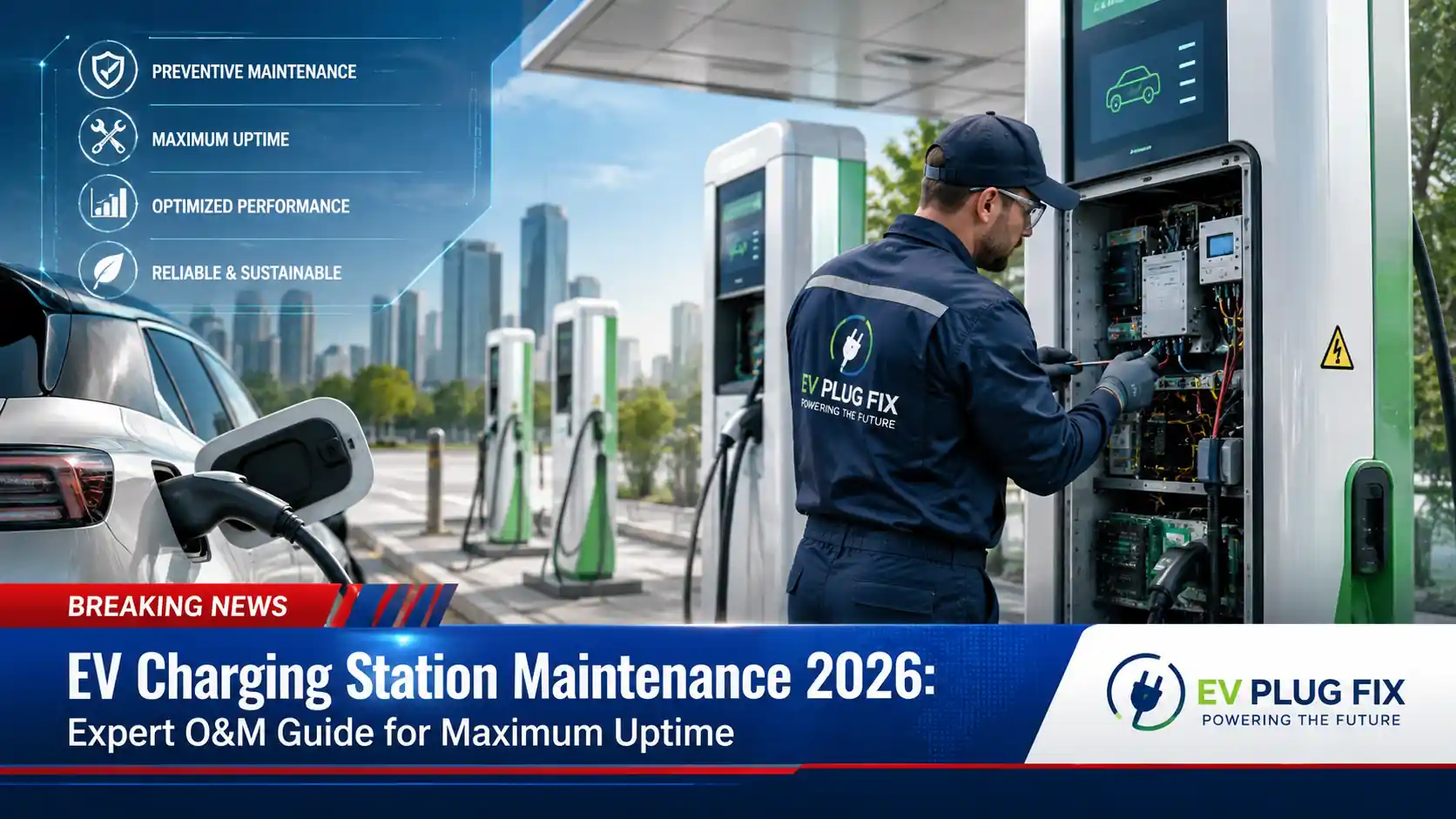
EV charging station maintenance should combine routine visual inspections, remote monitoring, planned preventive service and fast fault response rather than waiting for a charger to fail. For commercial and public sites, the maintenance program should cover not only cables and power electronics but also payment systems, communications, firmware, cooling equipment and the physical charging site.
That distinction matters because a charger can appear online while still failing customers. A damaged connector, unreliable payment terminal, communications fault or repeated session failure can make an otherwise powered station effectively unusable.
For operators, the real maintenance objective is therefore broader than keeping the screen illuminated:
Keep each EVSE safe, available and capable of completing successful charging sessions with as little unplanned downtime as practical.
EV Charging Station Maintenance at a Glance
| Maintenance Layer | What It Covers | Main Objective |
|---|---|---|
| Routine inspection | Cables, connectors, enclosure, screen, signage, site condition | Find visible deterioration early |
| Preventive maintenance | Manufacturer-specified inspections, cleaning, testing and servicing | Reduce avoidable failures |
| Remote monitoring | EVSE status, communications, alarms, fault logs and session data | Detect problems before or shortly after drivers do |
| Corrective maintenance | Diagnosis, component repair/replacement and recommissioning | Restore failed equipment |
| Lifecycle management | Parts availability, firmware support, obsolete hardware and upgrades | Control long-term operating risk |
There is no universal maintenance interval that fits every EV charger. The correct schedule depends on the manufacturer’s requirements, charger design, utilization, environment, contractual obligations and applicable electrical regulations.
Why EV Charger Maintenance Is an Uptime Issue
For a home charger, an outage is inconvenient. For a busy public charging hub or fleet depot, the same failure can affect revenue, vehicle schedules and driver confidence.
That is why operators should distinguish planned maintenance from unplanned downtime.
Taking an EVSE out of service deliberately for inspection may prevent a much longer outage later. The objective is not to avoid maintenance downtime entirely. It is to control when maintenance happens and reduce unexpected failures.
This becomes particularly important when operating large portfolios. A fault that looks minor at one charger can become an expensive recurring problem when repeated across hundreds of units.
Operators budgeting for this work should treat maintenance as part of total operating cost rather than an unexpected repair expense. Our guide to EV charger maintenance costs examines the cost side of charger servicing, networking and long-term component replacement in more detail.
The UK 99% Reliability Rule: What It Actually Means
The UK’s Public Charge Point Regulations 2023 provide a useful example of why charger reliability has become an operational metric rather than a marketing claim.
Under the regulations, a charge point operator’s network of rapid public charge points rated at 50 kW and above must, on average, meet 99% reliability over the calendar year.
That does not mean every individual rapid charger is legally required to achieve 99% uptime every month.
The government measures the requirement as an annual average across the operator’s rapid network using EVSE status information. Operators also have reliability reporting and publication obligations.
For operators covered by the rules, this makes accurate status data and maintenance records part of compliance as well as operations.
External reference: UK Government — Public Charge Point Regulations 2023 guidance.
Build the Maintenance Program Around the Whole Charging System
A charging station is not just a box delivering electricity.
A commercial charging installation can include:
- EVSE hardware;
- charging cables and connectors;
- AC or DC power equipment;
- switchgear and protective devices;
- DC power modules;
- fans or liquid-cooling systems;
- displays and user interfaces;
- RFID readers;
- contactless payment terminals;
- cellular or Ethernet communications;
- charging-station management software;
- load-management equipment;
- meters;
- bollards, foundations and cable-management systems.
A maintenance program that checks only the charging connector can therefore miss failures elsewhere in the service chain.
What Operators Can Inspect Without Opening the Charger
Frequent non-intrusive inspections can identify obvious problems before they become service calls.
Site staff can generally look for visible deterioration without opening electrical compartments or performing electrical measurements.
Cables and Connectors
Check for cuts, abrasion, damaged strain relief, cracked connector housings, damaged contacts, contamination and signs of excessive heat.
High-use charging sites deserve particular attention because cables are repeatedly handled, dropped, twisted and sometimes driven over.
EVSE Enclosure
Look for impact damage, corrosion, broken doors or covers, loose external components and evidence of water ingress.
A charger’s original environmental rating does not make damaged seals or housings irrelevant. Once the enclosure has been physically compromised, it needs assessment.
Display and User Interface
Confirm that the screen, buttons, indicator lights and card readers are functioning normally.
For public chargers, the user interface is part of operational availability. A charger that can technically deliver power but cannot reliably authorize a customer is still a poor charging asset.
Site Condition
Inspect bollards, wheel stops, signage, lighting, cable-management equipment and the area surrounding the charger.
Vegetation, debris, snow, standing water or physical obstructions can create problems without any internal EVSE failure.
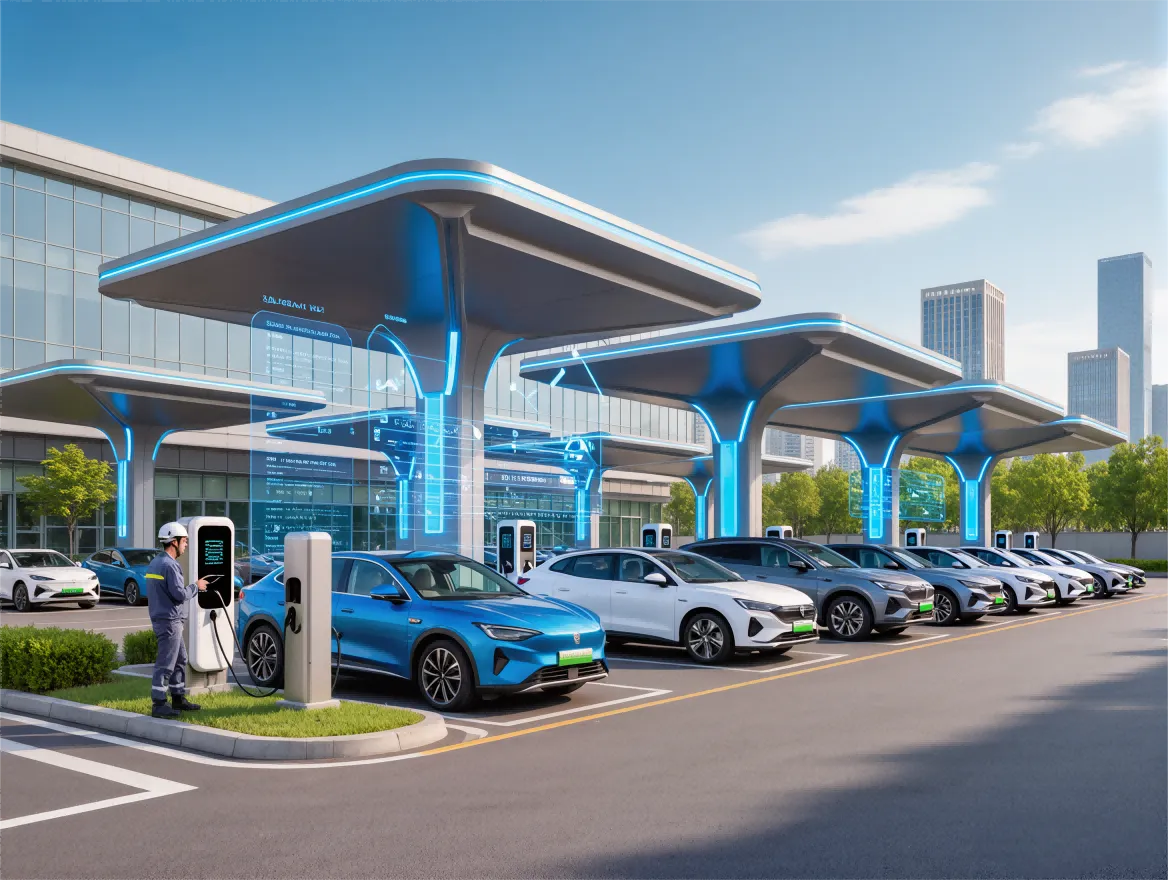
Visual inspections can identify damaged cables, connectors, enclosures and site equipment before faults develop into longer outages.
EV Charging Station Preventive Maintenance Checklist
| Area | Inspection or Service Item | Who Should Handle It? |
|---|---|---|
| Cable | Check external condition, strain relief and abnormal wear | Site staff visual check / technician for repair |
| Connector | Inspect housing and accessible contact condition | Site staff visual check / technician if damaged |
| Enclosure | Check impact damage, corrosion, seals and water ingress | Visual check; qualified service if compromised |
| Cooling | Check vents, filters, fans or liquid-cooling system where applicable | According to OEM service procedure |
| Electrical protection | Electrical tests and protective-device verification | Appropriately qualified technician |
| Power connections | Inspection/testing of internal terminations where required | Appropriately qualified technician |
| Firmware | Verify supported version and required updates | Operator/OEM/service provider |
| Network | Check connectivity, communications and recurring disconnects | Network/O&M team |
| Payments | Test authorization and payment methods | Operations team |
| Charging session | Confirm the EVSE can complete a functional charging test | Qualified service/O&M team as appropriate |
These are categories rather than universal service intervals. Actual maintenance procedures should come from the charger manufacturer and the requirements applicable to the installation.
Electrical Maintenance Is Not a Visual-Inspection Task
There is an important boundary between an operator walking a site and a technician servicing high-power electrical equipment.
Opening an EVSE cabinet, testing energized circuits, verifying protective devices, checking internal power connections or servicing DC power electronics should not be treated as routine DIY maintenance.
Before intrusive service, qualified personnel should follow the applicable isolation and lockout/tagout procedures, verify the equipment state and work according to the manufacturer’s service documentation and local electrical requirements.
This distinction becomes increasingly important with DC fast charging equipment, where high-voltage power conversion and thermal-management systems add complexity beyond ordinary visual maintenance.
Cooling and Thermal Management Need Special Attention on DC Fast Chargers
High-power DC charging produces substantial heat.
Depending on the charger design, thermal management may involve air filters, fans, heat exchangers or liquid cooling. High-current charging cables can also use liquid cooling.
A blocked airflow path, deteriorating fan or cooling-system fault can lead to power derating or shutdown before the charger suffers a complete hardware failure.
Maintenance teams should therefore track temperature-related alarms rather than simply resetting them and returning the station to service.
A recurring thermal alarm is data.
If several events occur under similar ambient temperatures or charging loads, the pattern can help identify a cooling or component problem before a permanent failure develops.
Software Is Part of EV Charger Maintenance
Modern networked chargers are both electrical equipment and connected computing devices.
Firmware, communications and backend software can affect authentication, billing, monitoring, load management, remote commands and charging-session behavior.
A charger can therefore fail operationally without a failed power module.
Maintenance teams should track:
- firmware version;
- connectivity status;
- communication failures;
- recurring fault codes;
- failed authorization attempts;
- remote-reset frequency;
- payment failures;
- charging-session failures.
For larger networks, this information is much more useful when analyzed systematically rather than charger by charger. Our EV charging station analytics guide explains how uptime, session success, fault classification and other operational metrics can reveal underperforming assets.
OCPP and Remote Diagnostics
For networked charging infrastructure, the charging-station management system can provide a first line of diagnosis before a technician is dispatched.
The Open Charge Point Protocol (OCPP) supports communication between compatible charging stations and management systems. Depending on the protocol version and implementation, that communication can include charger status, transactions, metering, diagnostics, monitoring and device-management functions.
This enables a useful O&M workflow:
Detect → classify → attempt approved remote recovery → verify → dispatch only when physical service is required.
The potential saving is not that software magically repairs broken power electronics. It is that the operations team can avoid some unnecessary site visits and give technicians better diagnostic information before they arrive.
Operators planning an OCPP-based maintenance strategy should verify the exact protocol version, supported functions and implementation rather than assuming every “OCPP compatible” product exposes the same diagnostic capabilities.
Our detailed OCPP guide covers the protocol and its role in charger-to-backend communication.
Preventive vs Predictive vs Corrective Maintenance
A mature charging operation uses all three.
| Strategy | Trigger | Example |
|---|---|---|
| Preventive | Time, usage or OEM schedule | Inspecting cables and servicing cooling equipment before failure |
| Predictive / condition-based | Telemetry or deteriorating performance | Investigating repeated thermal alarms before the charger shuts down permanently |
| Corrective | Confirmed fault | Replacing a failed connector, fan, payment terminal or power module |
Preventive maintenance should not become indiscriminate parts replacement. Condition data can help operators focus attention where it is most likely to prevent downtime.
Track the Right EV Charger Maintenance KPIs
“How many repairs did we complete?” is not enough to judge an O&M program.
Operators need metrics that show whether maintenance actually improves charging availability and the driver experience.
1. Availability or Uptime
Measure how long the relevant EVSE is operational according to the definition used by your organization, SLA or applicable regulation.
Always document the definition. Communication uptime and driver-facing availability are not necessarily the same thing.
2. Charging Session Success Rate
Measure the percentage of legitimate charging attempts that result in a successful charging session under your chosen definition.
This can reveal customer-facing problems that a simple “online/offline” metric misses.
3. Mean Time to Repair (MTTR)
MTTR helps show how quickly the maintenance process restores service after a repairable failure.
It is particularly useful when comparing sites, charger models, contractors or fault categories.
4. Mean Time Between Failures (MTBF)
MTBF can help track reliability trends, but operators should define consistently what qualifies as a failure.
A network disconnect, payment fault and failed DC power module are very different events.
5. Repeat Fault Rate
A charger that returns to service quickly but fails again two days later was not necessarily repaired effectively.
Track repeated faults by charger, component and error category.
6. Truck Rolls
Track technician dispatches and, more importantly, what caused them.
If a large number of site visits resolve issues that could have been diagnosed remotely, the problem may be in the O&M process rather than the charger hardware.
Don’t Forget Payment-System Maintenance
For public charging, a payment problem can become an availability problem.
The UK government’s reliability guidance provides a particularly clear example: where a contactless payment terminal is required and is not working, the affected charge point can count as downtime for the reliability calculation unless the specified exception applies.
That means maintenance testing at applicable public sites should include the complete customer journey:
Find charger → connect → authenticate/pay → initiate session → receive energy → end session.
Testing only whether voltage is present at the charger misses much of the real charging experience.
External reference: Office for Product Safety and Standards — Regulations for public charge points.
Video: How EVSE Maintenance Testing Works
The following short video gives additional visual context on DC fast charger maintenance. It should be treated as general educational material rather than a substitute for the service documentation, training and electrical-safety procedures required for a specific charger.
Technical maintenance involving electrical measurements, internal components or energized equipment should be performed only by appropriately trained and qualified personnel.
Create a Fault Escalation Process Before Something Breaks
Maintenance performance depends on what happens after an alarm appears.
Every charging operation should know:
- who receives the alert;
- who performs remote diagnosis;
- which faults permit an approved remote reset;
- which faults immediately remove an EVSE from service;
- who can dispatch a technician;
- what response time the SLA requires;
- which spare parts are available;
- who owns the warranty claim;
- how repair completion is verified.
Without this chain of responsibility, sophisticated monitoring can simply produce sophisticated alerts that nobody acts on.
Spare Parts Strategy Can Determine Repair Time
A technician arriving quickly does not guarantee a quick repair if the required component is unavailable.
Operators should identify parts that combine meaningful failure exposure with long procurement lead times.
Depending on the equipment, the list may include charging cables, connectors, screens, card readers, communication components, fans or other manufacturer-specific service parts.
DC fast chargers can require specialized power and thermal-management components that should be considered separately from simpler AC EVSE.
The right spare-parts inventory depends on fleet size, charger models, failure history, warranty arrangements and supplier lead times. Stocking every possible component is rarely efficient; stocking nothing can make a minor failure last weeks.
Lifecycle Management Starts Before the Charger Fails
A functioning charger can still become an operational risk if its manufacturer stops supporting firmware, backend connectivity or replacement components.
Maintain an asset register that includes:
- manufacturer and model;
- serial number;
- commissioning date;
- firmware version;
- network/CSMS configuration;
- warranty status;
- service history;
- major replaced components;
- known recurring faults;
- support/end-of-life notices.
This gives operators time to plan replacements instead of discovering obsolescence after a critical failure.
A Practical EV Charging O&M Workflow
A scalable maintenance program can be summarized in seven steps:
- Inventory: Know exactly which assets and software versions are deployed.
- Inspect: Perform non-intrusive site checks and OEM-required preventive service.
- Monitor: Collect charger status, fault and charging-session data.
- Prioritize: Separate safety-critical faults from degraded service and minor issues.
- Diagnose remotely: Use available logs and approved remote functions before dispatching a technician.
- Repair and verify: Correct the fault and confirm that a real charging session succeeds.
- Learn: Feed failure history back into inspection intervals, spare-parts planning and procurement decisions.
The final step is what turns maintenance records into a reliability program.
EV Charging Station Maintenance FAQ
How often should EV charging stations be maintained?
There is no universal interval for every EVSE. Follow the charger’s manufacturer-specified maintenance schedule and adjust the operational inspection program for utilization, environment, equipment design, regulations and site conditions. High-use public DC charging equipment can require different attention from a lightly used AC charger.
What maintenance can site staff perform?
Site staff can generally perform non-intrusive tasks such as checking for visible cable damage, enclosure damage, debris, broken screens, site obstructions and obvious vandalism. Electrical testing, internal inspection and repair should be assigned to appropriately qualified personnel according to the manufacturer and local requirements.
Can EV chargers be monitored remotely?
Networked chargers can provide remote operational information through their charging-management systems. Available functions vary by charger, backend and protocol implementation, but may include status monitoring, fault information, session data and certain remote commands.
What is the most important EV charger maintenance metric?
There is no single metric that tells the whole story. Availability should be evaluated alongside charging-session success, MTTR, repeat faults and other customer-facing performance measures. A charger being “online” does not prove that a driver can successfully charge.
Bottom Line
Good EV charging station maintenance is not a yearly cleaning visit and it is not a sequence of emergency repairs.
It is an operating system for the charging asset.
Inspect the physical equipment. Monitor the software and communications. Test the customer journey. Track recurring failures. Keep the right service information and spare parts available. Use qualified technicians when work moves beyond non-intrusive inspection.
Most importantly, measure the outcome.
If maintenance is working, the evidence should appear in fewer repeat faults, faster repair times, better charging-session success and higher usable availability.
Source Transparency
The UK reliability discussion in this guide was checked against the UK Government’s current guidance for the Public Charge Point Regulations 2023 and the underlying regulations. The 99% requirement is described only in its applicable context: the annual average reliability of an operator’s network of rapid public charge points covered by the regulation.
Maintenance procedures and intervals are intentionally not presented as universal requirements. Charger designs differ significantly, particularly between AC EVSE and high-power DC charging equipment. The manufacturer’s current installation and service documentation, applicable electrical regulations, warranty terms and qualified service procedures take priority for a specific installation.
Operational metrics such as MTTR, MTBF, availability and charging-session success should be defined consistently within an organization or service contract before comparing performance between sites or networks.