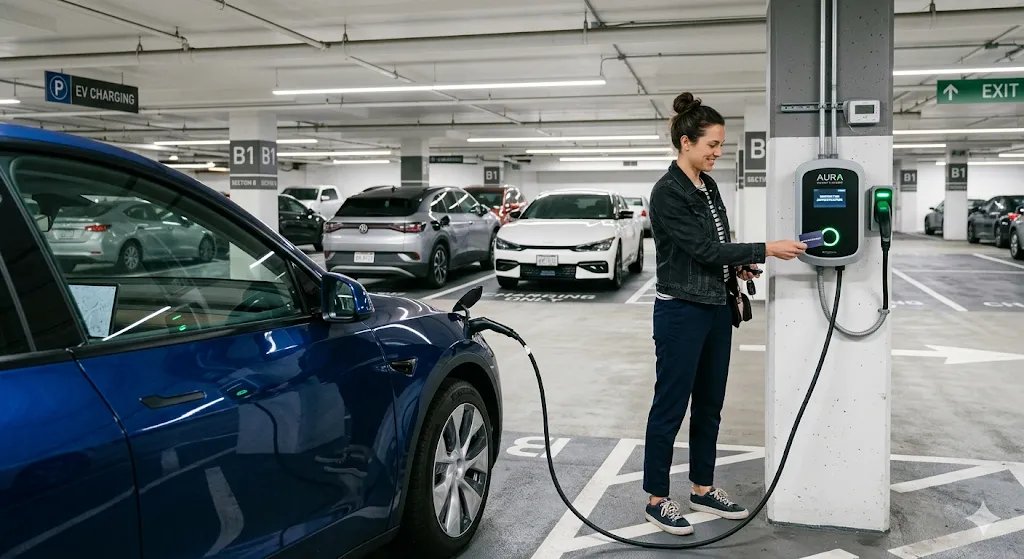
At many workplace, apartment, fleet and public charging sites, starting an EV charging session can be as simple as tapping a card or key fob on the charger. The card identifies a charging credential, while the charger or its management system decides whether that credential is allowed to start a session.
That explains most everyday RFID issues: a card can work on one network but not another, some chargers can still recognize approved users during an internet outage, and a lost charging card should be disabled as soon as possible.
What Is RFID EV Charging?
RFID stands for radio-frequency identification. In EV charging, an RFID card, badge or key fob provides a contactless way to identify a driver or charging account.
Tapping the card does not directly turn charging power on. The charger reads the credential, checks whether it is approved for that location or service and, if authorization succeeds, allows the charging session to begin.
RFID is commonly used where access needs to be controlled, including workplaces, apartment parking, fleets and public charging networks.
What Happens When You Tap an RFID Card?
The details vary between charging systems, but the process is usually straightforward:
- You tap the card or key fob: the charger reads the supported contactless credential.
- The charger identifies it: the system obtains the information it uses to recognize the card.
- Authorization is checked: the charger either checks its own stored data or asks the charging network’s management system.
- The session starts: if the card is approved and the vehicle is ready, charging can begin.
- The session is recorded: managed chargers can record information such as energy delivered and transaction details.
A charger being able to read a card does not necessarily mean that the card is authorized to use that charger.
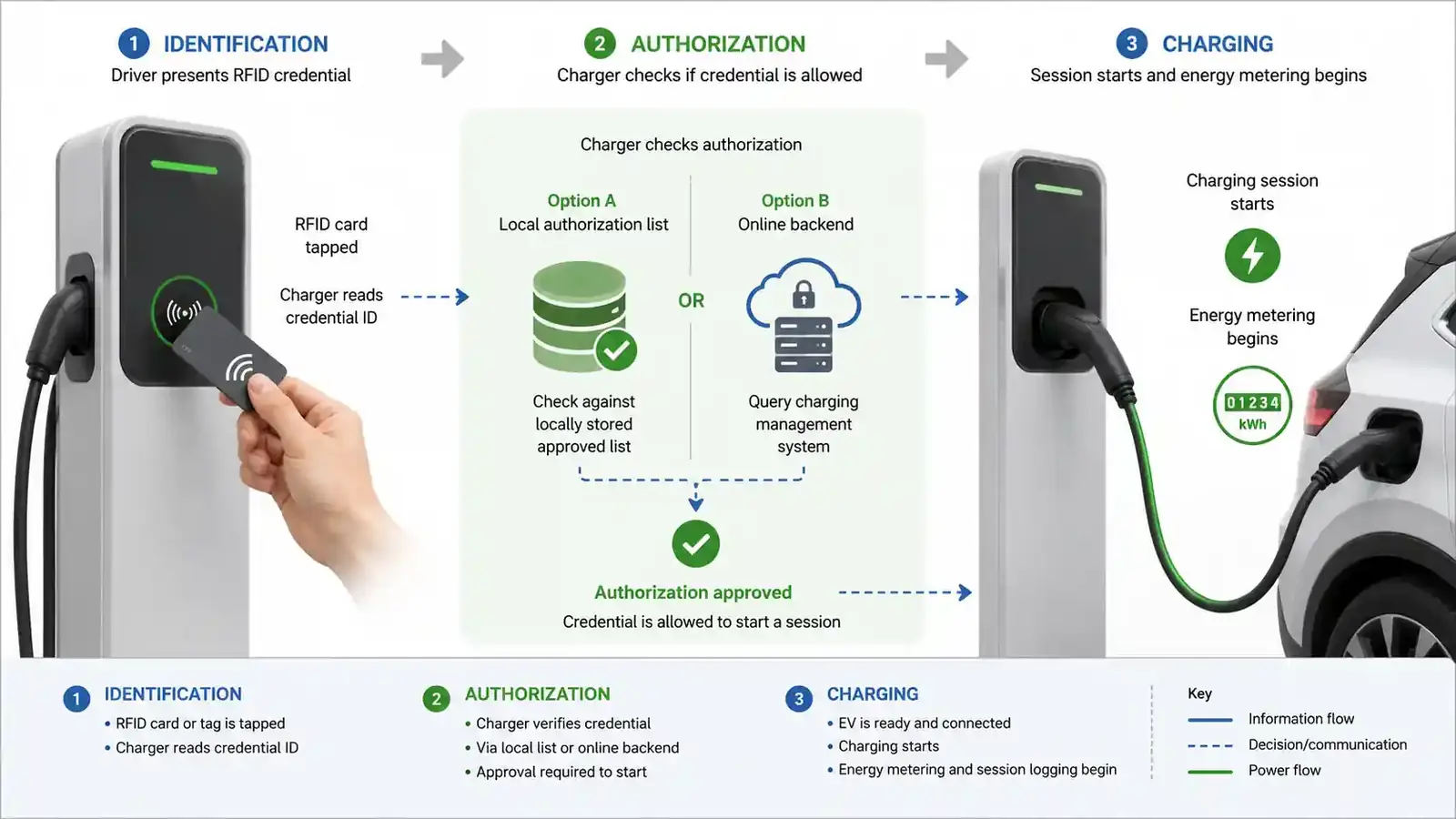
This type of charger-to-backend authorization is supported within the Open Charge Point Protocol ecosystem. The Open Charge Alliance describes OCPP as a communication protocol between charging stations and charging management systems and includes authorization functions within the protocol.
What to Check When RFID Will Not Start a Charge
If an RFID card does not start a session, first make sure it is the correct card for that charger or charging network. A card that works elsewhere may not be registered or permitted at the station you are trying to use.
If the charger reacts to the tap but rejects it, possible causes include an expired or revoked credential, an account problem, a card that is not authorized at that location or a communication problem between the station and its backend.
If the charger shows no response at all, the card technology may not be supported by the reader, or the charger may require a different access method. Follow the instructions displayed on the charger rather than trying unrelated contactless cards.
Where an authorization or network error is shown, the charging provider is usually best placed to check whether the problem is with the card, account, charger or network connection. For broader station-startup issues, see this EV charger troubleshooting guide.
What Happens If an RFID Card Is Lost?
Report a lost charging card to the company, employer, fleet manager or property operator that issued it and have the credential disabled where possible. If the card is linked to an online account, also review recent charging history for unfamiliar sessions.
Some chargers can authorize users from locally stored data when they are offline. In those systems, a revoked credential may not be recognized as revoked by every disconnected charger until authorization information is updated. The exact behavior depends on the charging system.
Can RFID Charging Work Without an Internet Connection?
Sometimes. A charger that depends entirely on a live authorization request may be unable to approve a new session when its network connection is down. Other chargers can store approved credentials locally and check them without contacting the backend each time.
Open Charge Alliance documentation for OCPP 2.0.1 includes support for a local authorization list that can be used when a charging station is offline or to shorten authorization time while it is connected.
Offline capability should therefore be checked for the specific charger and charging service rather than assumed simply because the station has an RFID reader.
Why One RFID Card May Not Work Everywhere
Contactless charging cards are not automatically interchangeable. RFID covers several technologies and credential formats, and the charger must both support the card’s technology and recognize it as an approved credential.
Many EV charging cards use 13.56 MHz contactless technology, but using the same frequency does not make two cards compatible. Products within families such as MIFARE DESFire can also support security features that depend on how the charging provider has implemented them.
NXP describes its MIFARE DESFire family as operating at 13.56 MHz and using ISO/IEC 14443 Type A technology. A charger still needs to support the particular credential implementation used by the charging service.
For a driver, the simplest test is whether the charging provider officially supports the card or credential you intend to use.
RFID and NFC Are Related but Not Interchangeable
NFC is part of the broader contactless technology landscape and operates at 13.56 MHz, but an NFC-capable smartphone cannot automatically replace an EV charging RFID card.
A charging service may support a physical RFID card, a mobile NFC credential, both or neither. Smartphone support depends on the charger, app and way the credential has been implemented.
RFID Charging Is Not the Same as Contactless Card Payment
An RFID charging card and a contactless bank card may both be tapped against a charger, but they perform different jobs. An operator-issued charging card usually identifies an existing charging account or membership. A debit or credit card is used through a payment system.
This distinction matters at public chargers. In the European Union, the Alternative Fuels Infrastructure Regulation (EU) 2023/1804 sets requirements for ad hoc payment at publicly accessible recharging points, with specific requirements depending on factors including charging-point power and deployment date. A network’s proprietary RFID membership card is not itself the same thing as an ad hoc bank-card payment option.
RFID vs Plug & Charge
RFID also differs from vehicle-based automatic authentication. With RFID, the driver normally presents a separate card or key fob. With ISO 15118-based Plug & Charge, compatible vehicles and charging equipment can use digital credentials exchanged through the charging connection to support automatic authorization.
The Open Charge Alliance includes ISO 15118 support and Plug & Charge-related functionality within the OCPP 2.0.1 ecosystem. Availability still depends on the vehicle, charger, charging network and their implementation.
RFID remains useful where automatic vehicle authentication is unavailable, while Plug & Charge can remove the need to present a separate card when all parts of the charging system support it.
Can a Card Be Restricted to One Charger?
Yes. Private charging systems can be configured so that a particular card is accepted only by selected chargers. The card itself does not have to be physically manufactured for one charging point; the restriction can simply be stored in the charger or management system. This is common in situations such as assigned residential parking, workplaces or multi-unit charging sites where access needs to be limited.
RFID Charging Security for Drivers
RFID security varies according to the credential technology and the way the charging service manages authorization. Some systems rely on relatively simple identifiers, while others can use stronger cryptographic credentials and additional backend protections.
Drivers do not normally need to manage those technical details. The useful precautions are straightforward: report lost cards promptly, remove unused credentials from your account where possible, protect the login associated with the charging service and review charging history if you notice activity you do not recognize.
For site managers, credential revocation, secure communications, software maintenance and offline authorization policies also form part of the overall access-control design.
FAQ
Does an RFID card contain my EV charging balance?
Not necessarily. In many managed charging systems, the card mainly identifies your account while permissions, billing information and charging records are stored in the provider’s system. The design varies between operators.
Can any RFID card start an EV charger?
No. The charger’s reader must support the credential technology, and the charging system must also recognize the card as authorized.
Can I copy my EV charging card to my phone?
Do not assume that you can. Smartphone NFC and physical charging cards may use different credential formats and security methods. A phone can replace a card only when the charger and charging service specifically support a compatible mobile credential.
Will an RFID charger work if Wi-Fi or cellular service goes down?
Some will. Chargers with suitable locally stored authorization information may be able to approve existing credentials without a live backend connection. Others depend on online authorization, so offline behavior varies by system.
Is RFID required to use a public EV charger?
No. Depending on the network and location, public chargers may also support apps, QR-based access, payment terminals, contactless bank-card payment or automatic vehicle authentication.
Bottom Line
RFID EV charging is a way of identifying and authorizing a driver, not simply a card-operated power switch. You tap a supported credential, the charging system checks whether it is approved and the session starts only after authorization succeeds.
For most drivers, three questions matter: does the charging service support your card, is that card authorized at the charger you want to use, and how quickly can you disable it if it is lost?
RFID cards, smartphone NFC credentials, contactless bank-card payments and ISO 15118 Plug & Charge may all provide convenient ways to access charging, but they are separate systems and should not be assumed to work interchangeably.
Source Transparency
This article distinguishes general RFID concepts from EV-specific charging authorization. Technical information about charging-station authorization, local authorization lists and OCPP capabilities was checked against documentation from the Open Charge Alliance. Contactless smart-card characteristics were checked against NXP’s MIFARE DESFire documentation. EU public-charging payment requirements were checked against the official text of Regulation (EU) 2023/1804.
RFID implementations vary between charger manufacturers and charging networks. Offline authorization, mobile credentials, card compatibility and access restrictions should therefore be confirmed against the documentation for the specific charger or charging service.