
There is no single answer to the question, “How much does it cost to charge an electric car?”
An EV driver who charges overnight at home can pay dramatically less per mile than someone who relies on DC fast chargers. Even two neighbors with the same EV can have different charging costs if one uses an off-peak electricity tariff while the other charges during expensive peak hours.
The useful way to calculate EV charging cost is therefore not to start with a national “average full charge.” Start with how many kilowatt-hours you actually need, what you pay per kWh, your vehicle’s efficiency, and where you charge.
Home charging is usually the cost benchmark to beat, especially when an EV can charge during lower-priced off-peak hours. Public Level 2 charging can still be economical depending on the site, while frequent DC fast charging can substantially increase the cost per mile. Instead of relying on a generic national estimate, calculate your own cost using your electricity rate and EV efficiency.
EV Charging Cost Calculator: The Formula That Actually Matters
The simplest calculation is:
Energy added (kWh) × electricity price ($/kWh) = charging energy cost
For example, adding 50 kWh at an electricity price of $0.18/kWh costs:
50 × $0.18 = $9.00
But that is the price of 50 kWh at the billing point. Real charging also involves conversion and thermal losses, so the energy drawn from the grid can be higher than the energy ultimately stored in the battery.
For planning purposes, a more realistic formula is:
Battery energy added ÷ charging efficiency × electricity rate = estimated wall-to-battery charging cost
If the battery receives 50 kWh, the overall charging process is assumed to be 90% efficient, and electricity costs $0.18/kWh:
50 ÷ 0.90 × $0.18 = $10.00
Cost Per Mile Is More Useful Than Cost Per Full Charge
Comparing “full-charge cost” between EVs can be misleading because battery sizes differ.
A better ownership metric is:
Electricity rate ÷ vehicle efficiency (miles/kWh) = energy cost per mile
At $0.18/kWh:
| EV Efficiency | Energy Cost per Mile | Energy Cost per 10,000 Miles |
|---|---|---|
| 4.5 mi/kWh | $0.040 | $400 |
| 4.0 mi/kWh | $0.045 | $450 |
| 3.5 mi/kWh | $0.051 | $514 |
| 3.0 mi/kWh | $0.060 | $600 |
| 2.5 mi/kWh | $0.072 | $720 |
These EV Plug Fix examples isolate the cost of electricity used for driving and do not include charging losses, charger installation, subscription fees or taxes.
How Much Does Home EV Charging Cost?
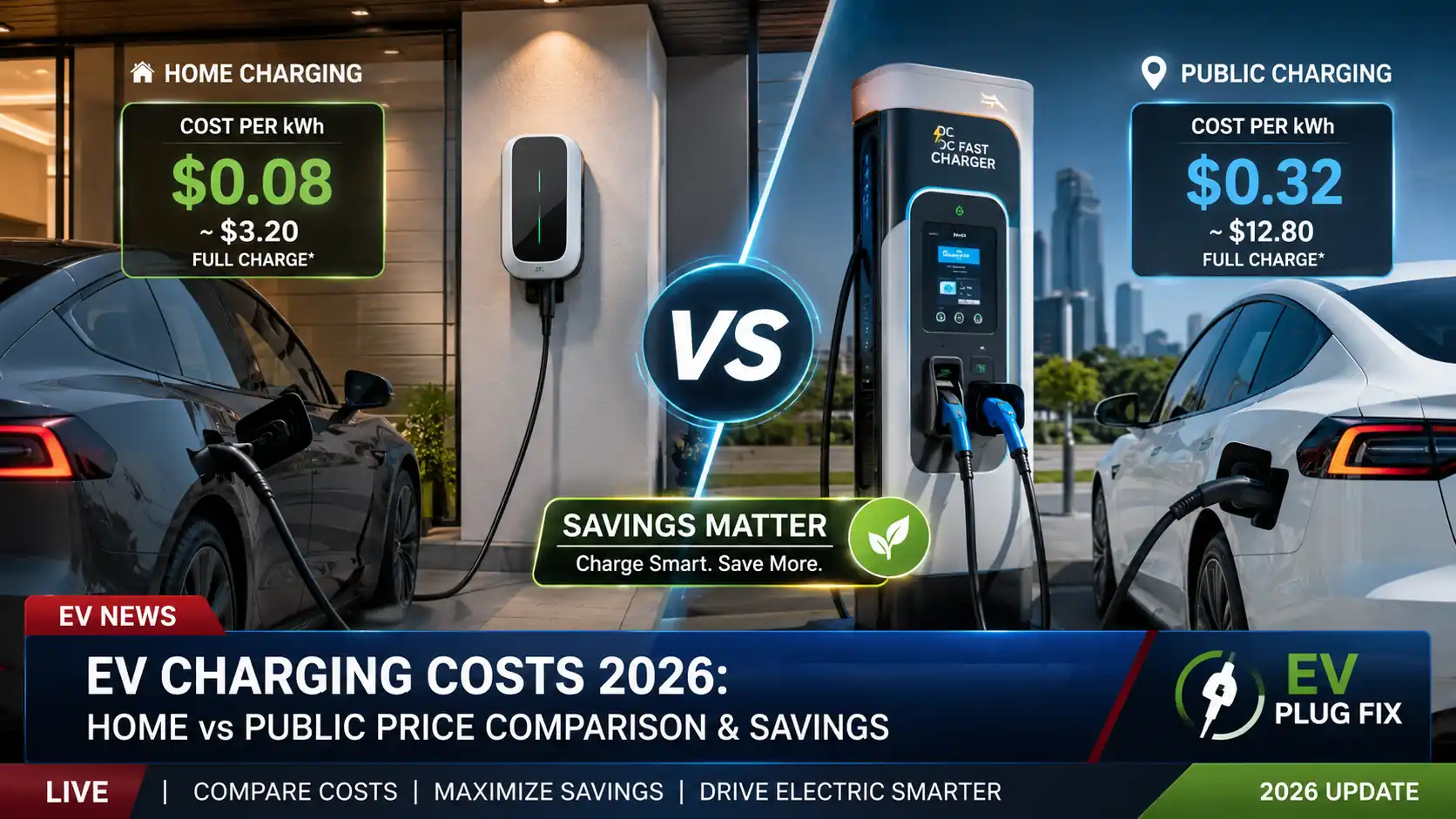
Home charging is usually where EV ownership has its strongest energy-cost advantage because drivers pay their residential electricity tariff rather than the retail price charged by a public charging network.
Suppose your EV needs 60 kWh and your electricity price is $0.18/kWh.
60 × $0.18 = $10.80
If you want to account for an assumed 90% charging efficiency:
60 ÷ 0.90 × $0.18 = $12.00
This also demonstrates why simply multiplying the vehicle’s advertised battery capacity by an electricity rate is only an approximation.
Home Charging Cost at Different Electricity Rates
The following table uses a hypothetical EV receiving 60 kWh of battery energy and assumes 90% wall-to-battery efficiency.
| Electricity Rate | Grid Energy Required | Estimated Charging Cost |
|---|---|---|
| $0.08/kWh | 66.7 kWh | $5.33 |
| $0.12/kWh | 66.7 kWh | $8.00 |
| $0.18/kWh | 66.7 kWh | $12.00 |
| $0.25/kWh | 66.7 kWh | $16.67 |
| $0.35/kWh | 66.7 kWh | $23.33 |
The lesson is more important than any one number: your local tariff can change charging cost more than the charger itself.
If you’re deciding how to set up charging at your property, see our guide to home EV charging guide.
Level 1 vs Level 2: Does Faster Home Charging Cost More?
Level 1 and Level 2 charging are primarily descriptions of how the vehicle receives AC power, not electricity tariffs.
If your utility charges the same $/kWh regardless of charger type, a Level 2 charger does not automatically make each kWh more expensive simply because it charges faster.
In fact, Level 2 charging can reduce charging time substantially and may avoid some of the longer-duration overhead associated with very slow charging.
| Home Charging Method | Typical Characteristic | Cost Implication |
|---|---|---|
| Level 1 | 120 V AC in North America | Low infrastructure requirement but very slow |
| Level 2 | Higher-power AC charging | Faster charging; may require dedicated electrical work |
The bigger financial difference is usually the upfront installation cost, not the electricity price during each session.
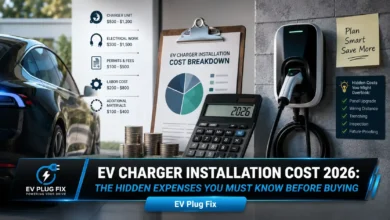
How Much Does a Level 2 Home Charger Really Cost?
There is no trustworthy universal installation price because two houses can require completely different electrical work.
A straightforward installation near an electrical panel can be relatively inexpensive. A project requiring a long cable run, trenching, panel work, load management or a service upgrade can cost substantially more.
Break the Quote Into These Components
- EVSE hardware;
- breaker and protective equipment;
- cable/conduit;
- labor;
- permit and inspection where applicable;
- distance from panel to charging location;
- panel or service upgrades;
- load-management equipment if required; and
- outdoor mounting or trenching.
Practical buying rule: Do not budget a home charger from the EVSE’s retail price alone. Get the electrical installation assessed first if panel capacity or wiring distance is uncertain.
A Major 2026 Change: The U.S. Federal Charger Tax Credit Has Ended for New Installations
This is important because older EV charging guides can now give readers outdated information.
The U.S. Alternative Fuel Vehicle Refueling Property Credit under Section 30C previously allowed qualifying individuals to claim 30% of eligible costs, up to $1,000 per charging port, subject to location and other requirements.
However, the law changed. According to the IRS, qualifying property had to be placed in service by June 30, 2026. Property placed in service after that date is not eligible for the credit under the terminated provision.
Therefore, someone installing a home EV charger now should not assume the old federal 30C credit is still available.
State, local and utility incentives may still exist, so those should be checked separately before installation.
Can Time-of-Use Charging Cut Your Electricity Bill?
Potentially—and this is one area where a generic national charging-cost estimate becomes particularly misleading.
Time-of-use tariffs charge different electricity prices at different times of day. If an EV owner can move a large charging load from an expensive period to a cheaper overnight period, the savings can be substantial.
A Simple Time-of-Use Example
Assume your EV needs 50 kWh of grid electricity.
| Charging Rate | 50 kWh Session Cost |
|---|---|
| $0.08/kWh off-peak | $4.00 |
| $0.18/kWh standard rate | $9.00 |
| $0.32/kWh peak rate | $16.00 |
The same car receives the same 50 kWh. Only the tariff changes.
That is why smart scheduling can sometimes deliver more meaningful savings than replacing a perfectly functional charger.
The EV Plug Fix guide to smart EV charging explains how scheduled charging can be used to target cheaper tariff windows.
Never switch to an EV-specific or time-of-use tariff based only on its cheapest advertised overnight rate. Compare the entire household’s peak and off-peak consumption because a lower EV charging rate can be offset by higher electricity prices at other times.
How Much Does Public EV Charging Cost?
Public charging is harder to summarize with one number because operators can vary prices by location, charging network, membership, time of day and other conditions.
Drivers can also encounter idle or congestion-related fees.
For this reason, a fixed statement such as “public charging costs $0.48/kWh” becomes outdated quickly.
The better approach is to check the specific station immediately before charging.
Public Charging Cost Examples
Here is what 50 kWh would cost at several illustrative per-kWh prices:
| Public Charging Price | Cost for 50 kWh |
|---|---|
| $0.25/kWh | $12.50 |
| $0.35/kWh | $17.50 |
| $0.45/kWh | $22.50 |
| $0.55/kWh | $27.50 |
| $0.70/kWh | $35.00 |
These are calculation scenarios, not claims that every charging network currently charges these rates.
When comparing stations, see the EV Plug Fix guide to using a public EV charging station can help you evaluate more than price alone.
Tesla Supercharger Pricing: Why a Fixed National Price Is Misleading
Tesla does not publish one universal U.S. Supercharger price.
Pricing is station-specific and can vary. Some locations also use different peak and off-peak prices.
Tesla instructs drivers to check the specific Supercharger location in the vehicle or Tesla app for current pricing.
This means statements such as “Tesla Superchargers cost $0.25–$0.50/kWh” should not be treated as a permanent nationwide rule.
For current station-specific information, use Tesla’s official Supercharging information.
Electrify America Pricing Also Varies by Station
The same caution applies to Electrify America.
Electrify America states that DC fast-charging prices depend on the charger location, plan and energy delivered, with current pricing displayed in its app and on the charger.
The network also offers a Pass+ membership that currently advertises approximately 25% savings on charging compared with its standard pricing.
Current prices should therefore be checked directly through Electrify America’s official pricing page or app rather than copied from an older nationwide price table.
Why DC Fast Charging Usually Costs More
DC fast charging is built around a different value proposition from home charging: speed and travel convenience.
Instead of leaving the car plugged in for hours, compatible EVs can add substantial energy during a relatively short road-trip stop.
But delivering high charging power requires expensive equipment, electrical infrastructure, site development, networking and ongoing operation. The retail charging price can also reflect demand charges, property costs and network economics.
For drivers, the practical consequence is simple: DC fast charging can be worth paying more for during a road trip without necessarily being the cheapest way to power everyday commuting.
The EV Plug Fix AC-to-DC conversion in EV charging guide explains the technical differences in more detail.
Home vs Public vs DC Fast Charging: A Fair Cost Comparison
Instead of presenting volatile network prices as permanent facts, we can compare charging strategies using clearly stated assumptions.
Assume an EV:
- drives 12,000 miles per year;
- averages 3.5 miles/kWh; and
- requires approximately 3,429 kWh of battery energy for those miles.
The following comparison excludes charging losses so that the effect of electricity price remains easy to see.
| Charging Scenario | Assumed Price | Cost per Mile | Annual Energy Cost |
|---|---|---|---|
| Low-cost home/off-peak | $0.10/kWh | $0.029 | ~$343 |
| Home example | $0.18/kWh | $0.051 | ~$617 |
| Public example | $0.30/kWh | $0.086 | ~$1,029 |
| Fast-charging example | $0.55/kWh | $0.157 | ~$1,886 |
These are EV Plug Fix calculation scenarios, not national price forecasts. Replace the assumed $/kWh figure with your actual tariff or station price to calculate your own result.
What Actually Changes Your Charging Cost?
Before accepting any article, calculator or salesperson’s claim about how much an EV costs to charge, check these six variables:
| Variable | Why It Changes the Answer |
|---|---|
| Electricity price | The same EV can cost dramatically more to charge in a high-rate area |
| EV efficiency | A more efficient vehicle travels farther on each kWh |
| Charging losses | Grid energy can exceed battery energy added |
| Home/public mix | Frequent public fast charging can raise annual costs |
| Time of charging | TOU tariffs can make timing financially important |
| Extra fees | Membership, parking, idle or congestion fees can affect session cost |
Battery Size vs Efficiency: Which Matters More?
Battery size determines how much energy a battery can hold. It does not by itself determine how expensive the vehicle is to drive.
Consider two EVs:
| Vehicle | Battery | Efficiency | Electricity Rate | Energy Cost per Mile |
|---|---|---|---|---|
| EV A | 60 kWh | 3.0 mi/kWh | $0.18/kWh | $0.060 |
| EV B | 90 kWh | 4.0 mi/kWh | $0.18/kWh | $0.045 |
EV B has the larger battery but costs less in electricity per mile in this example because it uses energy more efficiently.
This is why shoppers comparing EV ownership costs should look at energy consumption or miles/kWh, not just battery capacity.
How Weather Changes EV Charging Cost
Real-world EV efficiency is not fixed.
Cold temperatures, cabin heating, very hot conditions, high speeds, towing and other factors can increase energy consumption.
If efficiency drops, cost per mile rises even if electricity prices remain unchanged.
For example:
| Efficiency | Rate | Energy Cost per Mile |
|---|---|---|
| 4.0 mi/kWh | $0.18/kWh | 4.5¢ |
| 3.5 mi/kWh | $0.18/kWh | 5.1¢ |
| 3.0 mi/kWh | $0.18/kWh | 6.0¢ |
| 2.5 mi/kWh | $0.18/kWh | 7.2¢ |
A realistic annual charging budget should therefore use your actual driving efficiency whenever possible rather than an idealized efficiency figure.
Are EV Charging Memberships Worth It?
A charging membership is worthwhile only if the discount exceeds the membership cost.
The calculation is simple:
Monthly membership fee ÷ savings per kWh = break-even monthly energy
For example, suppose a hypothetical plan costs $7 per month and saves $0.10/kWh:
$7 ÷ $0.10 = 70 kWh
You would need to buy more than approximately 70 kWh through that network each month before the energy discount exceeds the membership fee, ignoring any additional benefits.
This calculation is especially useful for drivers who fast-charge only occasionally.
Are Free EV Chargers Actually Free?
Some workplaces, hotels, retailers and parking facilities offer charging without a separate energy fee.
But “free charging” can still involve another cost:
- paid parking;
- hotel stay;
- customer purchase;
- employee-only access;
- time limits; or
- idle fees.
So the correct question is not simply whether the charger displays $0.00/kWh. Consider the total cost of accessing and occupying the charging location.
7 Ways to Reduce EV Charging Costs
- Charge at home when practical. It gives you direct access to your residential tariff.
- Check off-peak rates. Charging time can matter as much as charging location.
- Schedule charging automatically. Smart charging reduces the chance of accidentally charging during expensive periods.
- Use DC fast charging strategically. Pay for speed when speed provides real value.
- Compare memberships mathematically. Calculate your break-even energy usage before subscribing.
- Monitor efficiency. A falling miles/kWh figure directly raises your electricity cost per mile.
- Check the station price before plugging in. Public charging prices can change by location and time.
Bottom Line
The most useful EV charging-cost number is not the price of a theoretical 0–100% charge. It is your cost per mile under the charging pattern you actually use.
A driver with efficient EV, low-cost overnight electricity and reliable home charging can have extremely low energy costs. Another driver using the same vehicle but relying heavily on premium-priced DC fast charging can spend several times more.
Start with three numbers:
your electricity price + your EV’s real efficiency + the percentage of charging you expect to do at home.
Then add charging losses, public charging and membership fees where relevant.
That produces a far more useful ownership estimate than any generic claim that an EV “costs $X to fully charge.”
Public charging prices can change by network, location and time. Network-specific pricing statements in this guide should therefore be checked against the operator’s current app or website before charging. Federal tax-credit information is based on current IRS guidance. EV Plug Fix calculation tables, examples, cost scenarios and buying rules are editorial calculations designed to illustrate how charging economics work; they are not predictions of what every EV owner will pay.