
Installing EV charging in an apartment building, condominium or other multi-unit dwelling is less about choosing a charger and more about planning shared infrastructure. Parking rights, electrical capacity, cable routes, billing and future expansion can all become harder to change after equipment is installed.
That is why the first charger request should not automatically become the building’s charging strategy. A solution that works for one resident today can become expensive or awkward when ten more residents want to charge.
A better approach is to decide how the property will provide charging over time, then install only the equipment needed for the current phase. Depending on the building, that could mean chargers at assigned spaces, a smaller pool of shared Level 2 stations, managed charging across multiple parking spaces, or a combination of these approaches.
Start With the Parking Layout, Not the Charger
Parking often determines what is practical before electrical equipment enters the discussion.
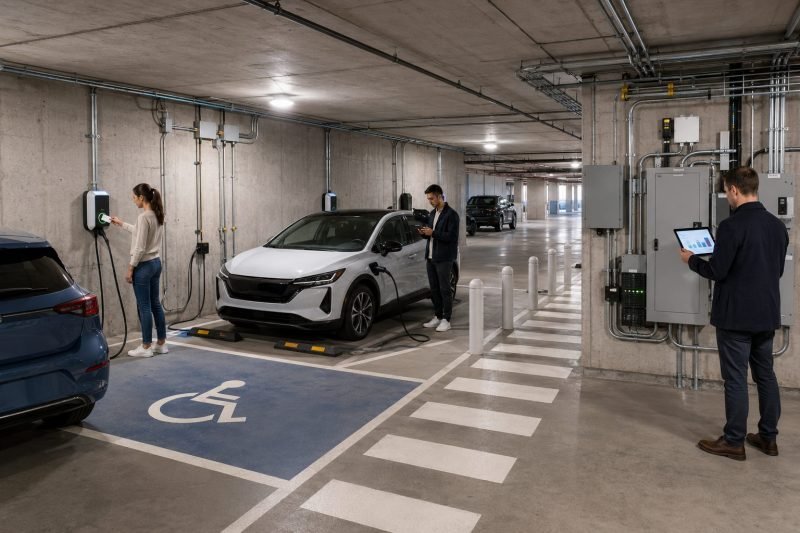
In a building with assigned spaces, residents may expect to charge where they already park. But their stalls may be far from suitable electrical distribution equipment, and connecting each charger to the corresponding apartment meter may be impractical or unnecessarily expensive.
Shared parking creates a different problem. A charger tied permanently to one resident makes less sense when parking spaces themselves are not assigned.
Before requesting equipment quotes, establish:
- Who controls each parking space: Is it deeded, assigned, leased, visitor-only or shared?
- Where suitable electrical equipment is located: Long or difficult cable routes can materially affect installation cost.
- Who will own the infrastructure: The property, association, resident or another party?
- Who can use the chargers: Individual residents, authorized tenants, guests or the public?
- Who pays: Installation, electricity, network fees, maintenance and eventual replacement all need an owner.
- How the system can expand: Adding the next group of chargers should not require rebuilding the first installation.
Electrical, building, accessibility, parking and metering requirements vary by jurisdiction, so these questions should be resolved alongside the applicable local requirements rather than after a layout has been finalized.
Dedicated or Shared Charging?
There is no single arrangement that suits every apartment or condominium. The most useful distinction is between charging where a resident normally parks and asking residents to use a common charging area.
Charging at assigned parking spaces
A charger at a permanent stall is convenient. The resident parks, plugs in and can normally leave the vehicle there without moving it when charging finishes.
The weakness appears when installations are handled one at a time. The first few circuits may be easy to accommodate, but repeated individual projects can produce inefficient cable routes and consume electrical capacity without considering what later residents will need.
Even if only one or two residents currently drive EVs, their installation should therefore be checked against a building-wide expansion plan.
Shared chargers
Shared Level 2 stations can make sense where parking is unassigned or where a property wants to serve several EV drivers without immediately installing a charger at every potential space.
The technical side can be relatively straightforward compared with the parking policy. Residents need to know who may use the charging spaces, whether vehicles must be moved after charging, how visitors are treated and what happens when several drivers want the same charger.
A technically excellent charging installation can still frustrate residents if its parking spaces are routinely occupied by cars that are not charging.
Many properties will ultimately use both approaches: dedicated charging where assigned parking makes it practical and shared chargers where common access works better.
Do Not Decide Charger Count From EV Count Alone
If six residents currently own EVs, the building does not necessarily need exactly six charging stations. Nor does installing six chargers automatically mean the property is prepared for the next six EVs.
Start by finding out how residents actually use their vehicles. A short survey can identify current EV ownership, likely purchases, typical daily driving and parking patterns. An electrical assessment can then determine available capacity, distribution constraints and realistic cable routes.
Together, those two pieces of information are more useful than a simple charger-per-car calculation.
For example, a building may discover that several vehicles can share charging capacity because they remain parked overnight. Another property may find that running individual circuits to distant assigned spaces is so disruptive that a common charging area makes more sense.
The goal is not to predict exactly how many EVs the building will have ten years from now. It is to avoid making today’s installation an obstacle to tomorrow’s expansion.
The Charger Is Only Part of the Installation Cost
Hardware prices are easy to compare. Complete multifamily installations are not.
The project may require panels, switchgear, conduit, wiring, mounting equipment, communications infrastructure, trenching or other modifications to the building’s electrical distribution.
Distance matters as well. Two identical chargers can have very different installed costs if one parking space is close to suitable electrical equipment while the other requires a difficult route through a garage or across a parking area.
This is why quotes should be compared as complete installed systems rather than by charger price alone. Our guide to EV charger installation costs and hidden expenses covers many of the costs that can sit outside the hardware purchase.
A qualified electrical professional should assess the existing installation before the property assumes that a service, panel or transformer upgrade is either necessary or unnecessary.
Long Parking Times Make Power Sharing More Practical
Apartment parking has an advantage that many public charging sites do not: vehicles often remain parked for hours.
A resident who plugs in after work may not need maximum charging power immediately. The vehicle simply needs enough energy before it is driven again.
That creates an opportunity to manage the combined charging load instead of designing every charging space on the assumption that every vehicle will draw maximum power simultaneously.
A compatible load-management system can keep participating chargers within a defined electrical limit and distribute available power as charging demand changes. More advanced arrangements can also account for other loads where the system and installation are designed to do so.
Our guide to dynamic load balancing for EV chargers explains the underlying approach in more detail.
Load management does not create electrical capacity. It controls how available capacity is used.
That distinction matters. If the available power cannot deliver enough energy to residents during their normal parking periods, sharing it more intelligently will not eliminate the underlying constraint. Managed charging also has to be designed and installed in accordance with the requirements applying to the property.
Prepare for More Chargers Without Buying Them All Today
There are two expensive extremes in multifamily charging.
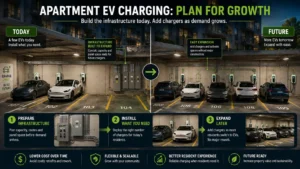
One is installing chargers at large numbers of unused spaces years before they are needed. The other is electrifying only today’s EV spaces with no thought about how the next installation will be built.
A phased project can separate infrastructure that is disruptive to add later from hardware that can be purchased as demand develops.
During the first phase, for example, the property can consider conduit, raceways, distribution equipment and communications pathways that will eventually serve additional spaces. Chargers can then be added in later phases without repeating as much construction work.
Terms such as EV-ready, EV-capable and EV-installed should be used carefully. Their formal definitions can differ between codes, programs and jurisdictions. Construction documents should specify exactly what infrastructure is being provided rather than relying only on a label.
Decide How Residents Will Pay Before Installation
Billing is much easier to design before chargers are purchased.
The first question is where the electricity will be measured. A charger supplied through common building electrical infrastructure creates different accounting issues from an installation that can appropriately use an individual resident’s electrical service.
Where several residents use common infrastructure, networked chargers can provide functions such as authentication and charging-session records. The right arrangement depends on the selected equipment, local metering and billing requirements, utility tariffs and the property’s cost-recovery policy.
Charging residents only for the underlying electricity may also leave other costs unaccounted for. Depending on the project, the property may be paying network subscriptions, transaction charges, maintenance, repairs and eventual equipment replacement.
For systems that depend on measured charging consumption, our EV energy meter and billing guide explains some of the metering considerations involved.
Whatever billing model the property chooses, residents should understand it before regular charging begins. Changing an established billing arrangement after residents have built expectations around it is considerably harder.
Networked Chargers Solve Problems but Create Dependencies
For a multifamily property, networking can be useful. It can provide resident authentication, session records, remote monitoring and coordinated charging across multiple stations.
Those features also mean the property can become dependent on communications and software that may remain in use for years.
Before choosing a system, ask what happens when the internet connection fails. Can authorized residents still charge? Does load management continue? Which functions require the cloud service? How are updates delivered?
The property should also understand what happens if it later wants to change its networking arrangement. Can charging data be exported? Can the existing hardware operate with another service? Which features are proprietary?
Support for an open communications standard can increase options, but a protocol label by itself does not guarantee that every feature will work across different chargers and software platforms. Required integrations should be confirmed for the actual products being considered.
Our comparison of networked and non-networked EV chargers looks more closely at the trade-offs between connected management and simpler standalone equipment.
A Sensible Rollout for an Apartment or Condo
For most existing properties, the planning process can be kept fairly straightforward:
- Ask residents about current and expected demand. Do not design from assumptions alone.
- Map the parking. Record assigned, shared, visitor and other relevant spaces.
- Assess the electrical system. Identify existing loads, available capacity, distribution equipment and practical cable routes.
- Choose the access model. Decide where dedicated charging makes sense and where shared charging is more practical.
- Estimate energy needs. Consider how far residents drive and how long their vehicles remain parked rather than focusing only on charger power ratings.
- Evaluate managed charging. Determine whether available capacity can be shared while still meeting residents’ charging needs.
- Design the next phase now. Identify conduit, electrical and communications work that would be difficult to add later.
- Set billing and responsibilities. Residents should know what they pay, while management should know who handles faults, network issues and maintenance.
- Check local requirements and available funding. Do this before equipment commitments make the design difficult to change.
- Commission and measure. Test charging, authentication and load controls, then let actual usage guide expansion.
Check Incentives Before Building Them Into the Budget
Incentives can materially change project economics, but availability depends on location, timing and eligibility. Utility programs, local grants and government funding may also impose requirements covering equipment, networking, accessibility or installation.
For U.S. projects, one important recent change affects the federal Alternative Fuel Vehicle Refueling Property Credit under Section 30C. IRS guidance states that, following a change in federal law, qualifying refueling property must have been placed in service by June 30, 2026.
A multifamily project beginning after that date should therefore not assume the federal credit is available simply because older EV charging guidance mentions it.
Other state, local and utility programs may still be available independently. Our broader guide to EV charging grants and funding can help identify the types of programs worth checking, but eligibility should always be confirmed directly with the current program administrator before money is included in the project budget.
Questions That Reveal More Than a Charger Specification Sheet
Maximum charging power is easy for a vendor to quote. The harder questions concern what happens when dozens of residents depend on the system for years.
Ask whether multiple ports can share a defined electrical capacity and how that allocation works when several vehicles are connected. Find out how residents and visitors are authenticated and how charging records can be exported.
Recurring charges deserve particular attention. A low hardware price can be less attractive if the property later discovers significant per-port software, networking or transaction fees.
Also ask what happens when something fails. Who provides technical support? Can residents continue charging during an internet outage? How long are software updates expected? Are replacement parts available? How are additional chargers added?
Finally, ask what happens if the relationship with the network provider ends. A charger is a long-lived physical asset; the property should understand how dependent that asset is on one company’s continuing software service.
Common Mistakes That Make Expansion Harder
Installing resident requests one by one. It may be quick initially, but repeated individual installations can consume electrical capacity and create awkward cable routes without establishing a scalable system.
Buying hardware before assessing the building. A charger with attractive specifications is not necessarily suitable for the property’s electrical, parking or billing model.
Designing every port for simultaneous maximum power. In long-dwell residential parking, this can result in infrastructure that is larger and more expensive than the actual charging pattern requires.
Assuming load management eliminates every capacity problem. It does not. The available electrical capacity still has to supply enough energy during the time vehicles are parked.
Ignoring recurring software costs. Network subscriptions and transaction charges can continue long after the installation contractor leaves.
Waiting to think about expansion. Future conduit or distribution work is often easier to accommodate while the first construction phase is already underway.
Three Questions Residents and Property Managers Usually Ask
Does every apartment parking space need its own charger?
No. Dedicated chargers work well where residents have permanent spaces and the electrical layout supports them. Shared chargers can serve multiple drivers with fewer initially installed ports. Many buildings will use a mixture of both, while preparing additional spaces for later expansion.
Can load management avoid an electrical service upgrade?
Sometimes. It can limit combined EV charging demand or distribute available power among vehicles, which may allow more charging ports to operate within existing capacity. Whether that is sufficient depends on the building’s loads, available capacity, residents’ energy needs, parking duration and applicable electrical requirements.
Should a building install chargers now for residents who do not yet own EVs?
Not necessarily. It can be more economical to prepare difficult-to-add infrastructure now and purchase additional charging hardware when demand appears. The important point is that the first phase should leave a practical path for the second.
Bottom Line
A good multi-unit EV charging strategy begins with the building, not the charger.
Understand who controls the parking, where electrical capacity is available, how long residents normally park, how charging will be billed and who will own and maintain the system. Then decide which spaces need chargers now and which should simply be prepared for future demand.
For many apartment and condominium properties, the most practical result will be a combination of Level 2 charging, managed electrical capacity and phased expansion. The exact mix will differ from one building to another.
The important thing is to avoid treating every new EV as an isolated electrical project. Once charging is planned as shared building infrastructure, it becomes much easier to decide what should be installed today and what can wait until more residents actually need it.
Sources and Methodology
This guide is based on general electrical and multifamily EV charging planning principles and current U.S. federal tax guidance. Electrical, accessibility, parking, metering, billing and property-governance requirements vary by jurisdiction and building type, so project-specific requirements should be confirmed with the relevant qualified professionals, utility and authority having jurisdiction.
For U.S. federal tax-credit information, see the IRS Alternative Fuel Vehicle Refueling Property Credit guidance and IRS Form 8911 instructions. Project owners should verify current eligibility rather than relying on older descriptions of the incentive.