Public EV Charging Pricing Strategies: How Operators Set Sustainable Rates

Public EV charging pricing starts with an awkward reality: the electricity going into the vehicle is only one of the costs behind the price shown on the charger.
An operator may also be paying demand-related utility charges, payment and roaming fees, network costs, maintenance, customer support, rent or a host revenue share, plus the cost of the chargers and the electrical infrastructure behind them. Those expenses then have to be recovered from a charging site whose utilization may be difficult to predict, particularly during its first years of operation.
That is why copying a nearby network’s price is a poor starting point. A motorway DC fast-charging hub, an urban rapid charger and a hotel car park can have very different economics. A better approach is to work out what the individual site needs to earn, test that figure against realistic utilization, and only then ask whether customers are likely to accept the resulting price.
Start With What the Charging Site Actually Costs
Electricity is the obvious variable cost, but a useful pricing model needs to capture the rest of the site as well.
| Cost area | What may be included | Why it matters |
|---|---|---|
| Electricity | Energy consumed, time-of-use rates and electrical losses | Generally rises as more energy is delivered |
| Peak-related utility costs | Demand, capacity or similar tariff charges | High simultaneous power demand can materially affect the bill |
| Transactions | Card processing, roaming and session-related charges | Can increase with transactions or charging revenue |
| Operations | Network software, connectivity, maintenance and customer support | Includes recurring costs that continue regardless of individual sessions |
| Site | Rent, insurance, parking agreements or host revenue share | May remain payable even when utilization is weak |
| Capital | Chargers, switchgear, transformers, civil works and installation | The project ultimately has to support the infrastructure investment |
Capital costs deserve particular attention because the charger purchase price can be only one part of the project. Switchgear, grid upgrades, trenching, foundations, protection equipment, permits and commissioning can materially change the investment required to open a site. We cover those expenses separately in our guide to commercial EV charging station installation costs.
The same applies after commissioning. Network subscriptions, preventive maintenance, repairs and service visits do not disappear from the business case once construction is finished. Operators building a long-term model should therefore budget for EV charger maintenance costs rather than treating them as unexpected exceptions.
Why Utilization Has Such a Large Effect on the Price
A charging site can have substantial costs before the first vehicle plugs in. That makes utilization particularly important: the more energy the site sells, the more widely its fixed costs can be spread.
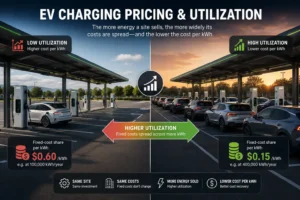
Consider a deliberately simplified example. Assume a site has $60,000 in annual fixed costs. These numbers are hypothetical and are included only to show the relationship between utilization and cost recovery.
| Annual energy sold | Annual fixed cost | Fixed-cost contribution per kWh |
|---|---|---|
| 100,000 kWh | $60,000 | $0.60/kWh |
| 200,000 kWh | $60,000 | $0.30/kWh |
| 400,000 kWh | $60,000 | $0.15/kWh |
The annual fixed cost has not changed. The difference is simply how much electricity is available over which to spread it.
This creates one of the harder problems in public charging economics. A lightly used site may require a high price to recover its costs, but increasing the price can make the charger less attractive and potentially make the utilization problem worse. The opposite approach—pricing as though future demand has already arrived—can leave the project short of its financial target.
A sensible model therefore needs more than one utilization forecast. At minimum, the operator should see what happens in a downside case, a realistic base case and a stronger-demand case.
Turning Site Costs Into a Required Charging Rate
Suppose a site is expected to sell 300,000 kWh in a year. Its modeled annual costs look like this:
| Item | Hypothetical annual amount |
|---|---|
| Electricity | $45,000 |
| Demand-related utility charges | $18,000 |
| Network, connectivity and payment costs | $15,000 |
| Maintenance and customer support | $12,000 |
| Site costs | $15,000 |
| Annual capital recovery allocation | $30,000 |
| Total | $135,000 |
Again, these are illustrative numbers rather than industry averages.
Recovering $135,000 from 300,000 kWh requires average realized revenue of $0.45 per kWh before allowing for any additional return, contingencies or costs omitted from the example:
$135,000 ÷ 300,000 kWh = $0.45/kWh
Now suppose the project needs $165,000 in annual charging revenue to meet its financial objective. The required average becomes $0.55/kWh.
The important part comes when utilization changes. At 200,000 kWh of annual sales, that same $165,000 revenue requirement works out to $0.825/kWh. At 400,000 kWh, it falls to $0.4125/kWh.
That does not mean the operator should automatically put whichever number the spreadsheet produces on the charger. The calculation reveals what the business case requires; the market determines whether that requirement is realistic.
If nearby stations offer a comparable service for substantially less, the operator needs to investigate why its required price is so high. The problem may be the site’s capital cost, utility tariff, rent, utilization forecast or investment assumptions. Sometimes the economics need fixing rather than the tariff.
Not Every Charging Site Is Trying to Achieve the Same Thing
Public charging covers several quite different businesses.
A motorway fast-charging hub generally needs throughput. Vehicles arriving there often need energy quickly, and a car occupying a charger after it has finished can prevent another paying customer from using the asset.
A hotel has almost the opposite pattern. A guest may plug in during the evening and reasonably leave the vehicle parked overnight. Maximizing charger turnover every few minutes is not the point.
Retail locations introduce another consideration: charging may support the host’s main business. The direct charging margin can matter, but so can the value of attracting or retaining customers. Workplace charging may likewise be partly subsidized as an employee benefit rather than operated as a standalone charging business.
These differences matter because there is no universally correct markup. Before choosing a tariff, the operator should be clear about what the site is intended to achieve.
Per-kWh, Session, Time or Membership Pricing?
Once the required economics are understood, the next question is how to collect the revenue from customers. The answer should be driven by both the site’s operating problem and the rules in the market where it operates.
Per-kWh pricing
Charging by energy delivered gives drivers a relatively straightforward way to compare costs. It also avoids directly penalizing a vehicle simply because it charges more slowly.
What it does not do is make fixed costs disappear. Rent, software, infrastructure and other recurring expenses still have to be recovered through the energy price or another legitimate revenue source.
Time and occupancy fees
Time becomes more useful when it represents occupancy rather than acting as a substitute for the energy price.
Two cars connected for 30 minutes do not necessarily receive the same amount of energy. Actual charging power depends on factors including the vehicle’s charging limit, battery state of charge, temperature, power sharing and site constraints.
But if a fully charged or otherwise finished vehicle remains in a scarce charging bay while other drivers are waiting, an occupancy fee can have a clear purpose: getting the space back into service.
Session fees
A fixed fee per charging session can provide a minimum contribution toward transaction costs. The trade-off is that the fee weighs much more heavily on a driver buying a small amount of energy than on someone completing a large session.
That does not automatically make a session fee wrong. It means the operator should know exactly what the fee is intended to recover and consider how it changes the effective price of different-sized sessions.
Memberships
Membership pricing needs its own calculation rather than an arbitrary discount.
If a customer pays $10 per month for a lower charging rate, the operator should estimate how much discount that customer is likely to consume. A heavy user could receive more than $10 in reduced charging contribution each month. That may still make commercial sense if membership creates enough additional charging volume or retention, but the benefit should be demonstrated rather than assumed.
Demand Charges Can Change the Economics of Fast Charging
At some sites, the utility bill is affected not only by how many kWh are consumed but also by peak electrical demand. That distinction matters for high-power charging because several vehicles charging simultaneously can create a large short-duration load.
The operator should model the actual electricity tariff rather than approximate these costs with a generic electricity price. Relevant details can include how demand is measured, the applicable measurement interval, time periods and seasonal provisions.
Once the real cost is understood, there are several possible responses. The operator might simply pay the demand charge if utilization is strong enough to absorb it. Another site might use power management to limit simultaneous peaks. Time-dependent customer pricing could make sense where drivers can shift demand, while some projects may investigate battery storage.
For sites with several chargers or constrained electrical capacity, dynamic load balancing can help distribute available power as demand changes.
But each solution has a cost. Limiting power can affect charging speed and throughput. Storage introduces capital cost, efficiency losses and operational complexity. Variable prices are ineffective if drivers cannot realistically change when they charge.
The cheapest-looking technical solution is therefore not necessarily the cheapest business solution.
Regulation Can Decide What the Tariff Is Allowed to Look Like
Operators cannot choose a pricing structure solely because their billing platform supports it. Rules governing billing units, metering, additional charges and price disclosure vary between markets.
European Union
The EU Alternative Fuels Infrastructure Regulation (AFIR) sets specific pricing requirements for publicly accessible charging.
For publicly accessible charging points with a power output of at least 50 kW, the ad hoc price must be based on the price per kWh for electricity delivered. An occupancy fee expressed as a price per minute may also be charged.
For publicly accessible charging points below 50 kW, applicable ad hoc price components must be made clearly available before the charging session. AFIR specifies the order in which the relevant price components are presented.
These provisions apply to relevant publicly accessible charging points deployed from 13 April 2024. Operators should check the current text of Regulation (EU) 2023/1804 rather than relying on a tariff used by another network.
United Kingdom
The UK’s Public Charge Point Regulations 2023 require the maximum price a consumer could be charged for a public charging session to be clearly displayed in pence per kWh or pounds per kWh before charging.
Government guidance addresses situations including fixed fees, subscriptions and prices that vary by time. Where dynamic pricing is used, the consumer cannot be charged more than the maximum displayed before the session began.
The UK government’s current guidance should be checked when designing the customer-facing tariff.
United States
In the United States, operators need to pay particular attention to state-level adoption and enforcement. NIST’s model commercial EV fueling requirements use the kilowatt-hour for electricity sold as vehicle fuel and allow separately disclosed time-based services such as parking, but the applicable weights-and-measures framework depends on the jurisdiction.
The practical point is simple: a pricing model used in one state should not be assumed to satisfy the requirements in another.
NIST’s Electric Vehicle Fueling FAQs provide useful background on commercial EV fueling and methods of sale. Where billing depends on measured energy, our EV energy meter guide also explains the role of metering in charging and billing.
Dynamic Pricing Is Useful Only When It Changes Something Valuable
It is easy to make EV charging prices more sophisticated. The harder question is whether doing so improves the business.
A simple peak/off-peak rate may help where electricity costs differ predictably by time and customers have enough flexibility to respond. More responsive pricing may be worth examining when underlying costs or site constraints change frequently.
Before implementing it, the operator should be able to answer a few practical questions: What causes the price to change? How often can it change? When does the customer see the final applicable price? What happens to a session that crosses between pricing periods? How are roaming customers and members treated?
Most importantly, the operator should decide in advance how success will be measured.
If a variable tariff does not shift meaningful demand, improve site margin or relieve an identifiable constraint, a simpler price may be better.
Idle Fees Are About Access, Not Just Revenue
A busy fast-charging site can lose usable capacity when vehicles remain parked in charging bays after they no longer need the charger. An idle or occupancy fee can address that problem by encouraging drivers to move their vehicles.
That does not mean every station needs one.
Operators should first look at actual behavior. Are finished vehicles regularly blocking chargers? Are other drivers waiting? Is the site intended for short stops or long stays? Can customers reasonably return to their cars when charging ends?
A hotel car park, for example, should not automatically copy the occupancy policy of a motorway charging hub.
Where an idle fee is justified, the trigger, price, grace period if offered, and notification process should be clear to the driver. The operator should also distinguish its charging-network fee from any separate parking charge imposed by the site owner.
A Practical Way to Set the Price
For a new site, the process can be reduced to a sequence of decisions rather than an elaborate pricing formula.
- Build the complete cost model. Include electricity, peak-related utility costs, transactions, operations, site expenses and capital recovery.
- Forecast realistic charging demand. Estimate sessions and annual energy sales under more than one utilization scenario.
- Set the revenue requirement. Distinguish what the site needs for cost recovery from the financial return expected from the project.
- Calculate the required average revenue. Work out what each kWh or session needs to contribute under the different utilization cases.
- Compare the result with the local market. Price should be considered alongside charging power, reliability, location, parking and convenience—not in isolation.
- Choose the simplest tariff that solves the problem. Add time, occupancy, session or membership components only when they have a clear role.
- Check the rules before launch. Confirm that the billing units, meter, fees and customer disclosures meet the requirements where the charger operates.
- Measure what actually happens. Replace assumptions with real site data as soon as enough of it exists.
The Numbers to Watch After Launch
Revenue per kWh alone does not tell you whether a pricing change worked. A higher price can improve the margin on each kWh while reducing charging volume enough to leave the site worse off.
Useful measures include total energy delivered, sessions, average energy per session, utilization, realized revenue per kWh, electricity and demand-related costs, payment and roaming expenses, charger availability and failed sessions.
Occupancy is worth monitoring where congestion matters. Membership operators should separately track subscription revenue, member usage and the cost of discounts.
The figures also need context. An outage, seasonal travel pattern or new competitor can change utilization independently of pricing. That is why a good pricing review looks at what changed around the site rather than assuming every movement in demand was caused by the tariff.
Once an operator begins managing many locations, site-level decisions also become a network problem. Our guide to scaling an EV charging network looks at the wider operational challenges involved.
Where Charging Pricing Models Commonly Go Wrong
Copying the nearest competitor. Their price is useful market information, but it tells you almost nothing about their electricity contract, utilization, rent, infrastructure cost or investment objectives.
Marking up the electricity rate. This can create the appearance of a healthy margin while leaving much of the actual site cost outside the calculation.
Assuming rated charger power is what every customer receives. Vehicle limits, state of charge, battery temperature, power sharing and site constraints all affect actual charging speed. This becomes especially important if time affects the bill.
Adding fees simply because the billing platform supports them. Every component should solve an identifiable financial or operational problem. Otherwise it makes the tariff harder to understand without improving the underlying economics.
Using one utilization assumption everywhere. A lightly used destination charger and a busy highway hub can behave like completely different businesses even when they belong to the same network.
Ignoring reliability. A theoretically perfect tariff does little for a site where drivers frequently encounter unavailable chargers or failed sessions. Reliability affects repeat use, utilization and ultimately the assumptions on which the pricing model depends.
A Few Questions Operators Usually Ask
Why is public EV charging often more expensive than charging at home?
A public charging price may have to support much more than the electricity itself. The operator can be paying for commercial charging equipment, electrical infrastructure, site access, maintenance, network services, payment processing and customer support. Fast-charging sites may also face utility costs associated with high electrical demand. The exact difference depends on the location and market.
Can an operator charge both per kWh and for occupying the charger?
In some markets, yes, but the applicable regulations need to be checked. Commercially, the two components solve different problems: the energy rate pays for charging, while an occupancy fee can discourage vehicles from blocking scarce charging capacity. The EU’s AFIR, for example, permits an additional per-minute occupancy fee at relevant publicly accessible charging points of at least 50 kW alongside the kWh-based ad hoc price.
How do you know whether the charging price is too high?
The spreadsheet alone cannot answer that. Compare realized utilization and revenue with the business case, then look at competing stations with similar charging power and convenience. If the site requires a price substantially above the local market simply to work financially, the underlying costs or utilization assumptions may deserve more attention than the tariff.
Bottom Line
There is no universal sustainable price for public EV charging because there is no universal charging site.
The useful starting point is the site’s complete economics: what it costs to build and operate, how much energy it can realistically sell, and what revenue the project needs to generate. The resulting number then has to survive a second test in the real market.
If customers will not accept the price the financial model requires, adding another fee is unlikely to solve the underlying problem. The operator may need higher utilization, lower costs, a different site design or a different investment assumption.
Per-kWh rates, memberships, dynamic prices and occupancy fees are tools. They work when each one has a clear purpose. The strongest pricing strategy is usually the one that understands the site’s costs first, keeps the customer-facing tariff as clear as possible, and changes course when actual operating data shows that the original assumptions were wrong.
Sources and Methodology
The regulatory sections of this guide draw on Regulation (EU) 2023/1804, UK government guidance for the Public Charge Point Regulations 2023, and NIST material on commercial electric vehicle fueling. The numerical examples are hypothetical calculations designed to explain pricing mechanics; they are not industry averages, reported network results or recommended retail prices.
Actual charging economics depend on the utility tariff, equipment, financing, contracts, taxes, utilization and regulatory requirements applying to the individual site. Operators should verify current requirements before implementing or changing a public charging tariff.