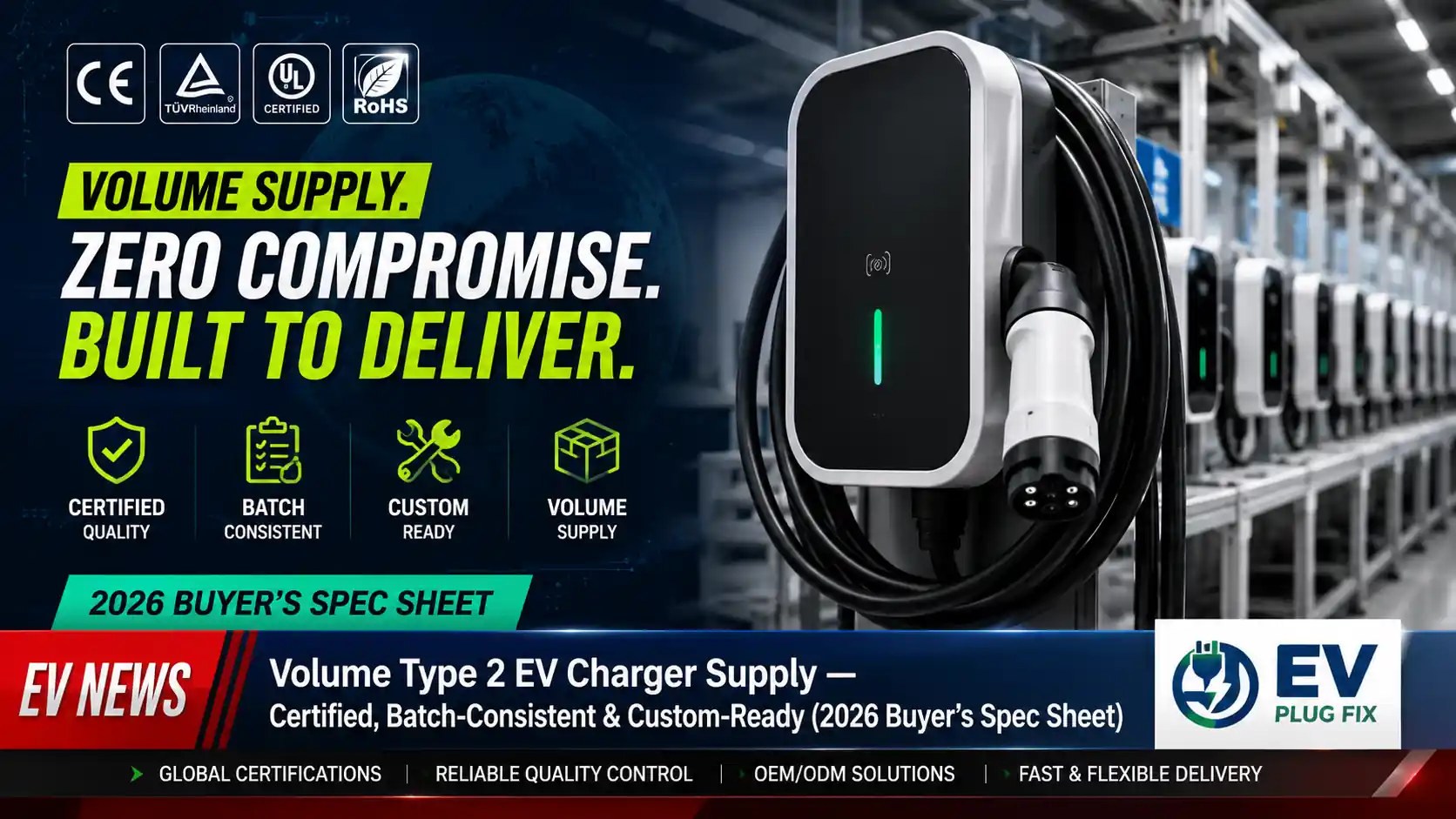
Buying Type 2 EV chargers in volume is not the same as choosing a wallbox for one home.
A distributor ordering 500 units, a fleet electrifying several depots, or a property developer standardizing chargers across multiple sites has a different problem: how do you know the product delivered six months from now will match the product you approved today?
That question shifts the buying decision away from headline specifications such as 7 kW, 11 kW or 22 kW. For commercial buyers, certification evidence, production consistency, component control, software integration, customization, warranty logistics and delivery reliability can matter just as much as charging power.
Do not qualify a volume EV charger supplier from a product page alone. Before committing to a large order, verify the exact model’s certificates, request production and QC documentation, confirm software requirements in writing, approve a production sample, and define what happens if later batches differ from the approved unit. A lower unit price can quickly become expensive if certification, integration or field-failure problems appear after deployment.
What Volume Buyers Should Actually Evaluate
A useful supplier evaluation starts with three questions:
- Can the supplier prove that the exact product meets the requirements of your target market?
- Can it reproduce the approved specification consistently across multiple production batches?
- Can it support your commercial requirements after the first shipment?
Those questions create a more useful procurement framework than simply comparing feature lists.
| Evaluation Area | Evidence to Request | Why It Matters |
|---|---|---|
| Compliance | Certificates, declarations, test reports and exact model references | Reduces regulatory and market-entry risk |
| Production | Factory process, QC flow, aging tests and batch records | Helps establish repeatability at scale |
| Components | BOM controls and critical-component substitution policy | Reduces unexpected changes between batches |
| Software | Protocol version, API/OCPP documentation and test environment | Prevents integration surprises after deployment |
| Customization | Approved sample, drawings and written change specification | Defines exactly what the supplier must reproduce |
| After-sales | Warranty, RMA workflow, spare-parts plan and response terms | Controls downtime after units reach the field |
Feyree as a Volume Type 2 EV Charger Supplier
Feyree markets itself as an EV charging manufacturer with in-house R&D and OEM/ODM capabilities rather than only a retail charger brand.
Its published company information describes EV charging development dating to 2014, support for private-label projects, and product families covering portable chargers, wallboxes, cables, connectors and adapters.
For a commercial buyer, however, those claims should be treated as the starting point for supplier qualification, not the end of it.
The correct question is not simply, “Does Feyree say it has CE, OEM customization or an IP66 charger?” The procurement question is:
“Can Feyree provide evidence for the exact model, configuration and production batch we intend to purchase?”
That distinction will guide the rest of this evaluation.
Certification: Verify the Product, Not Just the Supplier
EV charging equipment sits inside a regulated electrical system, so compliance should be checked at model level.
The IEC’s IEC 61851-1 standard covers general requirements for conductive EV supply equipment, including characteristics, operating conditions, the connection between EVSE and the vehicle, and electrical safety requirements.
Feyree’s published factory information lists certifications and compliance markings including CE, LVD, EMC, RoHS, REACH and UKCA. Individual product pages also advertise certifications for particular charger configurations.
For procurement purposes, however, a logo on a website is not enough.
EV Plug Fix Certification Verification Matrix
| Target Market | What to Investigate | What the Buyer Should Request |
|---|---|---|
| European Union | Applicable CE requirements, electrical safety, EMC and substance restrictions | EU Declaration of Conformity plus supporting reports for the exact model |
| United Kingdom | Applicable UK product and installation requirements | Current conformity documentation for the exact product and intended placement on the market |
| United States | Applicable electrical safety, installation and communications requirements | Evidence acceptable to the relevant authority, project owner or electrical inspector |
| Australia / New Zealand | Applicable electrical equipment and installation requirements | Evidence that the exact product can legally be supplied and installed in the intended jurisdiction |
| Multi-market programs | Whether one hardware version actually covers every target country | Model-by-model compliance matrix rather than a general corporate certificate list |
Procurement rule: Never approve a large EVSE order because the supplier says “CE certified” or displays multiple certification logos. Ask for documents tied to the exact model number and configuration you will receive, then have the documentation reviewed against the requirements of the destination market.
Manufacturing Traceability: Can the Approved Charger Be Reproduced?
This is where volume procurement differs sharply from buying a single charger online.
A sample can perform perfectly and still tell you very little about what happens in batch three, five or ten.
Feyree’s published manufacturing material describes automated SMT production, internal PCB and firmware development, aging tests and final quality-control processes. Those are useful indicators of manufacturing capability, but a commercial buyer should convert them into verifiable purchase requirements.
What to Request Before a Volume Order
- production flow for the exact charger family;
- incoming inspection criteria for critical components;
- PCB/SMT inspection process;
- functional test procedure;
- electrical safety test procedure;
- aging or burn-in procedure where applicable;
- final inspection checklist;
- serial-number or lot traceability method;
- sample QC report from a completed batch; and
- written process for approving component substitutions.
The last point is easy to overlook.
If a relay, MCU, cable, connector material or protection component changes after certification or sample approval, the finished charger may no longer be functionally identical to the unit you evaluated.
For that reason, a strong purchase agreement should define which components are controlled and when buyer approval is required before substitution.
EV Plug Fix Batch Consistency Scorecard
Rather than inventing “good” test values, a buyer can use a blank acceptance framework and require the supplier to populate it with evidence from the actual production batch.
| Verification Item | Golden Sample | Production Batch | Acceptance Requirement |
|---|---|---|---|
| Electrical safety tests | Documented | Supplier QC record | Must meet approved specification |
| Charging-current accuracy | Baseline recorded | Batch sample results | Within agreed tolerance |
| Connector/cable specification | Approved BOM | Batch BOM | No unauthorized substitution |
| Thermal performance | Baseline test | Batch sample test | Within agreed test limits |
| Firmware version | Approved version | Production version | Exact or approved revision |
| App/backend behavior | Acceptance test | Production verification | No material functional regression |
| Label/certification markings | Approved artwork | Production sample | Exact approved configuration |
This framework is intentionally more useful than publishing unexplained sample SPC numbers. The values that matter are the values agreed for your product and your batch.
Component Quality: Look Beyond Marketing Percentages
Feyree publishes several detailed material claims for parts of its charger portfolio, including copper conductors, TPU cable construction, plated charging pins and weather-resistant enclosures.
Those details can be useful, but commercial buyers should verify the specification rather than treating a marketing percentage as a proxy for overall charger reliability.
For example, cable conductor quality matters, but so do:
- terminal crimp quality;
- connector contact resistance;
- relay/contactors and switching life;
- PCB thermal design;
- temperature sensing;
- water sealing;
- strain relief;
- firmware fault handling; and
- protective-device implementation.
Our EV charger safety comparison explains why the protection architecture deserves as much attention as headline charging power.
Safety: Don’t Reduce RCD Protection to a Checkbox
Residual-current protection is especially important in EV charging because charging equipment must safely handle electrical fault conditions involving both the supply and the connected vehicle.
Feyree advertises configurations with AC 30 mA and DC 6 mA leakage protection, while some of its published material describes this under Type B protection terminology.
For a procurement team, the important step is to confirm the exact protection architecture of the model being purchased and whether it satisfies the installation rules where the charger will be deployed.
Do not assume that every Feyree charger has identical internal protection simply because another model in the product family lists it.
Ask the supplier for the protection specification and supporting test documentation for the exact SKU. Then let the project electrical designer or qualified installer determine what upstream protection is still required. Charger-integrated protection does not remove the need to follow local installation rules.
IP66 and Temperature Ratings: Useful, but Verify the Exact Component
Several Feyree charger products are advertised with an IP66 enclosure rating and operating temperatures around -30°C to +55°C. These specifications can be valuable for outdoor installations exposed to rain, dust, summer heat or winter conditions.
But buyers should pay attention to exactly what carries the rating.
For example, a charging control box can have one IP rating while the vehicle connector or mains plug has another. Feyree’s own product information for some portable models distinguishes between an IP66 main unit and an IP65 charging connector.
That level of detail matters when writing a tender specification.
What to Request for an Outdoor Deployment
- IP test evidence for the exact enclosure;
- separate connector/plug ingress rating;
- operating and storage temperature ranges;
- UV exposure information for cables and plastics;
- thermal derating behavior at high ambient temperatures;
- installation orientation requirements; and
- limitations on permanent outdoor use.
Factory-Direct Supply: What Is the Real Advantage?
A factory-direct relationship can reduce communication layers between the buyer and the engineering/production team.
That becomes valuable when the project requires more than a standard retail SKU.
Feyree’s published OEM/ODM model includes consultation, product development, prototyping, certification coordination, manufacturing and after-sales support. The company also advertises customization extending into branding, packaging, firmware and software interfaces.
For a distributor or private-label brand, the real advantage is not simply putting a different logo on the enclosure.
The potential advantage is having one accountable supplier for:
- hardware configuration;
- firmware behavior;
- labeling;
- packaging;
- mobile-app presentation;
- documentation;
- production changes; and
- after-sales technical escalation.
That can simplify project management—but only if every customization is documented before mass production.
OEM vs ODM: Know What You Are Actually Buying
“OEM” and “ODM” are often used loosely in charger sourcing.
There is a major difference between changing a logo on an existing product and changing the electrical design, firmware behavior or software ecosystem.
| Customization Level | Example | Procurement Risk |
|---|---|---|
| Cosmetic | Logo, enclosure color, packaging | Relatively low |
| Configuration | Cable length, plug type, default current settings | Moderate |
| Firmware | Charging logic, schedules, UI behavior | Higher testing requirement |
| Software | White-label app, backend or API integration | Requires security and interoperability review |
| Electrical redesign | Major PCB/component or power-stage changes | Can affect testing and certification |
Procurement rule: The deeper the customization, the less useful the original off-the-shelf certificate or test result may become without confirming that the modified configuration remains covered.
White-Label Apps and OCPP: Ask for a Demonstration, Not a Checkbox
For fleets, charging networks and commercial sites, the software layer can determine whether an otherwise capable charger is operationally useful.
Feyree markets app-controlled chargers and OCPP-capable commercial configurations, along with white-label software options for OEM customers.
If OCPP or API integration is important to your project, do not accept “OCPP supported” as the complete answer.
EV Plug Fix Software Due-Diligence Checklist
| Question | Why You Need the Answer |
|---|---|
| Which OCPP version is supported? | Backend compatibility depends on implementation |
| Which profiles/features are implemented? | Protocol support can vary substantially |
| Can we test against our CSMS before ordering? | Integration problems are cheaper to find before deployment |
| Who controls OTA updates? | Defines operational and security responsibility |
| What happens if cloud service becomes unavailable? | Determines charger behavior during backend outages |
| Who owns charging-session data? | Important for fleets, privacy and analytics |
| Is there a documented API? | Prevents dependence on undocumented integrations |
| Can firmware be rolled back? | Useful when an OTA release creates field problems |
If dynamic power management is required, see our guide to dynamic load balancing for the electrical considerations involved in sharing limited site capacity across chargers.
MOQ, Lead Time and Logistics: Put the Numbers in the Contract
Volume procurement requires more than asking, “How quickly can you ship 500 chargers?”
Lead time can change with customization, certification work, component availability, packaging requirements and shipping destination.
Instead of treating indicative supplier timelines as guaranteed production commitments, use them for initial planning and then confirm the final schedule in the purchase agreement.
EV Plug Fix Order Planning Framework
| Stage | What Should Be Completed |
|---|---|
| RFQ | Exact SKU, quantity, destination, customization and compliance requirements |
| Sample | Functional and visual approval |
| Pre-production | Golden sample, BOM/configuration freeze and packaging approval |
| Production | Agreed QC and traceability process |
| Pre-shipment | Inspection, documentation and batch verification |
| Delivery | Shipping documents, serial/lot records and receiving process |
| Deployment | Installation, commissioning and backend verification |
When building the overall project budget, remember that the charger purchase price is only one component. Electrical infrastructure, civil works, networking, commissioning and ongoing support can materially affect commercial EV charging installation costs.
Warranty and RMA: The Part Buyers Often Evaluate Too Late
Feyree advertises a two-year warranty on several charger products and describes after-sales support for OEM and distribution partners.
For a consumer buying one charger, a warranty period may be enough information.
For a fleet operating 500 chargers, it isn’t.
The procurement team needs to understand what happens after unit number 37 fails at a customer site.
Questions to Put in the Commercial Agreement
- When does the warranty period begin?
- Which components and failure modes are covered?
- Who pays return freight?
- Is advance replacement available?
- Where are failed products returned?
- What diagnostic evidence must be supplied?
- Are spare PCBs, cables or complete replacement units available?
- What is the target RMA response time?
- What happens if the same defect appears across a production batch?
- How long will firmware and app/backend support continue?
This becomes increasingly important as the installed base grows. Our guide to EV charging network scaling covers the operational issues that appear when a charging deployment expands beyond a handful of units.
EV Plug Fix Supplier Readiness Scorecard
Instead of reducing supplier selection to price per charger, a procurement team can score a potential volume supplier across the following categories.
| Category | Weight | What Earns a High Score |
|---|---|---|
| Compliance evidence | 20% | Model-specific, verifiable documentation for target market |
| Manufacturing & QC | 20% | Traceable production process and batch records |
| Electrical safety | 15% | Documented protection architecture and test evidence |
| Software interoperability | 15% | Demonstrated integration, documented protocol/API and update process |
| Supply continuity | 10% | Controlled components and realistic production planning |
| Customization control | 10% | Golden-sample and change-management process |
| Warranty & RMA | 10% | Clear field-support and replacement process |
EV Plug Fix interpretation:
- 90–100: Strong candidate for final commercial qualification.
- 75–89: Potentially suitable, with remaining items to close before PO.
- 60–74: Significant due diligence still required.
- Below 60: We would not commit to a large deployment without resolving major gaps.
This score is deliberately based on evidence received during procurement. A final numerical score should not be assigned to Feyree—or any other manufacturer— solely from public website information.
A Safer Pre-Order Path: Sample → Pilot → Production
For a first relationship with any EV charger manufacturer, jumping directly from a web quotation to 500 or 1,000 units creates unnecessary risk.
A more defensible process is:
Engineering sample → small pilot batch → production order
Stage 1: Engineering Sample
Use the sample to verify the basics:
- electrical configuration;
- vehicle compatibility;
- charging stability;
- app behavior;
- network connectivity;
- physical construction;
- labeling; and
- backend integration where required.
Stage 2: Pilot Batch
A pilot batch tests something a single sample cannot: repeatability.
Deploy units under realistic conditions and record installation issues, charging failures, communication problems, thermal behavior and support response.
Stage 3: Production Order
Only after the product and supplier process pass the pilot should the buyer freeze the approved configuration and scale the order.
The purchase agreement should reference the approved sample, documentation set, firmware revision and any critical BOM requirements.
The best evidence of a supplier’s volume capability is not a factory photograph or a perfect prototype. It is the ability to reproduce an approved configuration consistently, document what changed, and resolve field failures after deployment.
Procurement Checklist: 12 Things to Verify Before Ordering
- Exact model certification — obtain the applicable declarations, certificates and supporting reports.
- Golden sample — keep a signed or otherwise controlled reference unit/configuration.
- Production traceability — confirm serial, lot or batch identification.
- Critical components — establish which substitutions require buyer approval.
- Electrical protection — verify the exact leakage/fault protection architecture.
- Environmental ratings — distinguish enclosure, connector and plug ratings.
- Software integration — test OCPP/API requirements against your actual backend.
- Firmware control — document approved versions and OTA responsibilities.
- Customization scope — freeze hardware, branding, packaging and software requirements.
- Production schedule — define lead time after final approval rather than relying on an indicative quote.
- Pre-shipment inspection — agree on sampling and acceptance criteria before production.
- Warranty/RMA — define replacement, freight, support and recurring-defect procedures.
If the project depends on public incentives or government funding, review the eligibility rules before locking the hardware specification. Our guide to EV charging grants and funding explains why program requirements can influence equipment selection.
Should You Source Volume Type 2 Chargers From Feyree?
Based on the manufacturer’s published information, Feyree presents several characteristics worth investigating for a B2B sourcing project: EV-charging specialization, OEM/ODM support, in-house development claims, multiple charger formats, weather-resistant product options, customization and published manufacturing/QC processes.
Those characteristics make the company a candidate for supplier qualification.
They do not eliminate the qualification process.
For a small branded order, cosmetic customization and standard product documentation may be enough. For a 500- or 1,000-unit commercial deployment, the qualification process should go further: verify model-specific compliance, test samples, validate software integration, define component-change controls, run a pilot batch and negotiate warranty/RMA terms before scaling.
That approach applies whether the supplier is Feyree or a much larger EVSE manufacturer.
The Bottom Line
Volume EV charger procurement is fundamentally a risk-management exercise.
The cheapest charger is not necessarily the lowest-cost charger once certification problems, installation delays, software incompatibility, batch variation, field failures and replacement logistics are included.
Feyree’s published manufacturing, product and OEM/ODM capabilities give commercial buyers enough reason to consider the company during a Type 2 EV charger sourcing exercise. But public specifications should be the beginning of due diligence, not a substitute for it.
The strongest procurement process is straightforward:
verify the exact product → test the sample → validate compliance and software → run a pilot → freeze the configuration → inspect production → then scale.
That process gives a distributor, fleet operator or project developer something far more valuable than a long specification sheet: evidence that the charger being purchased can be deployed repeatedly and supported after it reaches the field.
Manufacturer-specific capabilities in this guide are based on Feyree’s published product, factory and OEM/ODM information and should be verified against the exact model and commercial agreement before procurement. Standards information is linked to the relevant standards body. EV Plug Fix scorecards, procurement rules, acceptance frameworks and recommendations are independent editorial analysis intended to help buyers perform supplier due diligence; they are not claims that EV Plug Fix has physically audited Feyree’s factory or independently certified its products.