
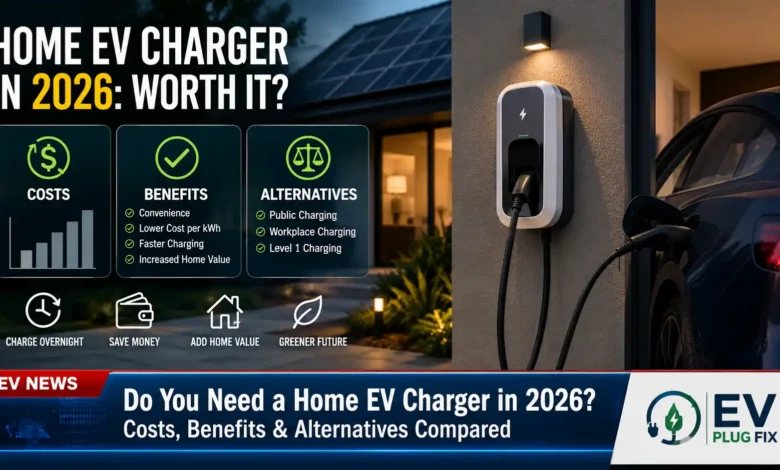
You do not need a dedicated home EV charger simply because you own an electric car. You need a safe, reliable way to replace the energy you normally use before the car is needed again. For some drivers, a 120-volt Level 1 connection is enough. Others are better served by 208- or 240-volt Level 2 charging, while dependable workplace or public charging can make a home installation unnecessary.
That distinction between replacing your normal daily energy use and recharging an empty battery to 100% is the key to the decision. A charger does not need to refill the entire battery overnight if your typical day uses only a small part of it.
| Your situation | Likely best option |
|---|---|
| Short daily driving and long overnight parking near a suitable outlet | Level 1 may be enough |
| Moderate or high daily mileage with private parking | Level 2 is usually the most convenient choice |
| Reliable workplace charging covers most driving | Home Level 2 may be optional |
| No dedicated parking at home | Apartment, workplace or public charging may be necessary |
| Routine driving requires frequent separate fast-charging stops | Home or workplace charging is worth investigating |
Level 1 vs Level 2: how much charging do you need?
In North America, Level 1 charging normally uses a 120-volt household supply. Level 2 uses higher-voltage AC power, commonly 208 or 240 volts. For most owners, the important difference is how much driving range can be restored while the car is parked.
The U.S. Department of Energy’s Alternative Fuels Data Center estimates that Level 1 typically adds about 2 to 5 miles of range per charging hour, while Level 2 adds roughly 10 to 30 miles per hour. Its general comparison lists DC fast charging at about 100 to 200 or more miles in 30 minutes. Actual results vary with the vehicle, charging power, efficiency, battery state and conditions.
This is why Level 1 should not be dismissed simply because it is slow. The Department of Energy gives an example in which eight hours of 120-volt Level 1 charging replenishes about 40 miles of range for a mid-size EV. If that comfortably covers what you normally drive in a day, faster home charging is a convenience rather than a necessity.
Level 1 becomes less practical when consecutive high-mileage days regularly consume more energy than the outlet can restore. The receptacle and circuit must also be suitable for sustained EV charging; the fact that a portable charging cable fits an outlet does not by itself establish that the installation is appropriate.
When Level 2 is worth it — and when it isn’t
Level 2 is most useful when Level 1 regularly leaves the car short of the energy needed for the next day. Faster charging also helps households with shorter parking windows, higher daily mileage or multiple EVs competing for available charging time.
Private parking makes the case stronger because a garage or driveway can turn charging into something that happens automatically while the vehicle is parked. Where the vehicle, EVSE or utility supports scheduled charging, owners may also be able to shift charging to lower-priced periods. Whether that saves money depends on the tariff actually available at the address.
On the other hand, a Level 2 installation is easy to postpone when Level 1 already covers normal use or when workplace charging reliably supplies most of the energy the car needs. Apartment residents and drivers without dedicated parking may instead need to judge their building charging options, workplace and nearby public options.
Public-only charging can work, including for drivers who cannot charge at home, but assess the stations you would genuinely use. Their prices, reliability, availability and the extra time required for charging stops matter more than national charger counts. A station beside a place you already visit is much more convenient than one that requires a separate trip.
What does home EV charging cost?
Home charging has two separate costs: the electrical equipment and installation, and the electricity consumed afterward.
Installation prices vary too much for a single national average to describe every home. A straightforward installation near suitable electrical capacity is very different from a project requiring a long cable run, panel work, a service upgrade or trenching. A home charger installation cost assessment is more useful than assuming a generic installation figure applies to your property.
Electricity prices vary by utility and tariff as well. As a U.S. reference point, the U.S. Energy Information Administration reported an average residential electricity price of 18.34 cents per kWh for June 2026.
Home charging cost = electricity drawn from the grid in kWh × your applicable electricity rate.
For a simple pre-loss illustration, 40 kWh at $0.18 per kWh equals $7.20. In actual charging, the electricity drawn from the grid will be somewhat greater than the energy ultimately stored in the battery because charging is not perfectly efficient. When comparing home and public charging costs, use your real electricity tariff and the current prices at the public stations you would actually use.
A current note on U.S. charger incentives
Older guides may say the federal Alternative Fuel Vehicle Refueling Property Credit under Section 30C runs through 2032. That is no longer the applicable cutoff for new installations. Current IRS guidance reflects a revised termination date of June 30, 2026, so property placed in service after that date cannot qualify for the federal credit.
State, local and utility incentives are separate and may still be available. Check current programs where you live before including an incentive in your purchase calculation.
Match the charger to the car and electrical system
A wallbox’s maximum advertised output is not necessarily the charging rate your EV will receive. AC charging can be limited by the vehicle’s onboard charger, the EVSE configuration, branch-circuit capacity and the electrical service available at the property.
Before paying for a high-power Level 2 unit or costly electrical upgrades, determine what AC charging rate the vehicle accepts and how quickly you actually need to replenish it. If a lower-power installation can easily restore normal daily use during the available parking window, extra capacity may offer little practical benefit.
Any new circuit or related electrical work should comply with applicable electrical codes, EV charger permit requirements and equipment instructions.
Essential Questions & Expert Answers
Can a normal household outlet charge an EV?
Yes, if the vehicle has compatible Level 1 charging equipment and the outlet and electrical circuit are suitable. In the United States, Level 1 commonly uses 120-volt AC power and, according to the Department of Energy, typically adds about 2 to 5 miles of range per charging hour.
Is home charging always cheaper than public charging?
No. The comparison depends on your electricity tariff and the prices charged by the public stations available to you. Workplace charging may also change the calculation if it is free or subsidized. Compare the actual options in your routine rather than assuming either home or public charging is always cheaper.
What if I rent or cannot install a charger?
Check whether your building provides charging, whether your workplace offers it and which public stations fit naturally into your weekly routine. An EV can be practical without private home charging, but convenient and dependable access matters more than simply having chargers somewhere nearby.
Bottom Line
Choose the least expensive safe charging arrangement that reliably replaces your normal daily energy use within the time your EV is parked. That may be Level 1, Level 2 or a dependable combination of workplace and public charging; the fastest home charger is not automatically the best choice.
Source Transparency
Charging-rate guidance in this article is based primarily on the U.S. Department of Energy Alternative Fuels Data Center, including its Level 1, Level 2 and DC fast-charging comparisons. U.S. residential electricity pricing uses Energy Information Administration Electric Power Monthly data for June 2026. Federal charger-tax-credit information was checked against current IRS guidance reflecting the June 30, 2026 termination date for Section 30C qualifying property. Electricity rates, utility programs, equipment availability, public-charging prices, permitting requirements and state or local incentives vary by location and can change, so readers should verify current local terms before making a purchase or installation decision.