
The price of a home EV charger is only part of the installation budget. Cable routing, circuit protection, available electrical capacity, mounting, testing and any panel or supply upgrades can add substantially to the project.
Before buying a wallbox, establish three things: how much AC power the vehicle can accept, what the property can supply and how the electrical cable will reach the parking space. Those answers determine whether a simple installation is possible or whether additional electrical and building work will be needed.
Home EV Charger Installation at a Glance
| Check before installation | Why it matters |
|---|---|
| Vehicle AC charging limit | Sets the maximum AC charging rate the car can actually use |
| Home electrical supply | Determines how much charging load the property can support |
| Single-phase or three-phase supply | Affects whether 7.4 kW, 11 kW or 22 kW charging is practical |
| Cable route | Can significantly change material, labor and civil-work costs |
| Circuit and fault protection | Must match the EVSE, circuit design and applicable national rules |
| Load management | Can reduce charging power when household demand is high |
| Charger location | Affects cable reach, weather exposure, mounting and installation complexity |
Do not choose charging power from the wallbox rating alone. A 22 kW charger is not automatically better than an 11 kW or 7.4 kW unit if the vehicle or property cannot use the additional capacity.
Start With the Cable Route
The route from the electrical panel to the planned charger location is one of the biggest variables in installation scope. A short, accessible run may need little more than suitable fixed wiring and mounting work. A route through finished rooms, multiple walls, outdoor conduit or a driveway trench can require considerably more material and labor.
There are two separate cables to consider. The installation cable is the fixed electrical wiring supplying the EVSE from the distribution board or electrical panel. The charging cable connects the EVSE to the vehicle.
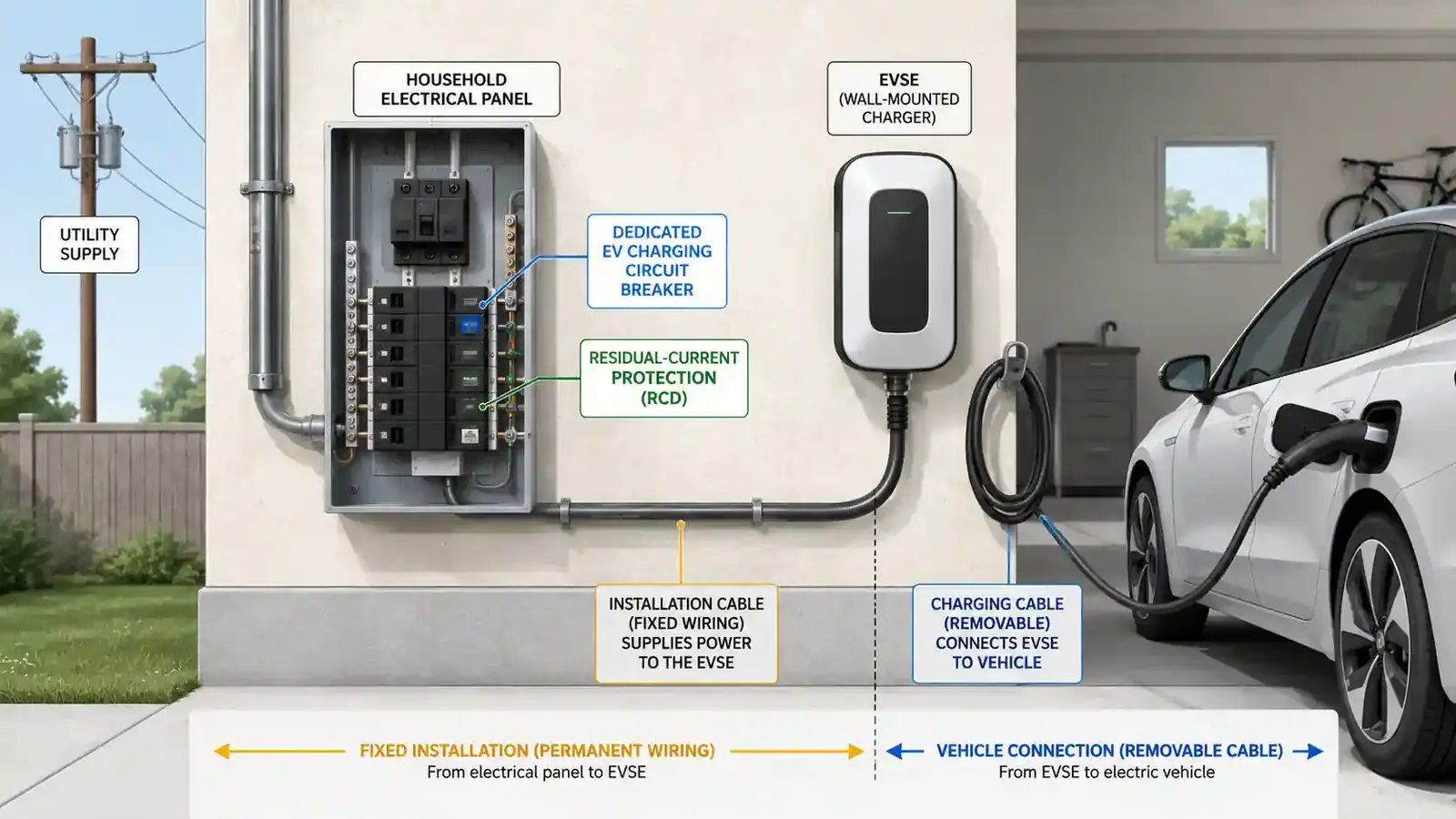
For the vehicle side, measure from the proposed wallbox position to the charge port with the car parked normally. Allow enough reach for comfortable connection without leaving unnecessary cable on the ground.
The fixed wiring needs an electrical design rather than a simple length measurement. Required current, route length, installation method, conductor material, ambient temperature, grouping with other circuits and voltage-drop limits can all influence conductor selection.
Charger position can therefore affect the project cost more than the price difference between two wallboxes. A location that requires a long cable run, difficult wall penetrations or trenching may make a relatively inexpensive charger costly to install. Where the parking arrangement allows it, a practical location closer to the electrical panel can simplify the work considerably.
Where Home Charger Installation Costs Come From
There is no useful universal installation-cost range for Europe because labor rates, electrical rules, taxes, permitting and the amount of site work vary significantly between countries and properties. Even two homes using the same wallbox can have very different total costs.
The main cost drivers are usually:
- distance between the electrical panel and parking space;
- cable size and installation method;
- drilling, conduit, trenching and surface restoration;
- circuit breakers and residual-current protection;
- distribution-board or electrical-panel modifications;
- earthing or bonding work where required;
- dynamic load-management equipment;
- outdoor mounting and weatherproof accessories;
- inspection, testing and certification;
- network-operator, permitting or notification requirements.
Older or heavily loaded electrical installations can make an apparently inexpensive charger much more costly to install. For that reason, compare quotations for the complete installation rather than comparing wallbox prices alone.
Check Electrical Capacity Before Choosing Charging Power
A higher-rated wallbox does not guarantee faster charging. The usable AC charging rate is limited by the home’s supply, the charging circuit, the EVSE and the vehicle’s onboard charger.
| Nominal charging power | Typical European supply arrangement | Approximate current | What to check |
|---|---|---|---|
| 7.4 kW | 230 V single-phase | 32 A | Available single-phase capacity and vehicle AC limit |
| 11 kW | 400 V three-phase | 16 A per phase | Three-phase supply and vehicle three-phase capability |
| 22 kW | 400 V three-phase | 32 A per phase | Supply capacity and whether the vehicle can use 22 kW AC |
These figures describe common nominal European configurations, not installation specifications. Network voltage varies, and the completed circuit still has to be designed for the property and equipment.
An 11 kW wallbox connected to a vehicle whose onboard charger accepts a lower AC rate will charge at the lower rate. The limitation is particularly relevant when comparing 7kW vs 11kW chargers or considering 22 kW equipment because many passenger EVs cannot use 22 kW AC even where the property can supply it.
Check the vehicle specification before paying for additional electrical capacity that the car cannot use.
How Much Faster Are 7.4 kW, 11 kW and 22 kW at Home?
The practical difference between charger ratings becomes clearer when you compare the amount of energy that needs to be added to the battery. As a simple example, consider an EV that needs approximately 60 kWh of energy added during a charging session.
| AC charging power | Approximate theoretical time to add 60 kWh | Important limitation |
|---|---|---|
| 7.4 kW | About 8.1 hours | Vehicle and circuit must support the charging rate |
| 11 kW | About 5.5 hours | Typically requires compatible three-phase charging |
| 22 kW | About 2.7 hours | Vehicle must support 22 kW AC as well as the property |
These are theoretical calculations based on energy divided by charging power. Real charging sessions take longer because of conversion losses, charging-system behavior and changes in available power.
The comparison also shows why charger power should match actual use. If the car remains parked for eight or ten hours overnight, the time saved by a higher-powered installation may have little practical value. Conversely, a household that regularly needs to replace a large amount of energy in a short parking window may benefit more from additional charging capacity.
Circuit Protection: Breakers, RCDs and DC Fault Current
Home EV charging is normally supplied by a circuit designed specifically for the charging point, with the exact circuit and protective arrangements determined by the applicable national wiring rules and EVSE instructions. IEC 60364 addresses electrical installations supplying electric vehicles, while IEC 61851 covers general requirements for conductive EV supply equipment.
Breaker and Cable Sizing
A charger’s maximum current does not by itself determine the breaker or cable size. The protective device, conductor and EVSE have to work as a coordinated circuit.
This is why rules such as “always use 6 mm² cable for a 7 kW charger” are unreliable. Route length, installation method, conductor material, thermal conditions, grouping, voltage drop and national requirements can change the appropriate design.
When reviewing a quotation, ask what charging current the circuit is designed to provide and whether the proposed cable and protection account for the actual route and installation conditions.
Residual-Current and DC Fault Protection
IEC 60364:2018 requires each AC connecting point to be individually protected by an RCD with a rated residual operating current not exceeding 30 mA. Where an IEC 62196 socket-outlet or vehicle connector is used, protection against DC fault current is also required unless suitable protection is provided by the EV charging station.
Under the IEC arrangement, this can be provided by a Type B RCD, or by a Type A or Type F RCD used together with a residual direct current detecting device (RDC-DD) complying with IEC 62955. National wiring rules can adopt or supplement these requirements, so the final protective arrangement must follow the rules in force at the installation location and the EVSE documentation.
This makes the charger’s built-in protection relevant when comparing products and installation quotes. Two EVSE models with similar charging power may require different upstream protective arrangements.
Technical references include IEC 60364:2018, IEC 62955:2018 and IEC 61851.
Type 2 in Europe: Connector Standards vs Residential Wiring Rules
Type 2 is the principal AC charging interface for European light-duty EV charging, but connector interoperability requirements and residential electrical-installation rules should not be treated as the same thing.
The consolidated technical specifications associated with Regulation (EU) 2023/1804 specify that relevant AC normal-power light-duty recharging points installed or renovated from 8 January 2026 must, for interoperability purposes, be equipped at least with Type 2 socket-outlets or vehicle connectors for Mode 3 charging as described in EN IEC 62196:2022. The regulation also provides an alternative for certain normal-power points at or below 3.7 kW whose primary purpose is Mode 2 charging.
For relevant AC high-power light-duty recharging points installed or renovated from 8 January 2026, the technical specification likewise refers to at least Type 2 vehicle connectors for Mode 3 charging as described in EN IEC 62196:2022. Relevant points installed before that date may fall under the earlier referenced technical specification until they are renovated.
The consolidated EU text can be checked in Regulation (EU) 2023/1804.
These interoperability provisions should not be read as a complete wiring code for every private residential charger. A home installation must also satisfy the electrical, equipment, network and other requirements applicable in the country where it is installed. Vehicle connector compatibility should be confirmed separately, particularly for older or imported EVs.
Outdoor Installation Is About More Than the IP Rating
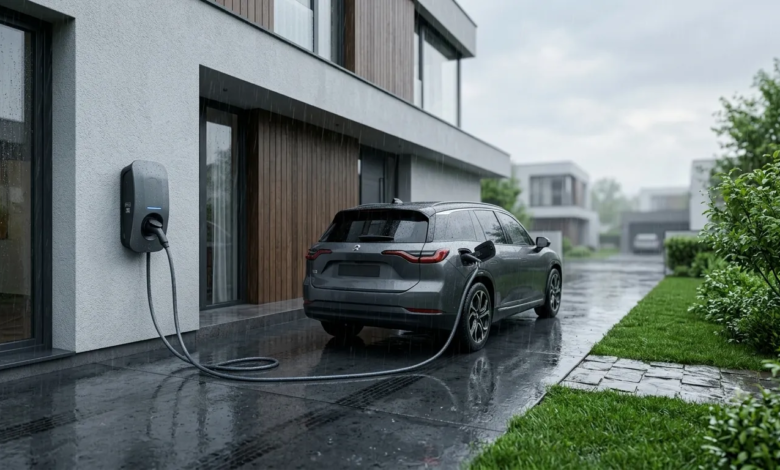
An outdoor charger needs an enclosure suitable for its environment, but a higher IP number is not a general measure of installation quality.
IP65, for example, describes a dust-tight enclosure protected against water jets under defined test conditions. IP67 additionally addresses temporary immersion under specified conditions. Neither rating makes an unsuitable flood-prone location acceptable or replaces correct cable entries, mounting, drainage and electrical installation.
Consider the charger’s declared environmental limits together with direct sunlight, temperature, standing water, coastal exposure and risk of physical impact at the proposed location.
Can Load Management Reduce Installation Constraints?
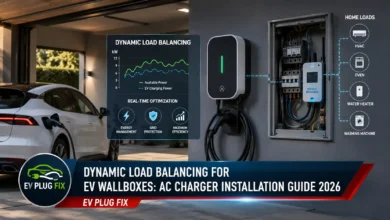
Dynamic load management allows compatible charging equipment to adjust EV charging power as household demand changes. It can be useful where running the charger continuously at its maximum rating would place too much demand on the available supply.
It does not create additional electrical capacity, and it is not automatically a substitute for supply or panel upgrades. Its value depends on the property’s load profile, the charging system and local electrical requirements.
For homes with solar PV, compatible energy-management features may also increase charging when surplus on-site generation is available. Scheduled charging can be useful for households with time-of-use electricity tariffs.
Which Smart Features Are Worth Paying For?
Prioritize functions that solve a real charging problem. Scheduled charging, dynamic load management and solar-aware charging can each be useful in the right household. A driver who simply needs dependable overnight charging may gain little from paying for a long list of connected features.
For app-dependent chargers, consider what happens if the internet connection or manufacturer’s cloud service is unavailable. Also check connectivity requirements and the manufacturer’s stated software-support arrangements if long-term smart functionality matters to you.
7.4 kW, 11 kW or 22 kW: Which Should You Install?
The best home charging power is not necessarily the highest available rating. It is the charging rate that fits the vehicle, electrical supply and normal parking time without requiring unnecessary electrical work.
Choose 7.4 kW When
A 7.4 kW installation can make sense where the property uses a suitable single-phase supply, the vehicle supports the charging rate and overnight parking provides enough time to replace the energy used during the day. For many drivers, this is already sufficient for routine home charging.
Choose 11 kW When
An 11 kW wallbox is particularly relevant where a suitable three-phase supply is available and the vehicle can accept three-phase AC charging. It provides a meaningful reduction in charging time compared with 7.4 kW without the electrical demand of a typical 22 kW installation.
Choose 22 kW Only When You Can Use It
A 22 kW wallbox is most useful when the property has sufficient three-phase capacity, the vehicle can actually accept 22 kW AC and faster home charging solves a real need. Installing 22 kW equipment does not make a vehicle with an 11 kW onboard charger charge at 22 kW.
Future-proofing should therefore consider likely future vehicles and the cost of the electrical infrastructure, not just the maximum number printed on the wallbox.
How to Get a Useful Installation Quote
A site assessment before purchasing the charger can prevent expensive surprises. The installer should know the supply arrangement, available capacity, distribution-board condition, proposed cable route, charger position, desired charging power and the vehicle’s AC capability.
Mention future plans such as another EV, solar PV or a home battery if they could affect the electrical design.
When comparing quotes, look beyond the headline installation price. Confirm whether the price includes the required cable run, protective devices, mounting, load management, testing, certification, civil work and any applicable network or permitting process.
Before You Buy: A Practical Checklist
- Vehicle: Confirm its maximum AC charging rate and phase capability.
- Property: Establish the supply type and available electrical capacity.
- Cable route: Plan the fixed wiring route and make sure the vehicle charging cable reaches the normal parking position.
- EVSE: Review its electrical protection, environmental and connectivity requirements.
- Charging power: Choose 7.4 kW, 11 kW or 22 kW according to what both the property and vehicle can use.
- Quote: Obtain a site-specific price covering the complete installation rather than only the wallbox.
- Installation: Use an appropriately qualified installer. The installation must comply with the applicable electrical, network-operator, permitting and notification requirements.
FAQ
Is 7.4 kW enough for home EV charging?
For many drivers, yes. Whether 7.4 kW is sufficient depends on daily energy use, available charging time, battery capacity and the vehicle’s AC charging limit. A higher-powered wallbox provides no charging-speed benefit when the vehicle or electrical supply cannot use the additional capacity.
Do I need three-phase power for an 11 kW home charger?
A common European 11 kW AC configuration uses a 400 V three-phase supply at approximately 16 A per phase. The vehicle also needs compatible three-phase AC charging capability to use the full nominal power.
What cable size is needed for a 7.4 kW EV charger?
There is no universal cable size based on charger power alone. Required current, route length, conductor material, installation method, temperature, grouping, voltage-drop limits and national wiring requirements all influence conductor sizing.
Does every home EV charger need a Type B RCD?
No. Under the IEC 60364 arrangement for an IEC 62196 connecting point, DC fault-current protection can be provided by a Type B RCD or by a Type A or Type F RCD together with an RDC-DD complying with IEC 62955. Suitable protection may also be incorporated into the charging station as part of the overall design. National rules and the EVSE instructions determine the arrangement required for a particular installation.
Should I install a 22 kW charger for future-proofing?
Only if the electrical supply, likely future vehicles and charging needs justify it. A typical 22 kW three-phase installation requires substantially more current than an 11 kW installation, and many passenger EVs cannot accept 22 kW AC. Paying for unused electrical capacity is not necessarily useful future-proofing.
How much does home EV charger installation cost?
A single Europe-wide figure would be misleading. Total cost varies with country, labor rates, cable distance, civil work, electrical-panel condition, protective equipment, supply capacity, load management and local approval requirements. A site-specific quotation is the most reliable way to establish the complete installed price.
Bottom Line
Choose the electrical installation before choosing the biggest wallbox rating. The vehicle’s AC charging capability, the property’s available supply and the cable route determine whether 7.4 kW, 11 kW or 22 kW charging is practical and what the installation is likely to involve.
Have the circuit designed for the actual property and EVSE rather than relying on generic cable, breaker or RCD rules. Compare complete installation quotations that include protection, testing, cable routing and any required site work—not just the price of the charger.
Source Transparency
This guide uses IEC 60364:2018 for EV-supply installation principles, IEC 62955:2018 for residual direct current detecting devices and IEC 61851 for general conductive EV supply equipment requirements. The European connector discussion reflects the consolidated 8 January 2026 version of Regulation (EU) 2023/1804 and its technical specifications referring to EN IEC 62196:2022 for relevant AC charging points installed or renovated from that date.
These references do not replace national installation rules. Cable sizing, circuit protection, earthing, permissible charging capacity, inspection and network requirements can differ between jurisdictions. The completed installation must comply with the applicable electrical, network-operator, permitting and notification requirements, together with the EVSE manufacturer’s installation instructions.