
Europe’s EV Market Shift: Tesla, BYD, BMW and Volkswagen Compared
European EV Market Transformation 2026 :- Technical Guide and Industry Dynamics

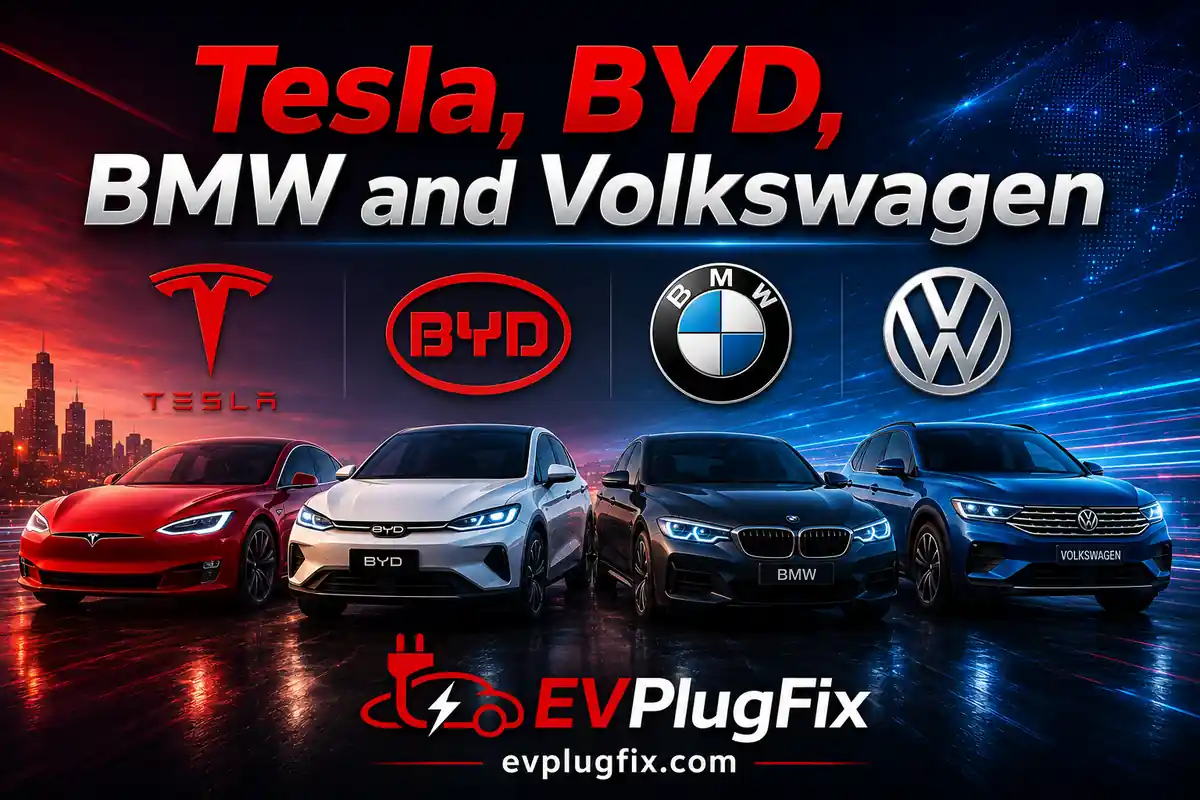
Europe’s electric-car market is becoming more competitive at both ends of the price and technology spectrum. Tesla continues to lean on efficiency, software and its charging ecosystem. BYD brings deep battery integration to a widening model range. BMW’s Neue Klasse is pushing high-voltage charging technology into the premium market, while Volkswagen is targeting smaller, more affordable EVs with its MEB+ platform.
Those strategies make the four manufacturers more interesting to compare than a simple sales ranking suggests. They are not converging on one battery chemistry, voltage architecture or charging formula. Instead, they are making different trade-offs between cost, range, charging speed, efficiency and integration.
Europe’s EV Market in 2026
Battery-electric cars continue to gain ground in the EU. According to the European Automobile Manufacturers’ Association, 1,220,890 battery-electric cars were registered during the first half of 2026. BEVs represented 20.7% of new EU car registrations, compared with 15.6% in the first half of 2025.
The wider market remains mixed. Hybrid-electric vehicles accounted for 37.3% of registrations over the same period and plug-in hybrids for 9.8%, while petrol and diesel combined fell to 29.7%. Europe is clearly electrifying, but battery-only cars are growing alongside other electrified powertrains rather than replacing them all at once.
 "Diagram showing the main forces reshaping the European EV market")
Regulation continues to shape manufacturers’ product plans. Existing EU CO2 rules set fleet-wide emissions targets for new cars and vans. In December 2025, the European Commission proposed revisions that include additional flexibility affecting 2030 compliance and, from 2035, a proposed 90% reduction in tailpipe CO2 emissions for new cars compared with the current 100% reduction requirement, alongside specified compensation mechanisms. Those changes remain a proposal and would require adoption through the legislative process before replacing current law.
Tesla vs BYD vs BMW vs Volkswagen: The Strategic Differences
The clearest dividing line is not simply range or peak charging power. Tesla’s advantage is built around ecosystem integration; BYD emphasizes battery and vehicle integration; BMW is using its new generation to pursue premium efficiency and very high charging capability; Volkswagen is trying to bring newer EV technology into smaller, lower-priced cars.
| Manufacturer | Current EV emphasis | Notable technology | Best reason to consider it |
|---|---|---|---|
| Tesla | Efficient EVs tied closely to software and charging | Supercharger integration, route planning and software updates | A tightly integrated road-trip and charging ecosystem |
| BYD | Expanding model choice backed by in-house battery expertise | LFP Blade Battery and dedicated EV platforms | Battery integration and increasingly broad European choice |
| BMW | Premium next-generation electric vehicles | Neue Klasse Gen6, 800V architecture and cylindrical cells | High-end charging, efficiency and vehicle technology |
| Volkswagen | Compact and more affordable mainstream EVs | MEB+, cell-to-pack battery system, LFP/NMC options | Lower-cost access to a modern European EV platform |
Specifications still need to be checked on the exact vehicle. A brand can sell several battery sizes, chemistries and charging configurations, and a spectacular peak charging figure does not by itself determine how quickly a car completes a real charging stop.
Tesla’s Strength Is the Ecosystem Around the Car
Tesla remains distinctive because the vehicle, navigation system and fast-charging network were developed as parts of the same ecosystem. On a long trip, the car can incorporate charging stops into route planning rather than leaving the driver to treat public charging as an entirely separate task.
European Model Y versions currently include variants with maximum Supercharging rates of up to 250 kW. Range and charging specifications differ by version, so there is little value in assigning one range or charging figure to every Tesla.
The Supercharger network itself has changed as selected European locations have opened to compatible non-Tesla vehicles. Tesla’s differentiator is therefore less about exclusive physical access than the degree of integration between its cars, navigation software and charging infrastructure. Drivers comparing networks should also consider the availability of reliable public EV charging stations along their regular routes.
Drivers who travel frequently should weigh that convenience against local purchase prices, insurance costs, service access and the charging alternatives available on their normal routes.
BYD Brings the Battery Business Into the Car Business
BYD competes from a different position because battery production is a major part of its wider business. Its Blade Battery uses lithium iron phosphate chemistry, or LFP, and has become one of the company’s defining EV technologies.
LFP cathodes avoid nickel and cobalt and offer useful thermal-stability characteristics, although their energy-density trade-offs differ from nickel-rich battery chemistries. BYD also promotes the Blade Battery’s performance in demanding safety tests. Those claims should not be interpreted to mean that any battery is immune to failure: pack structure, thermal management, crash protection and control systems remain important parts of vehicle safety.
In Europe, BYD’s significance increasingly comes from the variety of vehicles around that battery expertise. Models including the Dolphin Surf, Atto 2, Seal, Seal U and Sealion 7 cover markedly different segments and do not share one universal charging specification.
This makes BYD particularly interesting for shoppers comparing battery approach and price, but the final decision still depends on the chosen model’s range, charging performance and local sales and service network.
BMW Neue Klasse Pushes Charging at the Premium End
BMW’s Neue Klasse represents the sharpest architectural change of the four strategies. Its sixth-generation eDrive technology moves to an 800V electrical system and newly developed cylindrical battery cells.
BMW specifies up to 400 kW DC charging for the Neue Klasse iX3 50 xDrive and a WLTP range of 679 to 805 km, depending on configuration. Under suitable conditions, BMW says the vehicle can add up to 372 km of WLTP range in ten minutes.
Those are manufacturer specifications rather than independent charging-test results, but they illustrate BMW’s target: combine long range with short high-power charging stops in a premium vehicle. The relevant comparison is the complete charging curve, efficiency and journey time, not the 800V label in isolation.
Volkswagen’s ID. Polo Targets a Different Problem: Price
Volkswagen is aiming further down the market with the ID. Polo. The compact EV uses the upgraded MEB+ architecture and a cell-to-pack battery system, with different battery chemistries offered according to version.
The model has a 37 kWh net LFP battery option and a 52 kWh net NMC battery. Volkswagen says the larger battery can provide up to 454 km of WLTP range and charge from 10% to 80% in about 24 minutes under suitable DC charging conditions. AC charging is rated at up to 11 kW.
Price is central to the proposition. In Germany, Volkswagen lists the entry-level ID. Polo Trend with the 37 kWh battery from €24,995; pricing and availability vary by market.
That puts Volkswagen’s engineering priorities in useful perspective. The ID. Polo is not intended to beat a premium Neue Klasse BMW in a peak-power contest. Its appeal rests on bringing a modern EV platform, practical charging and usable range to a lower price point.
Charging Technology: The Differences That Matter
The four strategies also show why 800V should not be treated as a new minimum specification. Higher voltage allows a given amount of power to be transferred at lower current, which can help reduce resistive losses and support very high charging rates when the battery, electronics and charger are designed for them.
Yet a well-optimized lower-voltage EV can still be an excellent long-distance car. What matters on the road is how efficiently the vehicle uses energy and how quickly it moves through a useful charging window. Battery preconditioning, temperature, state of charge and the power available from the charging station can all change the result.
European connector standardization makes cross-brand charging simpler. For covered publicly accessible light-duty infrastructure, EU technical requirements center mainstream AC charging on Type 2 and DC charging on CCS Combo 2. There is a low-power AC exception: certain charging points at or below 3.7 kW whose primary purpose is Mode 2 charging may use IEC 60884 socket outlets instead.
For mainstream European EV buyers, the practical compatibility takeaway is simple: Type 2 AC and CCS Combo 2 DC remain the key interfaces to check.
Home Charging Can Matter More Than Peak DC Power
Drivers who charge at home may rarely use their vehicle’s maximum DC capability. A model with an 11 kW onboard AC charger, for example, can use that rate only when the wallbox, household supply and installation can also support it. Where electrical capacity is limited, a lower charging rate or dynamic load balancing may be more appropriate.
This is another reason to compare Tesla, BYD, BMW and Volkswagen according to actual use. A commuter who normally replenishes the battery overnight has different priorities from someone regularly covering hundreds of motorway kilometres in a day. A broader home EV charging guide can help match charging power to the vehicle, property supply and daily mileage.
Which Strategy Fits Which EV Buyer?
None of the four manufacturers has a universal advantage, but their current strategies line up with distinct priorities.
- Tesla: strongest case for drivers who value integrated navigation, charging and vehicle software, particularly on frequent longer journeys.
- BYD: worth close attention for buyers interested in LFP battery technology, vertical integration and an expanding range of models at different price points.
- BMW: the technology-led choice among these four for buyers prioritizing premium vehicles, long range and very high charging capability through the Neue Klasse generation.
- Volkswagen: increasingly relevant to buyers whose priority is a smaller, more affordable European EV rather than maximum charging power.
Urban buyers should put dimensions, efficiency, price and access to overnight charging near the top of the list. Frequent motorway drivers have more reason to examine charging curves, route planning and rapid-charger coverage. In either case, the exact model and battery version matter more than a manufacturer-wide headline specification.
What Europe’s EV Transition Does Not Mean
The growing sophistication of EV technology does not mean every manufacturer is heading toward identical hardware. There is no requirement for every European passenger EV to use an 800V architecture, and different battery chemistries are likely to coexist as manufacturers balance cost, energy density, durability and performance.
Solid-state batteries are also not guaranteed to replace conventional lithium-ion technology on a fixed timetable after 2030. Commercialization depends on manufacturing scale, cost and the applications in which the technology proves competitive.
Similarly, vehicle-to-grid capability is developing without being a universal feature of every new EU passenger EV. Bidirectional operation depends on compatible vehicles, chargers, communication protocols and electricity-market arrangements. Megawatt Charging System technology, meanwhile, is primarily aimed at heavy-duty electric transport rather than ordinary passenger cars.
Essential Questions & Expert Answers
What share of new EU cars are fully electric in 2026?
Battery-electric vehicles accounted for 20.7% of new EU car registrations in the first half of 2026, according to ACEA, up from 15.6% in the first half of 2025.
Do I need an 800V EV for fast charging in Europe?
No. Lower-voltage and 800V-class EVs can both support rapid DC charging. An 800V architecture can facilitate very high charging rates, but journey performance also depends on efficiency, battery temperature, the charging curve and available charger power.
Does Europe use CCS2 for DC charging?
CCS Combo 2 is the central interoperable DC interface specified for covered light-duty public charging infrastructure under EU requirements. Type 2 is the mainstream AC interface, with a regulatory exception allowing IEC 60884 sockets for certain AC charging points at or below 3.7 kW whose primary purpose is Mode 2 charging.
Is BYD’s Blade Battery safer than every other EV battery?
No reliable blanket ranking can be made from battery chemistry alone. BYD promotes the thermal stability and safety-test performance of its LFP Blade Battery, but overall vehicle battery safety also depends on pack construction, thermal management, crash protection and control systems.
Is BMW moving to 800V EV technology?
Yes. BMW’s sixth-generation eDrive technology for Neue Klasse uses an 800V architecture. BMW specifies up to 400 kW DC charging for the Neue Klasse iX3 50 xDrive.
How much does the Volkswagen ID. Polo cost?
In Germany, Volkswagen lists the entry-level ID. Polo Trend with its 37 kWh battery from €24,995. Prices, specifications and availability can differ in other European markets.
Is Volkswagen abandoning MEB?
No. The ID. Polo uses Volkswagen’s evolved MEB+ architecture. Newer vehicle architectures can be introduced alongside MEB-based products rather than immediately replacing the entire electric range.
Bottom Line
Europe’s EV competition is becoming more useful for buyers precisely because manufacturers are taking different routes. Tesla is strongest when software and charging integration are priorities. BYD brings battery expertise and vertical integration. BMW’s Neue Klasse pushes high-voltage charging and premium EV technology, while Volkswagen is applying its MEB+ platform to the affordability challenge.
None of those approaches makes every competing vehicle obsolete. A buyer who mostly charges overnight may value Volkswagen’s lower-cost compact strategy more than a 400 kW charging peak. A frequent motorway traveller may put much more weight on Tesla’s charging ecosystem or BMW’s next-generation charging performance. BYD adds another competitive route through battery integration and a rapidly broadening vehicle range.
The useful question is therefore not which manufacturer has won Europe’s EV transition. It is which combination of price, efficiency, range, charging performance and infrastructure best matches the journeys the car will actually make.
Source Transparency
This article was checked against information available in August 2026. EU registration figures come from the European Automobile Manufacturers’ Association. Charging connector requirements were checked against the consolidated EU Alternative Fuels Infrastructure Regulation. Current vehicle CO2 rules and the December 2025 proposal for changes to the post framework were checked against the European Commission.
Vehicle and technology specifications were taken from manufacturer information, including Tesla, BYD Europe, BMW Group and Volkswagen Newsroom. Manufacturer performance figures are presented as manufacturer specifications rather than independent test results. Prices, availability, charging specifications and regulatory proposals can change by market and over time.