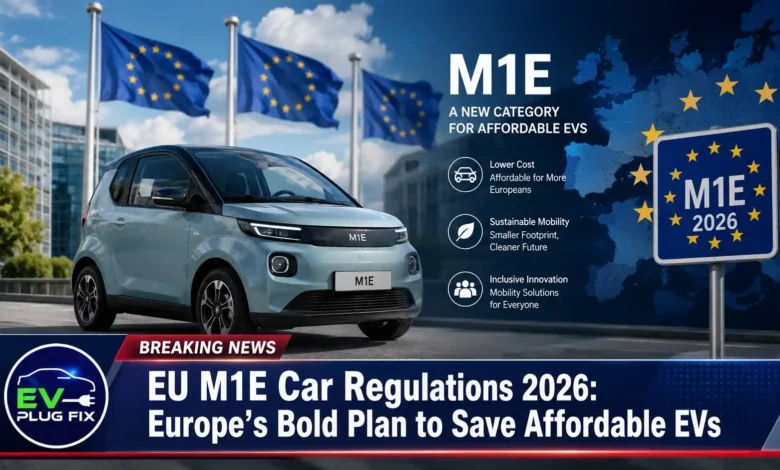
Europe’s M1E initiative is designed to improve the economics of small electric cars, but it is not yet a finished set of EU rules. The European Commission introduced the new vehicle subcategory in December 2025 as part of a wider automotive package, and the relevant legislation was still under negotiation as of August 2026.
The core definition is simple: an M1E vehicle would be a pure-electric M1 passenger car no longer than 4.2 metres. Separate measures would give qualifying EU-made small zero-emission cars additional weight in manufacturers’ fleet CO2 calculations.
Those two elements are easy to confuse. Being short enough for M1E does not automatically mean a car must be built in Europe, while the proposed EU-production conditions apply to the separate CO2 incentive. Nor does M1E establish a €15,000 statutory price.
What Is the M1E Electric Car Category?
M1E would sit within the existing M1 passenger-car classification. Under the Commission’s proposed amendment to Regulation (EU) 2018/858, an M1E vehicle is defined by two main characteristics: it must be a pure-electric M1 passenger car and its length must not exceed 4.2 metres.
| Issue | Commission proposal |
|---|---|
| Vehicle type | Pure-electric M1 passenger car |
| Maximum length | 4.2 metres |
| EU production required for M1E classification? | No, not under the basic size-based definition |
| EU production relevant to the CO2 incentive? | Yes |
| Super-credit value | 1.3 vehicles for qualifying EU-made small zero-emission cars, through 2034 |
| Status in August 2026 | Still going through the EU legislative process |
The classification is therefore broader than many headlines suggest. It does not contain a €15,000 price ceiling, and EU assembly is not part of the basic M1E definition.
Why the EU Wants a Separate Category for Small EVs
The policy addresses a problem that has become increasingly visible in Europe’s new-car market: building genuinely inexpensive small cars while meeting modern regulatory requirements can be difficult to make commercially attractive.
Costs associated with safety systems, cybersecurity, software, type approval and other requirements are easier to absorb in a high-priced vehicle than in an entry-level city car. Manufacturers have also increasingly concentrated on larger vehicles that can support higher margins.
The Commission’s impact assessment highlighted the limited choice at the affordable end of the electric-car market. In its assessment of the 4.2-metre threshold, it identified only 12 battery-electric models of that size priced below €25,000 before purchase incentives. Buyers comparing today’s lower-cost options can also see how this segment currently looks among affordable electric cars under €30,000.
A dedicated M1E category would give policymakers a defined group of compact EVs that could be considered for targeted regulatory treatment or incentives. That should not be read as a blanket exemption from modern vehicle-safety requirements. Any simplification would still need to be specified through the relevant legislation and technical rules.
M1E is also different from Japan’s kei-car system. A European EV measuring up to 4.2 metres can be substantially larger than a kei car and would remain an M1 passenger vehicle.
How the 1.3 M1E Super Credit Would Work
A separate amendment to the EU’s passenger-car CO2 standards would provide the most significant manufacturer incentive associated with the new category.
Under the Commission text, each qualifying small zero-emission M1 vehicle that meets the M1E definition and is made in the EU would count as 1.3 vehicles when calculating a manufacturer’s average specific CO2 emissions. The mechanism is intended to run through 2034.
This is an accounting benefit rather than a direct payment to the manufacturer or customer. Giving qualifying small EVs additional weight in fleet-emissions calculations could make developing, producing and selling them more attractive to carmakers.
What Would Count as “Made in the EU”?
The production test goes beyond final assembly. Under the Commission’s March 2026 Industrial Accelerator Act proposal, an M1E vehicle seeking the associated EU-made benefit would need to be assembled in the European Union and satisfy an additional sourcing condition.
The proposed criteria require EU assembly plus either:
- at least 70% of the ex-works value of non-battery vehicle components to originate in the EU; or
- a traction battery containing at least three specified main battery components originating in the EU, including the battery cells.
The practical effect is that the incentive is aimed not only at European final assembly but also at supporting more of the vehicle and battery supply chain within the EU.
A China-built electric car could still fit the basic M1E size definition if it is a pure-electric M1 car no longer than 4.2 metres. What it would not satisfy is the EU-assembly condition attached to the 1.3 super credit. The distinction is therefore between vehicle classification and eligibility for the manufacturing incentive, rather than a nationality-based ban on the M1E category itself. That distinction also matters when considering Chinese electric car pricing and the different market conditions inside and outside the EU.
Will M1E Create €15,000 Electric Cars?
M1E does not impose a €15,000 maximum retail price. Discussions about electric cars in the €15,000 to €20,000 range reflect the wider political and industry objective of restoring genuinely affordable vehicles to the European market, not a price written into the M1E definition.
The policy could help reduce some of the economic disadvantages of producing smaller EVs by enabling regulatory simplification, targeted national incentives and the proposed manufacturer super credit. Retail pricing will still depend on battery costs, component sourcing, labour, production volumes, equipment levels, taxes and individual manufacturers’ strategies.
For buyers, the important point is that M1E may encourage more competition among compact EVs, but a particular showroom price cannot be inferred from the vehicle category alone.
Which Existing EVs Are Short Enough?
Several current European electric cars illustrate the type of vehicle covered by a 4.2-metre dimensional limit.
| Model | Approximate length | What the dimension tells us |
|---|---|---|
| Renault 5 E-Tech Electric | About 3.92 m | Within the proposed 4.2 m limit |
| Citroën ë-C3 | About 4.02 m | Within the proposed 4.2 m limit |
| Fiat Grande Panda Electric | About 4.0 m | Within the proposed 4.2 m limit |
| Peugeot E | About 4.06 m | Within the proposed 4.2 m limit |
Length alone does not establish final M1E status or eligibility for the 1.3 super credit. A vehicle would still need to meet the relevant legal definition, while access to the manufacturing incentive would depend on the separate EU-production criteria.
Stellantis E-Car as a Real-World Example
Stellantis’ E-Car project shows how manufacturers are already responding to Europe’s push for smaller, less expensive EVs. The company announced the programme in May 2026 and said production is expected to begin in 2028 at its Pomigliano d’Arco plant in Italy, with vehicles planned for multiple Stellantis brands.
Stellantis did not confirm a €15,000 production price, specific Fiat Panda or Citroën 2CV nameplates, or Leapmotor as the technology partner in that announcement. The project is therefore relevant as an example of the industry’s direction, rather than proof of a particular future M1E model or price.
Could Member States Offer Special M1E Incentives?
A formal M1E definition could give governments a convenient way to target support specifically at compact electric cars. The Commission’s impact assessment envisages the possibility of fiscal and non-fiscal measures at EU or national level, subject to applicable rules including state-aid requirements.
That could eventually lead to incentives designed around vehicle size or category, but the M1E label would not by itself create an automatic entitlement to a purchase grant, cheaper charging, toll exemptions or preferential road access.
Any buyer benefit would depend on the separate programmes introduced by individual member states or at EU level.
What Happens Next?
The M1E definition, the 1.3 CO2 mechanism and the origin rules sit across several legislative files. The Commission introduced the M1E measure in December 2025, while Council discussions during 2026 showed that member states were still examining the new category and possible changes.
For buyers, three developments matter most: the final wording adopted by EU lawmakers, any national incentive schemes that use the M1E category, and actual small-EV announcements from manufacturers.
If the measures survive negotiations broadly in their current form, they could improve the commercial case for compact EVs made in Europe. Whether that translates into significantly cheaper cars will depend on manufacturers as much as regulators and on the wider European EV market.
FAQ
Is M1E already an official EU vehicle category?
Not yet. The European Commission introduced the M1E legislation in December 2025, and as of August 2026 it had not completed the EU legislative process.
What is the M1E size limit?
The Commission text defines an M1E vehicle as a pure-electric M1 passenger car no longer than 4.2 metres.
Does an M1E car have to be made in Europe?
Not for the basic M1E classification. EU production becomes relevant to the separate proposed 1.3 CO2 super-credit mechanism, which includes additional origin requirements.
Bottom Line
The EU’s M1E initiative would create a distinct category for pure-electric passenger cars up to 4.2 metres long. Its purpose is to give European policymakers a clearer basis for supporting compact EVs, while a separate 1.3 super-credit mechanism would strengthen the incentive to manufacture qualifying vehicles in the EU.
It does not guarantee a €15,000 electric car, and being under 4.2 metres does not by itself make a vehicle eligible for every related incentive. The next things to watch are the final legislative wording, the national support schemes that may use the category and confirmed small-EV product plans from manufacturers.
Source Transparency
This article is based primarily on European Commission legislative proposals and supporting documents, including COM(2025) 993 on automotive technical simplification, the Commission’s impact assessment SWD(2025) 1056, the proposed amendments to Regulation (EU) 2019/631 covering small-EV super credits, and the 2026 Industrial Accelerator Act proposal covering EU-origin criteria. Council legislative documents were checked to establish the proposal’s status during 2026.
Stellantis information about the E-Car project, including the planned 2028 start of production at Pomigliano d’Arco, comes from the company’s May 2026 announcement. Manufacturer plans are identified as such and should not be read as independently verified guarantees of future specifications, model names, prices or launch dates. Policy details in this article reflect the position available in August 2026 and may change as the EU legislative process continues.