
Installing an 11 kW or 22 kW EV wallbox does not mean your home can safely deliver that power whenever the car asks for it. An oven, heat pump, water heater and other high-load appliances may already be consuming much of the property’s available electrical capacity.
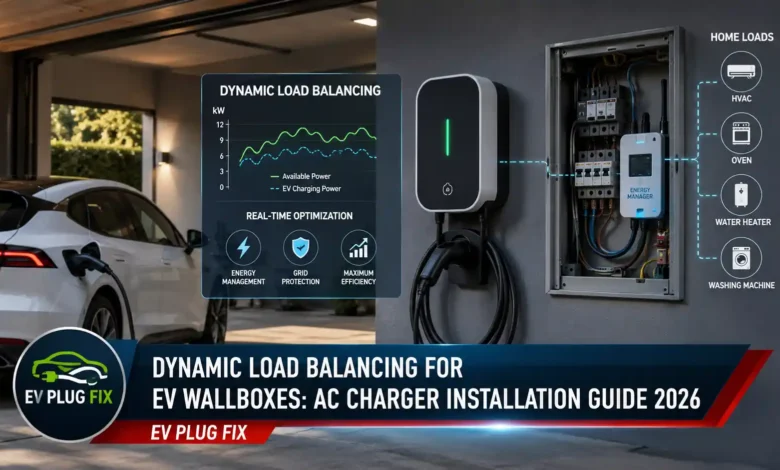
Dynamic load balancing (DLB) addresses that problem by monitoring household demand and automatically adjusting EV charging current to stay within a configured electrical limit. When household demand rises, charging power falls. When capacity becomes available again, charging power can increase.
For many homeowners, that makes load balancing more important than simply choosing the wallbox with the highest advertised kW rating.
Dynamic load balancing is particularly valuable when the electrical service has enough capacity for EV charging most of the time but cannot safely support the charger’s maximum output alongside every household load. It can help make better use of existing capacity, but it should not be presented as a guaranteed substitute for an electrical upgrade. The correct solution depends on the property’s supply, maximum demand, wiring, protective devices, charger and local electrical requirements.
What Is Dynamic Load Balancing for an EV Charger?
A conventional EV charger can operate at a configured current limit without knowing how much electricity the rest of the property is consuming.
A charger with dynamic load balancing adds another layer of information: real-time or near-real-time measurement of the property’s electrical load.
The system then determines how much capacity remains available for the EV.
A simplified example looks like this:
Available EV charging capacity = configured household limit − other household load
Suppose a single-phase installation has a hypothetical 60 A operating limit and household appliances are drawing 25 A.
The theoretical remaining capacity is:
60 A − 25 A = 35 A
If the charger has been configured for a maximum of 32 A, it could potentially charge at its full configured current.
If household demand then rises to 45 A:
60 A − 45 A = 15 A
The charging system can reduce EV current rather than continuing to request 32 A.
This is a simplified EV Plug Fix illustration. Actual configuration must include the system’s protection strategy, safety margins, phase arrangement, charger limits and applicable electrical requirements.
Why Dynamic Load Balancing Matters
EV charging introduces a large electrical load that can remain active for hours.
At the same time, modern homes may have several substantial loads:
- electric ovens and hobs;
- heat pumps;
- electric water heating;
- air conditioning;
- clothes dryers;
- electric space heating;
- solar and battery systems; and
- other high-power appliances.
These appliances do not necessarily operate at maximum power simultaneously. That creates an opportunity for a smart charger to use otherwise-unused capacity dynamically instead of permanently reserving the charger’s maximum possible current.
Static Current Limit vs Dynamic Load Balancing
| Feature | Static Charging Limit | Dynamic Load Balancing |
|---|---|---|
| EV current | Fixed/configured limit | Changes with available capacity |
| Monitors household demand | No | Yes |
| Responds to appliance loads | No | Yes |
| Can reclaim unused capacity | Limited | Yes |
| Complexity | Lower | Higher |
| Sensor/meter required | Usually no | Typically yes |
Dynamic Load Balancing Does Not Create More Electrical Capacity
This is the most important limitation to understand.
DLB cannot turn a constrained electrical supply into a larger one.
Instead, it manages when and how much of the existing capacity the EV can use.
If household demand leaves 20 A available, a 32 A charger cannot safely obtain 32 A simply because dynamic load balancing is installed. The system’s job is to reduce charging demand accordingly.
This is why claims that load balancing automatically “eliminates panel upgrades” are too broad.
When DLB Can Help Avoid an Upgrade
It may help when:
- the existing electrical service has useful spare capacity during much of the day;
- maximum household and EV loads do not need to operate simultaneously;
- the existing installation is otherwise suitable;
- the charger can modulate its charging current appropriately; and
- the installation complies with applicable electrical requirements.
When an Electrical Upgrade May Still Be Needed
An upgrade or other electrical work may still be necessary when:
- the existing supply is already heavily constrained;
- wiring or protective devices are unsuitable;
- the charging circuit cannot support the required load;
- the property needs additional capacity for other electrification projects;
- local rules require modifications; or
- the desired charging performance cannot be achieved within existing limits.
Think of dynamic load balancing as a capacity-management tool, not a capacity-creation tool. It can help you use an existing electrical supply more intelligently, but it cannot correct an undersized or unsafe installation.
How Does an EV Charger Measure Household Load?
Load-balancing systems need measurement data before they can make charging decisions.
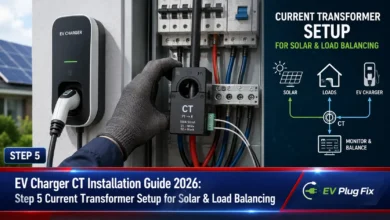
The exact architecture varies by manufacturer, but common approaches use an energy meter and/or current transformers (CTs) installed at an appropriate point in the electrical system.
The measurement system communicates load information to the charger or energy-management controller, which then adjusts EV charging current.
CT Clamp Load Balancing Explained
A current transformer can measure electrical current without placing the full load through the measurement electronics.
In a home EV charging installation, appropriately positioned CT sensors can provide information about current flowing through the incoming supply or individual phases.
Feyree, for example, currently publishes Type 2 wallbox configurations where CT-based measurement communicates with the charger over RS485. Its documentation states that the charger can reduce output as household demand increases and restore charging power as capacity becomes available.
Basic CT-Based DLB Flow
Household load changes → CT measures current → data reaches wallbox → charger recalculates available capacity → EV current adjusts.
This feedback loop continues while the vehicle is charging.
Energy Meter vs CT Clamp: Are They Really Two Different DLB Strategies?
“Meter-based” and “CT clamp-based” DLB are not always completely separate categories because an energy meter may itself obtain current measurements through CTs.
A more useful distinction for buyers is to examine the complete measurement architecture.
| Question | Why It Matters |
|---|---|
| Where is current measured? | Determines which loads are visible to the system |
| Is each phase measured? | Important for three-phase installations |
| What device performs measurement? | Could be an energy meter, CT interface or another controller |
| How does data reach the charger? | Can affect reliability and installation complexity |
| What happens if communication fails? | Critical fail-safe behavior should be known |
| How quickly does charging respond? | Important when large household loads switch on suddenly |
Buying rule: Do not choose a charger simply because the product page says “CT” or “smart meter.” Ask what is measured, where it is measured and what the charger does with that measurement.
Single-Phase Dynamic Load Balancing
Single-phase DLB is relatively straightforward conceptually.
The system monitors the relevant household load and changes the EV charging current so that the configured limit is not exceeded.
Consider a hypothetical charger capable of 32 A:
| Other Household Load | Configured Limit | Theoretical Capacity Remaining |
|---|---|---|
| 15 A | 60 A | 45 A |
| 30 A | 60 A | 30 A |
| 45 A | 60 A | 15 A |
| 55 A | 60 A | 5 A |
If available capacity falls below the charger’s supported minimum charging current, the system may pause charging rather than continue reducing current.
For example, Feyree’s current Type 2 DLB product information states that charging pauses when available capacity falls below 8 A and can resume when sufficient capacity returns.
That behavior is product-specific and should not be assumed for every dynamic load-balancing charger.
Three-Phase Dynamic Load Balancing Is More Complicated
Three-phase charging introduces another issue: total household power alone may not tell the full story.
Individual phases can carry different loads.
For example:
| Phase | Household Load |
|---|---|
| L1 | 18 A |
| L2 | 31 A |
| L3 | 12 A |
If a three-phase EV charger adds equal current to all three phases, L2 may become the limiting phase even though L1 and L3 have considerably more spare capacity.
A well-designed three-phase DLB strategy therefore needs to account for phase loading appropriately rather than looking only at one aggregate number.
Feyree Plan A and Plan B: What Do They Actually Do?
Feyree’s current Taurus Type 2 DLB documentation describes two approaches for its three-phase wallboxes.
Plan A: Control Based on the Most Heavily Loaded Phase
Under the current published Plan A logic, L1, L2 and L3 are monitored individually. The most heavily loaded phase becomes the limiting reference used to control charging current.
This is useful when household loading is uneven across phases because the charger cannot simply assume that all phases have identical spare capacity.
Plan B: Three-Phase Total-Current Management
Feyree also documents a Plan B for three-phase installations that evaluates the combined current across the three phases against a configured household-current value.
| Feyree DLB Mode | Control Concept | Potential Use |
|---|---|---|
| Plan A – Single Phase | Available current on single-phase supply | Single-phase home charging |
| Plan A – Three Phase | Monitors phases individually; most-loaded phase constrains charging | Three-phase homes with uneven phase loading |
| Plan B – Three Phase | Controls against combined three-phase current | Installations where aggregate current management is appropriate |
These are Feyree-specific operating modes, not universal industry definitions of “Plan A” and “Plan B.” Another charger manufacturer may use completely different terminology.
How Feyree’s Dynamic Load Balancing Works
Feyree currently offers Type 2 DLB wallboxes in 7.6 kW single-phase, 11 kW three-phase and 22 kW three-phase configurations. Its product information describes adjustable charging output, CT/energy-meter measurement and RS485 communication between the measurement hardware and wallbox.
The basic operating sequence is:
- Measurement hardware monitors household current.
- Load data is transmitted to the wallbox.
- The charger calculates how much current is available within its configured limit.
- Charging current is reduced when household demand rises.
- Charging power can increase again when demand falls.
- If insufficient capacity remains, supported configurations can pause charging.
This is fundamentally different from manually configuring a wallbox at a permanently low current.
With DLB, the goal is to use more available capacity when conditions permit without maintaining that higher charging load when the house needs the capacity elsewhere.
7.6 kW vs 11 kW vs 22 kW: Which Wallbox Makes Sense?
A larger wallbox rating does not automatically mean faster real-world charging.
| Wallbox Class | Typical Electrical Configuration | Key Question |
|---|---|---|
| ~7 kW / 7.6 kW | Single phase, up to around 32 A depending on market/model | Can the home supply sustain the required single-phase current? |
| 11 kW | Three phase, typically 16 A per phase | Does the EV support 11 kW three-phase AC charging? |
| 22 kW | Three phase, typically 32 A per phase | Can both the installation and vehicle use 22 kW AC? |
Feyree’s current Type 2 DLB range includes these three configurations.
However, installing a 22 kW wallbox does not make an EV with an 11 kW onboard AC charger charge at 22 kW.
The vehicle’s onboard charger remains one of the limiting factors.
DLB Can Make a Higher-Rated Wallbox Useful Even When Full Power Isn’t Always Available
This is one of the strongest arguments for dynamic load balancing.
Suppose a home has enough spare capacity for 11 kW EV charging overnight but not while cooking, heating and other appliances are running.
Without dynamic management, the installer might need to configure the charger at a conservative fixed limit.
With properly implemented DLB, the charger can potentially:
- reduce power during high household demand;
- recover additional charging capacity when appliances switch off; and
- use higher charging power during low-demand periods.
This does not guarantee that the EV always receives maximum wallbox power. It allows the charger to make better use of capacity that would otherwise remain unused.
Will Dynamic Load Balancing Stop Breaker Trips?
Preventing overload-related tripping is one of DLB’s core purposes, but the wording matters.
A properly configured system can reduce EV charging load as total electrical demand approaches its configured limit.
That does not mean DLB can prevent every breaker trip.
A breaker can trip because of:
- overcurrent;
- short circuits;
- earth/leakage faults;
- equipment failure;
- incorrect installation;
- incorrect protection selection; or
- other electrical problems.
Dynamic load balancing addresses load management. It is not a substitute for the rest of the electrical protection system.
Does DLB Replace RCD and DC Leakage Protection?
No.
Load balancing and fault protection perform different jobs.
| Function | Purpose |
|---|---|
| Dynamic Load Balancing | Controls charging demand relative to available electrical capacity |
| Overcurrent Protection | Protects circuits against excessive current under defined fault/overload conditions |
| Residual-Current Protection | Provides protection associated with leakage/fault current |
| DC Leakage Detection | Addresses DC residual-current considerations relevant to EV charging architecture |
The exact protection architecture must be verified for the charger and installation rather than inferred from the presence of DLB.
For a broader comparison, see our EV Charger Safety guide.
Be Careful With “Type B RCD” Marketing Claims
Marketing descriptions such as “AC 30 mA + DC 6 mA” should not automatically be treated as proof of a particular Type B RCD architecture or as a universal installation requirement.
Different EVSE designs can implement residual-current protection differently, and upstream protective-device requirements depend on the equipment, manufacturer’s instructions and applicable installation rules.
Before purchasing a wallbox, verify:
- the exact integrated residual-current protection;
- DC residual-current detection specifications;
- required upstream RCD type;
- required overcurrent protection;
- manufacturer wiring instructions; and
- local electrical-code requirements.
Do not choose or omit an upstream RCD simply because a product page uses the words “Type B.”
IP65 and IP66: What the Rating Tells You
Many wallboxes intended for outdoor mounting advertise IP65 or IP66 enclosure ratings.
Feyree currently lists IP66 on its Gemini Type 2 DLB wallboxes, while other models within its broader charging range can use different enclosure specifications.
Ingress protection is useful, but it should not be interpreted as a universal environmental guarantee.
Before outdoor installation, verify:
- the exact charger’s IP rating;
- whether the rating applies to the complete installed assembly;
- cable-entry requirements;
- operating-temperature range;
- mounting orientation;
- drainage and exposure conditions; and
- manufacturer installation instructions.
Dynamic Load Balancing vs Solar Surplus Charging
These features are related but not identical.
Dynamic load balancing primarily manages EV charging against an electrical-capacity constraint.
Solar surplus charging attempts to adjust EV charging according to excess photovoltaic generation.
A charger may support one, both or neither.
If you have solar panels—or expect to install them later—do not assume a DLB label automatically means the charger can intelligently follow solar export.
Dynamic Load Balancing vs Scheduled Charging
Scheduling is another feature that should not be confused with DLB.
A scheduled charger might begin charging at midnight because electricity is cheaper then.
A dynamically balanced charger changes charging power according to available electrical capacity.
A smart charging system can potentially use both:
Schedule = when to charge.
DLB = how much power can safely be allocated at that moment.
Our guide to off-peak EV charging explains the cost side of scheduled charging.
Can DLB Manage Two or More EV Chargers?
Possibly—but this requires another distinction.
Home load balancing between a charger and the building is not necessarily the same thing as load sharing among multiple chargers.
A multi-EV installation may need to decide both:
- how much total capacity is available for EV charging; and
- how that EV capacity is divided among connected vehicles.
For example, if 24 A is available for EV charging and two cars are connected, the system needs a strategy for distributing that 24 A.
It might divide current equally, prioritize one charger, use departure times, or apply another rule.
A wallbox advertising household DLB should therefore not automatically be assumed to support coordinated management of dozens of chargers.
“Dynamic load balancing” can describe different capabilities. Ask whether the product manages one charger against household load, shares capacity among multiple chargers, responds to solar generation, or combines these functions.
Why the “50 EVs on a 63 A Connection” Claim Needs Context
Claims that a 63 A connection can support very large numbers of EV charge points need substantial context.
That type of statement is misleading without specifying charging demand, dwell time, minimum current, diversity, scheduling strategy and whether all vehicles need to charge simultaneously.
Load management can allow a constrained electrical connection to support more charge points than could operate simultaneously at full rated power, but it cannot create energy or unlimited charging capacity.
If many vehicles share a limited supply, each vehicle may receive less power or wait until capacity becomes available.
For multi-unit residential buildings and fleets, the correct design question is therefore not:
“How many chargers can this connection support?”
It is:
“Can the available energy deliver the required miles to the required vehicles before their departure times?”
A Practical DLB Sizing Framework
Before choosing a load-balancing wallbox, evaluate these six layers.
| Layer | Question |
|---|---|
| 1. Electrical supply | Single phase or three phase, and what capacity is actually available? |
| 2. Household demand | Which loads can operate while the EV is charging? |
| 3. Vehicle | What AC charging power can the EV accept? |
| 4. Wallbox | What current range and DLB behavior does it support? |
| 5. Measurement | How and where is household current measured? |
| 6. Installation | What protection and wiring are required locally? |
Should You Pay Extra for Dynamic Load Balancing?
DLB provides the most value when electrical capacity is constrained or household loads vary substantially.
DLB Is Particularly Worth Considering If:
- you have several high-power electrical appliances;
- you use electric heating or a heat pump;
- you want higher EV charging power without unnecessarily reserving that capacity all day;
- you have a three-phase home with uneven phase loading;
- you expect future household electrification;
- breaker trips are a concern under simultaneous loads; or
- an electrician identifies load management as a suitable alternative to other electrical work.
DLB May Provide Less Value If:
- the property already has abundant spare electrical capacity;
- the EV charges at relatively low power;
- you intentionally charge at a low fixed current overnight;
- the charger is rarely used; or
- the required measurement hardware makes the system unnecessarily complex for your installation.
Feyree Taurus and Gemini: What We Could Verify
Feyree currently publishes several wallbox families with dynamic load balancing rather than one universal DLB specification.
The company’s current Taurus Type 2 product documentation describes 7.6 kW, 11 kW and 22 kW variants and multiple DLB modes. Feyree also lists a Gemini Type 2 series with 7 kW, 11 kW and 22 kW configurations, CT measurement, RS485 communication and IP66 enclosures.
This matters because buyers should verify the exact product generation and SKU. Feyree states that its Taurus DLB hardware/software was upgraded for orders from its China warehouse beginning March 30, 2026, meaning older units may not behave identically to current versions.
Feyree DLB Readiness Check
| Feature | Publicly Documented | What to Verify Before Installation |
|---|---|---|
| Single-phase DLB | Yes | Exact measurement and current-limit configuration |
| Three-phase DLB | Yes | Plan selected and per-phase behavior |
| CT measurement | Yes on current models | CT placement and phase mapping |
| RS485 | Yes on current Type 2 DLB models | Cable routing and supported distance |
| 7/7.6 kW class | Yes | Exact voltage/current configuration |
| 11 kW | Yes | Vehicle three-phase AC capability |
| 22 kW | Yes | Vehicle and supply support |
| Outdoor enclosure | IP rating published by model | Exact SKU and complete installation conditions |
Installation Mistakes That Can Defeat Dynamic Load Balancing
Buying a DLB-capable charger does not guarantee that load balancing will work correctly after installation.
1. Incorrect CT Placement
If the sensor does not measure the loads the system expects it to measure, the charger can make decisions using incomplete information.
2. Reversed CT Orientation
Some systems depend on measurement direction. Incorrect orientation can produce incorrect import/export readings.
3. Wrong Phase Mapping
On a three-phase installation, each measurement channel must correspond correctly to its phase.
4. Incorrect Household Limit
A DLB algorithm is only as useful as its configuration. Entering an arbitrary current value instead of a professionally determined limit undermines the protection strategy.
5. Communication Failure
The charger needs a defined safe behavior if it stops receiving valid measurement data.
6. Assuming DLB Replaces Electrical Design
It does not.
The charging circuit, cable sizing, protection, earthing and other installation requirements still need to be designed correctly.
Questions to Ask Before Buying a DLB Wallbox
- Does it support my single-phase or three-phase supply?
- How is household current measured?
- Are CTs or an energy meter included?
- Does it monitor each phase separately?
- What is the minimum charging current?
- What happens when available current falls below that minimum?
- What happens if communication with the meter fails?
- Can the DLB limit be configured locally?
- Does the system require cloud connectivity?
- Does it support solar surplus charging separately?
- Can multiple chargers share one available-power budget?
- What upstream electrical protection is required?
- Which DLB functions apply to my exact SKU?
- Can my EV actually accept the charger’s maximum AC power?
If you’re planning an outdoor installation, also review the EV Plug Fix home EV charging solutions guide.
Bottom Line
Dynamic load balancing solves a real EV charging problem: the wallbox may be capable of drawing more current than the home can safely spare at every moment of the day.
Instead of permanently restricting charging to an unnecessarily low level, DLB allows compatible equipment to respond to changing household demand.
But its value should not be exaggerated.
DLB does not create electrical capacity, replace circuit protection or guarantee that an electrical upgrade will never be required.
The strongest installation starts by determining the property’s actual electrical constraints, then choosing a charger and measurement architecture that can manage those constraints correctly.
For products such as Feyree’s current Taurus and Gemini Type 2 wallboxes, the published DLB functionality—including single- and three-phase operation, CT-based measurement and configurable load-management strategies—makes them candidates for installations where capacity management is important. But the exact SKU, DLB generation, electrical protection and installation requirements should be verified before purchase.
Feyree-specific specifications in this guide are based on the manufacturer’s currently published product documentation and should be verified against the exact SKU before installation. The calculation examples, DLB sizing framework and readiness check are EV Plug Fix editorial analysis based on published information. The article does not present the referenced wallboxes as physically tested by EV Plug Fix or Feyree’s DLB hardware as independently audited. Electrical installations should be designed and completed according to applicable local requirements and manufacturer instructions.