
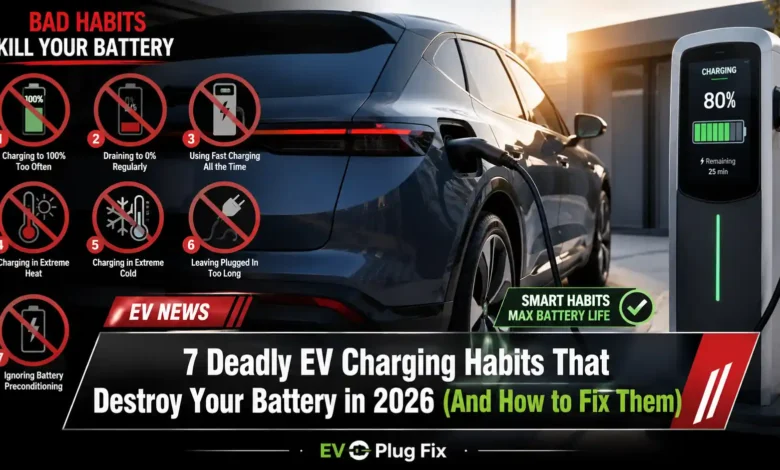
EV batteries lose some usable capacity as they age, and charging conditions can influence the rate of that degradation. Battery chemistry, temperature, charge level and the vehicle’s battery-management strategy all matter, so the best starting point is the charging guidance provided for your specific EV.
Within those manufacturer limits, a few habits are worth avoiding when convenient. The biggest concerns are prolonged time at extreme states of charge, excessive heat and repeatedly demanding high charging power when the battery is in unfavorable conditions.
1. Keeping the Battery Near Full When You Do Not Need the Range
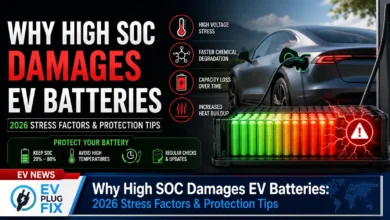
Charging to 100% for a long journey is a normal use of an EV. The less favorable habit is repeatedly keeping some lithium-ion batteries at a very high state of charge when the extra range serves no purpose.
Higher states of charge generally correspond to higher cell voltage, which can accelerate unwanted chemical reactions in many lithium-ion chemistries. Heat can make those conditions more stressful.
Manufacturer recommendations therefore vary by vehicle and battery. Some EVs recommend a lower everyday charge limit while allowing a higher target when additional range is needed. Use the daily limit shown by your vehicle rather than assuming every EV should be treated the same way. The effects of high state of charge are especially relevant when considering how long a battery remains near full.
2. Leaving the Battery at a Very Low State of Charge
EV battery-management systems maintain protective buffers, so an indicated 0% is not usually the cell’s absolute electrochemical minimum. Even so, leaving a vehicle with very little usable energy provides little advantage and reduces the margin available for unexpected driving or energy consumption while parked.
This becomes more important during extended parking because an EV may continue using small amounts of energy for battery management, connected services, security features or other electronics. Recharge before long-term parking if the battery is already very low, and follow the storage instructions in the owner’s manual.
3. Using DC Fast Charging for Routine Charging When Slower Charging Is Convenient
DC fast charging is designed into modern EVs and is valuable for road trips and for drivers who lack dependable home charging. There is no reason to fear an occasional rapid-charging session.
Higher charging currents can, however, produce more heat and electrochemical stress than lower-rate charging. Lithium plating is one concern under unfavorable combinations of high charging current, low battery temperature and cell state of charge.
The vehicle manages much of this risk by heating or cooling the pack and reducing charging power when necessary. For everyday charging, convenient AC charging is a sensible choice when it is available; a home EV charging routine can make slower charging practical for many drivers. On a trip, use DC fast charging when its speed is useful rather than following an arbitrary weekly limit.
4. Reaching a High Charge Level Long Before Departure
If you need a high charge for a trip, when the battery reaches that level can matter as much as the target itself. Charging to a high state of charge immediately before leaving is preferable to reaching the same level the previous evening and leaving the car parked there for many additional hours.
This is particularly relevant because calendar aging is influenced by both state of charge and temperature. Vehicles with scheduled charging or departure-time settings can often finish charging closer to the planned journey, reducing unnecessary time at a high state of charge without sacrificing range.
5. Storing an EV Without Following Its Storage Instructions
Long-term storage is different from ordinary overnight parking. Leaving an EV unused for weeks or months at an extreme state of charge can expose the battery to conditions that are less favorable for aging or, at the low end, leave too little reserve for normal standby consumption.
The correct storage target varies by manufacturer and battery system. Some vehicles are also intended to remain connected to power during extended storage. Before a long absence, check the owner’s manual for the recommended charge level, charging connection and any vehicle settings that should be changed.
6. Skipping Battery Preconditioning Before High-Power Charging
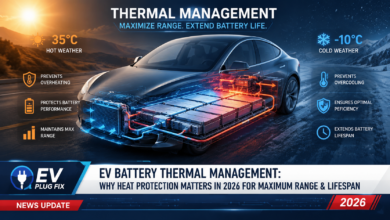
Lithium-ion batteries accept charge differently depending on temperature. A cold battery has lower charge acceptance, while excessive heat accelerates many of the chemical reactions associated with aging. The vehicle’s battery thermal management helps control these temperature-related charging conditions.
Many EVs can prepare the battery before a planned DC fast-charging stop. When supported, entering the charger as a destination in the vehicle’s navigation system can activate automatic battery preconditioning and bring the pack toward a more suitable temperature before charging begins.
There is usually no need for the driver to target a specific battery temperature or manually time the process. Let the vehicle’s thermal-management system control it according to its own design.
7. Deliberately Turning Every Charge Into a Deep Battery Cycle
Waiting until the battery is nearly empty and then charging close to full every time is unnecessary for most daily driving. Lithium-ion batteries experience cycle aging as energy moves through the cells, and the depth and conditions of those cycles can influence long-term degradation.
This does not mean owners should micromanage every percentage point or avoid using the vehicle’s available range. Deep discharges and high charges are useful when a journey requires them. For routine commuting, however, charging an electric car regularly within a comfortable portion of the usable range avoids creating deep cycles simply out of habit.
Is the 20–80% Rule Necessary?
The familiar 20–80% rule is best treated as a general battery-care shortcut rather than a requirement for every EV. Manufacturers choose different usable buffers, battery chemistries and charging strategies, so the recommended everyday limit shown by the vehicle is more useful than a percentage borrowed from another model.
LFP batteries and nickel-based lithium-ion batteries also have different characteristics and may receive different charging instructions. If your EV specifies a particular daily charge limit or periodically recommends a higher charge for battery-management purposes, follow that guidance.
What Matters Most for EV Battery Aging?
Battery degradation comes from both calendar aging, which occurs with time, and cycle aging from charging and discharging. Drivers have the most influence over a few conditions: how long the pack remains at an extreme state of charge, exposure to high temperature, the depth and frequency of charging cycles and the conditions under which high-power charging occurs.
The vehicle itself handles much of the difficult work. Its battery-management system controls charging current, protects cell-voltage limits and operates thermal-management systems where fitted. Good battery care therefore requires fewer rules than many charging myths suggest.
A Simple Charging Routine
- Use the everyday charge limit recommended for your vehicle.
- Finish high charges close to departure when the extra range is needed.
- Avoid leaving the vehicle near empty or full for extended periods when practical.
- Use battery preconditioning before fast charging when your EV supports it.
- Check model-specific instructions before storing the vehicle for weeks or months.
FAQ
Should an EV be charged to 100% once a month to calibrate the battery?
Only when the vehicle manufacturer recommends such a routine for your battery type. Battery-management, cell-balancing and state-of-charge estimation strategies differ between EVs, so a scheduled full charge that is useful for one model should not automatically be applied to another.
What charge level is best when leaving an EV parked for several weeks?
Use the storage guidance in the owner’s manual. Manufacturers may specify a moderate charge level, recommend leaving the vehicle connected to power or provide additional storage instructions. The appropriate procedure depends on the vehicle and battery system.
Is slow charging always better for an EV battery?
Slower AC charging can reduce the thermal and electrochemical demands associated with very high charging rates, making it well suited to routine home or workplace charging. That does not make DC fast charging inappropriate: modern EVs are designed to regulate rapid charging when it is needed.
Bottom Line
Protecting an EV battery does not require avoiding 100% charges or DC fast chargers altogether. More useful habits are limiting unnecessary time at very high or very low charge, avoiding needless deep cycles, using scheduled charging before trips and allowing the vehicle to prepare its battery for high-power charging.
Above all, follow the charging and storage guidance for your particular EV. Modern battery-management systems handle most of the technical protections automatically, leaving the driver to concentrate on a few sensible habits rather than constantly managing individual percentage points.
Source Transparency
This guide distinguishes established lithium-ion aging mechanisms from model-specific charging recommendations. Battery chemistry and vehicle software vary, so manufacturer instructions take priority over generalized charging rules.
Technical background was checked against research and guidance from the U.S. Department of Energy, the National Renewable Energy Laboratory and the DOE Office of Scientific and Technical Information concerning lithium-ion degradation, temperature, charging rates and lithium plating. Manufacturer-specific guidance was checked against Tesla’s Model 3 owner’s information, Tesla’s battery and range guidance and Ford’s Mustang Mach-E charging guidance.