
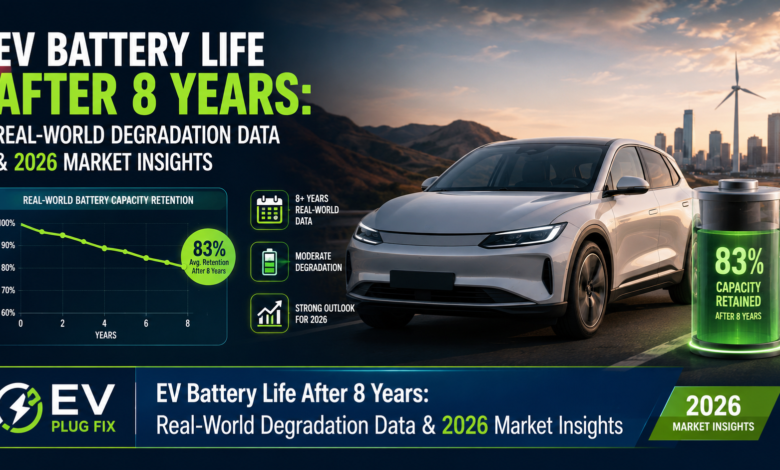
Eight years is an important age for an electric vehicle, but mainly because it coincides with a common battery-warranty period in the U.S. It is not an expiration date for the traction battery. Battery capacity normally declines gradually, with the rate depending on the vehicle, battery design, temperature, charging behavior and use.
The practical takeaway is more reassuring than the eight-year milestone may suggest. Large-scale fleet data indicates that many properly functioning EV batteries can still retain roughly four-fifths or more of their original usable capacity around this age, although individual results vary substantially.
Geotab published an updated battery-health article in 2026 based on its expanded 2025 analysis of more than 22,700 EVs across 21 models. The analysis reported average degradation of 2.3% per year. A simple projection of that fleet average gives about 81.6% state of health after eight years. That is a useful benchmark, not a prediction for a particular car.
What the Real-World Battery Data Shows
Battery degradation describes a reduction in the amount of usable energy a pack can store compared with when it was new. A battery at 82% state of health, for example, retains roughly 82% of its original usable energy capacity.
Its available range would generally be expected to be lower than when the vehicle was new, but capacity loss does not translate perfectly into the same percentage of range loss. Software buffers, vehicle efficiency, temperature, power limitations, tire condition, driving speed and other forms of vehicle aging can all affect real-world range.
Geotab’s expanded analysis provides useful context for how operating conditions can change the degradation rate:
| Operating group | Average annual degradation | Eight-year interpretation |
|---|---|---|
| Overall dataset | 2.3% | Simple projection: about 81.6% state of health |
| Low DC fast-charging frequency | 1.5% | Geotab projected about 88% state of health |
| High DC fast-charging frequency | 2.5% | Faster average degradation than the low-frequency group |
| High-frequency, high-power DC fast charging | 3.0% | Geotab projected about 76% state of health |
Geotab defined low DC fast-charging frequency as DCFC accounting for less than 12% of total charging sessions. Vehicles above that threshold averaged 2.5% degradation per year. Among frequent DCFC users, the highest-power group—where more than 40% of DC fast-charging sessions exceeded 100 kW—averaged 3.0% per year.
These figures are aggregated fleet averages. Battery system design, chemistry and battery-management software were among the intrinsic factors Geotab identified as important but did not separately analyze in this comparison. A battery-health measurement on the individual vehicle is therefore more useful to a buyer than assuming its condition from age alone.
What to Check Before Buying an Eight-Year-Old EV
If you are evaluating an older electric car, the most useful question is not simply how old the battery is. You want to know how much usable capacity remains, whether that capacity provides enough range for your driving, and what protection or repair options remain.
- Check battery state of health. Look for vehicle diagnostic information, a manufacturer battery test or a credible independent assessment where one is available for that model.
- Confirm the battery warranty. Check the vehicle’s original in-service date, mileage, warranty term, degradation threshold and whether the coverage transfers to subsequent owners.
- Judge the remaining range against your actual driving. An older battery does not need new-car capacity to be useful. Allow enough margin for winter conditions, highway driving and normal day-to-day variation.
- Do not use the dashboard range estimate as a battery-health test. The estimate can move substantially with recent driving style, temperature and energy consumption.
- Check recall and repair history. A vehicle may have received battery modules or an entire pack under a recall or warranty campaign, meaning the traction battery can be newer than the car itself.
- Investigate repair support for the exact model. Dealer procedures, independent repair options and parts availability vary widely between vehicles and markets.
- Inspect the rest of the EV. Tires, suspension, brakes, climate control, charging equipment, cooling components and the 12-volt electrical system still contribute to ownership costs.
A documented battery assessment can be particularly valuable once the original warranty is close to expiring or has already ended. Two EVs of the same age and mileage can have meaningfully different battery histories.
Charging, State of Charge and Climate
Geotab’s analysis found charging power to be an important operational factor. Frequent high-power DC fast charging was associated with faster average degradation than predominantly lower-power charging, making long-term EV charging habits relevant when assessing battery aging.
This does not make DC fast charging something an owner must avoid. Its purpose is to provide rapid charging when time matters. For routine charging where a vehicle can remain parked for hours, AC charging or lower-power charging avoids making high-power DC charging the default.
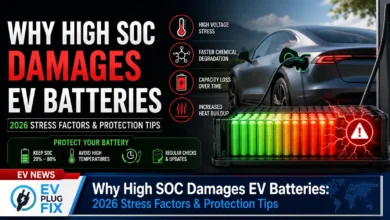
State of charge also deserves some nuance. Geotab examined how much cumulative time vehicles spent at extreme charge levels, defined as below 20% or above 80%. Low exposure meant less than 50% of total time at those extremes, medium exposure meant 50% to 80%, and high exposure meant more than 80%.
The low- and medium-exposure groups showed similar average degradation, while vehicles spending more than 80% of their cumulative time at extreme states of charge showed faster degradation. Importantly, Geotab restricted this SOC comparison to vehicles with low DC-fast-charging usage to control for the effect of charging power.
The finding is therefore not evidence that every EV should always be charged through its entire displayed range, nor does it override manufacturer instructions. It suggests that occasional high or low charge levels are different from leaving a battery habitually near its extremes for prolonged periods. Vehicle-specific charging guidance remains especially relevant because high state of charge, battery chemistry, usable buffers and battery-management strategies can affect long-term battery condition.
Climate produced another measurable difference. Geotab classified its mild-climate group as vehicles experiencing less than 35% of days above 25°C and its hot-climate group as vehicles experiencing more than 35% of days above 25°C. Vehicles in the hot group degraded about 0.4% faster per year on average than those in the mild group.
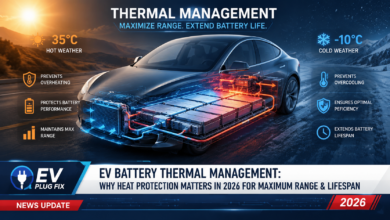
The study did not have enough vehicles operating exclusively in consistently cold climates to isolate extreme cold’s long-term degradation effect in the same way. Temperature can also cause temporary changes in available range that should not be confused with permanent capacity loss, which is why EV battery thermal management is important to understanding how heat and cold affect battery performance.
Eight Years Is a Warranty Milestone, Not a Lifespan
The U.S. Department of Energy’s Alternative Fuels Data Center notes that several EV manufacturers offer battery warranties of eight years or 100,000 miles. Coverage is manufacturer- and model-specific, however, so the warranty document for the individual vehicle is what matters.
Warranty duration also should not be interpreted as expected battery life. The Alternative Fuels Data Center cites predictive modeling indicating that today’s EV batteries may last approximately 12 to 15 years in moderate climates and roughly 8 to 12 years in extreme climates. Actual battery life depends on factors including charging and driving patterns, battery chemistry, design and thermal management.
California’s Advanced Clean Cars II rules illustrate why warranty thresholds and durability standards also need to be kept separate. For applicable 2026-and-later model-year BEVs and PHEVs, the rules establish an eight-year/100,000-mile traction-battery state-of-health warranty. The threshold is 70% SOH for model years 2026 through 2030 and rises to 75% for model year 2031 and later.
California’s vehicle durability requirement is a separate measure. For 2026 through 2029 model-year ZEVs, vehicles must be designed so that at least 70% of vehicles in a test group maintain at least 70% of their certification range value over a useful life of 10 years or 150,000 miles, whichever comes first. For model year 2030 and later, the requirement changes to an average of at least 80% of certification range value across the test group over that useful life.
Those California requirements should not be interpreted as the warranty terms for every EV currently on U.S. roads. Older model years and vehicles sold under different regulatory requirements may have different coverage.
Why Two Eight-Year-Old Batteries Can Age Differently
A simple annual degradation rate is useful for comparing large groups, but battery aging does not necessarily proceed at exactly the same rate each year. Geotab observed that degradation curves can change over time rather than following a perfectly straight line.
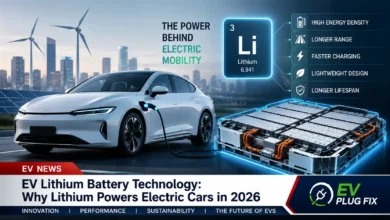
Battery chemistry is only one part of that variation. LFP, NMC and other lithium-ion battery chemistries have different characteristics, but pack cooling, software buffers, battery-management strategy, cell design, charging limits and operating history also influence long-term condition.
For used-car shopping, this makes measured condition more informative than a broad claim that one battery chemistry will always outlast another. Model-specific history matters as well: recalls, software updates and battery replacements can make two outwardly identical vehicles very different propositions.
What if the Battery Has a Problem?
Gradual degradation and battery failure are not the same thing. Capacity loss normally reduces how much energy the pack can store. A fault involving cells, modules, contactors, sensors, cooling equipment or other battery components may instead require diagnosis and repair.
Repair options are vehicle-specific. Some packs and service procedures support component or module replacement, while other cases may require replacement of a larger assembly. Independent battery repair is available for some vehicles and markets, but parts availability, expertise and warranty implications vary.
There is likewise no meaningful universal price for replacing an EV battery. Pack size, vehicle architecture, labor, parts supply and whether a replacement is new, used or remanufactured can dramatically change the cost. Anyone considering an older EV for which battery replacement would be financially decisive should obtain current model-specific repair information rather than rely on generic online price ranges.
A retired automotive battery may also retain enough capacity for another application, and second-life stationary storage and battery recycling are active areas of development. Those possibilities do not change the purchase decision for most used-EV buyers, however; the immediate priorities are remaining battery health, usable range, warranty status and realistic repair support.
Does an Eight-Year-Old Battery Make an EV a Bad Buy?
No. An eight-year-old EV can still be a practical purchase if its battery condition, range, price and overall vehicle condition make sense together.
Consider a car that originally delivered substantially more range than its owner now needs. Even after meaningful degradation, it may remain entirely adequate for commuting and local driving. The same battery could be unsuitable for someone who regularly depends on long highway trips with limited charging opportunities.
State of health therefore needs context. An 80% battery is not automatically “good” or “bad”; it means roughly four-fifths of the battery’s original usable energy capacity remains. Whether that is sufficient depends on the vehicle and the job expected of it.
Essential Questions & Expert Answers
Does an EV battery die after eight years?
No. Eight years commonly marks a battery-warranty period in the U.S., not a programmed end of battery life. A functioning battery can continue serving the vehicle after its warranty expires.
How much battery capacity can remain after eight years?
There is no universal percentage. Geotab’s expanded 2025 analysis of more than 22,700 EVs reported average degradation of 2.3% per year. A simple projection of that average produces about 81.6% state of health after eight years, but individual vehicles can be above or below that benchmark.
Is 80% battery health acceptable after eight years?
It can be. Around 80% state of health means roughly four-fifths of the original usable battery energy remains. The practical question is whether the resulting real-world range provides sufficient margin for the owner’s driving.
Does DC fast charging shorten EV battery life?
Geotab found an association between frequent high-power DC fast charging and faster average degradation. Vehicles with DCFC accounting for less than 12% of charging sessions averaged 1.5% annual degradation, while vehicles exceeding that frequency averaged 2.5%. The high-frequency, high-power group averaged 3.0%.
Do I need to keep an EV between 20% and 80% all the time?
Not according to Geotab’s fleet findings as a universal rule. In its SOC analysis, which was restricted to vehicles with low DC-fast-charging use to control for charging-power effects, accelerated degradation became significant among vehicles spending more than 80% of cumulative time below 20% or above 80% charge. Owners should still follow the charging guidance for their specific vehicle.
Should I avoid an EV once its battery warranty has expired?
Not automatically. An expired warranty increases the importance of assessing battery condition and repair risk, but battery health, usable range, vehicle condition and purchase price provide a better basis for the decision than age alone.
Bottom Line
Eight years should be viewed as an important evaluation point for an EV battery, not the point at which the battery becomes unusable. Real-world fleet evidence supports a reasonable expectation that substantial usable capacity can remain at this age.
Geotab’s expanded 2025 analysis, published in updated form in 2026, found average degradation of 2.3% per year across more than 22,700 EVs representing 21 models. A simple eight-year projection gives about 81.6% state of health, while the same dataset shows that charging power, prolonged exposure to extreme states of charge and hot operating conditions can influence the result.
For an existing owner, a functioning battery does not need replacement merely because the vehicle reaches its eighth birthday. Unexpected or unusually rapid changes in range or battery performance deserve investigation, but gradual capacity loss is part of normal battery aging.
For a used-EV buyer, the individual car matters more than the calendar. Check battery health, confirm the warranty and repair situation, and decide whether the remaining real-world range fits your needs. Those facts provide a far stronger basis for judging an eight-year-old EV than age alone.
Source Transparency
This article relies primarily on Geotab’s updated EV battery-health analysis, published in 2026 and based on its expanded 2025 dataset, together with information from the U.S. Department of Energy’s Alternative Fuels Data Center and California Air Resources Board regulations and supporting materials. Geotab’s degradation figures are aggregated fleet findings and associations rather than guaranteed outcomes for individual vehicles.
- Geotab: How Long Do Electric Car Batteries Last? Updated Real-World Battery Health Analysis
- U.S. Department of Energy Alternative Fuels Data Center: Electric Vehicle Benefits and Considerations
- U.S. Department of Energy Alternative Fuels Data Center: Maintenance and Safety of Electric Vehicles
- U.S. Department of Energy Alternative Fuels Data Center: Batteries for Electric Vehicles
- California Air Resources Board: Advanced Clean Cars II Battery Warranty Requirements
- California Air Resources Board: Advanced Clean Cars II ZEV Durability Requirements