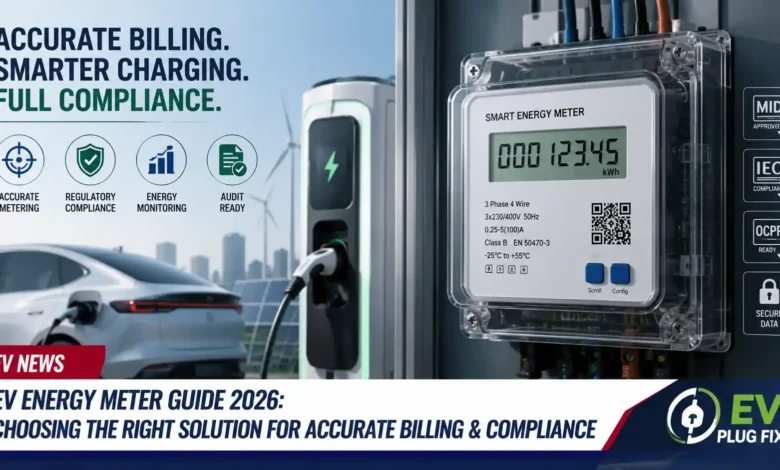
An EV energy meter records the electricity used during charging, but the right meter depends on what the measurement will be used for. Personal monitoring, employee reimbursement, apartment billing and public charging do not necessarily have the same requirements.
Before comparing meters, define three things: who will be billed or reimbursed, where the energy will be measured, and which country’s rules apply. Those decisions determine whether a charger’s built-in meter is sufficient, an external sub-meter makes more sense, or a more specific legally approved charging system is required.
How to Choose an EV Energy Meter
Start with the billing arrangement rather than a list of charger features. A practical selection process looks like this:
- Define the use. Decide whether the readings are for private monitoring, fleet accounting, employee reimbursement, tenant charging or the commercial sale of charging services.
- Confirm the jurisdiction. European MID requirements may be relevant, but national metrology, tax, employment and billing rules can add further conditions.
- Choose the measurement point. Determine whether electricity needs to be measured at an individual AC charger, on a dedicated feeder or within a DC charging system.
- Verify the exact product variant. Check the certificate and manufacturer’s documentation for the specific meter or charger model being purchased rather than assuming every version in a product family has identical approvals.
- Plan user allocation. Where several drivers share infrastructure, the system needs a reliable way to associate measured energy with the correct user or charging session.
- Check the records. For systems that depend on electronic transaction data, verify documented local transaction storage, meter-value retention, behavior during a network outage and synchronization after connectivity returns.
Connectivity features such as OCPP, APIs, RFID, Wi-Fi or Modbus can make those records easier to manage. They do not, by themselves, establish the metrological status of the energy measurement.
Where Should Charging Energy Be Measured?
An energy meter normally records electricity in kilowatt-hours, but readings depend on where the meter sits in the charging chain. Electricity measured by a wallbox is not necessarily identical to the increase in energy stored in the vehicle battery because charging involves conversion, thermal-management and other electrical losses.
For billing electricity delivered through charging equipment, the relevant figure is generally the energy measured at the measurement point required for that transaction, rather than an estimate of battery energy gained.
Integrated Charger Meter
A meter built into the charger is often the simplest arrangement for workplaces, fleets, apartment installations and company-car home charging. It can also make it easier for the charging system to associate meter readings with individual sessions or users.
Check the exact charger version carefully. A manufacturer may sell similar-looking variants with different meters or approvals. For example, go-e lists its Charger PRO with an integrated MID-compliant meter and also offers a version intended to meet additional German measurement and calibration requirements. Its RFID, OCPP and Modbus TCP functions are useful for management and integration but are separate product characteristics from the meter’s metrological conformity.
External Sub-Meter
An external meter installed on a dedicated charger circuit can be useful when retrofitting an existing charger, combining different charger brands or keeping the metering hardware separate from the charge point.
Selection should account for the meter’s approved application, electrical ratings, accuracy, installation requirements and applicable billing rules. A meter placed upstream of several chargers can record their combined consumption, but separate billing still requires a reliable method of allocating energy to individual users or sessions.
Vehicle-Reported Data
Vehicle displays and apps can provide useful charging and consumption records, particularly for drivers and fleet administration. They measure or calculate energy at a different point in the system, however, so their figures can differ from charger-side readings.
Whether vehicle data is acceptable for employee reimbursement depends on the employer’s policy and the relevant tax and legal rules. Where electricity is sold using measured consumption under legal-metrology rules, the applicable requirements for the billing measurement need to be considered separately.
AC and DC Charging Use Different Measurement Points
Most home, workplace and destination chargers deliver AC electricity to the vehicle, where the onboard charger converts it to DC for the battery. An AC meter in the wallbox or supply circuit therefore measures energy before that AC-to-DC conversion.
DC fast chargers perform the AC-to-DC conversion inside the charging station and deliver DC to the vehicle. Their metering architecture is consequently different. Operators should use meters and charging systems designed and approved for the intended DC application rather than applying the specifications of an AC wallbox meter to a DC installation.
This distinction is especially important when comparing charger readings with battery energy: the position of the meter determines which conversion losses are included in the measured value.
What MID Means for EV Charging
The EU Measuring Instruments Directive, Directive 2014/32/EU, sets requirements for specified measuring instruments placed on the European market. Annex MI covers active electrical energy meters used for residential, commercial and light-industrial purposes.
For an EV charging buyer, the important point is that MID conformity relates to the measuring instrument and its approved characteristics. It is not a universal approval of every billing, reimbursement or charging arrangement in Europe. National requirements and the purpose for which the measurement is used still matter.
The directive includes accuracy classes A, B and C and allows different requirements depending on the application and Member State. Buyers therefore should verify the class required for their specific project instead of assuming that a particular class is universally required simply because a charger is residential, commercial or high-powered.
Readers who need the detailed metrological requirements can consult the EU Measuring Instruments Directive 2014/32/EU.
MID and German Eichrecht
German charging projects can have requirements beyond MID conformity under the country’s measurement and calibration framework, including the Mess- und Eichgesetz. An MID-compliant meter alone does not establish that the complete charging and billing arrangement is suitable for every German application.
A key practical issue is verification of the measurement values used for billing. Germany’s Physikalisch-Technische Bundesanstalt provides information on validated transparency software associated with certain approved charging systems. Where such verification is part of the approved system, customers need access to the appropriate validated method for checking the measurement data used for their bill.
For a German project, therefore, check the approval and documentation for the complete intended charging solution, including how measurement records are generated, retained and made verifiable. Do not rely solely on an “MID meter” label in the charger specification.
Metering, User Identification and Billing Software
A charging backend can connect meter readings with RFID users, charging sessions, tariffs and invoices. The meter, charger and backend nevertheless perform different jobs: the meter produces the energy measurement, the charging equipment associates it with a transaction, and the backend stores and processes the resulting records.
This becomes particularly important at shared sites. An upstream meter may accurately measure total charger consumption while providing no information about which driver consumed it. Session identification or individual metering is needed when costs must be divided among users. For larger shared installations, multi-charger management can help administrators organize users, chargers and charging data.
Before buying a connected system, check its technical documentation for what happens during an internet or backend outage. Relevant questions include whether completed transactions are stored locally, whether meter values are retained, how much offline data can be held and whether stored sessions synchronize automatically when connectivity returns. These capabilities can matter for maintaining complete billing records even though they are not substitutes for the required meter approval.
Public Charging Has Additional EU Requirements
Public charging operators in the European Union also need to consider the Alternative Fuels Infrastructure Regulation (AFIR). This is an additional public-charging requirement rather than an EV meter certification standard.
Among its pricing provisions, AFIR requires transparent pricing for publicly accessible charging. At publicly accessible charging points with a power output of 50 kW or more, the ad hoc price charged to end users must be based on the price per kilowatt-hour for the electricity delivered; an occupancy fee expressed as a price per minute may also be charged.
Operators therefore need to consider both the measurement arrangement required for billing and the separate public charging pricing strategy that applies to their service. The current regulation is available through the EU Alternative Fuels Infrastructure Regulation.
Quick Comparison
| Metering method | Useful for | What to verify |
|---|---|---|
| Integrated charger meter | Workplaces, fleets, apartments and company-car charging | Exact charger variant, meter certification and intended billing use |
| External sub-meter | Retrofits, dedicated circuits and mixed charger installations | Electrical suitability, approved use and how readings are allocated to users |
| Vehicle data | Driver monitoring and some reimbursement arrangements | Whether the relevant employer, tax or reimbursement policy accepts the data |
FAQ
Can an employer use wallbox readings to reimburse home EV charging?
Potentially. A wallbox meter can provide useful session-level evidence, but the required documentation and acceptable reimbursement method depend on the country, tax treatment and employer policy. There is no universal rule requiring the same meter certification for every employee reimbursement arrangement.
What should I check when several employees share the same chargers?
Accurate total energy measurement is only part of the problem. The charging system also needs a dependable method of assigning sessions to individual employees, vehicles or accounts. Depending on the installation, that may involve RFID identification, authenticated charging sessions, separate meters or another documented allocation method.
Bottom Line
Define the billing use and jurisdiction first, choose the correct AC or DC measurement point, and then verify the exact meter or charger approval required for that application. Features such as RFID, OCPP and cloud billing should be evaluated after the measurement requirements are clear.
Source Transparency
This guide was checked against primary regulatory and technical sources available in August 2026, including the EU Measuring Instruments Directive 2014/32/EU, the EU Alternative Fuels Infrastructure Regulation, Germany’s Mess- und Eichgesetz, and PTB information on transparency software for EV charging. Product details relating to the go-e Charger PRO were checked against the manufacturer’s product information. Manufacturer descriptions are treated as product claims rather than independent certification of suitability for a particular installation.