
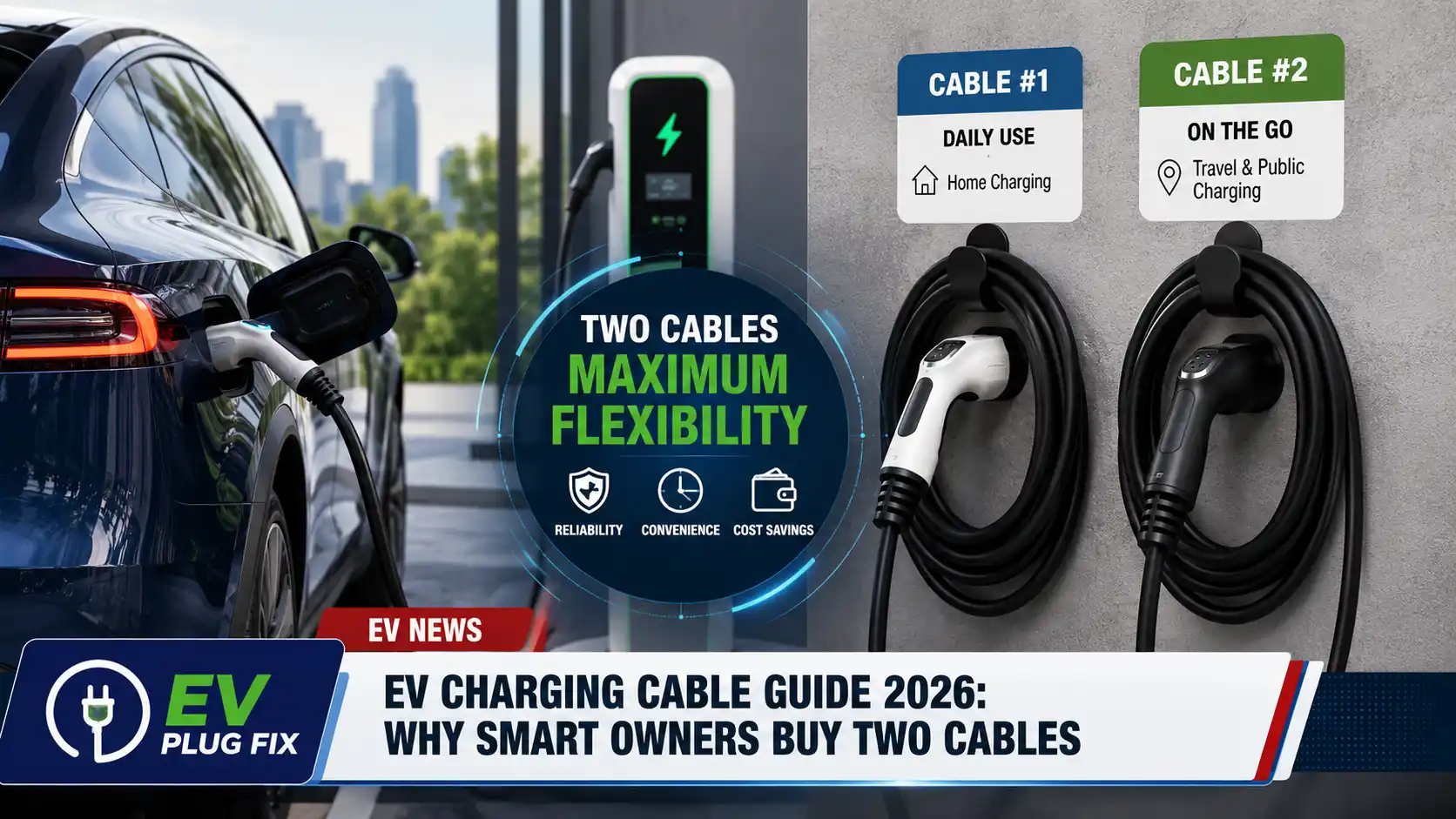
An EV charging cable should be chosen around three things first: connector compatibility, electrical rating and the length you actually need. Get those right and decisions about portability, outdoor use and whether to keep a second cable become much simpler.
Do not assume that a cable with a higher kilowatt rating will make your car charge faster. AC charging speed is limited by the charging supply, EVSE, cable and the vehicle’s onboard charger.
First Check Whether You Need a Detachable Cable
Charging equipment can be tethered, with its cable permanently attached, or socketed, requiring the driver to provide a compatible cable. The practical differences between these setups are covered in our guide to socketed vs tethered chargers.
Across Europe, many public AC charging points are socketed and may require a driver-supplied Mode 3 cable. Rapid and high-power DC chargers normally have tethered cables as part of the charging equipment. Home wallboxes are available in both configurations.
If the chargers you regularly use are already tethered, there may be little reason to buy an additional charging cable. If you use a socketed home wallbox or public AC chargers, a detachable cable becomes considerably more useful.
Start With Connector Compatibility
A detachable cable must match both the vehicle inlet and the charging point. Because EV charging connector types vary by market and vehicle, check the specifications of your EV and the charging equipment rather than relying on a listing that simply describes a product as an EV charging cable.
Type 2 is the principal standardized AC interface used by modern light-duty EV charging infrastructure in Europe. Under Regulation (EU) 2023/1804 as amended by Delegated Regulation (EU) 2025/656, AC normal-power and high-power recharging points for light-duty EVs installed or renovated from 8 January 2026 must provide at least Type 2 socket-outlets or vehicle connectors for Mode 3 interoperability. The regulation includes an exception for normal-power points at or below 3.7 kW whose primary purpose is Mode 2 charging, which may instead use socket-outlets compliant with IEC 60884:2022.
The relevant AFIR interoperability provisions reference EN IEC 62196:2022. For general technical reference, the newer international IEC 62196:2025 edition specifies dimensional compatibility and interchangeability requirements for AC plugs, socket-outlets, vehicle connectors and vehicle inlets.
These infrastructure rules do not standardize where manufacturers place the charging inlet on the vehicle. Charge-port position still varies, so cable reach remains an important practical consideration.
Vehicles from other markets, and some older vehicles, may use different AC interfaces. Confirm both ends of the required cable before ordering.
Match the Electrical Rating
Connector type alone does not determine how much AC power a cable can carry. Check its rated current and whether it supports the single-phase or three-phase charging arrangement you intend to use.
| Typical AC Setup | Nominal Current | Approximate Maximum Power |
|---|---|---|
| Single-phase | 16 A | 3.7 kW |
| Single-phase | 32 A | 7.4 kW |
| Three-phase | 16 A | 11 kW |
| Three-phase | 32 A | 22 kW |
These are nominal European examples. Actual charging power depends on supply voltage, available current, the EVSE, cable capability and the vehicle’s onboard AC charger.
For example, an EV limited to 11 kW AC will not charge at 22 kW simply because it is connected to a 22 kW charging point with a suitably rated 22 kW cable. A higher-rated cable does not force its maximum power into the vehicle. The charging system operates within the capabilities of the EVSE, cable and vehicle.
A cable with insufficient current or phase capability, however, can become a bottleneck. Check the stated current and phase configuration rather than choosing on the advertised kilowatt figure alone.
Connector Standards and Cable Standards Are Different
The standards covering the connector hardware should not be confused with those covering the cable itself. IEC 62196 addresses dimensional compatibility and interchangeability requirements for AC plugs, socket-outlets, vehicle connectors and vehicle inlets. Construction and test requirements for EV charging cables are principally addressed by the IEC 62893 series.
When comparing products, look for clear technical documentation covering the connector configuration, cable rating, applicable standards, conformity information and manufacturer specifications. Be cautious with listings that advertise only a headline power figure without clearly stating current, phases or connector type.
Choose Length by Measuring the Parking Setup
There is no single ideal EV charging cable length. Measure the route from the charging point to the vehicle inlet with the car parked as it normally will be, and leave enough practical reach to connect without pulling the cable tight.
A shorter cable is easier to handle and store, while additional length provides more flexibility when charger placement or vehicle orientation varies. Charge-port position matters particularly when the same wallbox is used by different EVs.
Avoid buying several extra metres purely as insurance if you intend to carry the cable regularly. Longer cables add storage bulk, and higher-current cables of otherwise similar construction are generally bulkier and heavier as well.
Outdoor Use, Handling and Storage
If the cable will regularly be used outdoors, check the manufacturer’s environmental and operating-temperature ratings. Suitability for water, dirt, sunlight and temperature extremes depends on the cable’s construction and documented specifications.
Portability deserves consideration too. A heavy cable may be unimportant when it stays beside a home charger but inconvenient when it has to share a small luggage compartment. A storage bag can separate a wet or dirty cable from other cargo, while a suitable holder can keep a home cable off the floor.
When a Second Cable Is Worth Buying
A second cable makes sense when it solves a recurring inconvenience. A driver who regularly uses both an untethered home wallbox and socketed public AC charging may prefer to leave one cable at home and keep another permanently in the vehicle.
Different lengths can also serve different jobs: a longer cable can remain at home where parking geometry requires it, while a shorter, easier-to-store cable travels in the car. If most of the charging equipment you use is tethered, however, a spare cable may offer little practical benefit.
A Note on “Smart” Charging Cables
Do not assume that a detachable cable marketed as “smart” will add features such as solar-surplus charging, load balancing, scheduling or remote control to an ordinary charging point. Those functions are commonly provided by the EVSE, charging network or vehicle. If smart charging matters to you, evaluate the complete charging system, including features such as dynamic load balancing, and the manufacturer’s description of exactly where its control features operate.
A Practical EV Charging Cable Checklist
- Confirm that you need a detachable cable. Tethered charging equipment already provides one.
- Check both interfaces. The cable must be compatible with the vehicle and charging point.
- Check current and phases. Do not choose solely from the advertised kW rating.
- Measure the actual reach. Account for charge-port position and normal parking orientation.
- Check the documentation. Look for applicable standards, conformity information, electrical ratings and manufacturer specifications.
- Consider outdoor conditions and storage. Check environmental ratings and whether the cable will be practical to carry.
- Buy a second cable only when it solves a real problem. Separate home and travel cables can be convenient but are not essential for every driver.
FAQ
Is Type 2 the standard AC charging connector in Europe?
Type 2 is the principal standardized AC interface for modern light-duty EV charging infrastructure in Europe. EU interoperability rules require Type 2 at applicable Mode 3 AC charging points, subject to specific regulatory exceptions including certain normal-power points at or below 3.7 kW primarily intended for Mode 2 charging. Always confirm the inlet on your particular vehicle before buying a cable.
Can I use a 22 kW cable with an 11 kW EV, and will it charge faster?
A genuinely compatible and appropriately rated 22 kW three-phase cable can be used where the vehicle and charging equipment support the same interface, but it will not make an 11 kW EV charge at 22 kW. The permitted AC charging current is determined by the capabilities of the EVSE, cable and vehicle, with the vehicle’s onboard charger limiting the power it can accept.
Do I need my own cable at public chargers?
It depends on the charger. Many socketed public AC charging points in Europe require the driver to provide a compatible Mode 3 cable, while DC rapid and high-power chargers normally provide a tethered cable. If you are unfamiliar with the process, this public EV charging guide explains how a typical charging session works.
Should I buy a second EV charging cable?
Consider one if leaving a cable at an untethered home charger saves you from repeatedly moving it, or if different cable lengths are useful at home and on the road. Otherwise, one suitable cable may be all you need.
Bottom Line
Buy for the charging setup you actually use: confirm the connectors, current and phase rating, measure the required reach and check the manufacturer’s environmental and conformity information. Higher ratings and extra length can provide useful flexibility, but neither automatically improves charging speed or makes a cable a better everyday choice.
Sources
The European interoperability requirements discussed above can be checked in Regulation (EU) 2023/1804 on EUR-Lex, including the amendments applicable from 8 January 2026, and in the European Commission’s AFIR questions and answers. The AFIR technical requirements reference EN IEC 62196:2022 for the relevant Type 2 interoperability provisions.
For current international technical references, IEC 62196:2025 covers dimensional compatibility and interchangeability requirements for AC plugs, socket-outlets, vehicle connectors and vehicle inlets, while the IEC 62893 series addresses cables for electric-vehicle charging. Product-specific current ratings, environmental limits and compatibility should be verified against current documentation from the relevant cable, EVSE and vehicle manufacturers.