EV Charging Connector Types Compared: Which Plug Fits Your Electric Car?

Electric-car charging plugs are becoming more standardized, but there is still no single connector used everywhere. The plug that fits your EV depends heavily on where the vehicle was sold, whether you are charging with AC or DC, and, increasingly, the model year of the car.
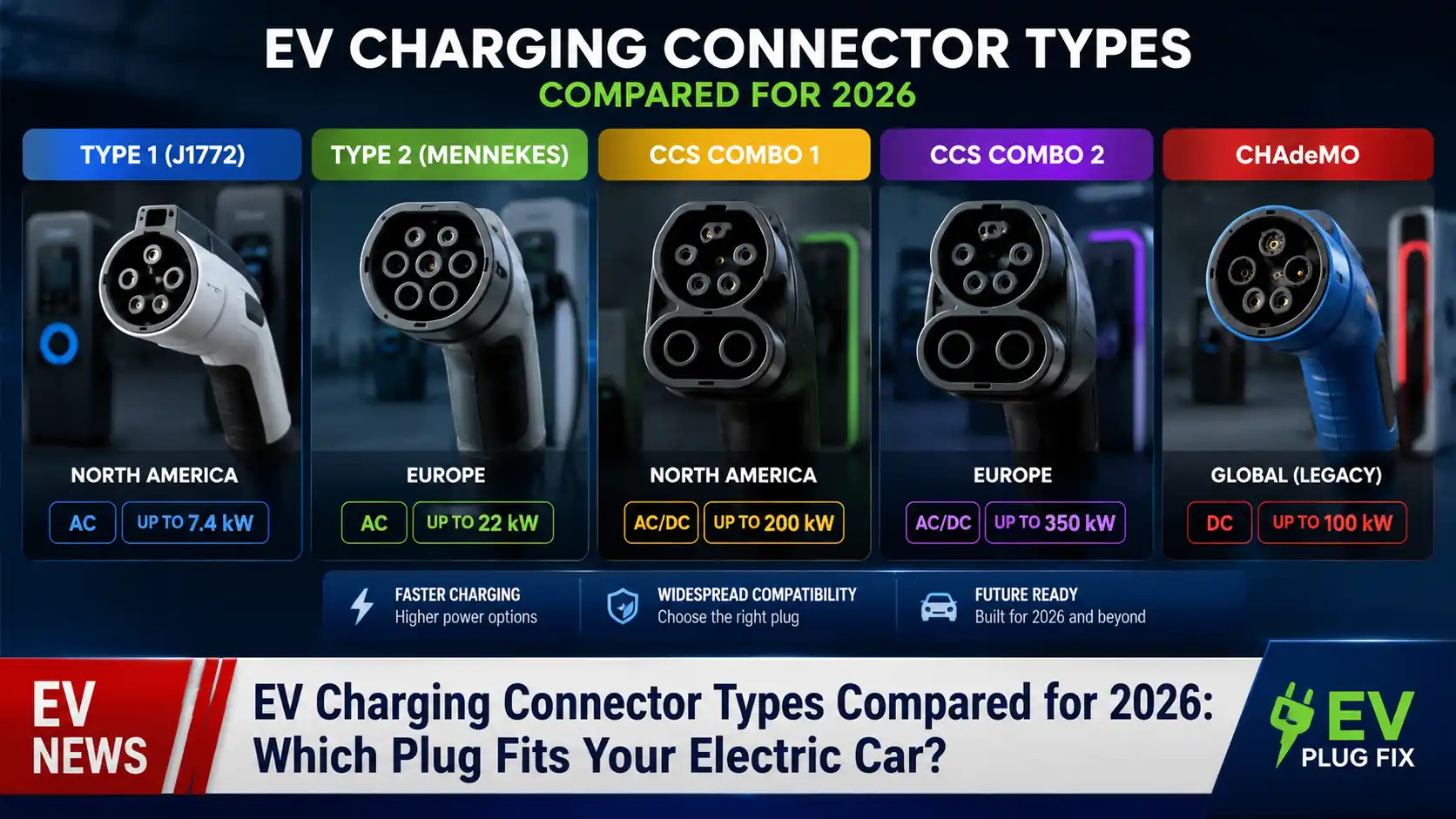
For most drivers, the connector question is simpler than the alphabet soup suggests. Europe revolves around Type 2 for AC charging and CCS Combo 2 for DC charging. North America is moving toward the SAE J3400 connector, derived from Tesla’s North American Charging Standard, while a large installed base of vehicles and charging equipment still uses J1772 or CCS1. China has its own GB/T ecosystem, and CHAdeMO remains relevant to a shrinking but important group of vehicles, particularly older Japanese EVs.
This guide explains the major EV charging connector types, what each one actually does and, most importantly, how to work out whether a charger will work with your car.
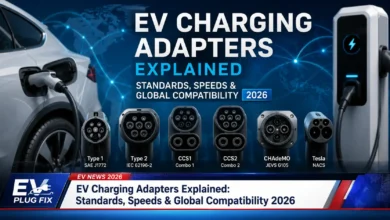
EV charging connectors at a glance
| Connector | Main use | Common markets | AC or DC? |
|---|---|---|---|
| SAE J1772 / Type 1 | Home and destination charging | North America; some older vehicles elsewhere | AC |
| Type 2 / Mennekes | Home, workplace and public charging | Europe and many other markets | Primarily AC |
| CCS1 | DC fast charging | North America | DC, with J1772 portion supporting AC at the vehicle inlet |
| CCS2 | DC fast charging | Europe and numerous other markets | DC, with Type 2 portion supporting AC at the vehicle inlet |
| SAE J3400 / NACS | AC and DC charging | North America | AC and DC |
| CHAdeMO | DC fast charging | Japan; legacy installations in other markets | DC |
| GB/T | AC and DC charging through separate interfaces | China | AC or DC, depending on connector |
The table describes the broad market picture rather than guaranteeing compatibility with an individual vehicle. Imported cars, older models and region-specific versions can use a connector that differs from the current norm.
The connector is only one part of charging speed
A plug’s physical design does not tell you how quickly a particular EV will charge. Charging speed is limited by the weakest relevant part of the system.
During AC charging, the charging point supplies AC electricity and the vehicle’s onboard charger converts it to DC for the battery. The car’s onboard-charger rating can therefore impose a lower limit than the charging point itself.
DC fast charging works differently. The charging equipment supplies controlled DC power to the vehicle, bypassing the car’s onboard AC charger. The battery pack, battery-management system, temperature, state of charge and vehicle charging curve then play major roles in determining the power the car will accept.
As a result, two vehicles using exactly the same connector can charge at very different speeds. A charger’s headline kilowatt rating is a maximum capability, not a promise that every compatible EV will receive that power.
SAE J1772, or Type 1
SAE J1772 is the familiar five-pin AC connector found on many North American EVs and plug-in hybrids. It is commonly called J1772, the J-plug or Type 1.
For years it was the default North American connection for AC Level 1 and Level 2 charging. It remains highly relevant because many vehicles, home chargers and public destination charging points continue to use it.
J1772 should not be confused with CCS1. A CCS1 vehicle inlet incorporates the J1772 interface and adds two larger DC contacts below it. That allows the same vehicle to accept ordinary J1772 AC charging as well as CCS1 DC fast charging.
North America’s move toward SAE J3400 does not make existing J1772 equipment suddenly unusable. Compatible adapters can bridge J1772 and J3400 in appropriate applications, although the vehicle manufacturer and charging-equipment instructions should determine which adapter is acceptable.
Type 2: Europe’s standard AC connection
Type 2, often called the Mennekes connector after the company associated with its original design, is the dominant AC vehicle-charging interface in Europe. Unlike Type 1, its design accommodates single-phase and three-phase AC charging.
European regulation reinforces that position. Under the EU’s Alternative Fuels Infrastructure Regulation and its updated technical requirements, publicly accessible AC charging points for light-duty EVs installed or renovated from 8 January 2026 must, for interoperability purposes, provide at least Type 2 socket-outlets or vehicle connectors meeting the referenced EN IEC 62196 specification.
That does not mean every Type 2 car charges at the same rate. A vehicle with an 11 kW onboard charger, for example, will not gain a 22 kW AC charging rate simply because it is connected to a 22 kW three-phase charging point.
Many European public AC stations use an untethered Type 2 socket, requiring the driver to carry a Type 2 charging cable. Tethered home and public units are also common.
CCS1 and CCS2: similar idea, different regional plugs
CCS stands for Combined Charging System. Its defining idea is straightforward: retain the established AC interface and add dedicated high-current contacts for DC fast charging.
There are two passenger-vehicle versions drivers commonly encounter.
- CCS1, or Combo 1: based on the J1772/Type 1 interface and historically widespread for North American DC fast charging.
- CCS2, or Combo 2: based on the Type 2 interface and dominant for European DC fast charging.
CCS1 and CCS2 are not physically interchangeable. A North American CCS1 plug will not simply fit a European CCS2 inlet because both carry the CCS name. The broader differences between European and US charging standards also help explain why regional vehicle versions can require different charging hardware.
In the European Union, Combo 2 has a regulatory interoperability role as well as a large installed base. Current EU requirements specify CCS Combo 2 for publicly accessible DC charging points covered by the relevant provisions. For equipment installed or renovated from 8 January 2026, updated EN IEC 62196 references apply in the categories specified by the regulation.
For a European passenger-EV buyer, the practical combination remains easy to recognize: Type 2 handles normal AC charging, while the additional DC contacts in a CCS2 inlet allow fast charging.
SAE J3400 and NACS: North America’s transition
Tesla originally developed its compact North American connector for its own vehicles and charging network. The company later opened the design under the North American Charging Standard name, or NACS.
The important change is that the interface is no longer merely a proprietary Tesla connector. SAE International published SAE J3400, covering conductive charging through this connector architecture. SAE describes J3400 as capable of transferring either DC power or single-phase AC power through the same two main current-carrying contacts.
That AC-and-DC arrangement is one reason the connector is physically compact compared with CCS, which uses separate large DC contacts below its AC interface.
Automakers and charging providers across North America have been moving toward J3400/NACS support. The transition, however, should not be interpreted as an overnight replacement of CCS1 or J1772. Existing vehicles will remain on the road for years, and charging networks have to serve a mixed fleet.
Federal funding requirements are more specific than a general recommendation about connector choice. Under the current 23 CFR 680.106(c), each DC fast-charging port subject to the federal rule must be capable of charging CCS-compliant vehicles and must have at least one permanently attached CCS Type 1 connector. The rule also permits additional permanently attached, non-proprietary connectors that meet the applicable requirements, so compliant chargers may also provide SAE J3400 connectors where appropriate. In other words, J3400 can supplement CCS1 on covered federally funded equipment under the current rule, but it does not replace the mandatory CCS1 capability.
NACS does not automatically mean Supercharger access
A matching physical connector is necessary, but it is not always sufficient. Access to a particular fast-charging network can also depend on vehicle authorization, communications compatibility, software, payment integration and the charging site’s hardware generation.
This distinction is especially important when evaluating Tesla Supercharger access for a non-Tesla EV. A vehicle having a native J3400/NACS inlet does not by itself prove that every Supercharger location will work with it.
CHAdeMO: still relevant, but increasingly a legacy consideration
CHAdeMO was one of the earliest widely deployed DC fast-charging systems and became closely associated with Japanese EVs, particularly earlier generations of the Nissan Leaf and several other Japanese-market models.
Its importance in new passenger vehicles outside Japan has declined as CCS and J3400/NACS have expanded. That makes CHAdeMO availability an important ownership consideration for someone buying a used EV that relies on the connector for fast charging.
The technology itself should not be dismissed as frozen or technically obsolete. The CHAdeMO Association released protocol version 2.1 in May 2026, adding provisions including higher charging current and Plug and Charge functionality. The association says the specification supports charging currents up to 800 A with compatible equipment.
CHAdeMO has also played a significant role in bidirectional EV charging. The CHAdeMO Association maintains certification and interoperability work for vehicle-to-grid applications. Whether an individual vehicle can actually export energy depends on the vehicle, charger, software and local regulatory or utility requirements.
GB/T: China’s charging ecosystem
China uses its own national standards for conductive EV charging connections. Drivers will generally encounter the term GB/T when discussing Chinese-market AC and DC charging equipment, but it is important not to treat GB/T as one universal physical plug for every type of charging.
China’s standards system defines separate requirements for charging connections. The current GB/T 20234.3 standard, for example, covers DC charging couplers.
This matters particularly for imported and exported vehicles. A car designed for the Chinese domestic market may have a different charging inlet from a nominally similar version sold in Europe, North America or the Middle East.
Do not assume that an adapter alone will make every imported EV compatible with the local fast-charging network. Physical fit, electrical architecture, communications protocols and manufacturer support all matter.
What about charging connectors in the Middle East?
The Middle East cannot be reduced to one connector rule because standards and vehicle fleets vary by country. Many markets have strong European influence and Type 2/CCS2 vehicles are common, but imported North American, Chinese and other regional-specification vehicles can create exceptions.
For drivers buying an imported EV, the country in which the car was originally sold can be more important than the badge on the bonnet. Two examples of the same model may have different charging inlets if they were built for different markets.
Before importing an EV, check the actual inlet on that specific vehicle and compare it with the AC and DC infrastructure available where the car will be used.
Can an adapter make a different connector work?
Sometimes, but an adapter is not a universal protocol translator.
Adapters are particularly useful during North America’s J1772/CCS1-to-J3400 transition. SAE has developed J3400-related adapter guidance, including SAE J3400/1, which addresses safety and qualification considerations for adapters between SAE J3400 and SAE J1772 interfaces.
Compatibility still needs to be verified for the specific vehicle and charging network. An adapter has to do more than make two pieces of hardware physically meet. Voltage limits, current ratings, locking, temperature monitoring, communications and vehicle authorization can all affect whether charging is safe and functional. A dedicated guide to EV charging adapter compatibility can help clarify the differences between physical fit, charging standards and supported speeds.
For that reason, an adapter specifically approved or recommended by the vehicle manufacturer is preferable to assuming that an unverified third-party product is suitable simply because its connectors fit.
How to identify the right plug for your EV
- Check the vehicle manual. Look for separate specifications for AC charging and DC fast charging.
- Inspect the actual charge inlet. This is especially important with used or imported vehicles.
- Check the car’s original market. A North American version and European version of the same model may use different connectors.
- Check AC capability. Connector compatibility does not tell you the maximum output of the onboard charger.
- Check DC capability. Some plug-in hybrids and older EVs have AC charging but no DC fast-charging capability.
- Verify network support. A physically compatible plug does not guarantee that every network or charger will authenticate and charge the vehicle.
- Confirm adapter approval. Use the vehicle and adapter manufacturers’ compatibility instructions rather than relying on plug shape alone.
Which connector should you look for when buying an EV?
Connector choice is mainly a regional and infrastructure decision rather than a contest over which plug has the best theoretical specification.
In Europe, Type 2 plus CCS2 provides the mainstream combination for passenger EVs. In North America, buyers need to consider the ongoing transition from J1772 and CCS1 toward SAE J3400/NACS, particularly when comparing older and newer model years. In China, the relevant GB/T specifications and the vehicle’s domestic-market configuration matter.
For a used EV, local charging availability can be more important than the connector’s technical capability. A CHAdeMO-equipped car may meet a driver’s needs perfectly if reliable CHAdeMO chargers exist along the routes they use. The same vehicle becomes less convenient if nearby networks have removed or stopped expanding CHAdeMO equipment.
The safest buying approach is to compare the vehicle with the charging infrastructure you will actually use rather than choosing a car from connector name alone. Check home-charging compatibility, the fast-charging connectors available on regular routes, the vehicle’s maximum AC and DC charging capabilities and whether any required adapter is officially supported. For an imported or used EV, confirm the exact regional specification rather than assuming that all versions of the model share the same inlet.
Future-proofing also needs perspective. A newer regional standard can be attractive, but widespread existing infrastructure does not disappear immediately when a market begins migrating to another connector. A well-supported older connector may still be practical for years if the networks around you continue to provide it, while a newer connector offers little benefit if the places you regularly charge do not support your vehicle or network access.
What is MCS and does it affect passenger cars?
The Megawatt Charging System, or MCS, is aimed primarily at heavy-duty electric transport rather than ordinary passenger EVs.
CharIN developed MCS around the much higher power requirements of electric trucks and other large vehicles. Its published system requirements discuss operation at up to 1,250 V DC and 3,000 A, which corresponds to a theoretical 3.75 MW electrical power level.
MCS therefore should not be presented as the next replacement plug for a typical family EV. It addresses a different charging problem: transferring extremely large amounts of energy into commercial vehicles that may have battery packs far larger than those in passenger cars.
Will wireless charging make plugs irrelevant?
Wireless charging could eventually reduce the need to physically connect a cable in some applications, but it does not make today’s connector decision irrelevant.
Inductive charging requires compatible equipment in both the vehicle and infrastructure. The EU has already incorporated interoperability specifications for certain static wireless charging installations into its regulatory framework, showing that wireless charging is becoming part of formal standardization rather than remaining purely experimental.
That is different from saying conductive plugs are about to disappear. Cable-based charging remains the practical foundation of today’s passenger-EV infrastructure.
FAQ
Is CCS the same as Type 2?
No. Type 2 is an AC charging interface. CCS2 uses the Type 2 portion of the vehicle inlet and adds two larger contacts for DC fast charging. A European CCS2-equipped EV can therefore normally use a Type 2 AC connector as well as a CCS2 DC connector.
Is NACS the same as SAE J3400?
NACS is the name Tesla gave its opened North American connector design. SAE subsequently standardized the interface through SAE J3400. In current North American charging discussions, NACS and J3400 are often used together, although SAE J3400 is the standards-based terminology.
Can a CCS car use a Tesla charger?
Sometimes. Compatibility depends on the region, vehicle, charging site, adapter or integrated connector, and network support. A physical adapter alone does not guarantee access to every Tesla Supercharger.
Can I charge a J1772 car from a J3400 home charger?
Potentially, with an appropriate compatible adapter. Check the vehicle, charging-equipment and adapter manufacturers’ instructions before use.
Does having the right connector guarantee maximum charging speed?
No. The vehicle, charger, battery temperature, state of charge and other operating limits can reduce charging power substantially below the connector or charging station’s theoretical capability.
Should I avoid a used EV with CHAdeMO?
Not automatically. Check the fast-charging stations on the routes you actually use. A CHAdeMO vehicle can still be practical where suitable chargers remain available, but declining connector availability in some markets can make long-distance charging less convenient.
Bottom Line
There is no universal EV plug, but the regional picture is becoming easier to understand. Europe is centered on Type 2 for AC and CCS2 for DC. North America is transitioning toward SAE J3400/NACS while a substantial installed base of J1772 and CCS1 vehicles and charging equipment remains in use. China uses its GB/T standards, while CHAdeMO remains important for certain existing vehicles.
When choosing a car, home charger or adapter, do not make the decision from connector shape alone. Verify the exact vehicle specification, its original market, AC and DC charging capabilities, local charging-network support and any adapter requirements. Those details determine whether a charging connection is genuinely usable.
Source Transparency
This article distinguishes between physical connector compatibility and actual charging capability. Technical and regulatory details were checked against primary or standards-body sources available in August 2026, including SAE International’s J3400 documentation, the U.S. Joint Office of Energy and Transportation, the current 23 CFR 680.106 federal charging requirements, the European Commission’s AFIR guidance, China’s national standards database, the CHAdeMO Association and CharIN’s MCS documentation.
Connector standards, charging-network access and manufacturer compatibility can change. Owners should confirm current support with their vehicle manufacturer and charging provider before purchasing an adapter, importing a vehicle or relying on a particular network for regular travel.