
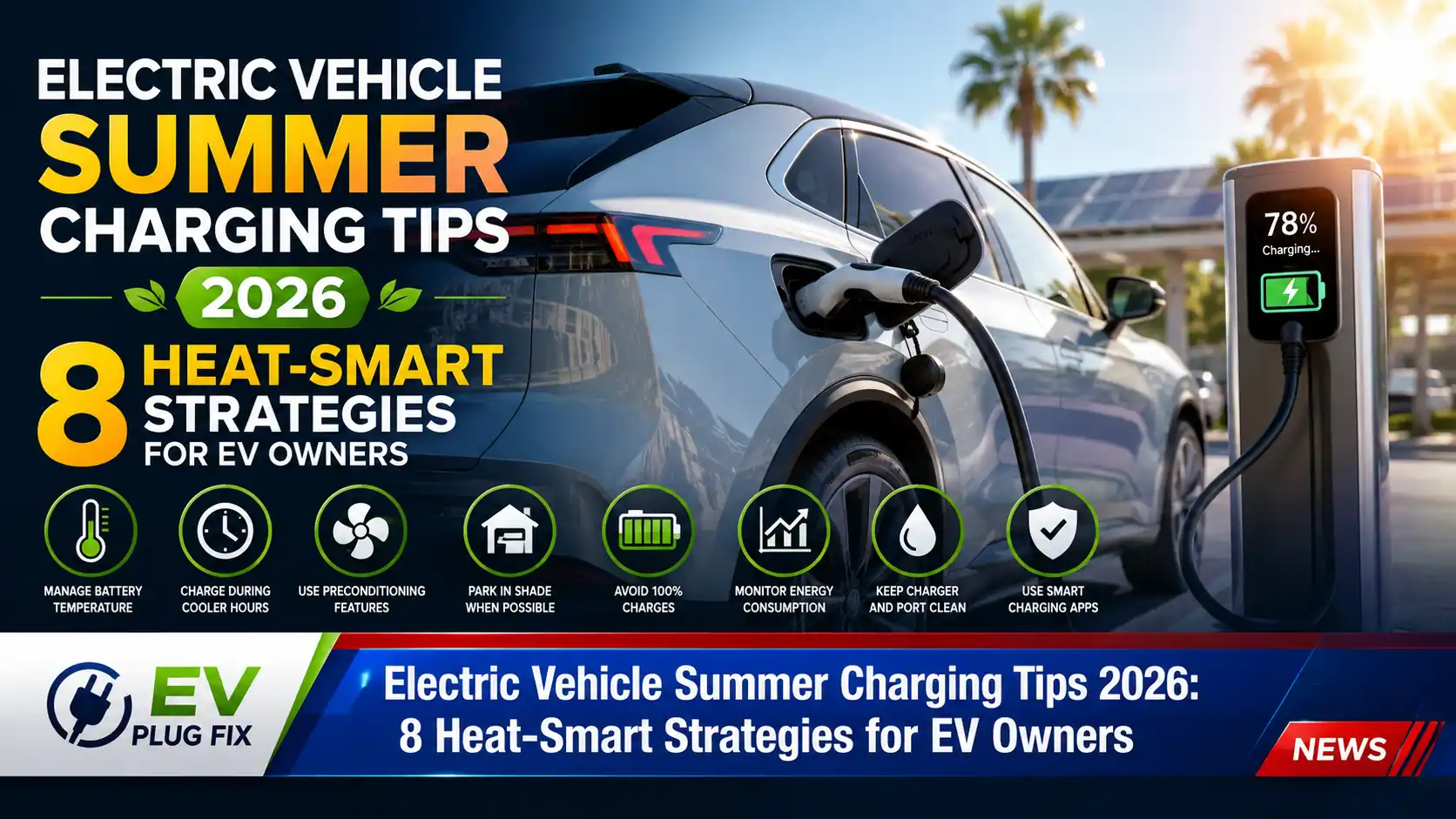
Hot weather does not mean you need to avoid charging an electric vehicle. Modern EVs monitor battery temperature and can use thermal-management systems to keep the pack within its intended operating range. When conditions are unusually hot, the vehicle may devote more energy to cooling or adjust the charging power it accepts.
There is no universal outside-temperature threshold at which every EV begins charging more slowly. Battery chemistry, pack design, recent driving, state of charge, charging power and the vehicle’s software all influence what happens. The most useful summer EV charging tips are therefore simple: use your car’s thermal-management features as intended, follow its model-specific charging guidance and allow some flexibility when fast charging on very hot days.
How Heat Can Affect EV Charging
A modern EV’s battery-management system monitors conditions such as cell voltage, temperature and state of charge while the battery is charging. Many vehicles also have active battery heating and cooling systems that help maintain suitable pack temperatures. For a deeper look at how these systems respond to temperature, see this guide to EV battery thermal management.
If the battery becomes hotter than the vehicle’s preferred operating range, the car may increase battery cooling or reduce the charging power it requests. The charging station can also limit output because of its own operating conditions or thermal protection.
This is why a claim such as “all EVs lose a certain percentage of charging speed above a particular temperature” is misleading. There is no single derating percentage or temperature that applies to every EV.
Heat can matter over the longer term as well. Geotab’s updated real-world battery analysis found an association between hotter climates and higher average battery degradation in its dataset. The effect should not be interpreted as a prediction for an individual vehicle because battery design, charging power, usage and other factors also influence aging. Geotab’s EV battery-health analysis provides details on the dataset and methodology.
1. Use Battery Preconditioning When Your EV Supports It
Battery preconditioning prepares the traction battery for driving or charging by moving it toward a temperature the vehicle considers suitable. Exactly what it does, when it operates and how it is activated vary by model.
Some EVs automatically prepare the battery when the driver selects a compatible DC fast charger through the vehicle’s navigation system. Tesla’s Model 3 documentation, for example, says that navigating to a Supercharger with Trip Planner automatically prepares the battery for efficient charging, including during extreme heat.
Tesla’s current Model 3 guidance also recommends navigating to the charging location well before arrival when practical so the vehicle has time to establish suitable battery conditions. That is model-specific advice rather than a universal preconditioning time for all EVs. See Tesla’s Model 3 hot-weather guidance for the current instructions.
Do not assume that turning on cabin air conditioning necessarily preconditions the traction battery for DC fast charging. Cabin conditioning and battery preparation can be separate functions. Check your owner’s manual to find out what your vehicle supports.
2. Schedule Home Charging Around Your Tariff and Departure
There is no universal best hour to charge an EV during summer. Electricity rates vary by utility and tariff, and nighttime temperatures differ by location and parking environment.
If your electricity plan offers lower off-peak prices, scheduled charging can move much of the session into that period. In climates where nights are cooler, charging later may also expose the vehicle and charging equipment to lower ambient temperatures than charging during the hottest part of the afternoon. Smart scheduling is one of several considerations covered in our home EV charging guide.
When practical, you can schedule charging so the battery reaches the state of charge you need closer to departure instead of automatically reaching a high state of charge many hours before the vehicle will be used.
Some EVs integrate charging schedules with cabin conditioning. Tesla’s summer-driving guidance, for example, says Scheduled Departure manages charging and cabin preconditioning. Tesla also states that preconditioning the cabin while the vehicle is plugged in allows the climate system to prepare the interior without drawing that energy from the traction battery.
These are examples of manufacturer-specific features. Check your vehicle’s documentation and your actual electricity tariff rather than assuming that every EV offers the same scheduling functions or that overnight electricity is always cheaper.
3. Use Shade When It Is Practical
Shade or covered parking can reduce solar heating of the cabin. A cooler interior can require less air-conditioning energy to reach a comfortable temperature before departure.
Do not treat shade as a guaranteed way to increase charging power. The battery pack is generally located low in the vehicle, and its temperature depends on factors including ambient conditions, recent driving, battery cooling and charging power rather than cabin temperature alone.
Still, a covered charging location can make a summer charging stop more comfortable and reduce cabin cooling demand when similarly convenient charging options are available.
At home, install and operate charging equipment according to the EVSE manufacturer’s instructions. Do not add improvised covers that interfere with required clearances, cooling or ventilation. If the charging equipment is intended for outdoor use, follow its specified installation and environmental requirements.
4. Follow Your EV’s Recommended Charge Limit
An 80% charge limit is often presented as a rule for every electric car, but manufacturer recommendations differ. Appropriate daily charging practices can vary by model, battery chemistry and software configuration.
The best default is the daily charging recommendation shown in your owner’s manual, vehicle interface or official manufacturer documentation. Drivers who want broader guidance on charge frequency and everyday state-of-charge management can also review how often to charge an electric car.
For many lithium-ion batteries, spending unnecessarily long periods at very high states of charge can contribute to aging, particularly when combined with high battery temperatures. That does not mean drivers should never charge to 100%. Charging higher before a journey when the additional range is useful is different from routinely leaving a battery at a very high state of charge for extended periods.
Geotab’s 2026 analysis provides useful fleet-level context. It found a stronger degradation association when vehicles spent a very large proportion of their time near high or low state-of-charge extremes. These findings describe trends across the company’s dataset and do not override the charging instructions supplied for an individual vehicle.
| Charging situation | Practical approach |
|---|---|
| Normal daily driving | Use the manufacturer’s recommended daily charge limit. |
| Long trip ahead | Charge higher when the additional range is useful and your vehicle permits it. |
| Extended parking | Follow the manufacturer’s storage and state-of-charge instructions. |
| Very hot weather | Avoid unnecessarily leaving the battery at a high state of charge for long periods when the manufacturer advises against it. |
5. Expect DC Fast-Charging Speed to Vary
The maximum power printed on a DC fast charger is the charger’s capability under suitable conditions. It is not a guarantee that every connected EV will receive that power or sustain it throughout a charging session.
The vehicle determines how much power it can accept. Actual charging power can depend on battery temperature, state of charge, the vehicle’s charging curve and the capabilities of the charger. Charging equipment can also reduce output because of site or equipment conditions.
Charging power normally changes during a session. Many EVs accept their highest power only within part of their state-of-charge range and taper charging as the battery fills.
A slower-than-expected charging session on a hot day therefore does not automatically indicate a defective battery. The car may be managing battery temperature, the charger may be limiting output, or the battery may simply have reached a point on its normal charging curve where power decreases.
If charging seems unusually slow, check the vehicle and charger for warnings or faults and compare performance at a similar battery state of charge. Persistent abnormal behavior is more meaningful than one isolated session.
6. Do Not Judge Battery Health From One Hot Charging Session
DC fast-charging speed is not a direct battery-health test. Even a healthy EV can charge at very different rates depending on battery temperature, state of charge and charging conditions.
There is also no single annual degradation percentage that every EV battery should match. Battery chemistry, pack design, age, usage, charging patterns and climate all influence capacity retention.
Geotab’s updated analysis, published in 2026, examined data from more than 22,700 electric vehicles across 21 makes and models and reported average battery degradation of 2.3% per year across the dataset. Geotab also identified charging power and climate among the factors associated with degradation.
That 2.3% figure is a dataset average, not a target, warranty threshold or prediction for an individual vehicle. A particular battery can age faster or slower.
If your EV offers a manufacturer-supported battery-health diagnostic, use that procedure when you need a meaningful assessment. Otherwise, seek service advice if the vehicle reports a battery fault, develops a persistent unexplained loss of usable capacity or repeatedly charges abnormally under comparable conditions.
7. Plan Summer Road Trips Around Real Charging Conditions
Hot weather can increase energy consumption because electricity may be needed to cool the cabin and, when required, manage battery temperature. The size of the effect depends on the vehicle, temperature, sunlight, speed, journey and climate settings, so a fixed percentage range penalty is not useful across all EVs.
Use your vehicle’s live energy estimate or a suitable route planner rather than relying entirely on its rated range. On unfamiliar routes, keep enough reserve to reach an alternative charger if your planned stop is unavailable or energy consumption is higher than expected.
The appropriate reserve depends on the route. A journey through an area with frequent charging alternatives does not require the same planning margin as a route with long gaps between stations.
Also remember that charging to nearly full at every road-trip stop is not necessarily the quickest strategy. Because DC charging power commonly tapers at higher states of charge, shorter charging stops can sometimes reduce total travel time when suitable charging stations are available farther along the route. If public charging is unfamiliar, our public EV charging station guide explains the typical charging process from arrival to disconnecting.
8. Pre-Cool the Cabin When Convenient
Air conditioning consumes energy and therefore affects overall efficiency. During a charging session, some incoming power can also be used by the vehicle’s cabin and battery thermal-management systems instead of going directly into stored battery energy.
There is no fixed HVAC power consumption that applies to every EV. Demand changes with vehicle design, cabin temperature, sunlight, humidity, fan speed and temperature settings.
When your vehicle supports it, cooling the cabin while the EV is still plugged in can reduce the amount of stored battery energy needed to establish a comfortable interior before departure. Shade and manufacturer-approved sunshades can further reduce cabin heat load.
There is no reason to endure an unsafe or uncomfortable cabin simply to improve an efficiency or charging-speed figure. Use climate control as needed, especially during extreme heat.
A Practical Hot-Weather Charging Routine
- Check your owner’s manual or official vehicle documentation for daily charging and hot-weather recommendations.
- Schedule home charging around your actual electricity tariff if doing so offers a cost advantage.
- When your EV uses navigation to trigger battery preparation, select the DC fast charger through the vehicle’s route planner.
- Use shade or covered parking when convenient, particularly when the vehicle will remain in strong sunlight for a long time.
- Expect DC charging power to change with battery temperature and state of charge.
- Maintain a sensible road-trip reserve when alternative charging stations are limited.
- Pre-cool the cabin while plugged in when your vehicle supports the feature and it is useful.
- Investigate persistent charging abnormalities rather than drawing conclusions from one unusually slow session.
Summer EV Charging Mistakes to Avoid
Do not assume every EV should be limited to 80%. Follow the daily charging recommendation for your particular vehicle and battery.
Do not expect the charger’s advertised maximum power throughout a session. Your vehicle controls the power it accepts, and that power normally changes as charging progresses.
Do not confuse cabin preconditioning with battery preconditioning. Depending on the vehicle, they may be separate functions.
Do not diagnose battery degradation from dashboard range alone. Estimated range can respond to recent energy consumption, temperature, climate-control use and driving conditions.
Do not rely on universal heat or charging-loss percentages. Thermal behavior and charging curves vary significantly among vehicles.
Do not improvise cooling or shade solutions around charging equipment. Maintain the installation conditions, clearances and environmental requirements specified by the equipment manufacturer.
FAQ
Is it safe to charge an EV in very hot weather?
Generally, yes, when the vehicle and charging equipment are being operated within their specified conditions. EVs monitor battery conditions and can adjust thermal management or charging power when necessary. Charging equipment also has operating limits and protective systems. Follow warnings or temperature restrictions in the documentation for your particular vehicle and charger.
Should I charge my EV to 80% in summer?
Use the daily charging limit recommended for your vehicle rather than treating 80% as a universal requirement. Recommendations can vary with battery chemistry and model. Charging higher when additional range is needed for a journey may also be appropriate when permitted by the manufacturer.
Why is my EV fast charging slowly when it is hot?
Battery temperature is one possible reason, but it is not the only one. A high state of charge, the vehicle’s normal charging curve, charger limitations or equipment conditions can also reduce charging power. One slow session does not by itself demonstrate a battery problem.
Should I precondition my EV before fast charging in summer?
Use battery preparation according to your vehicle manufacturer’s instructions. Some EVs automatically prepare the battery when a compatible fast charger is selected through the built-in navigation system. Other vehicles use different procedures or may not provide driver-controlled fast-charging preconditioning.
Is it better to charge an EV at night during summer?
It can be useful if nighttime temperatures are lower or your electricity tariff offers cheaper off-peak charging. Neither advantage applies everywhere, so check your local electricity plan and consider your parking conditions.
Can extreme heat permanently damage an EV battery?
Prolonged exposure to high battery temperatures can contribute to lithium-ion battery aging, but modern EVs are designed to monitor and manage battery temperature. How effectively this is done and how heat affects long-term battery health depend on the vehicle, battery design, climate and usage. Follow the manufacturer’s hot-weather and storage instructions rather than applying a universal temperature rule.
Bottom Line
Summer EV charging does not require a special set of rigid rules. Let the vehicle manage its battery temperature, use battery preconditioning when your model supports or recommends it, follow the manufacturer’s charging limits and schedule home charging according to your actual electricity tariff.
During road trips, expect DC charging power to vary with battery temperature and state of charge rather than assuming the charger’s maximum rating will be sustained. Shade and cabin pre-cooling can improve comfort and reduce cooling demand, but neither guarantees faster battery charging.
Most importantly, prioritize the instructions written for your specific EV. Battery chemistry, thermal-management hardware and charging software differ enough that model-specific guidance is more reliable than generic rules such as “always charge to 80%” or “always precondition for a fixed number of minutes.”
Source Transparency
This guide distinguishes general charging principles from manufacturer-specific instructions. Charging behavior, recommended state-of-charge limits, battery preconditioning and storage procedures can vary by model, battery chemistry, market and software version.
Tesla-specific examples were checked against current Tesla summer-driving guidance and Model 3 hot-weather documentation. These examples describe Tesla features and should not be assumed to work identically on other EVs.
Battery-aging context was checked against Geotab’s updated EV battery-health analysis. The 2026 analysis covers more than 22,700 vehicles across 21 makes and models and reports a 2.3% average annual degradation rate across its dataset. These fleet-level findings provide context and are not predictions, warranty limits or expected degradation rates for an individual vehicle.
Charging limits, preconditioning procedures, environmental operating limits and storage recommendations should ultimately be verified against the current owner’s manual and official support information for the specific vehicle and charging equipment.