
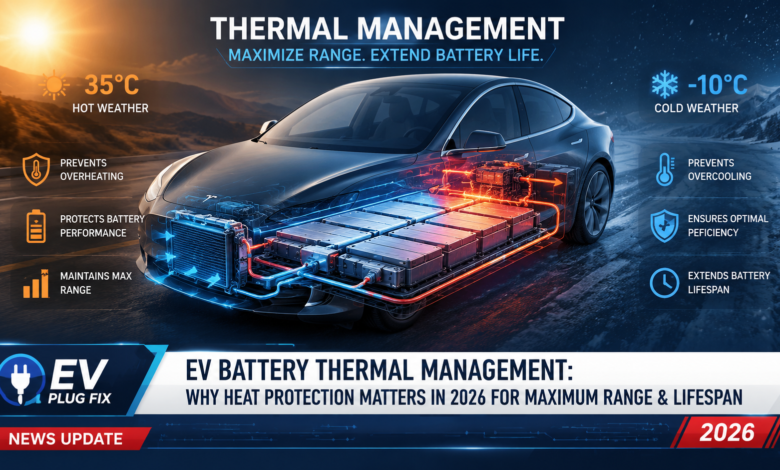
EV battery thermal management is the combination of hardware and software that keeps an electric vehicle’s traction battery within suitable temperature limits. It matters because lithium-ion cells behave differently when they are very hot or very cold, affecting available power, charging speed, efficiency, range and long-term degradation.
There is no single ideal battery temperature that applies to every EV. Cell chemistry, pack design and manufacturer control strategies differ. Instead, the vehicle continuously monitors battery conditions and heats or cools the pack when necessary, particularly during extreme weather, demanding driving and fast charging.
Why Battery Temperature Matters
Lithium-ion batteries rely on chemical reactions and the movement of lithium ions between electrodes. Temperature affects how easily those processes occur, which is why the same battery can behave very differently on a mild day, during intense summer heat or on a freezing winter morning.
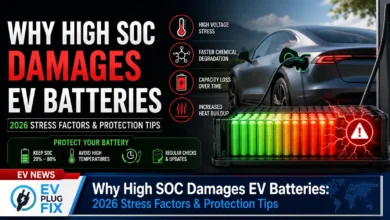
Excessive heat generally accelerates unwanted chemical reactions inside lithium-ion cells. Sustained exposure can contribute to capacity loss and increased internal resistance, especially when the battery also spends long periods at a high
state of charge.
Cold creates a different problem. Electrochemical reactions slow and internal resistance increases, temporarily reducing available power and usable energy. Much of this cold-weather performance loss can recover as the battery warms, so reduced winter range does not necessarily indicate permanent degradation.
Charging a cold battery requires particular care. At sufficiently low cell temperatures and high charging rates, lithium can deposit on the anode surface instead of being stored normally within its structure. This process, known as lithium plating, can permanently reduce battery capacity. Modern EVs therefore may restrict charging power until the pack has warmed sufficiently.
How EV Battery Thermal Management Works
A modern EV typically combines temperature sensors, battery-management software and dedicated heating or cooling hardware. The control system responds to factors such as battery temperature, charging power, vehicle load and ambient conditions.
The exact architecture varies considerably between manufacturers and models. Pack layout, coolant routing, cell chemistry, software calibration and charging strategy can all influence thermal performance, so the cooling method alone does not tell the whole story.
Liquid Cooling
Many current EVs use liquid-based thermal systems. Coolant circulates through plates, channels or other heat-transfer structures positioned close to the battery cells or modules. Heat moves from the battery into the coolant and is then transferred through the vehicle’s thermal circuit.
This approach can provide relatively consistent temperature control across a large battery pack and is well suited to vehicles that support high power output or repeated DC fast charging. However, performance still depends on the design of the complete system rather than simply the presence of liquid cooling.
Air Cooling
Some battery packs use ambient or conditioned air to manage temperature. Air cooling can simplify the system by reducing the need for coolant plumbing and associated components, but air generally transfers heat less effectively than liquid.
That does not automatically make every air-cooled battery unreliable. Vehicle power, battery chemistry, pack construction, climate and charging behavior all matter. The practical limitation is that controlling pack temperature can become more difficult under sustained high loads or demanding environmental conditions.
Refrigerant and Integrated Thermal Systems
Some EV thermal architectures integrate battery conditioning with the vehicle’s refrigerant and heat-pump systems. Depending on the design, this can allow the vehicle to move heat between the battery, cabin, power electronics and outside environment more efficiently.
These integrated systems can be particularly useful when the battery needs active cooling during charging or heating before a cold-weather charging stop. The implementation differs by vehicle, however, so owners should consult documentation for their specific model rather than assume that all EVs behave the same way.
Comparing EV Battery Cooling Systems
| Thermal Approach | Main Advantage | Potential Limitation | Typical Role |
|---|---|---|---|
| Passive cooling | Simple design | Limited active temperature control | Lower-demand battery applications |
| Active air cooling | Relatively simple active cooling | Lower heat-transfer capability than liquid | Selected EV and hybrid designs |
| Liquid thermal management | Effective heat transfer and pack control | Additional pumps, plumbing and components | Common in modern EV battery packs |
| Integrated refrigerant or heat-pump system | Can coordinate battery and cabin thermal needs | Greater system complexity | Advanced integrated EV thermal architectures |
What Happens to an EV Battery in Hot Weather?
Hot weather creates both immediate and long-term challenges. The battery may need active cooling while driving or charging, while sustained high cell temperatures can accelerate degradation over time.
DC fast charging adds another source of heat because high charging power increases thermal load within the pack. If the battery becomes too warm, the vehicle may reduce charging power to protect the cells. This is one reason charging performance can vary even when two sessions use the same charger.
Some EVs may continue running thermal-management equipment while parked or plugged in. Owners may occasionally hear pumps or fans after leaving the vehicle. Whether this happens, and under what conditions, depends on the manufacturer’s control strategy.
Parking in shade or a garage can reduce exposure to extreme environmental heat, but owners generally do not need to manually manage every temperature change. The vehicle’s battery-management system remains the primary protection mechanism.
What Happens to an EV Battery in Cold Weather?
Cold weather can temporarily reduce available battery energy and increase energy consumption elsewhere in the vehicle. Cabin heating, battery heating and increased drivetrain losses can all contribute to lower winter driving range.
The battery itself also becomes less receptive to high charging power when cold. An EV arriving at a fast charger with a cold pack may therefore charge substantially more slowly than the charger’s advertised maximum would suggest.
Once the battery warms, charging power may increase. This is why battery preconditioning has become an important feature on EVs designed around frequent fast charging.
Why Battery Preconditioning Matters Before Fast Charging
Battery preconditioning means deliberately heating or cooling the battery toward a temperature suitable for the task ahead. Depending on the vehicle, preconditioning may occur before departure, before charging or automatically while navigating toward a compatible fast-charging station.
In cold weather, warming the pack can allow the battery to accept higher charging power sooner while reducing conditions that can promote lithium plating. In hot conditions, cooling may be used to keep battery temperature within the vehicle’s operating limits.
Navigation-linked preconditioning can be especially convenient because the vehicle knows that a charging stop is approaching and can begin preparing the battery before arrival. Not every EV supports this feature, and activation requirements differ between models.
How Thermal Management Affects EV Range
Thermal management itself consumes energy. Heating a cold battery or running pumps, fans and refrigeration equipment requires electricity, so some energy that could otherwise propel the vehicle is used for temperature control.
That does not mean battery conditioning is wasteful. Allowing the battery to remain at an unsuitable temperature can reduce efficiency, power availability and charging performance. The vehicle is balancing immediate energy consumption against battery performance and protection.
Winter range loss is particularly noticeable because several effects can occur simultaneously: battery chemistry slows, cabin heating requires energy, the battery may need heating and cold conditions can increase other vehicle losses. Thermal management is therefore only one part of the winter-range equation.
Can Better Thermal Management Extend Battery Life?
Temperature is an important factor in lithium-ion battery aging, but it should not be treated as the only factor determining EV battery lifespan. Cell chemistry, time spent at high state of charge, charging behavior, calendar age and usage patterns also influence degradation.
A capable thermal-management system helps by reducing the amount of time cells spend at undesirable temperatures. This is particularly valuable during fast charging, sustained high-power driving and operation in very hot or cold climates.
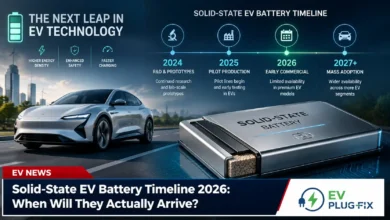
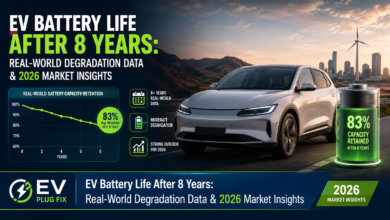
It is therefore too simplistic to assume that one cooling technology guarantees a specific battery lifespan. Two vehicles using liquid cooling, for example, can still differ substantially in cell chemistry, thermal design, software strategy and usable battery buffers. Real-world evidence on EV
battery life after 8 years provides broader context for how battery capacity changes as vehicles age.
Practical Battery Care in Hot Weather
Owners do not need to constantly monitor battery temperature, but a few sensible habits can reduce avoidable heat exposure.
- Use shade or covered parking when practical. This can reduce prolonged exposure to extreme environmental heat.
- Leave the vehicle plugged in when recommended by the manufacturer. Some EVs can use external power for battery conditioning while connected.
- Avoid leaving the battery unnecessarily at a very high state of charge for long periods. Follow the manufacturer’s everyday charging recommendation for your vehicle and battery chemistry.
- Do not worry if charging power falls when the battery is hot. The vehicle may be deliberately protecting the pack.
- Use scheduled charging where useful. Charging during cooler periods can sometimes reduce thermal demand.
Practical Battery Care in Cold Weather
Winter battery care is less about preventing the battery from becoming cold and more about using the vehicle’s built-in conditioning features effectively.
- Precondition while plugged in when possible. External electricity can provide some of the energy needed to warm the vehicle before departure.
- Use navigation-linked battery preconditioning before DC fast charging when your vehicle supports it.
- Expect lower charging power with a cold battery. Charging speed can improve as the pack warms.
- Expect some temporary range reduction. Cold-weather range loss does not automatically mean the battery has permanently lost capacity.
- Follow model-specific guidance. Battery chemistry and thermal strategies vary, so universal charging percentages and temperature rules should be treated cautiously.
Does Fast Charging Damage a Hot or Cold Battery?
Temperature is one reason EVs actively manage DC fast-charging power. The battery management system considers cell conditions before deciding how much charging current the pack should accept.
If the battery is too cold, charging power may initially be restricted. If it becomes too hot, the vehicle may increase cooling or reduce charging power. These interventions can make the charging curve look inconsistent, but they are part of the battery-protection strategy.
Repeated fast charging should therefore be considered alongside temperature, battery chemistry and the manufacturer’s control strategy rather than treated as an isolated cause of degradation. More broadly, charging
habits that affect battery degradation include several factors beyond fast charging alone.
What to Check When Buying an EV
Thermal management deserves attention when comparing EVs, especially if you live in an extreme climate or frequently depend on DC fast charging. Instead of looking only for the phrase “liquid cooled,” consider how the vehicle behaves in real use.
- Does the vehicle support active battery heating and cooling?
- Can it precondition the battery before fast charging?
- Does navigation automatically trigger charging preconditioning?
- How does charging performance change in very hot or cold conditions?
- What everyday charge limit does the manufacturer recommend for that specific battery chemistry?
- What battery warranty applies in your market?
These questions provide more useful information than assuming a particular thermal technology automatically makes one EV superior to another.
Common EV Battery Thermal Management Questions
Does cold weather permanently reduce EV battery capacity?
Usually, much of the immediate range and power reduction experienced in cold weather is temporary. Battery performance improves as the pack warms. Long-term degradation is a separate process influenced by temperature exposure, age, charging behavior and battery chemistry.
Why does my EV fast charge slowly in winter?
A cold battery may not safely accept its maximum charging power. The vehicle can limit current while heating the pack, after which charging power may increase. Battery state of charge, charger capability and other conditions also affect the charging curve.
Should I always charge my EV to only 80%?
No single percentage is appropriate for every EV. Everyday charging recommendations vary by manufacturer and battery chemistry. Follow the guidance provided for your specific vehicle, particularly because some battery chemistries may have different recommended charging routines. A practical guide to how
often to charge an electric car explains how charging frequency and everyday routines can vary.
Is liquid cooling always better?
Liquid cooling provides strong heat-transfer capability and is widely used in modern EVs, but battery durability depends on the complete system. Cell chemistry, pack construction, software, operating limits and charging strategy also matter.
Why does my EV make noises while parked?
Pumps, fans, valves or other thermal equipment may operate while some EVs are parked or charging. This can be normal battery or cabin thermal management, although unusual or persistent noises accompanied by a warning message should be checked according to the vehicle manufacturer’s guidance.
Bottom Line
EV battery thermal management is one of the systems working quietly behind range, charging performance and long-term battery health. Heat can accelerate unwanted aging reactions, while cold temporarily reduces performance and can make high-power charging more difficult.
Modern EVs address those challenges by monitoring battery conditions and controlling heating, cooling and charging power. Owners can help by using preconditioning when available, following model-specific charging recommendations and avoiding unnecessary exposure to extreme conditions where practical.
The most useful lesson is simple: do not judge battery health or charging performance from temperature alone. Battery chemistry, state of charge, vehicle software and thermal-system design work together, and the vehicle’s own battery-management system remains the primary line of protection.
Source Transparency
This article explains established lithium-ion battery and EV thermal-management principles rather than presenting manufacturer claims as independent testing. Exact temperature limits, charging behavior, preconditioning features and recommended charge levels vary by vehicle, battery chemistry, software version and market. Owners should use the manufacturer documentation for their specific EV when making model-specific charging or battery-care decisions.