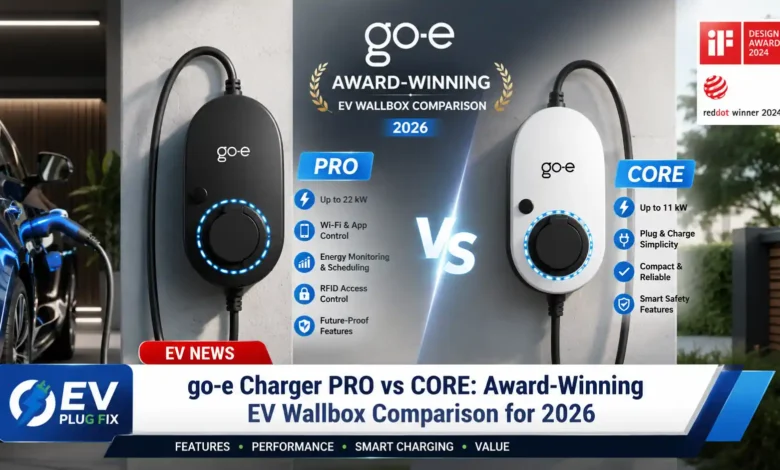
The go-e Charger PRO and go-e Charger CORE are closely related fixed-cable AC wallboxes. For most buyers, the choice comes down to one question: do you need certified energy metering?
The CORE has a basic, non-MID-certified meter for tracking consumption. The PRO CABLE adds an MID-compliant meter, while the PRO CABLE ME is designed to meet German measurement and calibration-law requirements. Charging features, connectivity and solar integration are otherwise broadly similar.
| Feature | go-e Charger CORE | go-e Charger PRO CABLE |
|---|---|---|
| Energy meter | Basic, non-MID meter | MID-compliant meter |
| German measurement and calibration law | No | No; PRO CABLE ME is the compliant variant |
| Charging cable | Fixed 6 m Type 2 | Fixed 6 m Type 2 |
| Power versions | Limited to 11 kW on delivery; installer can increase it to 22 kW where permitted | Sold in 11 kW and 22 kW variants |
| Wi-Fi | Yes | Yes |
| Ethernet/LAN | Yes | Yes |
| Cellular connectivity | 4G LTE with 2G/EDGE fallback | 4G LTE with 2G/EDGE fallback |
| PV surplus charging | Yes, with suitable energy measurement and control | Yes, with suitable energy measurement and control |
| Flexible electricity tariffs | Supported | Supported |
| ISO 15118 preparation | According to go-e, hardware-ready for future Plug & Charge and V2X functionality | According to go-e, hardware-ready for future Plug & Charge and V2X functionality |
| IP rating | IP66 | IP66 |
The Main Difference: Certified Metering
For a private garage where you simply want to track how much electricity the EV uses, the CORE’s basic meter may be all you need. You can monitor charging consumption without paying specifically for certified metering.
The PRO CABLE is aimed at installations where measured charging energy needs more formal documentation. Its integrated meter is MID compliant. MID refers to the European Measuring Instruments Directive, and this type of certified measurement can be relevant for company-car reimbursement and some shared or business charging arrangements.
An MID meter does not automatically make a charger suitable for every billing scenario. Rules for reimbursement, tenant charging and electricity resale vary between countries and use cases, so anyone relying on the meter for billing should check the requirements that apply locally.
When the PRO CABLE ME Makes Sense
For Germany, go-e also offers the PRO CABLE ME. This version is designed to comply with German Mess- und Eichrecht measurement and calibration requirements as well as MID requirements.
That makes the ME model the relevant option when a German charging setup specifically requires measurement-and-calibration-law-compliant charging data. The standard PRO CABLE and PRO CABLE ME should not be treated as interchangeable for every German billing application.
Charging Power: CORE vs PRO
Both families include configurations capable of up to 22 kW, but they reach that figure differently. The CORE is limited to 11 kW when delivered, and go-e states that an installer can increase it to 22 kW where the electrical installation and local rules allow. The PRO CABLE is sold in separate 11 kW and 22 kW variants.
The wallbox rating is only one part of charging speed. The property’s electrical supply and the EV’s onboard AC charger can set a lower limit. An EV that accepts a maximum of 11 kW AC will not charge at 22 kW simply because it is connected to a 22 kW wallbox.
Smart Charging, Solar and Load Management
The CORE and PRO share most of the features that make go-e’s current fixed-cable chargers more than simple wallboxes. Both support remote monitoring and control, charging schedules, RFID access, flexible electricity-tariff functions and load management.
Current go-e specifications also list Wi-Fi, Ethernet and 4G LTE cellular connectivity with 2G/EDGE fallback. Integration options include HTTP API, MQTT, OCPP 1.6 JSON and Modbus TCP. If the charger needs to work with a particular building-management, charging-backend or home-energy system, compatibility should still be checked before purchase.
Both chargers can also use surplus solar generation. They need information about what is happening elsewhere in the property, however, rather than independently determining how much spare PV power is available. That measurement and control can come from the go-e Controller or a compatible third-party energy-management setup. A dedicated guide to PV surplus charging with go-e explains how this type of solar integration works.
Dynamic charging based on changing household or building demand similarly requires the necessary measurement and control equipment. For a home with solar, the PRO therefore has no inherent advantage simply because of PV charging; its main extra value remains certified metering.
ISO 15118, Plug & Charge and V2X
According to go-e, both the CORE and PRO are hardware-ready for future Plug & Charge and V2X functionality using ISO 15118-related communication. That wording describes hardware preparation; it should not be read as certification of complete ISO 15118 functionality or a promise that every feature is usable today.
Future Plug & Charge or bidirectional charging operation also depends on compatible vehicles, software and other parts of the charging setup. Because the CORE and PRO have the same broad hardware preparation here, V2X is not a meaningful reason to choose one over the other today.
Installation and Everyday Use
Both products have a permanently attached 6-metre Type 2 cable. For routine home or workplace charging, that means plugging in without retrieving a separate cable from the car. The downside is less flexibility if the parking position later changes and a different cable length would be more convenient.
The wallboxes allow power-cable entry from different directions, including above, below or behind, which gives the electrician options when planning the installation. Both are rated IP66.
Installation requirements still depend on the property. Supply capacity, cable sizing, electrical protection, earthing and any local utility requirements need to be assessed separately from the charger’s headline power rating. These are also central considerations in a home EV charger installation.
A Brief Note on Design Awards
The PRO family has also received design recognition. The go-e Charger PRO CABLE received an iF Design Award in 2025, while the PRO CABLE ME was named a German Design Award 2026 winner in the Excellent Product Design, Automotive Parts and Accessories category. These awards apply to the specified PRO products and are not a practical reason on their own to choose PRO over CORE.
Which go-e Charger Should You Buy?
| Your Use Case | Best Fit | Why |
|---|---|---|
| Private home charging | CORE | You want the smart features and consumption tracking but do not need MID-certified measurement. |
| Charging where MID-certified measurement is needed | PRO CABLE | The integrated MID-compliant meter can support use cases that require certified energy measurement. |
| German installation requiring Mess- und Eichrecht compliance | PRO CABLE ME | This variant adds the measurement and calibration-law compliance intended for those applications. |
For landlords, employers and fleet operators, the meter should not be the only consideration. User access, backend compatibility, billing, available electrical capacity and load management all need to fit the planned charging setup.
FAQ
Do I need the PRO for company-car charging at home?
Not necessarily. The required meter depends on the employer’s reimbursement method and the rules that apply in the relevant country. The PRO CABLE provides MID-compliant measurement, but buyers should confirm what their employer or reimbursement process actually requires before choosing a charger.
Can the CORE be upgraded from 11 kW to 22 kW?
go-e states that the CORE is limited to 11 kW when delivered and that an installer can increase it to 22 kW. Whether 22 kW can actually be used depends on the electrical installation, local requirements and the vehicle’s AC charging capability.
When would I need the PRO CABLE ME instead of the regular PRO CABLE?
The PRO CABLE ME is intended for German installations that require compliance with measurement and calibration law. A standard MID-compliant PRO CABLE should not automatically be assumed to satisfy those use cases.
Bottom Line
For most private home installations, the CORE provides the important smart, connectivity and solar features without adding certified metering that may never be needed. Choose the PRO CABLE when MID-compliant measurement has a real purpose, or the PRO CABLE ME when the German installation specifically requires its additional metering compliance.
Sources
Product features and metering distinctions were checked against go-e product information, technical documentation and support material available in August 2026. Design-award details were checked against the relevant award organizations. Buyers should confirm current regional specifications, software availability and local metering requirements before installation.