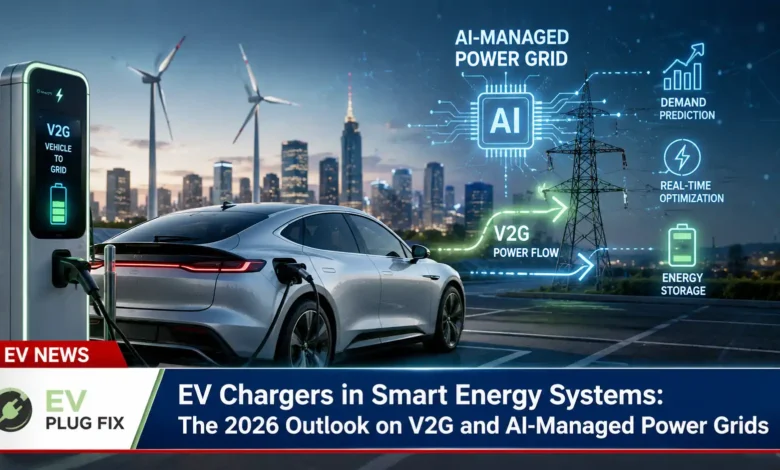
An EV charger can do much more than deliver electricity to a car. Connected to the right hardware and software, it can schedule charging around electricity prices, respond to a home’s total electrical load, use surplus solar generation and, in some installations, send energy from an EV back to a home or the electricity grid.
That makes smart EV charging an increasingly important part of home energy management and grid planning. But the technology is not one universal system. Smart charging, vehicle-to-home (V2H), vehicle-to-grid (V2G), Plug & Charge and solar integration have different hardware, communication and regulatory requirements.
For buyers, the distinction matters. A charger advertised as “smart” is not automatically bidirectional, and an EV capable of exporting electricity cannot necessarily provide home backup with any bidirectional charger.
What Makes an EV Charger Part of a Smart Energy System?
Basic charging is essentially one-way: electricity moves from the grid to the vehicle. Smart charging adds control over when and how quickly that electricity is delivered.
A connected charger or energy management system can potentially consider several inputs:
- Electricity tariffs: Charging can be moved into cheaper periods where the applicable tariff supports time-based pricing.
- Household demand: Dynamic load management can reduce EV charging power when other high-load appliances are operating.
- Solar generation: Compatible systems can increase charging when rooftop solar has surplus production.
- Grid or utility signals: Participating systems may alter charging in response to demand-response programs or other external signals.
- Vehicle requirements: The system can work toward a required departure time or target state of charge rather than simply charging immediately at maximum available power.
The intelligence may reside in the charger, a separate home energy management system, a utility or charging-network platform, the vehicle, or a combination of them.
V2H, V2G and V2L Are Not the Same Thing
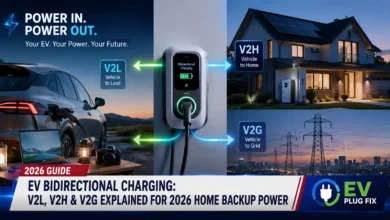
Bidirectional charging is often used as a broad term, but there are several distinct ways an EV can export energy.
| Technology | Where the Energy Goes | Main Use |
|---|---|---|
| V2L | Electrical appliances or equipment | Portable power |
| V2H | Home electrical system | Home backup and energy management |
| V2B | Commercial building | Building energy management |
| V2G | Electricity grid | Grid services and energy export |
V2L is generally the simplest because it can provide AC power directly from suitable outlets or an adapter without turning the entire home into an islanded electrical system.
V2H is considerably more involved. A home must be able to disconnect safely from the grid during an outage so that the EV does not energize utility lines. The installation therefore requires compatible power-conversion, control and isolation equipment in addition to a vehicle that supports the required form of bidirectional operation.
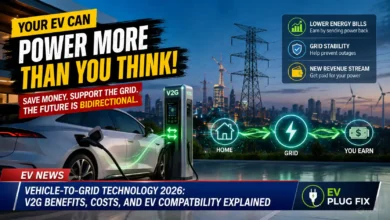
V2G adds another layer. Sending electricity to the public grid can depend on utility programs, interconnection requirements, metering, tariffs, local regulations and approval of the relevant equipment. A technically bidirectional vehicle and charger therefore do not guarantee that an owner can participate in V2G.
Vehicle-to-Home Charging Is Already Available, but Compatibility Is Limited
V2H is no longer purely experimental. Commercial home-backup systems are available, particularly in North America, but they remain strongly dependent on the vehicle and energy ecosystem.
For example, Tesla says Cybertruck can provide home backup through Powershare at up to 11.5 kW. Tesla’s system requires compatible home equipment, and the company currently lists Powershare availability for Cybertruck rather than its Model S, Model 3, Model X or Model Y. Tesla states that a fully charged Cybertruck can provide more than three days of home backup under its specified usage assumptions. Tesla Powershare information
GM Energy takes a similar ecosystem approach. Its PowerShift Charger and V2H Enablement Kit can provide backup power from compatible GM EVs to a properly equipped home. The enablement kit includes a Home Hub, inverter and a small dark-start battery, while GM lists the system’s backup power at 9.6 kW. GM’s list of V2H-capable vehicles now covers numerous Chevrolet, GMC and Cadillac EVs, although capability can depend on model year, vehicle hardware and software. GM Energy V2H system
These systems illustrate the main limitation facing consumers: bidirectional capability still needs to be checked as a complete chain. The car, charger, inverter or power-conversion hardware, home isolation equipment, software and local electrical requirements all have to work together.
How Much Home Backup Can an EV Actually Provide?
An EV can store substantially more energy than many dedicated residential batteries, but battery capacity alone does not determine backup duration.
Actual runtime depends on the usable energy available for export, the vehicle’s discharge limit, conversion losses and, most importantly, household consumption. Heating, air conditioning, electric water heating and cooking can consume energy far faster than a home running only refrigeration, lighting, communications and other selected loads.
Maximum output power is another separate limit. A large EV battery may contain enough energy to run essential loads for an extended period while still being unable to start or operate every high-power appliance simultaneously.
Manufacturer backup-duration claims should therefore be read together with their test assumptions rather than treated as a fixed number of days for every household.
How Solar and EV Charging Work Together
Solar-aware EV charging is one of the more practical applications of home energy management because it does not require the vehicle to export energy.
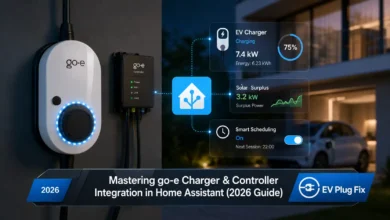
A compatible system can monitor power flowing between the home and grid and vary charging power according to available solar generation. Instead of charging at a fixed rate while excess solar is exported, the charger can direct some or all of that surplus into the car. This approach is commonly known as surplus solar EV charging.
The best strategy depends on the owner’s electricity tariff. Exporting solar can sometimes be financially preferable to putting it into the vehicle, particularly where export compensation is attractive. In other markets, self-consumption may be more valuable.
Adding V2H creates more options. In principle, a system could charge the vehicle during periods of surplus solar or low electricity prices and later use some of that stored energy for the home. Whether this is practical depends on vehicle support, local rules, battery reserve requirements and the economics of the tariff.
Where AI Fits Into EV Energy Management
Artificial intelligence is frequently used as a catch-all description for energy optimization, although many useful smart-charging functions can be handled by conventional rules and optimization software.
More advanced systems can use forecasts and historical data to predict household demand, renewable generation, charging requirements or electricity prices. A controller can then determine when to charge an EV, how much power to allocate and, where bidirectional operation is available, whether stored energy should be retained or exported.
A useful system might consider tomorrow’s expected solar generation before deciding whether to charge an EV fully overnight. Fleet software can perform a similar calculation across many vehicles while considering departure schedules and site power limits.
The important buying question is not whether a product carries an “AI” label. It is what data the system can access, which devices it can control, whether the optimization can be overridden and what happens if its internet or cloud connection fails.
OCPP and ISO 15118 Solve Different Parts of the Problem
Two standards appear repeatedly in discussions of intelligent EV charging: OCPP and ISO 15118. They are complementary rather than interchangeable.
OCPP, developed by the Open Charge Alliance, primarily handles communication between a charging station and a charging-station management system. It supports functions such as charger management, transactions and smart charging.
OCPP 2.0.1 expanded security, device management, smart-charging and ISO 15118 support compared with earlier versions. Full OCPP 2.0.1 certification, including optional profiles such as Smart Charging and ISO 15118 Support, became available in 2025. Open Charge Alliance OCPP 2.0.1 certification
ISO 15118 covers communication between the EV and EV charging equipment. It is the standard family associated with features including Plug & Charge. ISO 15118 defines communication requirements and message sequences for bidirectional power transfer. ISO 15118 overview
The distinction becomes particularly relevant with OCPP 2.1. Released in 2025, OCPP 2.1 adds support for ISO 15118, bidirectional charging functionality, distributed energy resource control and improved smart charging. Open Charge Alliance OCPP overview
Support for a standard on a specification sheet still does not guarantee that every feature is implemented. Buyers and operators need to check the exact OCPP version, supported profiles, vehicle-side ISO 15118 implementation and certification where relevant.
Plug & Charge Is Related to Smart Charging, but It Solves a Different Problem
Plug & Charge allows a compatible vehicle and charging station to handle authentication automatically rather than requiring the driver to identify themselves with an RFID card, payment card or charging app for every session.
It relies on certificates and a public-key infrastructure behind the user-facing experience. CharIN is also developing the Open Plug & Charge Network Communication Protocol, or OPNC, as a neutral API intended to improve interoperability among Plug & Charge stakeholders and multiple PKI ecosystems. CharIN Plug & Charge information
This should not be confused with V2G. A charger may support Plug & Charge without supporting bidirectional energy flow, while a bidirectional system has additional power-electronics and grid-integration requirements.
Can Smart Charging Help the Electricity Grid?
EVs create significant electrical demand, but much of that demand is flexible because many cars remain connected for longer than they actually need to charge.
That flexibility allows managed charging to move demand away from constrained periods without necessarily reducing the energy delivered to the driver. At a home level, load management can prevent the charger from competing unnecessarily with other large loads. Across a fleet or charging site, the same principle can keep aggregate demand within an electrical connection limit.
Vehicle-to-grid technology could extend that flexibility by allowing suitable EVs to export energy, but it is a more demanding proposition than simply delaying charging. Commercial deployment depends not only on technical standards but also on utility programs, market rules, interconnection procedures and a financial case that makes participation worthwhile.
What to Check Before Buying a Smart or Bidirectional Charger
The phrase “future-ready” is not enough when choosing charging equipment. Owners considering solar integration, V2H or eventual V2G should verify the functions they actually need.
- Vehicle compatibility: Confirm the exact model and model year support the desired charging or export feature.
- Bidirectional capability: Do not assume a smart charger can export power simply because it has network connectivity.
- Home backup hardware: V2H may require an inverter, gateway, transfer equipment, dedicated controls or other manufacturer-specific components.
- Solar integration: Check which meters, inverters and energy-management platforms are supported.
- Protocol versions: Look beyond an OCPP or ISO 15118 logo and identify the supported version and relevant functions or profiles.
- Local approval: Electrical, utility and interconnection requirements vary by jurisdiction, particularly for equipment that can energize a home or export to the grid.
- Offline behavior: Find out whether essential charging and home-backup functions continue if cloud connectivity is unavailable.
- Software dependence: Consider whether important features require a subscription, manufacturer cloud service or specific electricity provider.
Essential Questions & Expert Answers
Does every smart EV charger support V2G?
No. Most smart chargers are still unidirectional. Features such as scheduling, dynamic load balancing and solar charging do not imply that a charger can send electricity from the EV back to a building or grid.
Can any EV with a large battery provide home backup?
No. Battery capacity is only one requirement. The vehicle must support the appropriate energy-export function, and the home needs compatible charging, power-conversion, isolation and control equipment. Support can also vary between model years and markets.
What is the difference between OCPP and ISO 15118?
OCPP primarily connects the charging station with its management backend. ISO 15118 handles digital communication between the vehicle and charging equipment. Modern charging ecosystems can use both standards for different parts of the same charging session.
Is V2H the same as V2G?
No. V2H supplies a home from the EV, commonly for backup or energy management. V2G involves exporting energy or providing services to the electricity grid and can require additional utility approval, metering and market arrangements.
Can an EV completely replace a home battery?
It can perform some of the same functions when a compatible V2H system is installed, but the two are not equivalent. An EV can leave the property, while a stationary battery remains connected. Compatibility, output power, reserve settings and backup architecture also affect what each system can do.
Bottom Line
Smart EV charging is moving from simple scheduled charging toward coordinated energy management. Solar-aware charging and dynamic load control are already practical options for many installations, while commercial V2H systems show that an EV can also become a substantial source of home backup energy.
V2G is the more complex next step. Standards such as ISO 15118 and OCPP 2.1 provide important technical foundations, but standards alone do not create universal interoperability. Vehicles, chargers, home equipment, software, utilities and local regulations still have to align.
If you are buying equipment today, prioritize functions that are documented and supported for your exact vehicle and market. Treat broader promises of future V2G or universal bidirectional compatibility as potential upgrades rather than guaranteed features unless the manufacturer provides a specific supported path.
Source Transparency
This article was checked against primary technical and manufacturer information available in August 2026. Key references include the Open Charge Alliance for OCPP capabilities, the International Organization for Standardization for ISO 15118, CharIN for Plug & Charge and OPNC, Tesla for Cybertruck Powershare specifications, and GM Energy for its current V2H equipment and compatibility information.
Manufacturer performance and backup-duration statements are presented as manufacturer claims rather than independent test results. V2H and V2G availability can change with vehicle software, equipment certification, utility programs and regional regulations, so compatibility should be confirmed before purchase or installation.