
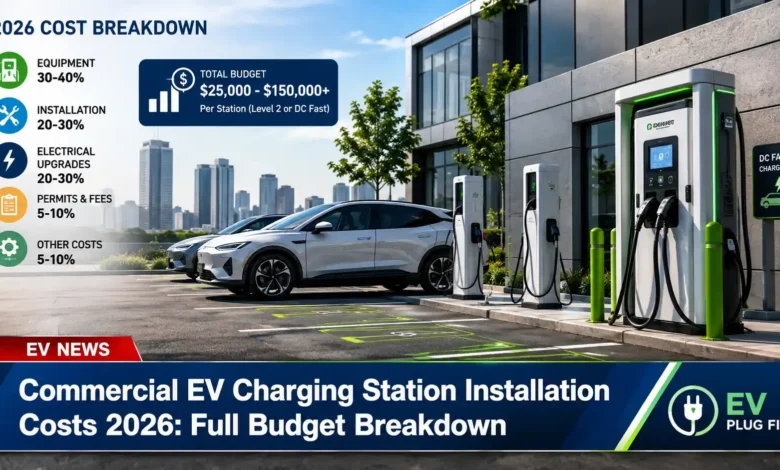
Commercial EV charging installation costs are easy to underestimate because the charger is only one part of the project. Electrical service, transformers, switchgear, trenching, concrete, permitting, accessibility work, networking and ongoing operating expenses can collectively cost as much as—or considerably more than—the EVSE itself.
That is why two businesses installing the same charger model can receive dramatically different project quotes. One site may have spare electrical capacity a few feet from the parking spaces. Another may require a new transformer, long underground conduit runs and major pavement restoration.
Do not budget a commercial EV charging project by multiplying charger price by the number of ports. Start with the site: available electrical capacity, charger power, distance from the electrical source, civil work and utility requirements. Hardware is one budget line; infrastructure determines whether the project is straightforward or expensive.
How Much Does a Commercial EV Charging Station Cost to Install?
There is no reliable universal price per charging port.
Published cost ranges can be useful for early planning, but they should not be treated as universal current prices. Site conditions, utility work, labor, charger power and civil construction can move the final budget substantially.
A better way to estimate a project is:
Total installed cost = EVSE hardware + electrical infrastructure + utility work + civil/site work + engineering/permitting + networking/payment equipment + commissioning + contingency
Then calculate operating costs separately.
Annual operating cost = electricity + demand charges + network/software + payment processing + connectivity + maintenance + site/lease costs + insurance + other operating expenses
This framework works for a two-port workplace installation as well as a multi-charger DC fast-charging site.
Why Charger Price Is a Poor Estimate of Project Cost
Commercial owners often begin by shopping for chargers.
That reverses the ideal sequence.
Before selecting equipment, you need to know what the site can support and what charging service the business actually needs.
| Cost Category | Examples | Variability |
|---|---|---|
| EVSE hardware | Charger, pedestal, cable management | Moderate |
| Electrical | Panels, breakers, wiring, conduit, switchgear | High |
| Utility infrastructure | Service upgrades, transformers, interconnection | Very high |
| Civil work | Trenching, boring, concrete, asphalt restoration | Very high |
| Engineering & permits | Design, drawings, permitting, inspections | Location-dependent |
| Accessibility & site equipment | Accessible routes, signage, bollards, striping | Site-dependent |
| Software & networking | Backend, cellular connection, payment services | Recurring |
| Maintenance | Preventive service, repairs, replacement components | Recurring |
Level 2 vs DC Fast Charging Costs
The most important cost distinction is usually not the charger brand. It is the charging architecture.
Commercial Level 2 Charging
Level 2 charging generally requires much less electrical power per port than DC fast charging.
That can make it appropriate for locations where vehicles remain parked for extended periods, including:
- workplaces;
- hotels;
- multifamily properties;
- employee parking;
- long-dwell retail locations; and
- some fleet applications.
The charger itself may be relatively affordable, but installation costs can still rise substantially when parking is far from the electrical room or existing capacity is limited.
DC Fast Charging
DC fast charging moves the power-conversion equipment outside the vehicle and requires significantly more site power.
As charger output rises, projects may require:
- larger electrical service;
- dedicated transformers;
- substantial switchgear;
- larger conductors;
- equipment pads;
- utility coordination;
- demand management; and
- more extensive commissioning.
For that reason, comparing a Level 2 project with a high-power DC fast-charging project only on a “cost per port” basis is often misleading.
Our AC-to-DC conversion in EV charging guide explains how dwell time and use case should influence that choice.
The Eight Major Commercial EV Charging Cost Categories
1. Charger Hardware
Hardware is the most visible expense because it is the easiest item to price before site engineering begins.
Depending on the project, hardware may include:
- EVSE;
- pedestals or wall mounts;
- charging cables;
- cable-management systems;
- payment terminals;
- RFID readers;
- communications hardware; and
- power cabinets or modules for DC systems.
Do not compare hardware solely by purchase price.
For commercial deployment, evaluate warranty, spare-parts availability, serviceability, software compatibility and expected support life as well.
2. Electrical Infrastructure
This is frequently one of the largest sources of cost variation.
Electrical work can include:
- new branch circuits;
- conduit;
- conductors;
- breakers;
- distribution panels;
- switchboards;
- transformers;
- disconnect equipment; and
- metering.
The key question is not simply:
“Does the building have electricity?”
It is:
“How much additional electrical load can the site support where and when the chargers need it?”
3. Utility Upgrades
A site may not have enough existing service capacity for the planned charging load.
Depending on the project and utility, additional work might include:
- service upgrades;
- a new or larger transformer;
- new utility conductors;
- meter changes;
- interconnection engineering; or
- other utility-side construction.
This can affect both project cost and schedule.
Planning rule: For high-power commercial charging, investigate utility capacity before treating a site as financially approved.
4. Trenching and Conduit
Distance matters.
A charger beside an electrical room is fundamentally different from a charger installed across a large paved parking lot.
Underground routing may require:
- saw cutting;
- excavation;
- conduit;
- backfill;
- concrete or asphalt restoration;
- traffic management; and
- landscape repair.
The original article used a fixed $75–$150-per-foot trenching estimate.
Actual bids can vary substantially with location, surface, depth, utility conflicts, labor costs and restoration requirements, so project-specific contractor pricing is more useful than a universal per-foot assumption.
5. Civil and Site Work
Trenching is not the only civil expense.
A commercial installation may also require:
- equipment foundations;
- charger pedestals;
- bollards;
- wheel stops;
- parking-space modifications;
- signage;
- striping;
- lighting;
- drainage work; and
- landscaping restoration.
6. Engineering, Permits and Inspections
Commercial charging projects often require more design work than residential installations.
Potential soft costs include:
- electrical engineering;
- civil engineering;
- site plans;
- permit applications;
- utility coordination;
- project management;
- inspection fees; and
- commissioning documentation.
Requirements vary significantly by jurisdiction and project size.
7. Accessibility Requirements
Commercial EV charging projects must account for applicable accessibility requirements rather than treating accessibility as a small generic allowance.
Costs can be affected by:
- parking-space dimensions;
- accessible routes;
- curb ramps;
- charger reach;
- operable-part placement;
- bollard positioning;
- signage; and
- surface slope.
The correct requirements depend on jurisdiction and project type, so accessibility should be incorporated during site design—not added after construction.
8. Network, Payment and Operating Costs
The project does not stop costing money when construction ends.
Networked commercial charging can involve recurring expenses for:
- charger-management software;
- cellular connectivity;
- payment processing;
- roaming services;
- customer support;
- maintenance;
- replacement parts;
- electricity; and
- utility demand charges where applicable.
Our guide to networked EV charger management covers the operational side in more detail.
Commercial Charging Budget Template
Instead of starting with a single cost-per-port assumption, build the project budget in layers.
| Budget Line | What to Enter |
|---|---|
| EVSE hardware | $_____ |
| Mounting/cable equipment | $_____ |
| Electrical distribution | $_____ |
| Utility/service upgrade | $_____ |
| Transformer/switchgear | $_____ |
| Trenching/conduit | $_____ |
| Concrete/asphalt restoration | $_____ |
| Accessibility/site modifications | $_____ |
| Engineering/design | $_____ |
| Permits/inspections | $_____ |
| Networking/payment setup | $_____ |
| Commissioning | $_____ |
| Contingency | $_____ |
| Total installed cost | $_____ |
This forces every major category into the conversation before the project receives final approval.
A Better Way to Calculate Cost per Port
Cost per port is useful after the total project has been estimated.
Installed cost per port = total installed project cost ÷ number of charging ports
For example, consider an illustrative project—not a market-price estimate:
| Item | Illustrative Cost |
|---|---|
| Charging hardware | $24,000 |
| Electrical work | $18,000 |
| Civil/site work | $12,000 |
| Engineering/permitting | $5,000 |
| Networking/commissioning | $3,000 |
| Contingency | $8,000 |
| Total | $70,000 |
If the project creates eight charging ports:
$70,000 ÷ 8 = $8,750 per port
If unexpected utility work increases the project to $110,000:
$110,000 ÷ 8 = $13,750 per port
The chargers did not change. The site infrastructure did.
These figures are EV Plug Fix calculation examples only and are not quotations or predictions of current installation prices.
Why Two Identical Chargers Can Have Completely Different Installed Costs
Consider two hypothetical businesses installing four identical Level 2 ports.
Site A
- spare panel capacity;
- parking beside electrical room;
- short conduit runs;
- minimal pavement disturbance; and
- straightforward permitting.
Site B
- insufficient existing capacity;
- parking 200 feet from electrical equipment;
- paved trench route;
- service upgrade required; and
- significant site modifications.
The hardware invoice can be identical while total installed costs differ substantially.
This is why searching for the “average commercial EV charger installation cost” can provide only an initial planning reference—not a project budget.
The Biggest Budget Question: Do You Have Enough Electrical Capacity?
Before selecting charging power, determine what the site can support.
Suppose a business wants ten 11.5 kW Level 2 chargers.
If all ten were theoretically operating at maximum output simultaneously:
10 × 11.5 kW = 115 kW
That does not automatically mean the site must dedicate 115 kW under every design, because charging demand may be managed dynamically.
But the operator needs to understand the site’s actual charging requirement before deciding how much infrastructure to build.
Can Load Management Reduce Installation Cost?
Potentially.
Smart load management can control how much power multiple chargers use simultaneously.
Consider another simplified example.
Eight chargers rated at 11.5 kW each have a combined theoretical maximum of:
8 × 11.5 kW = 92 kW
If the vehicles’ operational requirements can be met with a managed 50 kW charging budget, a suitable system could allocate that capacity among connected vehicles instead of allowing every charger to request maximum output simultaneously.
This does not create additional electricity.
It changes how available capacity is shared.
That can sometimes reduce or defer electrical upgrades, depending on the site and charging requirements.
For more on this approach, see our guide to dynamic load balancing.
But Load Management Can Also Become a False Economy
Restricting site power too aggressively can reduce charging performance.
For workplace charging with eight-hour dwell times, that may be acceptable.
For a busy public fast-charging site where drivers expect short sessions, insufficient power can reduce throughput and revenue.
Do not minimize electrical infrastructure simply because software can restrict charger power. Size the site around the charging service customers or fleet vehicles actually require.
How Dwell Time Changes the Economics
The vehicle’s expected parking time should influence charger selection before equipment is purchased.
| Use Case | Typical Charging Need | Planning Priority |
|---|---|---|
| Workplace | Long dwell | More ports may matter more than extreme power |
| Hotel | Overnight dwell | Reliable overnight energy delivery |
| Retail | Short-to-medium dwell | Match power to visit duration |
| Highway | Short dwell | High throughput and fast charging |
| Fleet depot | Known return/departure windows | Vehicle readiness by departure |
A lower-power charger that reliably delivers the energy required before departure can be a better investment than an unnecessarily high-power charger.
Demand Charges Can Change the DC Fast-Charging Business Case
Commercial electricity bills may include more than energy consumption measured in kWh.
Depending on the utility tariff, the business may also face demand charges associated with peak power use.
That makes DC fast charging economics particularly sensitive to:
- peak charger demand;
- charger utilization;
- time-of-use rates;
- load management;
- onsite generation; and
- battery storage.
Before approving a DC fast-charging project, obtain the applicable commercial tariff and model the site’s expected load profile rather than multiplying expected kWh by an electricity rate alone.
Should You Use Battery Storage to Avoid a Grid Upgrade?
Battery-buffered charging can be useful where grid capacity is constrained, but it is not automatically cheaper.
A battery system adds its own:
- capital cost;
- power electronics;
- controls;
- installation;
- maintenance;
- thermal management; and
- eventual replacement considerations.
The correct comparison is therefore:
Traditional grid upgrade cost + operating cost
versus
Battery-buffered system cost + available grid service + battery operating/replacement cost
A constrained site may favor storage. A site with inexpensive, readily available utility capacity may not.
Commercial EV Charging Tax Credit: An Important 2026 Change
U.S. project owners need to be particularly careful with outdated articles about the federal Alternative Fuel Vehicle Refueling Property Credit under Section 30C.
Current IRS guidance says the credit is not available for qualified refueling property placed in service after June 30, 2026. The termination date was accelerated from the previously scheduled December 31, 2032 date.
For qualifying business property placed in service during the eligible period, the IRS describes a credit generally equal to 6% of qualified cost, potentially increasing to 30% when prevailing-wage and apprenticeship requirements are met, subject to the applicable rules and $100,000 per-item limit. Eligibility also depends on location in a qualifying census tract and other requirements.
Because it is now August 2026, a new commercial charging project placed in service today should not be budgeted on the assumption that it will receive Section 30C.
Check current IRS guidance before relying on any federal tax-credit assumption.
State and Utility Incentives Still Need Project-Specific Research
The end of federal 30C eligibility for newly placed-in-service projects does not mean every charging incentive has disappeared.
Depending on location, projects may still encounter:
- utility make-ready programs;
- state rebates;
- local programs;
- fleet-specific programs;
- public charging grants; or
- other infrastructure funding.
But incentive availability changes frequently.
Do not place a rebate into the project’s financing model until eligibility, funding availability, application timing and equipment requirements have been confirmed.
Our EV charging grants and funding guide provides a starting point for researching available programs.
Capital Cost vs Operating Cost
Choosing the cheapest installation can produce a more expensive network over its lifetime.
Evaluate both:
CAPEX = cost to design, buy, construct and commission the charging site
and:
OPEX = cost to operate, power, network, maintain and support it
Five-Year Cost Framework
A simple ownership model is:
5-year ownership cost = initial installed cost + five years of software + maintenance + connectivity + site operating expenses + electricity-related costs
Revenue or avoided fuel cost can then be analyzed separately to calculate the project’s economics.
Commercial EV Charger ROI: Don’t Start With Revenue
Before estimating return on investment, decide what “return” means for the property.
A public charging operator may seek direct charging revenue.
A hotel may value:
- room bookings;
- guest satisfaction;
- longer stays; and
- competitive differentiation.
A workplace may value employee benefits.
A fleet may value fuel savings and vehicle readiness rather than public charging revenue.
A retailer may value customer dwell and store visits.
Different business models therefore require different ROI calculations.
Commercial Charging Cost Reality Check
Before accepting an installation budget, verify these ten items:
- Charger power: What output is actually required?
- Vehicle capability: Can target vehicles use that power?
- Dwell time: How long will vehicles remain connected?
- Existing electrical capacity: What spare capacity is genuinely available?
- Utility scope: Is a service or transformer upgrade required?
- Distance: How far is the charger from its power source?
- Civil conditions: What surfaces must be disturbed and restored?
- Accessibility: What site modifications are required?
- Recurring fees: What will software, connectivity and maintenance cost?
- Future expansion: Will today’s infrastructure support tomorrow’s ports?
If several of these remain unknown, the project probably does not yet have a reliable final budget.
How to Reduce Commercial EV Charger Installation Costs
Cost reduction should come from better design—not simply cheaper equipment.
1. Put Chargers Near Available Power
Shorter electrical routes can reduce conductor, conduit, trenching and restoration requirements.
2. Complete the Electrical Assessment Before Ordering Hardware
Do not discover after equipment arrives that the planned charger power requires an unexpected service upgrade.
3. Match Charger Power to Dwell Time
Installing more power than the use case requires can increase both equipment and infrastructure cost without delivering equivalent business value.
4. Evaluate Load Management
Where operationally appropriate, managed charging can reduce simultaneous peak demand.
5. Design Future Expansion During Phase One
Installing spare conduit, reserving switchgear capacity or designing the electrical system for future expansion may be less expensive than reopening completed construction later.
6. Phase Charger Deployment
If demand is uncertain, building electrical infrastructure for expansion while installing fewer chargers initially can allow utilization data to guide later investment.
7. Compare Total Ownership Cost
A cheaper charger can become expensive if it generates excessive maintenance, lacks remote diagnostics or requires proprietary replacement components.
Where Manufacturers Such as Parwatt Fit Into the Budget
Commercial charging hardware suppliers such as Parwatt can influence hardware architecture and equipment pricing, particularly in DC charging projects.
But the manufacturer does not determine every project cost.
For any supplier, buyers should evaluate:
- charger output;
- modular power architecture;
- OCPP/backend compatibility;
- regional certifications;
- warranty;
- spare-parts availability;
- remote diagnostics;
- service documentation; and
- expected support life.
Supplier quotations and project case studies can provide useful context, but they should be distinguished from independently verified cost evidence.
Ask the charger manufacturer for the hardware price. Ask the engineer, contractor and utility what it will cost to make that hardware work at the actual site. Those are different questions.
Three Quotes You Should Obtain Before Final Approval
For a substantial commercial project, a hardware quotation alone is not enough.
You ideally want visibility into three different cost layers:
1. Equipment Quote
Chargers, mounting hardware, payment equipment and related hardware.
2. Construction Quote
Electrical labor, conduit, conductors, trenching, concrete, foundations and site restoration.
3. Utility Scope
Any utility-side service, transformer, interconnection or make-ready work.
Engineering, permitting and recurring operating costs should then be incorporated into the complete project model.
Commercial EV Charging Budget Red Flags
Be cautious if a proposal:
- quotes only charger hardware;
- assumes existing capacity without an electrical assessment;
- uses a generic trenching allowance without measuring the route;
- does not address utility requirements;
- ignores accessibility;
- excludes commissioning;
- does not identify recurring software costs;
- assumes an expired federal tax credit;
- contains no allowance for unknown site conditions; or
- does not consider future expansion.
Bottom Line
The most important number in a commercial EV charging project is not the charger’s purchase price. It is the total cost of creating a reliable charging service at that specific site.
Level 2 charging can be relatively straightforward when electrical capacity is nearby. DC fast charging can require substantially more infrastructure. But in both cases, site conditions determine whether installation is simple or expensive.
Before purchasing equipment:
- define the charging use case;
- determine required power;
- assess existing electrical capacity;
- investigate utility requirements;
- measure electrical routes;
- scope civil and accessibility work;
- model recurring operating costs; and
- plan future expansion.
Once those pieces are known, charger pricing becomes meaningful.
Without them, a low hardware quote can create the illusion of a low-cost project while leaving the largest expenses outside the estimate.
Federal Section 30C information in this guide is based on current IRS guidance as of August 2026. Cost formulas, budget templates, examples, procurement rules and project-evaluation frameworks are EV Plug Fix editorial analysis and are not contractor quotations or nationwide cost forecasts. Actual commercial EV charging costs depend heavily on site conditions, utility requirements, local labor, permitting and equipment selection. Manufacturer claims should be verified against current technical documentation before procurement.