
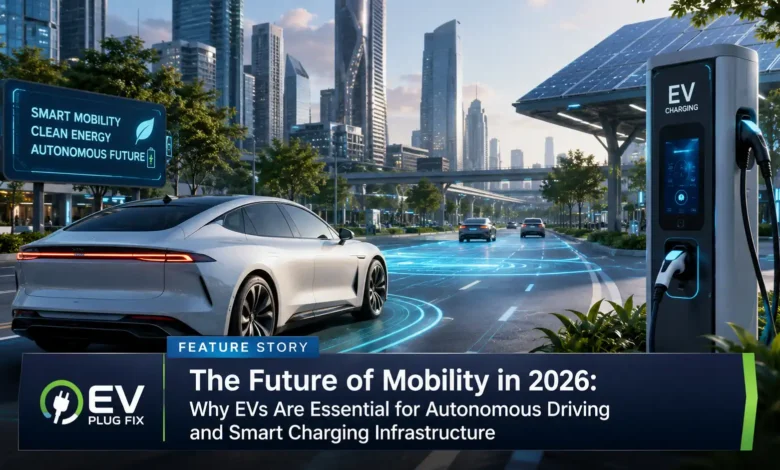
Electric vehicles and autonomous driving are usually discussed as separate changes in the automotive industry. In practice, they increasingly meet in the same vehicles, particularly in commercial robotaxi fleets.
There is no technical rule requiring an autonomous vehicle to be electric. Automated-driving hardware and software can be integrated with other powertrains. Battery-electric vehicles, however, bring several characteristics that suit the job: a large onboard electrical energy source, electronically controlled propulsion, modern computing architectures and the ability to manage energy centrally when vehicles operate as a fleet.
The trend is already visible in commercial deployment. In its 2026 analysis of autonomous vehicles, the International Energy Agency reported that commercial Level 4 robotaxi services were operating in more than 20 cities and that the commercial robotaxi services covered by its analysis used electric vehicles. The IEA also estimated that the global commercial robotaxi fleet had more than doubled to around 8,000 vehicles in 2025.
Those figures describe the market at that point in time; they do not establish that every future autonomous vehicle will be battery-electric. What they do illustrate is how electrification, automation and fleet operations are beginning to reinforce one another.
Why EV Platforms Work Well for Autonomous Driving
An automated-driving system needs much more electrical support than propulsion alone. Depending on the design, the vehicle may carry cameras, radar, lidar, positioning equipment, communications hardware and powerful onboard computers. Those systems must operate reliably while exchanging data with steering, braking and propulsion controls.
Battery-electric vehicles already carry a high-energy traction battery and the power electronics needed to distribute and convert electrical energy throughout the vehicle. That does not mean autonomous-driving electronics run directly from traction-battery voltage; appropriate conversion and low-voltage electrical systems remain necessary. The advantage is that the vehicle begins with a substantial electrical-energy platform capable of supporting propulsion and additional electronic loads.
The IEA also points to the relative simplicity of electric drivetrains as one factor that can support vehicle development and integration. Modern BEV platforms are frequently being designed at the same time that manufacturers are consolidating computing, communications and electronic control.
The useful connection, therefore, is not that a battery makes a vehicle autonomous. It is that an EV can provide a practical electrical and electronic foundation for the sensors, computers and controls on which automated driving depends.
 "Diagram showing how an EV battery supports propulsion, autonomous-driving computers, sensors and charging")
Software-Defined Vehicles Add Another Link
Autonomous driving is fundamentally software-intensive. The vehicle must process sensor inputs, estimate what is happening around it, plan an appropriate path and send commands to vehicle systems while monitoring faults and safety conditions.
Meanwhile, vehicle architecture is changing. Instead of assigning every function to a collection of largely isolated electronic control units, newer designs increasingly use centralized or zonal computing architectures. The goal is to consolidate functions, simplify communications and make software a larger part of how vehicle features are implemented and maintained. This broader shift also helps explain how AI is changing EV design and driving.
This transition is not exclusive to EVs. Internal-combustion and hybrid vehicles can also use advanced centralized computing. The overlap exists because many newer dedicated EV platforms have arrived during the same period in which manufacturers are redesigning vehicle electronics around software.
Over-the-air updates illustrate both the opportunity and the limitation. Software can sometimes be updated without replacing hardware or bringing every vehicle into a workshop, but safety-critical automated-driving functions still require appropriate testing, validation, cybersecurity controls and regulatory compliance. An OTA-capable EV should not be assumed to gain autonomous-driving capability simply through a software download.
Robotaxis Make the Convergence Easy to See
Robotaxis are a particularly useful example because fleet economics differ from private-car ownership. A commercial operator cares about how many useful service hours each vehicle can provide and how much time is lost to charging, maintenance, cleaning and other non-revenue activities.
The IEA reported that commercial robotaxi deployment in 2025 was concentrated mainly in China and the United States, with commercial activity also present in markets including the United Arab Emirates. Operators and developers active in this sector have included Waymo, Baidu, WeRide and Pony.ai, although deployment areas and commercial status can change quickly.
Electric propulsion can fit this operating model, but the drivetrain is only part of the equation. Operators still have to account for vehicle purchase cost, electricity prices, charging availability, charging downtime, battery durability, climate, maintenance and daily utilization.
A robotaxi that spends too much of its operating window waiting for energy is not being used efficiently. That makes the charging system part of broader EV charging network planning rather than simply a place to plug in the vehicle.
Driverless Fleets Create a Charging Challenge
A privately owned EV can be plugged in by its driver and left overnight. A genuinely driverless fleet creates an obvious operational question: who connects the charging cable when the vehicle arrives?
One answer is still a human employee. Another is an automated connection system. Conductive automated connectors, pantographs and robotic connection concepts have been developed for different vehicle and charging applications, although they are not interchangeable and are not universally deployed.
SAE J3105, for example, addresses conductive automated connection devices for electric-vehicle power transfer. The standard family includes configurations relevant to infrastructure-mounted and vehicle-mounted connection systems, with applications particularly suited to vehicles such as buses that follow predictable routes or depot schedules.
This is separate from autonomous driving. An autonomous vehicle can still need a person to connect a conventional charger, while a human-driven electric bus can use an automated charging connection. The operational value appears when a fleet can automate both vehicle movement and routine energy connection.
Why Managed Charging Can Beat Simply Adding Faster Chargers
Charging power matters, but maximum charger output is not necessarily the best measure of a fleet charging system. The more useful question is whether every vehicle can receive the energy it needs before its next scheduled assignment.
The U.S. Department of Energy describes managed charging as a way to coordinate EV charging with operational requirements and electrical conditions. Depending on the site, it can help control peak demand, make better use of available electrical capacity and coordinate charging with other facility loads or local generation.
Dynamic load balancing can help allocate available charging capacity according to demand rather than allowing every parked vehicle to draw its maximum charging power immediately.
Imagine a depot where many vehicles return within the same operating window. If every charger is allowed to reach full output simultaneously, the site’s peak electrical demand can be much higher than necessary. If some vehicles will remain parked for hours while others leave soon, a management system can allocate available capacity accordingly.
For a high-utilization fleet, charging management is therefore part of dispatch and energy planning, not merely a billing or charger-monitoring feature.
Solar and Battery Storage Are Site-Specific Tools
Solar PV and stationary battery storage can play useful roles at some charging depots, but neither is automatically required for an autonomous EV fleet.
On-site solar can supply part of a facility’s electricity when generation coincides with site demand. Stationary storage can shift energy between periods, help manage some peaks or support resilience when designed for those purposes.
Whether either investment makes financial or operational sense depends on the site. Electricity tariffs, demand charges, interconnection limits, available space, solar production, storage cost, charging schedules and fleet energy requirements can materially change the result.
For that reason, solar-plus-storage should not be added simply because a depot contains many EV chargers. Planners should first identify a specific constraint or economic opportunity and then model whether local generation or storage addresses it effectively.
Where Megawatt Charging Actually Fits
Megawatt-scale charging addresses a different problem from typical passenger-car charging. It is primarily relevant to heavy-duty battery-electric vehicles whose large batteries and demanding schedules can make charging time a significant operational constraint.
The Megawatt Charging System (MCS) is being developed for high-power conductive DC charging of commercial vehicles. IEC TS 63379, published in 2026, provides a technical specification for MCS-related vehicle couplers, vehicle inlets and cable assemblies.
Automation is also part of the longer-term MCS development discussion, which could be useful for highly automated freight operations. That does not make MCS the default charging technology for robotaxis. A passenger robotaxi and a long-haul electric truck have very different battery sizes, duty cycles and charging requirements.
A robotaxi depot may be able to maintain utilization with appropriately sized conventional DC chargers and careful scheduling. A heavy truck with a much larger energy requirement may need substantially higher charging power during a limited dwell period.
Autonomous Trucks Have a Different Energy Problem
Autonomous trucking could make charging time especially important because vehicle productivity is closely tied to route schedules and asset utilization. Automation may change some driver-related operating constraints, but it does not remove the truck’s need for energy.
An electric autonomous-truck operator would still need to consider route consumption, battery capacity, charging dwell time, charger availability, the vehicle’s charging curve and electrical capacity at depots or corridor charging sites.
MCS is intended to address the need for much higher charging power in heavy-duty applications. Battery swapping is another approach used or evaluated in some markets, but it requires compatible vehicle designs and substantial supporting infrastructure. Its suitability depends on the operating model and should not be assumed for autonomous freight in general.
The important point is that autonomous freight and autonomous passenger transport may share software and sensing technologies while requiring very different charging networks.
The Grid Becomes Part of Fleet Planning
Large EV fleets can create significant electrical loads regardless of whether the vehicles drive themselves. High vehicle utilization can make the challenge more demanding because charging must fit into narrower operating windows.
For a depot designer, charger nameplate power is only one input. More useful planning questions include:
- How much energy does the fleet need during a normal operating day?
- When are individual vehicles parked long enough to charge?
- What electrical capacity is already available at the site?
- How much charging must actually occur simultaneously?
- Can some charging be shifted to less constrained or less expensive periods?
- Would stationary storage address a documented capacity, resilience or tariff issue?
- What redundancy is required when a charger or electrical component is unavailable?
- How will vehicles connect to chargers if routine fleet operation no longer involves drivers?
Answering those questions can prevent both undersizing and unnecessary overspending. A fleet does not benefit from enormous charger ratings if the site cannot supply them or the vehicles do not need them.
Does Autonomous Driving Mean an Electric Future?
Not automatically. Autonomous-driving technology does not require a battery-electric drivetrain.
The stronger conclusion is that current commercial robotaxi deployment heavily favors electric vehicles and that there are practical reasons for the overlap. EVs offer substantial onboard electrical energy, electronically controlled propulsion and platforms that are often being developed alongside newer computing and software architectures.
Fleet operation adds another incentive. Electricity can be delivered and scheduled at a depot, allowing charging to be coordinated with vehicle dispatch, site loads and available electrical capacity. That becomes increasingly useful as fleets become more automated.
The relationship is therefore a convergence of engineering and operating requirements, not a technical inevitability.
What Charging-Site Planners Should Prioritize
Businesses preparing for automated or increasingly software-controlled fleets should avoid designing a charging site around assumptions about technologies that their vehicles may never use. Infrastructure should begin with measurable operating requirements while leaving practical room for expansion.
| Planning issue | Why it matters |
|---|---|
| Fleet duty cycle | Shows when vehicles can charge and how much energy must be restored between assignments. |
| Site power capacity | Defines how much charging load the facility can support before electrical or utility upgrades are needed. |
| Managed charging | Allows available power to be allocated according to vehicle schedules instead of maximizing simultaneous demand. |
| Charging redundancy | Limits the operational effect of individual charger or equipment failures. |
| Automated connection | Can become important if vehicles routinely arrive without personnel available to connect charging cables. |
| Standards and interoperability | Compatibility should be evaluated against the actual vehicles, chargers, interfaces and regional requirements being deployed. |
| Solar and storage | Should be justified by actual load profiles, tariffs, interconnection limits or resilience requirements. |
One fleet may justify a high-power depot with automated connections and stationary storage. Another may perform better with moderate-power chargers, adequate redundancy and carefully managed charging. The correct design follows the duty cycle rather than a technology checklist.
Essential Questions & Expert Answers
Do autonomous vehicles have to be electric?
No. Autonomous-driving systems can be integrated with different powertrains. Battery-electric vehicles are prominent in today’s commercial robotaxi deployments, but that is an industry trend rather than a technical requirement for autonomy.
Why are so many robotaxis electric?
EV platforms provide substantial onboard electrical energy and electronically controlled propulsion while many are also being developed around newer computing and software architectures. Fleet operators can additionally schedule and manage vehicle charging at centralized facilities.
Can a driverless EV charge itself?
Not unless the vehicle and charging infrastructure include a compatible automated connection system. Autonomous driving and automated charging are separate capabilities. Conductive automated connectors and pantograph systems already exist for certain applications, while robotic and other automated connection approaches continue to develop.
Do autonomous EV fleets need megawatt chargers?
No. Megawatt charging is aimed primarily at heavy-duty vehicles with large energy requirements and limited charging windows. Passenger robotaxis can have very different needs. Charger power should be selected from the vehicle’s charging capability, required energy, available dwell time and site electrical capacity.
Does an autonomous EV depot need battery storage?
No. Stationary storage is useful only when it addresses a defined operational or economic requirement, such as managing certain peaks, working within an electrical constraint, coordinating local generation or providing designed resilience. The business case depends on site-specific costs and operating conditions.
Bottom Line
Electric vehicles are not a technical prerequisite for autonomous driving, but the two technologies fit together unusually well. EVs provide a substantial electrical foundation for computing and sensors, electronically controlled propulsion and vehicle platforms that are evolving alongside software-defined architectures.
Commercial robotaxis provide the clearest current example of that convergence. The infrastructure implications, however, extend beyond the vehicle. High-utilization electric fleets need charging systems designed around energy demand, dwell time, electrical capacity, reliability and operating schedules.
That means the most important charging decision is rarely choosing the biggest charger available. Fleet planners should model how much energy each vehicle needs and when it can receive it, then determine whether smart EV charging, automated connections, higher-power charging, solar or stationary storage solves a specific constraint.
As autonomous fleets expand, the vehicle, charging depot and electrical system will increasingly have to be planned as parts of the same operation.
Source Transparency
This article separates current deployment information and published technical standards from broader conclusions about how future autonomous fleets may operate. Robotaxi deployment information is based primarily on the International Energy Agency’s 2026 autonomous-vehicle analysis. Charging and infrastructure references include material from the U.S. Department of Energy, SAE International and CharIN.
- International Energy Agency — Autonomous Vehicles, Global EV Outlook 2026
- U.S. Department of Energy — Managed and Bidirectional Charging
- SAE International — J3105 Automated Conductive Charging
- CharIN — Megawatt Charging System
- CharIN — IEC TS 63379 and MCS Standardization
Robotaxi deployments, commercial availability and technical standards continue to evolve. Anyone specifying charging infrastructure should confirm current vehicle requirements, utility conditions and applicable electrical and charging standards for the market where the equipment will be installed.