go-e Portal Review: Multi-Charger Management for Businesses and Apartments

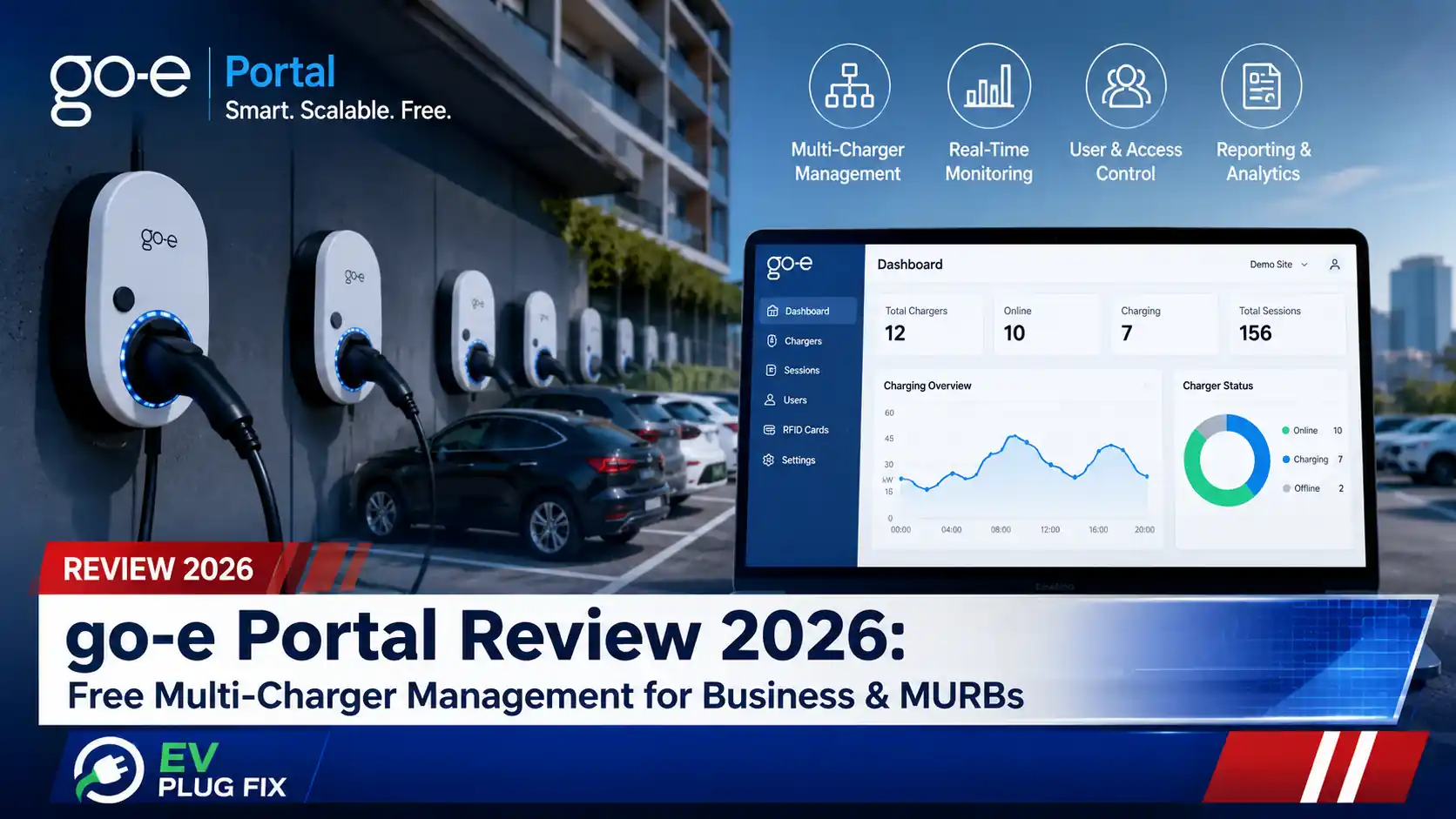
The go-e Portal is a browser-based management interface for organizations operating multiple compatible go-e Chargers. It brings device configuration, charger and RFID grouping, remote administration and energy reporting into one place, making it considerably more practical than managing a growing installation charger by charger.
Its strongest fit is private or semi-private charging at apartment buildings, hotels and workplaces. The central limitation is equally clear: the Portal manages go-e charging hardware and usage data, but it is not a complete commercial charge-point-management platform for operators that need automated payments, public roaming or more advanced network services.
go-e Portal Review: Pros and Limitations
| Strengths | Limitations |
|---|---|
| Central management of multiple compatible go-e Chargers | Not a complete public charging or payment backend |
| Charger and RFID grouping | Some advanced energy-management functions require additional hardware or integration |
| Group-based energy reporting | Energy reports should not automatically be treated as legally compliant billing records |
| Bulk and remote configuration | Compatibility varies by charger generation and feature |
| Portal access is currently described by go-e as free of charge | Third-party backend, payment or roaming services may carry separate costs |
| OCPP, Modbus TCP, MQTT and HTTP API options on supported hardware | Open interfaces still require compatible software or integration work |
For a property operator that mainly wants one interface for administering a collection of go-e Chargers, this is a useful feature set without much unnecessary complexity. The Portal becomes less convincing as the business model shifts from managing private charging points to operating charging as a paid public service. At that point, backend capabilities matter more than the manufacturer’s administration portal.
What the go-e Portal Actually Does
According to go-e’s current Portal documentation, operators can manage chargers across multiple locations and organize devices into groups. Those groups can represent individual properties, business units or other operational divisions.
Chargers and RFID identifiers can be grouped separately, and a device or RFID can belong to more than one group. Reports can then be generated for groups, which is particularly useful when charging consumption needs to be reviewed by property, department or authorized user rather than one charger at a time.
The main Portal functions include:
- Centralized device management: administer multiple compatible go-e Chargers through a browser.
- Device grouping: organize chargers by property, business unit or another useful structure.
- Bulk configuration: send settings to authenticated chargers within a group instead of configuring each unit separately.
- RFID management: organize RFID identifiers used for authorized charging.
- Energy reporting: generate reports for charger or RFID groups.
- Remote administration: configuration changes can be queued for an authenticated charger and applied when it reconnects.
This is where the Portal works best. A hotel with several chargers, for example, does not need staff opening individual charger interfaces simply to manage access or review usage. Likewise, an apartment operator can create a more manageable structure for chargers and RFID users as an installation expands.
Is the go-e Portal Free?
go-e currently describes Portal access for configuring, grouping and monitoring multiple go-e Chargers as free of charge. For organizations already considering go-e hardware, avoiding a separate Portal subscription is a genuine advantage.
That does not make the entire charging operation free. Chargers, installation, electricity, networking, maintenance and any external billing, payment or roaming services remain separate. Organizations planning a long-term deployment should also account for EV charger maintenance costs and confirm current Portal terms with go-e before purchase because cloud-service terms can change during the life of installed charging hardware.
Open Interfaces and Third-Party Backends
The Portal is not the only management route available within the go-e ecosystem. Supported charger generations expose several interfaces that can connect the hardware to external charging, building-management or automation systems.
| Interface | Typical Role | What to Check |
|---|---|---|
| OCPP 1.6 | External charge-point-management backend | Charger generation, backend support and required OCPP functions |
| Modbus TCP | Local building or energy-management integration | Supported registers, network design and charger generation |
| MQTT | Automation and IoT integration | Hardware support and implementation requirements |
| HTTP API | Custom local or cloud integration | API version, authentication and required controls |
go-e’s current support material documents OCPP 1.6 for supported HOME V3, Gemini, PRO and CORE products, while API and other interface support also depends on hardware generation. An operator expanding an older installation should therefore check the exact model and firmware rather than assuming a feature available on a current charger is available across the entire go-e range.
OCPP is the important option for sites that need an external charge-point-management system. It can allow compatible chargers to work with software providing functions such as commercial billing or broader user and network management. OCPP support alone, however, does not guarantee that a particular charger will work with every backend; both sides of the integration need to support the required implementation and features.
Modbus TCP, MQTT and the HTTP APIs are more attractive for custom energy-management and automation projects. They add flexibility, but they are interfaces rather than finished software. A site without the technical resources to build and maintain an integration may be better served by a supported third-party platform.
Load Management and the go-e Controller
Portal administration and building load management are separate parts of the go-e system. go-e Chargers can participate in load-management arrangements, while the separate go-e Controller measures building energy flows for go-e’s dynamic load-management functions.
That distinction matters at sites with several chargers sharing limited electrical capacity. With appropriate dynamic load balancing, charging power can be adjusted as other building loads change rather than allowing EV charging to operate without regard to total site demand.
The Controller also supports energy-management functions such as PV-surplus charging. With compatible chargers, go-e documents automatic switching between single-phase and three-phase charging, which can make smaller amounts of available solar surplus usable. At 230 V and the commonly used 6 A minimum charging current, go-e describes a starting point of roughly 1.4 kW for one-phase charging compared with about 4.2 kW for three phases.
These are Controller and charger capabilities, not reasons to buy the Portal itself. They matter when assessing the wider go-e ecosystem, but a site interested only in centralized charger administration does not need to treat PV optimization as part of the Portal’s core feature set. Vehicle compatibility and electrical design also need to be checked for any load-management or phase-switching installation.
How Well Does It Fit Apartments, Hotels and Workplaces?
| Site Type | Where the Portal Helps | When More Software May Be Needed |
|---|---|---|
| Apartments and multi-unit housing | RFID access, charger grouping and consumption reporting | Automated tenant billing, jurisdiction-specific metering or more complex account management |
| Hotels | Managing multiple chargers, reusable RFID access and reviewing guest charging consumption | Automated guest payments or public charging services |
| Workplaces | Employee access, centralized settings and group energy reports | Advanced reimbursement, fleet telematics, dispatch or vehicle scheduling |
Of these use cases, straightforward private charging is where the Portal feels most complete. For apartment operators, the broader challenge is designing practical EV charging for multi-unit dwellings around shared electrical capacity, access and consumption management. If users are known in advance, access is controlled through RFID and the operator mainly needs reporting and centralized administration, there may be little reason to introduce a more elaborate charge-point-management platform.
Requirements change when charging becomes a customer-facing commercial service. Automated payments, roaming, legally regulated billing or sophisticated tariff management can push an installation beyond what the Portal is designed to handle.
Compatibility Needs to Be Checked Carefully
Not every go-e charger generation supports every feature or communication interface. go-e’s current product information lists Controller compatibility across supported Gemini and HOME models, while particular functions have their own hardware requirements.
This is especially relevant when adding new chargers to an older installation. Operators should check the exact hardware version, firmware and required function before assuming that a feature demonstrated on a current Gemini, CORE or PRO charger will work on an earlier product.
go-e publishes manuals and interface information on its support and instructions page. That documentation is particularly important for OCPP, API, Modbus TCP and custom integration projects.
What the go-e Portal Does Not Replace
The Portal is an administration tool rather than a complete charging-business platform. Its main boundaries are straightforward:
- Public charging and payments: automated paid charging may require a compatible external backend and payment system.
- Regulated billing: Portal energy reports should not be assumed to satisfy local metering, taxation or tenant-billing requirements.
- Electrical design: load management does not remove the need for appropriate circuit, service-capacity and installation planning.
- Fleet operations: managing chargers is different from vehicle telematics, routing, dispatch and fleet scheduling.
- Custom integrations: OCPP, APIs, MQTT and Modbus make integration possible but do not provide a finished custom system on their own.
Those limits are not necessarily weaknesses for the Portal’s intended audience. Keeping charger administration relatively focused can be an advantage for a private site that does not need the cost and complexity of a full commercial charging platform. They become inconvenient when an operator expects the Portal itself to handle the entire customer, payment and network-management workflow.
Who Is the go-e Portal Best For?
The Portal makes the strongest case for organizations already using, or planning to standardize on, compatible go-e Chargers. A small or medium-sized apartment property, hotel or workplace that needs centralized settings, RFID administration and usage reporting may find the Portal sufficient without adding another management platform.
Its open interfaces also leave room for a site to become more sophisticated later. That is a notable strength: choosing the Portal for day-to-day administration does not necessarily prevent compatible chargers from being connected to an external backend or custom energy-management system.
Operators planning paid public charging should approach the decision from the opposite direction. Define the required backend, payment, metering, roaming and regulatory functions first, including how public charging pricing strategies will be implemented, then verify that the chosen go-e hardware integrates correctly with that architecture.
FAQ
Is the go-e Portal free?
go-e currently describes centralized configuration, grouping and monitoring through the Portal as free of charge. Hardware, installation, electricity and third-party backend or payment services are separate costs. Long-term buyers should confirm the current commercial terms with go-e.
Can the go-e Portal manage chargers at multiple locations?
Yes. go-e documents management across multiple locations, with chargers organized into groups. This can be useful for businesses or property operators responsible for more than one building or charging area.
Does go-e support OCPP?
Compatible go-e Charger generations support OCPP 1.6 for connecting to external backends. The specific charger generation and intended backend should be checked together before deployment because OCPP support does not guarantee universal backend compatibility.
Do I need a go-e Controller for dynamic load management?
For go-e’s Controller-based dynamic load-management setup, the Controller measures building energy flows and provides the data used to regulate charger power. Other implementations may be possible through supported interfaces or integration partners, depending on the hardware and system design.
Can the system charge from surplus solar power?
Yes. A compatible go-e Charger combined with the go-e Controller can regulate charging according to measured PV surplus. Supported newer chargers can also use automatic single-phase and three-phase switching to broaden the range of surplus power that can be used. These are Controller and charger functions rather than features of the Portal itself, and vehicle compatibility should be checked before deployment.
Verdict
The go-e Portal is a compelling centralized administration tool for compatible go-e hardware, particularly at apartments, hotels and workplaces that need charger grouping, RFID management, remote configuration and energy reporting without a separate Portal subscription. Its focused design is also its boundary: operators that require automated payments, roaming, regulated billing or advanced public-network operations should use a suitable commercial charging backend rather than expecting the Portal to replace one.
Source Transparency
This review is based primarily on current manufacturer documentation from go-e, including go-e Portal documentation, charger interface documentation, go-e Controller product information and support materials accessed in August 2026. Statements about Portal functions, hardware compatibility and go-e-specific energy-management features are therefore manufacturer-documented capabilities rather than independent performance testing.
No first-hand testing, customer deployment data or independent reliability measurements are claimed in this article. Commercial terms, firmware compatibility and cloud functionality can change, so operators planning a purchase or large deployment should confirm current requirements with go-e and any selected third-party backend provider.