
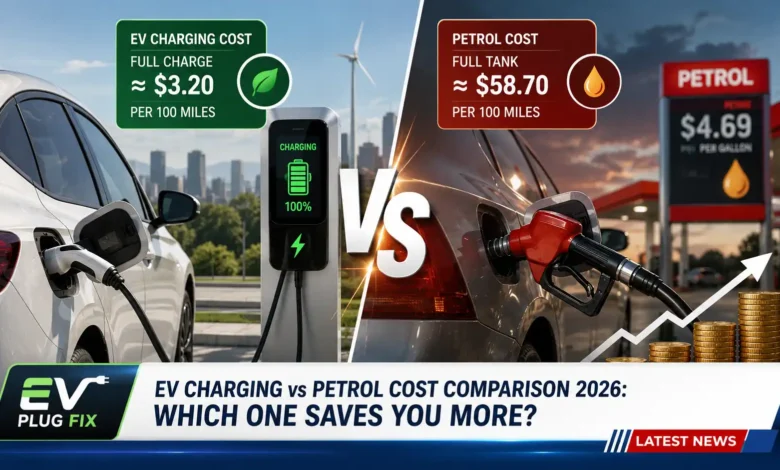
For many drivers who can charge mainly at home, an efficient electric car can cost substantially less in energy per kilometre than a comparable petrol car. The calculation changes sharply for drivers who depend on costly public rapid charging, where the EV advantage can narrow or disappear.
The fairest comparison is not the price of one kilowatt-hour against one litre of petrol. Compare how much each vehicle costs to travel the same distance.
A Quick EV vs Petrol Cost Comparison
Using simple illustrative assumptions, the difference can look like this:
| Example | Consumption | Energy price | Cost per 100 km |
|---|---|---|---|
| EV charged at home | 18 kWh/100 km | €0.25/kWh | €4.50 |
| EV using expensive public charging | 18 kWh/100 km | €0.70/kWh | €12.60 |
| Petrol car | 6.5 L/100 km | €1.75/L | €11.38 |
These figures are examples rather than European market averages, and the EV calculations do not add a separate allowance for charging losses. They show why charging location can matter as much as the vehicle itself.
How to Calculate EV and Petrol Costs
For an EV, multiply electricity consumption by the electricity price. A car using 18 kWh per 100 km with electricity costing €0.30 per kWh has a basic energy cost of:
18 kWh × €0.30 = €5.40 per 100 km.
The amount drawn from the grid can be higher than the energy eventually stored in the battery because charging involves conversion losses and can also consume energy for battery conditioning and vehicle electronics. If you already own the car, electricity recorded by a charger or household meter gives a better real-world cost figure than dashboard consumption alone.
For petrol, multiply fuel consumption by the pump price. A vehicle using 6.5 litres per 100 km with petrol costing €1.75 per litre would cost:
6.5 litres × €1.75 = €11.38 per 100 km.
Electricity prices, petrol prices and vehicle efficiency vary considerably by market and driving conditions, so local figures are more useful than a single headline claim about which technology is cheaper.
Why Home Charging Often Gives an EV the Advantage
Home charging usually provides the strongest EV economics because domestic electricity can cost much less than electricity sold through commercial rapid-charging networks. Time-of-use tariffs can reduce the cost further when a large share of charging is shifted into cheaper overnight periods. A broader breakdown of home vs public charging costs can help when estimating the charging mix you are likely to use.
UK figures provide a useful example. For July through September 2026, Ofgem lists an average electricity unit rate of 26.11 pence per kWh for a standard variable tariff paid by Direct Debit in England, Scotland and Wales. It is an average rather than a universal tariff, and regional and supplier-specific rates differ. Ofgem publishes the current price-cap unit rates.
HM Revenue & Customs also publishes advisory electric rates for company-car reimbursement. From 1 September 2026, the rates are 7 pence per mile for home charging and 15 pence per mile for public charging, based on an assumed EV efficiency of 3.59 miles per kWh. HMRC’s public-charging electricity-cost assumption is derived from the Zapmap price index for slow or fast public chargers below 50 kW, so the 15 pence figure should not be treated as a representative benchmark for rapid or ultra-rapid DC charging. HMRC publishes the methodology and current advisory rates.
These reimbursement rates are useful for illustrating the gap between home and public charging, but they are not predictions of what every EV driver will pay.
Public Charging Can Narrow the Gap
Public charging is not one price category. Workplace chargers, municipal AC posts, destination chargers, motorway rapid chargers and high-power charging hubs can all have different tariffs.
The price may also depend on whether a driver pays the operator directly or uses a roaming provider or membership. Parking charges, subscription fees and occupancy fees can affect the total session cost. These differences reflect the various ways operators structure public charging prices around electricity, site and network costs.
Drivers who depend mainly on public infrastructure should therefore base their comparison on the networks and locations they are likely to use rather than a generic public-charging average.
Public Charging Price Transparency in Europe
The EU’s Alternative Fuels Infrastructure Regulation, or AFIR, includes rules intended to make ad hoc public charging easier to understand and access without requiring a long-term contract with a charging operator or mobility service provider.
Under Article 5(4) of Regulation (EU) 2023/1804, publicly accessible charging points of at least 50 kW deployed from 13 April 2024 must base the ad hoc price charged to end users on the electricity delivered in kWh. If an occupancy fee is charged, it must be expressed per minute. Relevant price information must be available before the charging session. The European Commission’s AFIR guidance explains the payment and pricing rules.
The regulation improves price transparency, but drivers still need to compare operators because the underlying charging tariff can vary significantly.
Do Idle and Occupancy Fees Matter?
Occupancy or idle fees can add to the cost of a public charging session if a vehicle remains connected beyond the operator’s stated conditions. They are intended to discourage unnecessary use of charging bays after the relevant charging period.
They are better treated as session-specific charges rather than part of the normal electricity cost because drivers who follow the operator’s rules may never pay them. Check the applicable terms before using an unfamiliar network, particularly at busy rapid-charging locations.
How to Estimate Your Real Monthly Cost
A useful personal comparison should reflect your actual mix of home, workplace and public charging rather than assuming every kilowatt-hour costs the same.
- Estimate your monthly distance.
- Use a realistic EV consumption figure for your normal driving.
- Estimate what share of charging will come from home, work and public networks.
- Apply the price you expect to pay at each source.
- Use meter or charger readings where possible so charging losses are included.
- Compare the result with a similar petrol car using realistic fuel economy and your local pump price.
For example, an EV consuming 18 kWh per 100 km requires about 180 kWh at the battery to cover 1,000 km before charging losses are considered. At €0.25 per kWh, that battery-energy calculation is €45. At €0.70 per kWh, it rises to €126.
A petrol car averaging 6.5 litres per 100 km would use 65 litres over the same 1,000 km. At €1.75 per litre, the fuel cost would be €113.75.
Under those assumptions, low-cost electricity gives the EV a substantial advantage. Charging exclusively at the higher electricity price makes the EV more expensive for energy than the petrol example.
Charging Losses Can Affect the Result
An EV’s displayed driving consumption does not necessarily equal the amount of electricity purchased from the grid. Energy can be used in power conversion, thermal management and vehicle systems during charging.
The difference varies with the vehicle, charging equipment, charging power, battery temperature and other conditions, so there is no single loss percentage that should be applied to every EV.
Owners can get a practical wall-to-wheel figure by recording the electricity delivered by the charger or household meter over several normal charging sessions and comparing it with the distance driven.
Does Installing a Home Charger Pay for Itself?
There is no universal payback period. Installation cost depends on the charger, electrical capacity, cable route, labour, permits or inspections where required, and whether electrical upgrades are needed. A detailed look at EV charger installation costs can help identify expenses that need to be included before estimating payback.
The potential saving also depends on the alternative. Someone replacing frequent high-priced public charging with inexpensive home charging may recover the installation cost faster than a low-mileage driver who already has access to reasonably priced charging elsewhere.
A simple estimate is:
Home charger installation cost ÷ annual charging-cost saving = approximate payback period.
The calculation should use your actual expected charging pattern rather than assuming that every home charger will recover its cost within a fixed period.
When Can Petrol Be Cheaper?
On energy cost alone, petrol can be cheaper when a relatively efficient petrol car is compared with an inefficient EV relying predominantly on expensive public charging. Higher EV consumption during cold weather, towing or sustained high-speed driving can also affect the comparison, although petrol vehicles are likewise sensitive to driving conditions.
Energy expenditure is only one part of vehicle ownership. Purchase price, depreciation, insurance, financing, maintenance, taxes and incentives can have a larger financial effect than the difference between electricity and petrol. This comparison focuses on the energy used to drive the vehicles rather than complete lifetime ownership cost.
Keeping EV Charging Costs Under Control
- Use home or other low-cost charging when practical.
- Compare the full terms of time-of-use electricity tariffs, not only the cheapest overnight rate.
- Check direct, roaming and membership prices before starting a public charging session.
- Watch for parking, occupancy and other session-specific fees.
- Track your own electricity use and mileage rather than relying on generic savings percentages.
So, Is EV Charging Cheaper Than Petrol?
For drivers who obtain most of their electricity at home at a competitive tariff, an efficient EV can have a clear energy-cost advantage over a comparable petrol vehicle. For drivers who depend heavily on expensive public rapid charging, the outcome can be much closer and can sometimes favour petrol.
The most useful answer comes from calculating cost per 100 km or cost per mile with your expected charging mix, realistic vehicle consumption and current local energy prices.
FAQ
How much does it cost to charge an EV per 100 km?
Multiply the EV’s electricity consumption in kWh per 100 km by the price paid per kWh. An EV using 18 kWh per 100 km at €0.30 per kWh has a basic battery-energy cost of €5.40 per 100 km. For a more accurate figure, use electricity measured at the charger or meter so charging losses are reflected.
Is home EV charging cheaper than petrol?
It often is when an efficient EV is charged on a reasonably priced domestic tariff, especially if cheaper off-peak electricity is available. The result still depends on the electricity tariff, petrol price and efficiency of the two vehicles being compared.
Can public EV charging cost more than petrol?
Yes. An EV relying on expensive public charging can have a higher energy cost per kilometre than an efficient petrol vehicle. Compare actual public charging tariffs with the petrol price and consumption figures relevant to your journey.
Is rapid charging always more expensive than home charging?
No. Prices vary by market and provider, so rapid charging is not universally more expensive in every individual case. Commercial rapid and high-power charging, however, can carry substantially higher per-kWh prices than domestic electricity, making frequent reliance on it important to include in a running-cost calculation.
Should I include the household electricity standing charge in my EV cost?
If you would pay the same standing charge without owning an EV, it is usually more useful to compare the additional electricity consumed by the vehicle rather than assign the entire existing household standing charge to EV driving. Any additional fixed charge caused specifically by an EV tariff or charging arrangement should be included separately.
How do I compare EV charging costs if I use several charging networks?
Calculate a weighted average based on how much electricity you expect to obtain from each source. For example, multiply the share charged at home by the home tariff, do the same for workplace and public charging, and combine the results. Using actual charging records over several weeks gives an even better picture once you own the vehicle.
Does an EV still save money if I cannot charge at home?
It can, but there is no automatic saving. The result depends on the public networks available to you, their tariffs, your EV’s efficiency and the petrol alternative. Drivers without home charging should check the stations they would routinely use before relying on projected fuel savings when choosing a car.
Bottom Line
Home charging is where an EV is most likely to deliver a strong energy-cost advantage. Heavy reliance on expensive public charging can reduce that advantage or reverse it.
Before making a purchase decision, compare realistic cost per 100 km using your expected charging mix and local prices. That figure is more useful than any claim that an EV is always a fixed percentage cheaper to run than a petrol car.
Source Transparency
This article uses regulatory and government information available in August 2026 alongside clearly labelled mathematical examples. UK electricity figures are based on Ofgem’s published domestic price-cap information. The UK cost-per-mile examples use HMRC advisory electric rates, which are reimbursement benchmarks rather than universal consumer prices; HMRC’s public rate methodology uses Zapmap pricing for slow or fast public charging below 50 kW. European public-charging pricing information is based on European Commission guidance for Regulation (EU) 2023/1804.
Electricity tariffs, petrol prices and public charging rates can change frequently and vary by country, network, vehicle and tariff. The euro figures in this article are illustrative rather than claimed market averages, so readers should use current local prices for their own comparison.