EV Towbar Retrofitting: Which Electric Cars Can Tow and How Approval Works

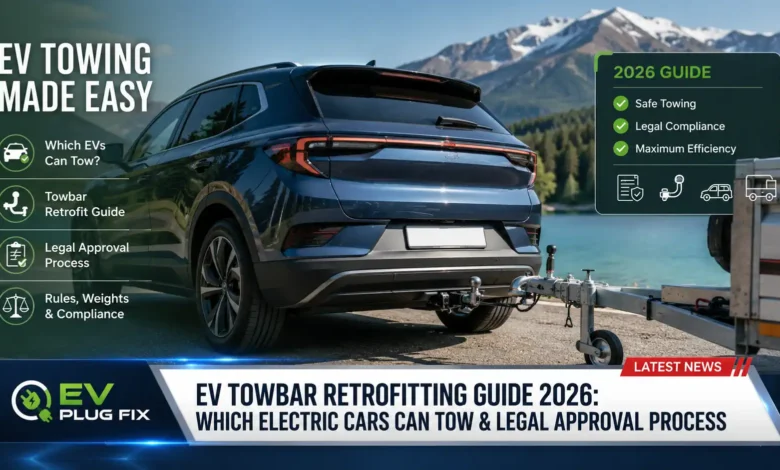
Retrofitting a towbar to an electric car can be straightforward, complicated or unsuitable depending on the exact vehicle. The deciding factor is not simply whether a hitch can be bolted to the rear structure, but whether the vehicle is approved for the job you want it to do.
A useful way to approach the decision is to answer three questions in order. First, establish whether your exact EV has an approved trailer mass. Second, decide whether you need the hitch for trailer towing or only for an accessory carrier such as a bicycle rack. Only then should you start comparing towbar hardware, wiring kits and approval requirements.
Check the vehicle’s Certificate of Conformity, registration documents, owner’s manual and manufacturer information for the exact model, model year and configuration. Towing limits from a different battery, drivetrain, trim or national specification may not apply to your car.
Can You Retrofit a Towbar to Any Electric Car?
No. EV towbar compatibility is vehicle-specific.
A proper retrofit can involve structural mounting points, permissible trailer and vertical loads, a dedicated wiring harness, trailer-light electronics, coding and software that changes vehicle behaviour when a trailer is connected.
Most vehicles fall into one of three categories:
- Approved for trailer towing: a compatible manufacturer or aftermarket towbar may be available, subject to the vehicle’s stated limits.
- Suitable for an approved accessory carrier but not trailer towing: the hitch can be used only for the application and loads for which it is approved.
- No approved towing or hitch installation: the availability of a physically compatible aftermarket part does not create a towing capacity.
That makes the vehicle’s homologation data more important than a towbar catalogue when deciding whether a retrofit is possible.
Where to Find Your EV’s Towing Capacity
For European vehicles, start with the Certificate of Conformity and registration documentation. In registration systems using the harmonised EU field structure, field O.1 normally identifies the technically permissible maximum braked trailer mass and O.2 the maximum unbraked trailer mass.
Trailer mass is only part of the calculation. The permissible vertical load at the hitch, gross vehicle weight, axle loads and any applicable combined vehicle-and-trailer limits can also restrict what the car can carry or tow.
If your documents show no trailer capacity, ask the manufacturer, its authorised representative or the competent national technical authority about the exact vehicle rather than borrowing a figure from another version.
Examples: Which Electric Cars Can Tow?
The following examples illustrate how widely towing approval can vary between EVs. They are not a compatibility database, and the individual vehicle’s documentation remains the controlling reference. Buyers comparing larger family vehicles may also find the overview of 7-seater electric SUVs and MPVs useful when narrowing down suitable EVs.
| EV | Example European towing limit/status | Retrofit consideration |
|---|---|---|
| Tesla Model Y | Up to 1,600 kg with the applicable European towing configuration | Tesla offers a Model Y Tow Package; confirm the limits applicable to the individual vehicle |
| Tesla Model S | Up to 1,600 kg on compatible vehicles | Current European Tesla listings differ slightly by market on production-date compatibility |
| Audi Q8 e-tron | Up to 1,800 kg braked trailer load in cited German-market specifications | German material lists an optional trailer hitch and an 80 kg nose-weight limit for the applicable configuration |
| Volkswagen e-Golf | No trailer capacity should be inferred from combustion-engine Golf models | Check the manual and homologation documents for the exact e-Golf model year and market before considering any hitch |
| Renault Zoe | Specific Zoe variants were sold without a homologated trailer mass | Verify the exact generation, variant and market; a recovery towing eye is not evidence of trailer approval |
Tesla Model Y Towbar Retrofitting
Tesla’s European Model Y towing documentation describes a towing package designed for trailer use as well as approved hitch-mounted accessories. Tesla states towing capability of up to 1,600 kg for applicable configurations, while the precise limits for an individual vehicle should be taken from its Certificate of Conformity, statutory plate and hitch information.
The package also illustrates why EV towbar installation is not purely mechanical. Depending on the vehicle and package, trailer connection can interact with lighting, parking assistance, stability functions and dedicated towing software.
Tesla Model S: Production Date Matters
Tesla currently lists a Model S Tow Package with towing capability of up to 1,600 kg for compatible vehicles. Compatibility wording is not identical across European Tesla shops: current UK and Irish listings describe 2022–2025 vehicles, while Tesla Germany specifies vehicles produced from 2022 to early 2025. Check the country-specific Tesla listing and the vehicle’s VIN before ordering.
Tesla states that the applicable vehicles were produced with the towbar structure, controller and wiring harness already installed, with the package supplying the components required to use that preparation. This is therefore different from fitting a completely new structural towing system to an older Model S that was not prepared for it.
Audi Q8 e-tron Towing Capacity
Audi’s German-market Q8 e-tron material lists an optional trailer hitch and specifies a braked trailer load of up to 1,800 kg and an 80 kg nose weight for the applicable configuration.
Those figures should be treated specifically as German-market specifications rather than universal limits for every Q8 e-tron sold in Europe. Model year, configuration and national homologation can matter, so the individual vehicle documents remain the appropriate place to confirm the permitted loads.
Volkswagen e-Golf: Check the Exact Variant
The e-Golf is a good example of why towing figures from a related combustion-engine model cannot simply be transferred to an EV.
Volkswagen documentation has varied by model year and market, so an unqualified claim covering every e-Golf should be avoided. Where the documentation for a particular e-Golf variant provides no approved trailer mass or restricts towing-bracket use, a generic Golf towbar cannot be treated as evidence that the EV is approved to pull a trailer.
Before fitting equipment to an e-Golf, identify the exact production year and market specification and check its Certificate of Conformity, registration data and applicable Volkswagen manual. Do not apply towing capacities published for petrol, diesel or other Golf variants.
Can You Fit a Towbar to a Renault Zoe?
The answer depends on what the hitch is intended to do and on the exact Zoe version. Zoe was sold across several generations, variants and national markets, so it is too broad to assign one towing statement to every Zoe produced.
Specific Zoe configurations were supplied without a homologated trailer mass in their vehicle specifications. For those vehicles, the screw-in towing eye described for vehicle recovery is not a trailer hitch and does not establish permission to pull a trailer.
Aftermarket carrier systems may exist for particular non-trailer applications. Their approval, mounting method and permissible load must be checked separately. If the Certificate of Conformity and registration documents for a particular Zoe provide no trailer mass, obtain vehicle-specific confirmation from the manufacturer or competent approval authority before considering trailer towing.
Can TÜV Approve a Towbar Retrofit in Germany?
German approval depends on the towbar’s documentation and on the extent of the modification. There is no single TÜV procedure that applies to every retrofit.
A component with an applicable ABE may require no separate inspection when all conditions in that approval are satisfied, although the ABE itself can make an inspection mandatory. Other components or modifications can require an Änderungsabnahme under §19(3) StVZO. More substantial modifications that are not covered by the usual approval documentation can require an Einzelabnahme under §19(2) in conjunction with §21 StVZO.
For a consumer, the simplest question to ask TÜV or another authorised inspection body before buying anything is: “What approval document and inspection procedure are required for this towbar on my exact vehicle?”
An individual assessment is not a guaranteed route to creating a trailer capacity for a vehicle that lacks the necessary technical basis. If no trailer mass appears in the vehicle documents, discuss the VIN and proposed installation with the inspection body before ordering the parts.
A Practical Approval Sequence
- Identify the vehicle. Record the model, model year, drivetrain, variant and VIN.
- Check the approved loads. Review the Certificate of Conformity, registration document, owner’s manual and manufacturer information.
- Define the use. Decide whether you need trailer towing or only a hitch-mounted accessory carrier.
- Select approved hardware. Match the towbar to the exact vehicle and intended application.
- Check the electronics. Establish whether a dedicated harness, control module, coding or manufacturer software is required.
- Confirm national approval requirements. Ask the inspection or registration authority which documents and inspections apply before installation.
- Use a competent installer. Follow the vehicle and towbar manufacturers’ installation requirements.
- Keep the paperwork. Retain component approvals, invoices and inspection reports, and update registration documents where national law requires it.
Does Retrofitting a Towbar Affect an EV Warranty?
Warranty consequences depend on the country, the manufacturer’s commercial warranty terms, applicable statutory consumer rights and the cause of any later failure. An independent retrofit should therefore not be described as either automatically cancelling an entire vehicle warranty or as having no possible warranty consequences. Owners considering the wider financial implications of modification may also want to review how EV insurance costs can differ from those of conventional vehicles.
In practice, disputes are most likely where a failure can be linked to unsuitable equipment, incorrect wiring or coding, structural damage, poor installation or operation beyond approved load limits. Owners should retain the towbar approval documents and installation records and check the relevant warranty terms for their market.
At EU level, Commission Regulation (EU) No 461/2010 forms part of the motor-vehicle competition framework. Commission Regulation (EU) 2023/822 extended its application until 31 May 2028, and the Commission also updated the sector’s Supplementary Guidelines in 2023. These competition rules concern aftermarket competition and servicing; they do not turn an unapproved modification into an approved one or require a manufacturer to cover damage caused by a modification.
Bike-Rack Loads and Trailer Loads Are Different
A hitch approved for carrying bicycles should be used according to its accessory-carrier limits, not according to the vehicle’s maximum trailer mass or trailer tongue-load figure.
A rear carrier creates vertical forces, dynamic loads and a significant bending moment because the mass of the rack and bicycles sits behind the hitch. A trailer applies a different combination of longitudinal, vertical and dynamic forces. Manufacturers can therefore specify different limits for the two uses.
Tesla’s Model Y documentation illustrates the principle: some versions specify up to 72 kg for a hitch-mounted accessory carrier, and Tesla explains that the accessory load is more cantilevered than a conventional trailer connection. Limits also vary with vehicle specification, so use the figure stated for the particular vehicle and application.
When calculating a carrier load, include the weight of the rack itself as well as the bicycles or other equipment.
Electrical Integration Matters on an EV
Modern towbar installation can involve considerably more than connecting trailer lamps to the existing rear-light wiring.
A vehicle-specific electrical kit can allow the car to recognise a trailer and coordinate functions such as rear parking assistance, trailer stability systems, lighting monitoring and driver-assistance features. Manufacturer towing packages may also activate a dedicated trailer or towing mode.
Incorrectly tapping into vehicle wiring can produce electrical faults or interfere with diagnostics. The towbar’s electrical kit should therefore be matched to the exact vehicle at the same time as the mechanical hardware, with any required coding or software activation included in the installation plan.
How Towing Affects EV Range
An EV that is approved for towing will normally consume more energy while pulling a trailer. Aerodynamic drag can be particularly important at motorway speeds, so trailer shape and frontal area can matter alongside mass.
There is no reliable universal percentage for EV range loss while towing. A low-profile utility trailer and a large caravan impose very different loads, while speed, temperature, wind, terrain and vehicle efficiency further affect consumption.
For longer journeys, plan charging stops with additional energy reserve and check charging-site layouts before departure. Some charging bays require a trailer to be disconnected or can be difficult to enter while towing, so knowing how public EV charging works can make trip planning easier.
What to Check Before Paying for an EV Towbar
Have the following information in hand before placing an order:
- The exact model, model year, variant and VIN.
- The approved braked and unbraked trailer masses, if applicable.
- The permitted vertical load for the intended towing or carrier application.
- Confirmation that the towbar is approved for the exact vehicle.
- The required wiring harness and control electronics.
- Any necessary coding or software activation.
- The component’s approval documentation.
- The inspection and registration requirements in your country.
- The installer’s documentation and invoice.
- The commercial warranty terms applicable to your vehicle and market.
If you cannot establish an approved trailer mass for the exact vehicle, resolve that point before paying for a towbar intended for trailer towing.
FAQ
Can a towbar be retrofitted to an electric car?
Yes, many EVs support a towbar retrofit or manufacturer towing package. The vehicle must be approved for the intended use, and the towbar, electrical equipment and permissible loads must match the exact configuration.
Can I tow if my EV registration document has no towing capacity?
A missing trailer mass should be investigated before towing. Check the Certificate of Conformity and manufacturer documentation, then ask the competent national approval or registration authority whether a vehicle-specific approval route exists.
Can TÜV make a non-towing EV legal for towing?
Not simply by inspecting an installed hitch. Germany provides several approval routes for modifications, including an Änderungsabnahme and, where appropriate, an Einzelabnahme, but the inspection body needs an adequate technical basis for approval. Ask about feasibility and required evidence before purchasing the towbar.
Can a Renault Zoe tow a trailer?
Zoe specifications vary by generation, variant and market, and particular Zoe configurations were supplied without a homologated trailer mass. Check the vehicle’s own Certificate of Conformity and registration documents rather than treating the recovery towing eye or an aftermarket carrier mount as evidence of trailer approval.
Can a Volkswagen e-Golf tow a trailer?
Do not apply the towing capacity of a combustion-engine Golf to an e-Golf. The answer must be established from the documentation for the exact e-Golf model year and market. If its homologation documents provide no approved trailer mass or its applicable Volkswagen instructions restrict towing-bracket use, it should not be treated as trailer-approved on the basis of a generic Golf towbar.
How much can a Tesla Model Y tow?
Tesla states towing capability of up to 1,600 kg for applicable European Model Y towing configurations. Check the Certificate of Conformity, statutory plate and hitch information for the limit that applies to the individual vehicle.
Which Tesla Model S vehicles support the Tow Package?
Current compatibility wording differs slightly between European Tesla markets. UK and Irish Tesla listings describe compatible 2022–2025 Model S vehicles, while Tesla Germany currently specifies production from 2022 to early 2025. Check the current Tesla listing for your country and confirm compatibility against the VIN.
Does a towbar automatically void an EV battery warranty?
There is no useful Europe-wide blanket answer because commercial warranty terms and statutory consumer rights vary by jurisdiction. Modification-related damage may be excluded or disputed, particularly where unsuitable equipment, poor installation or operation beyond approved limits caused the failure. Check the applicable warranty terms and keep the installation and approval records.
Bottom Line
EV towbar retrofitting starts with the car’s approval data. Establish the approved trailer mass first, decide whether the hitch is for towing or an accessory carrier, and then choose hardware and electrical equipment that are approved for that exact application.
Tesla Model Y and compatible Model S vehicles provide examples of EVs with substantial approved towing capability, while Audi’s German-market Q8 e-tron specifications show up to 1,800 kg for applicable configurations. Vehicles such as the e-Golf and Zoe require more careful variant-specific checking rather than assumptions based on related models or aftermarket hitch availability.
Before paying, have the Certificate of Conformity or equivalent approval data, registration document, exact towbar approval, permitted vertical load, wiring requirements and any required inspection procedure confirmed. That short document check can prevent an expensive installation that cannot legally perform the job for which it was bought.
Source Transparency
This guide distinguishes manufacturer specifications from general retrofit advice. Tesla Model Y towing and accessory-carrier information was checked against Tesla’s Model Y towing documentation. Model S compatibility and capacity should be checked against the current country-specific Tesla shop listing because production-date wording differs between European markets.
Audi Q8 e-tron figures in this guide refer specifically to Audi’s German-market Q8 e-tron information, which lists the applicable optional trailer hitch, trailer load and nose-weight specifications.
German modification procedures were checked against TÜV SÜD’s guidance on vehicle modifications, Änderungsabnahmen and individual approvals. The required procedure depends on the approval documentation and conditions attached to the particular component and modification.
The EU competition-law discussion reflects Commission Regulation (EU) 2023/822, which extended the application of Regulation (EU) No 461/2010 until 31 May 2028, together with the European Commission’s updated motor-vehicle Supplementary Guidelines.
Because e-Golf and Zoe specifications span different model years, variants and markets, this guide deliberately avoids assigning an unqualified towing prohibition or capacity to every vehicle carrying either name. Owners should use the Volkswagen or Renault documentation supplied for the exact vehicle, together with its Certificate of Conformity and registration data.
Towing and accessory-carrier specifications can change by market, production date and vehicle configuration. The approval documents and manufacturer limits for the individual vehicle take precedence over general figures in a buying guide.