
REEV vs EV: Which Powertrain Fits Your Driving?

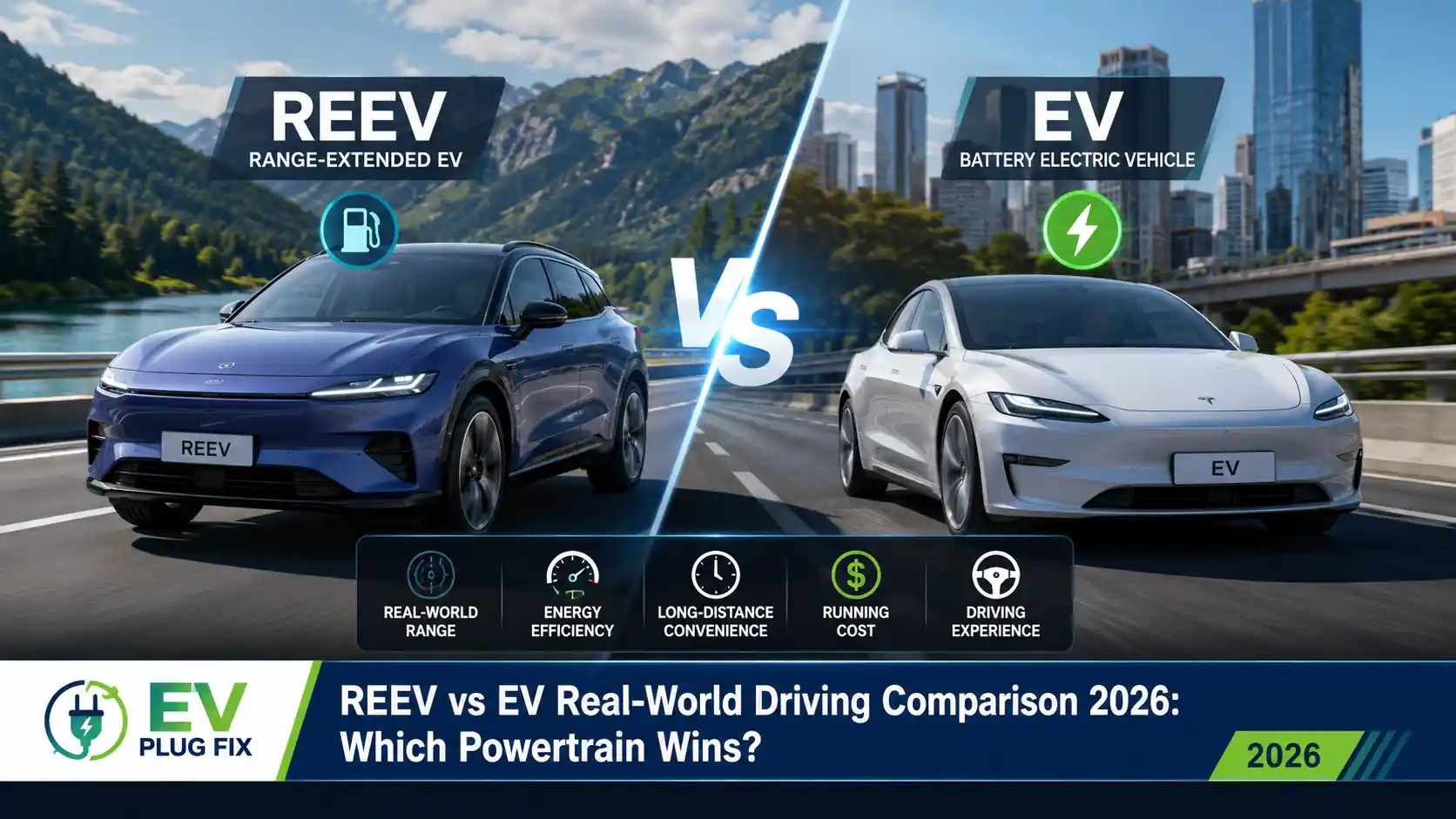
A range-extended electric vehicle can look like an appealing middle ground between a battery electric vehicle and a conventional combustion car. It can cover shorter journeys using stored electricity while carrying an onboard fuel-powered range extender for trips that exceed its usable electric range.
That does not automatically make a REEV better than a battery electric vehicle. The more useful comparison is how each powertrain fits the journeys an owner actually makes: daily commuting, home charging, motorway driving, long road trips and travel through areas where dependable public charging may be difficult to find.
REEV vs EV: The Key Difference
A battery electric vehicle, or BEV, stores its propulsion energy in a rechargeable traction battery. It has no gasoline or diesel engine onboard, so a driver who needs to travel beyond the available battery range must recharge.
A range-extended electric vehicle also uses a rechargeable traction battery and electric propulsion, but adds an onboard source of additional energy. In the traditional series range-extender layout, a combustion engine powers a generator. The generator produces electricity that allows electric propulsion to continue after the vehicle can no longer rely solely on its initial battery charge.
The terminology is not perfectly consistent across the industry. Vehicles described as range-extended EVs, EREVs or REEVs do not necessarily share an identical drivetrain. Some newer systems have additional operating modes and may allow the combustion engine to contribute mechanically under particular conditions. For that reason, buyers should examine the technical design of the specific vehicle rather than assuming that every model carrying a range-extender label operates as a pure series hybrid.
| Consideration | REEV | BEV |
|---|---|---|
| Energy strategy | Rechargeable battery plus an onboard range-extending energy source | Rechargeable traction battery only |
| External charging | Yes, for plug-in range-extended models | Yes |
| Long-distance energy source | Electricity plus onboard fuel | Electricity only |
| Tailpipe emissions | None while operating on stored electricity with the combustion engine off; emissions occur when fuel is burned | None |
| Mechanical complexity | Electric drivetrain plus combustion-related hardware | No combustion engine or fuel system |
| Reliance on public charging during long trips | Can be reduced by the fuel-powered range extender | Charging is required to continue once usable battery energy is depleted |
Daily Driving: When a REEV Can Behave Much Like an EV
If a REEV’s usable electric range comfortably covers your normal daily mileage and you recharge regularly, much of your routine driving may take place without the combustion range extender running. Commuting can therefore involve electric motor propulsion, regenerative braking and little or no routine fuel use.
The important qualification is that the battery must actually cover your driving. Battery capacity, usable electric range and energy-management strategies differ between models, and real-world range also changes with speed, temperature, terrain and driving conditions.
For someone with dependable home or workplace charging, a BEV offers a simpler route to the same basic electric-driving routine. It does not need to carry an engine, fuel tank, exhaust hardware and other combustion-related components for occasional longer journeys.
The case for a REEV becomes stronger when those longer journeys occur often enough that the additional energy source solves a recurring problem rather than remaining unused for most of the vehicle’s life.
Long Road Trips: Where the Difference Becomes Important
Taking a BEV on a Long Trip
Long-distance travel in a BEV can be straightforward when the car has sufficient real-world range, strong DC fast-charging performance and access to reliable chargers along the route. It becomes less convenient when one or more of those conditions are missing.
Battery capacity alone does not determine the quality of a BEV road trip. Motorway efficiency, weather, charger availability, battery temperature, route planning and the vehicle’s charging curve all affect how frequently and how long a driver needs to stop.
Peak charging power can also be misleading when viewed by itself. A vehicle may reach its maximum charging rate only under particular conditions or for part of a charging session. Two EVs with similar advertised range can therefore deliver noticeably different long-distance experiences.
Drivers comparing BEVs should look beyond the largest charging number in the specification sheet. Charging performance across a useful state-of-charge window, route coverage and charger reliability can matter more during real journeys.
Taking a REEV on a Long Trip
A REEV provides another option once the battery can no longer handle the journey on stored electricity alone. Its range-extending system can use onboard fuel to supply additional energy, reducing the need to depend exclusively on the next public charging station.
This can be particularly useful on routes where fast chargers are sparse, inconveniently located or unreliable. Refuelling may also be more predictable in regions where conventional fuel infrastructure is much more developed than high-power charging infrastructure.
The trade-off begins when the range extender operates. Fuel must be consumed, tailpipe emissions are produced, and engine noise may become part of the driving experience. Fuel consumption and vehicle performance in this operating mode vary substantially between models.
The range extender should not be assumed to switch on at one universal battery percentage or maintain the battery at one exact state of charge. Manufacturers can use different strategies based on battery condition, requested power, selected driving mode, navigation data and other operating factors.
Does a REEV Eliminate Range Anxiety?
A REEV can reduce dependence on charging infrastructure, but saying that it eliminates range anxiety oversimplifies the issue. The vehicle still requires energy, and the driver must manage both battery charge and fuel.
Its practical advantage is energy-source flexibility. A BEV ultimately needs access to electricity. A fuel-equipped REEV can use externally supplied electricity for plug-in operation and can rely on its onboard fuel-based system when additional range is required.
That flexibility matters most where public fast charging does not yet cover the routes a driver regularly uses with enough reliability or convenience.
Where charging infrastructure is already dependable, the calculation changes. A modern BEV with suitable range and strong fast-charging performance may complete the same trips without the weight and mechanical complexity of a second onboard energy system.
REEV vs EV Efficiency
Both REEVs and BEVs can take advantage of efficient electric motors and regenerative braking while operating electrically. The energy pathway changes when a combustion-powered range extender begins operating.
Fuel contains chemical energy that must first be converted by the combustion engine. In a series range-extender system, that mechanical energy is then converted into electrical energy by a generator before contributing to electric propulsion. Each conversion introduces losses.
A BEV charged from an external electrical supply avoids that onboard fuel-to-electricity conversion. This does not mean every BEV is automatically more efficient than every REEV under every possible condition, because vehicle size, aerodynamics, temperature, speed and drivetrain design also matter. It does explain why routinely charging a REEV is important if the goal is to make maximum use of its electric capability.
For many buyers, the most logical role of the range extender is therefore occasional support beyond the vehicle’s practical battery-only range rather than the primary energy source for everyday driving.
Maintenance and Mechanical Complexity
A BEV removes many service items associated with combustion engines. It has no engine oil to change, no fuel injection system and no combustion exhaust system.
A combustion-engine REEV retains additional mechanical systems alongside its battery, electric drive components and charging hardware. Depending on the design, this can include an engine, generator, fuel system, emissions-control equipment and associated cooling and lubrication components.
Exact maintenance schedules vary by vehicle and manufacturer, so the additional hardware does not by itself establish how reliable or expensive a particular REEV will be. It does mean that buyers should not expect its maintenance requirements to be identical to those of a BEV simply because electric motors provide much or all of the propulsion.
What About Emissions?
A BEV has no tailpipe emissions because it has no combustion engine. Its total environmental impact is broader than tailpipe emissions alone and depends on factors such as vehicle manufacturing, battery production, electricity generation and lifetime energy consumption.
A REEV can also travel without tailpipe emissions while it is running from stored battery electricity and the combustion engine remains off. When its fuel-powered range extender operates, however, combustion produces tailpipe emissions.
How frequently the range extender runs is therefore important. Someone who plugs in consistently and completes most journeys within the vehicle’s electric range will use a REEV differently from an owner who frequently depends on fuel during long-distance travel.
Which Is Better Without Home Charging?
Neither powertrain should be selected solely on the assumption that public charging will somehow fit into your routine after purchase.
A REEV’s fuel backup can reduce the consequences of inconvenient public charging. At the same time, buying a plug-in range-extended vehicle and rarely charging it can undermine one of its main advantages: completing routine journeys on externally supplied electricity.
A BEV without private home charging can still be practical when dependable workplace, residential, destination or nearby public charging is available. The key question is not whether the vehicle can technically use a charger, but whether suitable charging will be available when and where you realistically need it. Drivers who expect to rely on public infrastructure should also understand how public EV charging works in everyday use.
Who Should Choose a BEV?
A battery electric vehicle is generally the stronger fit when most of the following describe your situation:
- You have reliable access to charging at home, work or another regular location.
- Your routine mileage fits comfortably within the vehicle’s realistic driving range.
- Your regular long-distance routes have dependable fast charging.
- You want a vehicle with no tailpipe emissions.
- You prefer not to own or maintain a combustion engine and fuel system.
For this type of driver, a range extender may add hardware and complexity without solving a problem that occurs often enough to justify it.
Who Should Consider a REEV?
A range-extended vehicle becomes more compelling when several of these conditions apply:
- You can charge regularly enough to complete much of your everyday driving electrically.
- You frequently travel beyond the vehicle’s practical battery-only range.
- Fast-charging coverage on important routes is sparse or inconsistent.
- You need flexibility for long or unplanned journeys.
- You are comfortable owning a vehicle that still contains a combustion engine and fuel system.
The strongest case for a REEV is not simply concern about running out of battery. It is a driving pattern that can make substantial use of battery-electric operation while regularly benefiting from the additional range source.
Questions to Ask Before Buying
Combined-range figures alone do not tell you whether a REEV is the better choice. Compare the vehicle’s actual specifications with the journeys you make.
- What is its practical electric range? Consider whether the battery can cover your routine mileage under the weather, speed and driving conditions you normally encounter.
- How does the range extender actually work? Determine whether the vehicle uses a series architecture or additional hybrid operating modes.
- Can you charge conveniently? Regular access to external charging is important if you intend to complete most everyday driving electrically.
- What happens after the initial battery energy is depleted? Look for reliable model-specific information about fuel consumption, noise, performance and energy management in extended-range operation.
- How frequently do you travel beyond a suitable BEV’s practical range? A problem that occurs only rarely may not justify carrying an additional combustion-based energy system every day.
- What charging infrastructure exists on your normal routes? Reliable fast-charging coverage can significantly change the case for choosing a BEV.
FAQ: REEV vs EV
Does a REEV always use its gasoline engine only as a generator?
No. In the classic series range-extender layout, the combustion engine drives a generator and electric motors propel the vehicle. However, terminology is not completely standardized, and some vehicles described using extended-range terminology can operate in additional modes. Check the drivetrain design of the specific model rather than relying on its marketing category alone.
Can a REEV be charged at home?
Plug-in range-extended vehicles are designed to accept external electrical charging. Connector type, AC charging capability and required charging equipment vary by vehicle and market, so compatibility should be checked against the manufacturer’s specifications for the exact model. For the practical side of setting up charging, a home EV charger installation also needs to account for suitable cable, breaker and electrical capacity.
Is a REEV better for road trips?
It can be more convenient where fast charging is sparse or unreliable because onboard fuel provides an additional energy source. On routes with dependable high-power charging, a suitable fast-charging BEV can also be an effective long-distance vehicle without carrying a combustion range extender.
Does a REEV have zero emissions?
A REEV can produce no tailpipe emissions while driving on stored battery electricity with its combustion engine off. Once a combustion range extender operates, fuel is burned and tailpipe emissions are produced. A BEV has no tailpipe emissions during driving because it has no combustion engine.
Is a REEV the same as a plug-in hybrid?
Not necessarily. A traditional range-extended EV is centered on electric propulsion with a combustion-powered system providing additional energy when needed. Many plug-in hybrids are designed so that the combustion engine can directly contribute to wheel propulsion. The boundary has become less clear with newer multi-mode powertrains, making the architecture of the individual vehicle more useful than the label alone.
Do you still need to charge a REEV?
A fuel-powered range extender means the vehicle may be able to continue travelling without immediately finding a charger, but regular external charging is important if you want to make full use of its battery-electric capability. Consistently relying on fuel instead changes the ownership proposition and reduces the benefit of carrying a rechargeable traction battery.
Bottom Line
There is no universal winner in the REEV vs EV comparison. A BEV is usually the cleaner and mechanically simpler fit for drivers who can charge reliably and whose regular journeys are well served by battery range and available fast-charging infrastructure. It removes the combustion engine and relies entirely on externally supplied electricity for propulsion energy.
A REEV trades some of that simplicity for flexibility. It can handle routine journeys on stored electricity while retaining a fuel-based source of additional energy when charging is inconvenient or a trip extends beyond practical battery range.
The most useful question is not which vehicle advertises the largest combined-range figure. Ask how often you would genuinely need the range extender. If the answer is rarely or never, a BEV may be the more logical choice. If difficult long-distance routes are a regular part of your driving and charging remains a genuine constraint, a REEV can offer useful flexibility.
Source Transparency
This comparison reflects established principles of battery-electric and range-extended vehicle design. Because range-extender architectures, charging capabilities and control strategies differ between manufacturers and models, no single electric range, fuel consumption figure or operating strategy should be assumed to apply to every REEV.
Charging infrastructure, vehicle availability and model specifications also change over time and differ between markets. Before buying, verify electric range, charging capability, range-extender operation, maintenance requirements and drivetrain architecture using current documentation for the exact vehicle and market, supplemented by independent testing where available.