
EV Regenerative Braking Efficiency: 7 Factors That Affect Energy Recovery

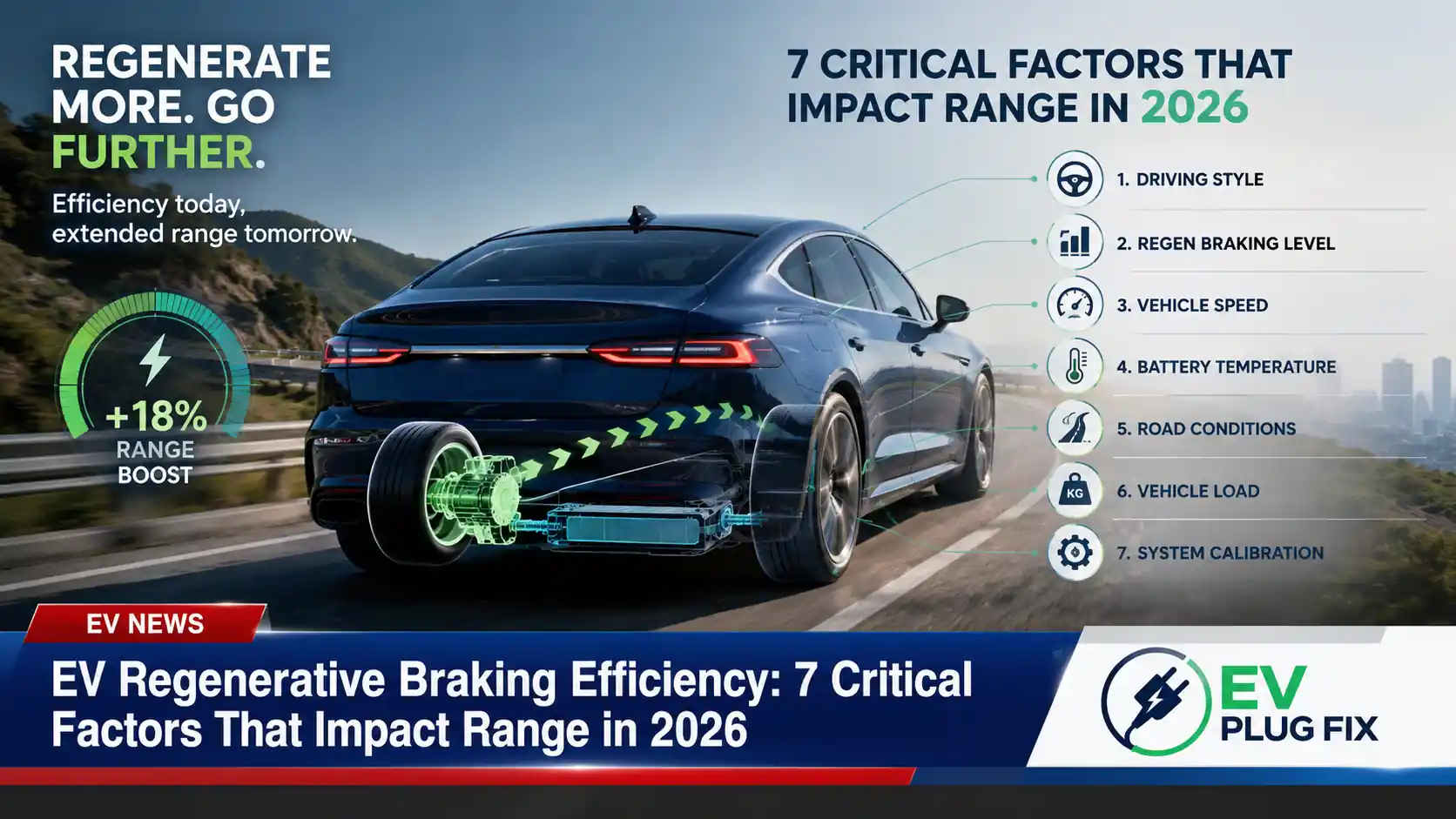
Regenerative braking lets an electric vehicle recover some of the energy that would otherwise be lost as heat during braking. When the car slows, the drive motor can work as a generator and send electrical energy back to the high-voltage battery.
How much energy actually returns to the battery varies widely. Battery temperature and charge level, speed, braking intensity, terrain, vehicle design and driving technique can all limit recovery. Stronger regeneration therefore does not automatically mean better overall efficiency.
How Regenerative Braking Efficiency Works
During regenerative braking, the motor produces braking torque while generating electricity. That electricity passes through the vehicle’s power electronics before reaching the battery. Energy is lost at each stage, so regeneration can never recover all of the kinetic energy removed from the vehicle.
There is also no universal regenerative-braking efficiency percentage. Results depend on what is being measured and under what conditions. A study published in Vehicles, for example, reported regenerative-braking efficiencies around 60% in specific BMW i3 tests. That figure is useful as a research example, not as a general efficiency rating for EVs. See the study in Vehicles.
A 2025 review published in Energies identifies battery state of charge, temperature, charging capability, motor operating conditions, vehicle speed and control strategy among the variables affecting energy recovery. It also notes that friction braking remains necessary when regeneration cannot provide the required braking. Read the review in Energies.
1. Driving Environment: City Versus Highway
Regeneration needs braking opportunities. City driving typically provides many of them through intersections, traffic lights, congestion and changing traffic speeds. Each necessary slowdown gives the EV a chance to recover some energy.
Steady highway driving provides fewer opportunities. That does not mean regenerative braking works poorly on highways; there is simply less braking energy available to recover when the vehicle spends long periods cruising at a nearly constant speed.
2. Battery Temperature and State of Charge
The battery has to accept incoming power for regenerative braking to work at its available capacity. A cold battery may have limited charging capability, while a battery near its upper charge limit may have little room to accept additional energy. Both effects are closely related to EV battery thermal management and the conditions under which the battery can safely accept energy.
Tesla, for example, states in its owner documentation that regenerative braking can be limited when the high-voltage battery is cold or fully charged. Its documentation also notes that preconditioning can help warm the battery before driving on supported vehicles. See Tesla’s regenerative braking documentation.
How the car feels when regeneration is restricted depends on the model. Some vehicles reduce lift-off deceleration, while others can use friction braking to maintain a more consistent response. A regeneration indicator on the dashboard can help show when energy recovery is limited.
3. Speed and Braking Intensity
A vehicle carries more kinetic energy as its speed rises, so more energy must be removed during a slowdown from higher speed. But that does not mean hard braking is the best way to recover it.
The motor, inverter and battery all have power limits. If the requested deceleration exceeds what the regenerative system can provide or the battery can accept, the vehicle may add friction braking. Some of the kinetic energy is then converted to heat rather than returned to the battery.
Regeneration also becomes more limited as motor speed falls near a stop, so many EVs increasingly rely on friction brakes or another mechanism for the final part of stopping.
4. Terrain and Elevation Changes
Long downhill sections can create sustained opportunities for regeneration as the vehicle converts gravitational potential energy into electrical energy. Drivers may even see the estimated range or battery energy increase during a sufficiently long descent.
That energy is not free. If the vehicle climbed the same elevation earlier, it used extra energy on the way up, and losses occur during both propulsion and regeneration. A round trip that returns to its starting elevation cannot recover all of the additional energy consumed during the climb.
On steep descents, safe speed control takes priority. The vehicle can use a combination of regenerative and friction braking when regeneration alone is insufficient or restricted.
5. Vehicle Mass
At the same speed, a heavier vehicle carries more kinetic energy, so more energy is potentially available when it slows. Regenerative braking can recover part of that energy.
Extra mass is still an efficiency penalty rather than an advantage. Energy was required to accelerate the additional weight and move it uphill, and regeneration cannot recover all of that energy. A high regeneration reading therefore does not necessarily mean a heavy EV is more efficient.
6. Motor, Drivetrain and Brake-Blending Design
EVs differ substantially in how they generate and control regenerative braking. Motor characteristics, inverter limits, driven axles, battery charging capability, traction conditions and software calibration can all affect how much regenerative torque is available.
Having two motors does not automatically mean an EV will recover more energy than a single-motor model. What matters is how the complete system is designed and controlled under the conditions in which the vehicle is being driven.
Brake blending is especially important. Pressing the brake pedal in some EVs can request regeneration first and add hydraulic braking only when necessary. Other vehicles divide lift-off regeneration and brake-pedal behavior differently. That is why two EVs can feel very different even when both make extensive use of regenerative braking.
7. Driver Behavior and Regeneration Settings
The strongest regeneration setting is not automatically the most efficient. Energy is lost whenever the vehicle accelerates, regenerates and then accelerates again. When there is no reason to slow, maintaining a smooth speed is usually preferable to deliberately creating another regeneration event.
When slowing is necessary, anticipation helps the regenerative system do more of the work. Gradually reducing accelerator input before a junction, traffic queue or lower speed limit can reduce the need for a hard stop that requires more friction braking.
One-pedal driving can make this easier in urban traffic, but technique still matters. Repeatedly lifting completely off the accelerator and then accelerating again can create unnecessary speed changes. Smooth pedal control is more important than simply selecting maximum regeneration.
When Strong Regeneration Is Most Useful
| Situation | Efficiency Priority |
|---|---|
| Stop-and-go city traffic | Use smooth regenerative deceleration when slowing is required |
| Open road at steady speed | Avoid unnecessary speed changes |
| Long downhill grade | Use available regeneration while maintaining a safe speed |
| Cold battery | Expect possible regeneration limits; use preconditioning if supported and appropriate |
| Battery near full charge | Expect reduced ability to accept regenerated energy |
| Emergency or hard braking | Brake as required for safety; energy recovery is secondary |
Does Regenerative Braking Extend EV Range?
Yes. Regenerative braking returns some energy to the battery that would otherwise be lost through friction braking, so it can reduce overall energy consumption and extend range. The benefit varies by route: stop-and-go driving and long descents provide more opportunities for recovery than steady cruising.
The important distinction is between recovering energy from a slowdown that was already necessary and creating extra slowdowns in an attempt to regenerate more energy. The first can improve efficiency; the second adds conversion losses. This same emphasis on minimizing avoidable energy losses is important when considering EV charging versus petrol costs over everyday driving.
Bottom Line
Regenerative braking efficiency is determined by the whole vehicle and the conditions in which it is driven, not simply by the regen level selected on the dashboard. Battery temperature and state of charge, braking demand, speed, terrain, vehicle mass, drivetrain design and driver behavior all influence how much energy makes it back into the battery.
There is no single recovery percentage that applies to every EV. The practical goal is to make good use of regeneration when the vehicle genuinely needs to slow, while remembering that safe braking always takes priority over energy recovery.