
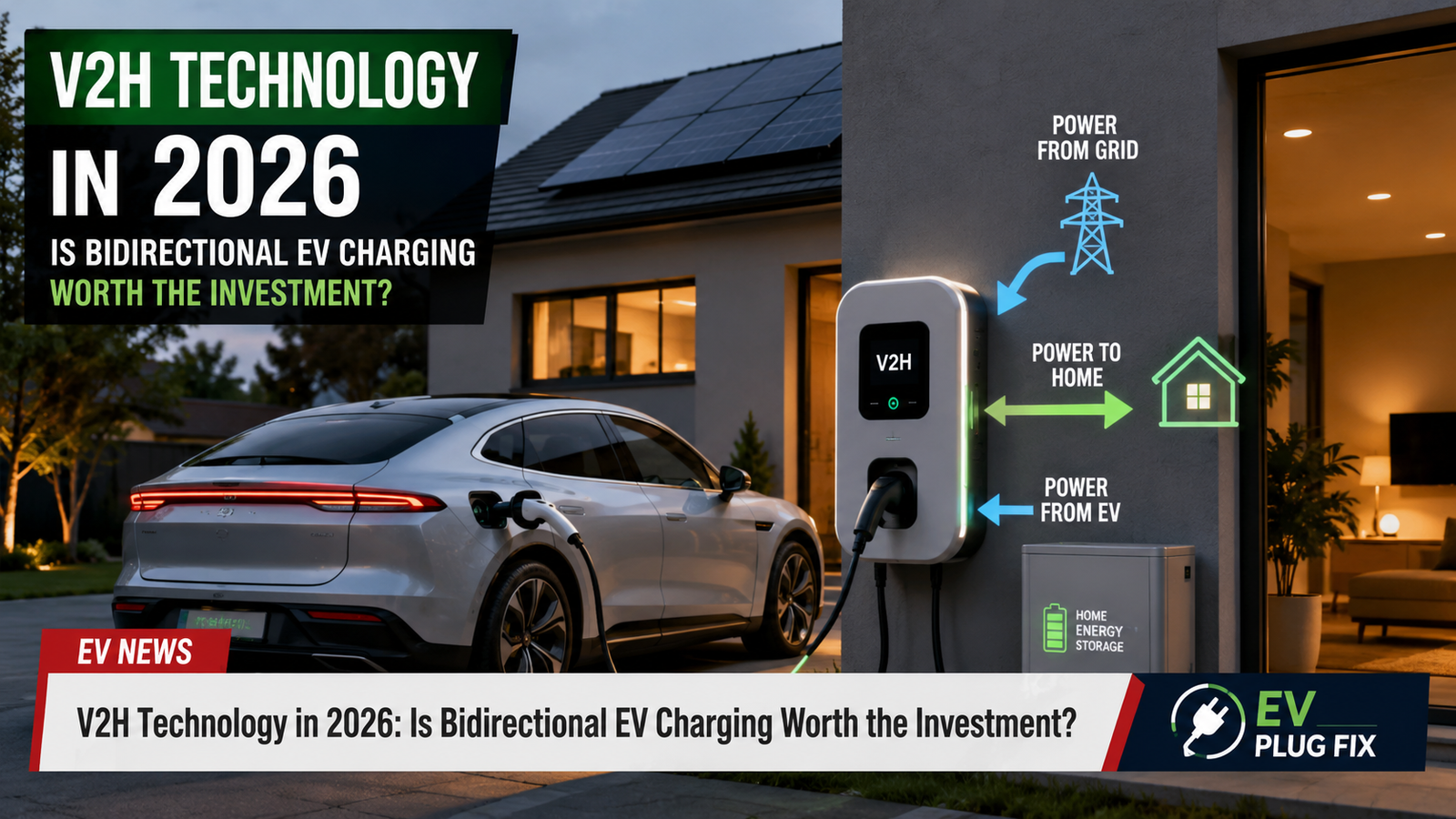
Vehicle-to-home charging has a simple appeal: an electric car already contains a large battery, so why buy another battery just to support the house? With a compatible vehicle and the right electrical equipment, V2H can send energy from an EV back into a home instead of allowing electricity to flow only from the house to the car.
The technology is commercially useful today, but it is not yet a straightforward upgrade for every EV owner. Some systems can provide automatic home backup during an outage, while others can also help households use stored energy when grid electricity is expensive. Compatibility remains specific to the vehicle, charging hardware, home electrical system and market.
For most buyers, V2H is most likely to be worth paying for when the additional installation cost is reasonable, the EV is normally home when electricity is expensive, and backup power has meaningful value. If the main goal is simply inexpensive overnight EV charging, a conventional home charger will usually be the stronger economic choice.
What V2H charging actually does
Normal home EV charging is essentially one-way: electricity travels from the grid or a home energy system into the vehicle battery. V2H adds the ability to send stored energy in the opposite direction and supply the home’s electrical loads.
A complete system usually involves more than a different charging connector. Depending on the design, it may require bidirectional power electronics, a gateway or transfer device, energy-management controls and electrical work that connects the system safely to the home’s panel.
Safe isolation from the utility grid is essential during a blackout. A home cannot simply be energized from an EV while remaining improperly connected to utility lines, so supported backup installations use equipment designed to prevent unsafe backfeeding.
V2H, V2G and V2L are different technologies
| Technology | What it does | Typical purpose |
|---|---|---|
| V2H | Sends energy from the EV to the home’s electrical system | Home backup and household energy management |
| V2G | Allows the vehicle to export electricity to the utility grid where supported | Grid services, demand response and possible compensation |
| V2L | Supplies electricity directly to appliances or equipment through vehicle outlets or an adapter | Tools, camping equipment and temporary portable power |
A vehicle with V2L is therefore not automatically capable of V2H. Running a refrigerator from an outlet in an EV is very different from automatically supplying household circuits through the electrical panel. The distinctions between these systems are covered in more detail in this guide to V2L, V2H and V2G.
Check compatibility before calculating savings
A large EV battery does not automatically mean that the vehicle supports home backup or bidirectional energy management. Confirm the exact vehicle, model year, market and supported home equipment before buying any hardware.
Ford’s F Lightning is one established example. Ford’s Home Backup Power setup uses compatible Lightning models with the required charging and home-integration equipment. Ford has also introduced Home Power Management for eligible configurations and participating electricity providers, allowing stored vehicle energy to be used when grid electricity is more expensive.
For a Ford buyer, the practical questions are whether the truck supports the intended feature, which Ford charging equipment and home-integration hardware are required, whether software activation applies, and whether Home Power Management is available through the relevant electricity provider.
Tesla’s Powershare Home Backup is currently centered on Cybertruck. Tesla lists up to 11.5 kW of continuous backup output with the supported home configuration. For a typical home without the required Tesla energy equipment, the system can involve a Universal Wall Connector, Powershare Gateway and professional installation.
Homes that already have Tesla energy equipment require closer checking. Tesla’s 2026 guidance distinguishes between different Powerwall and Wall Connector configurations, while broader Powerwall integration is also being enabled through software updates. Owners should therefore verify the requirements for their exact Powerwall generation, Wall Connector and current software rather than assuming an existing Tesla installation automatically provides Cybertruck home backup without further changes.
The broader lesson is simple: “bidirectional capable” is not a universal compatibility label. Verify the entire path from the vehicle battery to the home’s electrical panel.
How much does V2H cost?
There is no useful universal V2H installation price. Costs vary according to the manufacturer ecosystem, existing electrical equipment, panel configuration, wiring distance, permitting and whether the home already has compatible energy hardware.
The additional expense can include a bidirectional charging unit, gateway or transfer equipment, electrical-panel work, wiring, commissioning and energy-management hardware. The most useful number for a homeowner is therefore the incremental cost of adding V2H compared with the ordinary home-charging installation that would have been installed anyway.
Tesla currently lists its Powershare Home Backup Bundle in the United States at $1,970. Tesla says professional installation typically costs around $2,000 to $4,000, depending on the configuration and installation complexity. More extensive electrical work, such as panel changes or unusual wiring requirements, can increase the final quote.
Ford uses a different combination of charging equipment, home-integration hardware and software depending on the F Lightning configuration. That makes direct charger-to-charger price comparisons misleading unless they include everything required to achieve equivalent home-backup functionality.
V2H savings and payback
There is no defensible universal payback period for residential V2H. The financial case comes mainly from the value of electricity shifted between cheap and expensive periods, any available utility payments or incentives, and the value the household places on backup power.
A simple starting point for energy arbitrage is:
Gross value = energy shifted × effective electricity-price difference
For example, suppose a household shifts 10 kWh from a cheap charging period to an expensive period and the effective difference after losses is €0.15 per kWh. That cycle produces €1.50 of gross value. Whether that becomes meaningful annual savings depends largely on how frequently the opportunity occurs.
Ford estimates that some customers using Home Power Management with participating electricity providers in select states could save up to about $42 per month, or around $500 per year, based on available utility rates and vehicle data. It is a manufacturer estimate tied to specific electricity-rate conditions rather than a savings figure that should be applied to every F Lightning owner.
A homeowner considering V2H should therefore compare the extra cost of bidirectional capability with realistic annual savings under the home’s actual electricity tariff. If the EV is regularly away during the expensive part of the day, the opportunity to use its battery for price shifting may be limited even when the tariff itself looks attractive.
Backup power can be more valuable than bill savings
For some households, the strongest argument for V2H is not electricity arbitrage at all. It is the ability to use a large EV battery during a power outage; the practical considerations for using EV blackout power depend on both available battery energy and household loads.
Actual backup duration depends on the vehicle’s available state of charge and how much electricity the home consumes. Heating, air conditioning, electric cooking and other large loads can dramatically reduce how long any battery lasts.
Tesla says a fully charged Cybertruck can provide more than three days of home backup with Powershare under an assumption of approximately 30 kWh of household energy use per day. It is a manufacturer estimate, and actual duration varies with energy use, vehicle state of charge and system configuration.
Ford has published similar assumptions for the F Lightning. Ford has stated that an extended-range Lightning can provide up to three days of whole-home power based on approximately 30 kWh of consumption per day, with substantially longer operation possible when household energy is rationed. Current Ford consumer guidance also describes roughly two to three days of home power depending on the truck’s battery configuration and household demand.
That capability can change the economics for a home that would otherwise need a stationary battery or generator. In an area with rare, brief outages, however, the same backup feature may have relatively little financial value.
Battery use and other V2H trade-offs
Using an EV battery to power a home adds energy throughput beyond normal driving, so battery use belongs in the economic calculation. That does not mean V2H automatically causes rapid battery degradation.
Battery aging depends on factors including chemistry, temperature, state of charge, depth of discharge, cycling pattern and the vehicle’s battery-management strategy. A shallow daily energy shift is not equivalent to repeatedly using most of the battery’s capacity.
Supported systems may let owners reserve a minimum state of charge so household use cannot consume energy needed for driving. Manufacturer-controlled systems can also impose operating limits on bidirectional use.
Before buying V2H primarily for frequent tariff arbitrage, check the vehicle manufacturer’s current battery warranty and any terms covering bidirectional operation. Warranty conditions and supported uses can differ by model and market.
There is also a practical limitation that stationary batteries do not have: the EV may not be home when stored electricity is most valuable. Drivers who regularly commute during evening peak-rate periods should account for that before projecting savings.
When V2H is most likely to be worth it
- The incremental installation cost is modest: Existing compatible equipment can make the upgrade easier to justify.
- Your tariff has meaningful peak and off-peak differences: Cheap charging and expensive household electricity create more opportunity for energy shifting.
- The EV is usually home at the right time: Bidirectional capability has little financial value if the battery is elsewhere during peak periods.
- Backup power matters to you: Frequent outages or a strong need for household resilience can justify V2H even when bill savings alone do not.
- You have suitable solar generation: Depending on the tariff and system design, the EV may provide another way to store energy instead of exporting it at a lower value.
- A utility program improves the economics: Eligible incentives, demand-response payments or special electricity rates can materially change the calculation.
When a conventional home charger is probably better
A conventional charger will usually make more financial sense when electricity rates are relatively flat, outages are uncommon, the vehicle is normally away during peak periods or the home requires expensive electrical modifications before V2H can operate.
V2H also should not outweigh the basic job of choosing the right vehicle. Paying substantially more for an EV that is less suitable for your driving needs simply to obtain bidirectional capability can erase years of possible household-energy savings.
For most buyers, the sensible order is to choose the vehicle first, price an ordinary home-charging installation, and then decide whether the additional cost of V2H is justified by realistic bill savings and backup value.
What about commercial fleets?
Bidirectional charging can also benefit commercial vehicles because fleets often have predictable parking schedules and large combined battery capacity. However, the economics depend on vehicle availability, tariff structure, demand charges and infrastructure costs. Exporting energy to the grid is generally described as V2G, while using vehicles to support loads at a commercial site is commonly treated as vehicle-to-building or site energy management. The economics and grid-service role of vehicle-to-grid technology therefore differ from a residential V2H installation.
Those applications can be valuable, but they require a different financial model from a homeowner deciding whether to add V2H to one EV.
How to evaluate a V2H quote
Before accepting an installation proposal, make sure the quote separates the cost of ordinary EV charging from the additional expense required to gain bidirectional functionality.
- Confirm that your exact vehicle, model year, market and software version support the proposed system.
- Ask which charger, gateway, transfer equipment and electrical upgrades are required.
- Separate the cost of an ordinary home-charging installation from the additional cost of V2H.
- Check whether any hardware you already own actually reduces the required equipment for your specific configuration.
- Use your real electricity tariff rather than a national or regional average.
- Estimate when the vehicle will normally be plugged in and how much energy can realistically be shifted.
- Include charging and conversion losses in the financial calculation.
- Check vehicle, battery, charger and installation warranty conditions.
- Confirm applicable utility, permitting and interconnection requirements.
- Calculate electricity-bill savings and the value of backup power separately so that one does not hide weak economics in the other.
Bottom Line
V2H bidirectional charging can be worth paying for when the additional hardware and installation cost is reasonable and the household can make meaningful use of either backup power, favorable time-of-use electricity rates or both.
It is not yet a universally compelling upgrade for ordinary home charging. A driver on a flat electricity tariff, with a reliable grid and a car that is usually away during expensive periods, may gain very little financially from bidirectional capability. In that situation, a conventional smart charger will normally be cheaper and simpler.
The strongest V2H candidates are households where the EV is frequently available at home, the tariff rewards energy shifting and outage protection has real value. Judge the system by the incremental installed cost and the benefits your own home can actually use, not simply by the impressive size of the EV battery.
FAQ
Can every electric car use V2H charging?
No. The vehicle must support a compatible bidirectional power system, and it must work with the required charging and home-integration equipment. Support can vary by vehicle model, model year, software version and market.
Can V2H power a house during a blackout?
Yes, supported V2H systems can provide home backup. The property needs appropriate equipment to isolate it safely from the utility grid, and available power and backup duration depend on the vehicle, battery state of charge and household loads.
Is V2H the same as plugging appliances into an EV?
No. Supplying appliances directly from vehicle outlets is generally called vehicle-to-load, or V2L. V2H connects the vehicle to the home’s electrical system and requires additional control and safety equipment.
Can V2H lower electricity bills?
Potentially. The financial case is strongest when electricity can be bought cheaply during one part of the day and vehicle energy can replace more expensive grid electricity later. Savings depend on the tariff, losses, amount of energy shifted and whether the vehicle is actually connected when needed.
Does V2H damage an EV battery?
V2H adds battery cycling, but its effect on long-term degradation depends on battery chemistry, temperature, depth of discharge, state of charge and how the manufacturer manages bidirectional operation. Owners planning frequent use should check the manufacturer’s current battery-warranty terms.
Should I wait before installing V2H?
Waiting may make sense if your vehicle is not supported, compatible equipment is unavailable in your market or the financial case depends on future software, hardware or utility programs. If a currently supported system already provides valuable outage protection or useful tariff savings, there is no universal reason to delay solely because newer V2H products will continue to appear.
Source Transparency
This article uses current manufacturer information from Ford and Tesla to illustrate commercially available bidirectional home-power systems. Manufacturer estimates for savings, backup duration, output and system performance are presented as manufacturer claims rather than independent test results.
V2H hardware, software compatibility, installation requirements, pricing, electricity tariffs and utility programs can change. Tesla’s Powershare and Powerwall integration requirements in particular are evolving during 2026, so prospective owners should verify the requirements for their exact vehicle, Wall Connector, Powerwall configuration and software immediately before purchasing or scheduling installation.
Prospective buyers should also confirm current Ford equipment and software requirements, vehicle compatibility, utility eligibility, warranty terms, installation pricing and local electrical requirements before relying on any V2H savings or backup-power calculation.