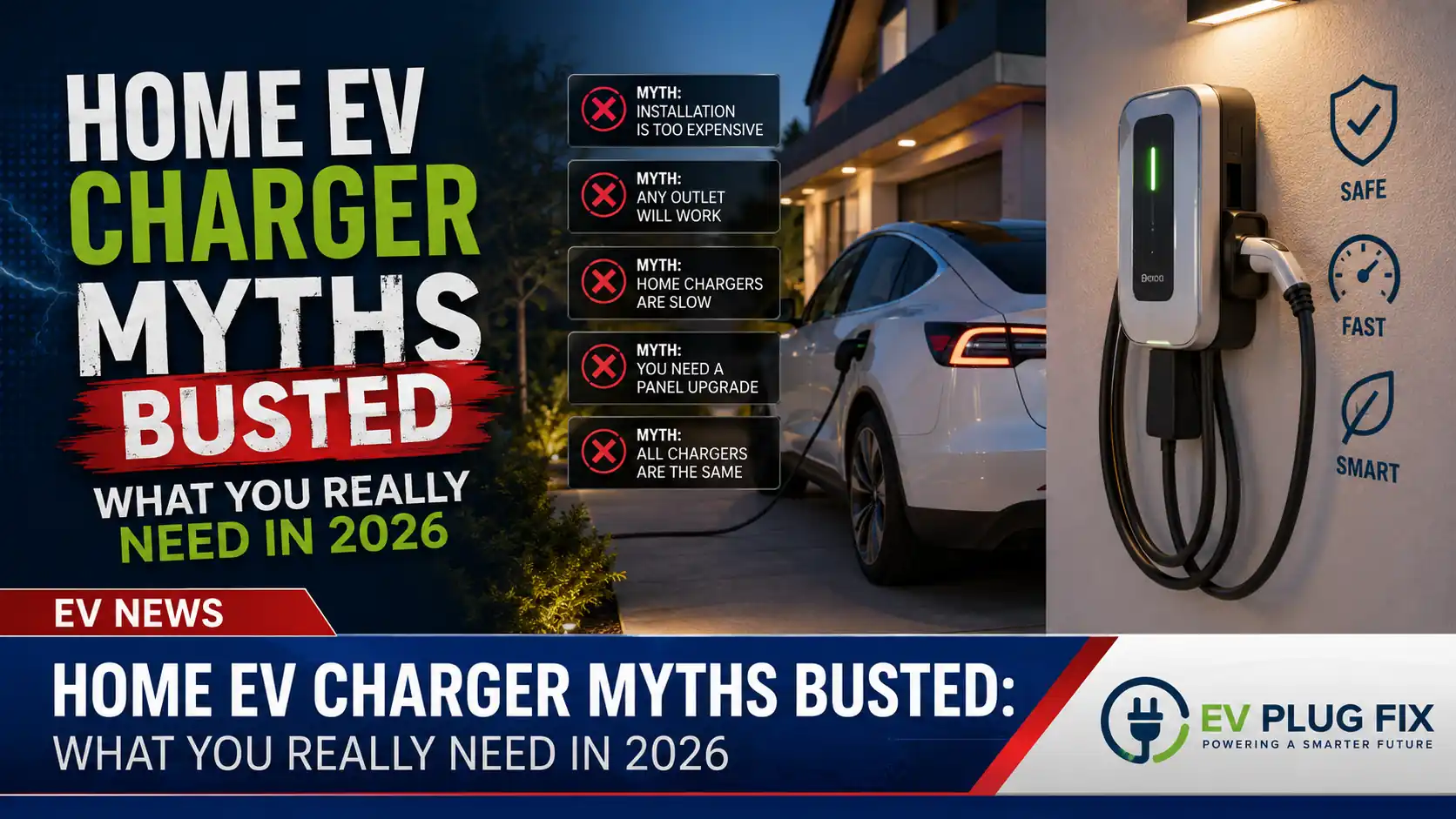
Shopping for a home EV charger can quickly turn into a contest over amperage, features and specifications. In practice, the right setup depends on how much energy you need to replace, how quickly your vehicle can accept AC power, what your home’s electrical system can support and how you plan to use the charger.
The equipment on the wall or charging cable is technically electric vehicle supply equipment, or EVSE; the vehicle’s onboard charger ultimately determines how much AC power the car can accept.
Myth 1: Every EV Owner Needs Level 2 Charging
Level 2 charging is faster, but faster does not automatically mean necessary. Level 1 charging from a 120-volt supply can still work for drivers who cover relatively few miles and have long overnight parking periods.
The U.S. Department of Energy’s Alternative Fuels Data Center estimates that Level 1 typically adds about 2 to 5 miles of driving range per charging hour. Actual results vary with vehicle efficiency, weather, charging losses and other conditions.
Level 1 is most plausible for low daily mileage, plug-in hybrids with smaller batteries or vehicles that remain plugged in for many hours. Level 2 becomes more useful as daily mileage rises, available charging time shrinks or multiple EVs need to share the charging window.
The practical test is simple: can the charging setup reliably replace the energy you normally use before you need the vehicle again? A broader home EV charger comparison can help when deciding whether dedicated equipment is necessary for your driving pattern.
Myth 2: More Amps Always Mean Faster Charging
Higher EVSE output only helps when the vehicle can accept the additional AC power. If a vehicle’s onboard charger is limited to 7.2 kW, connecting it to an 11.5 kW wallbox does not make the car charge at 11.5 kW.
| EVSE Output | Approximate Power at 240 V | Common Circuit Size |
|---|---|---|
| 24 A | 5.8 kW | 30 A |
| 32 A | 7.7 kW | 40 A |
| 40 A | 9.6 kW | 50 A |
| 48 A | 11.5 kW | 60 A |
These figures illustrate the relationship between charging current and circuit capacity for a continuous load; the EVSE manufacturer’s instructions and locally adopted electrical requirements still govern a specific installation.
Installing additional capacity can make sense if you expect a future EV with a higher AC charging rate, but it will not make today’s vehicle exceed its own charging limit.
Myth 3: Level 2 Charging Requires 200-Amp Electrical Service
A 200-amp electrical service is not a universal requirement for Level 2 charging. The important question is how much capacity remains after the home’s other electrical loads are considered, which requires more than simply reading the service rating on the panel.
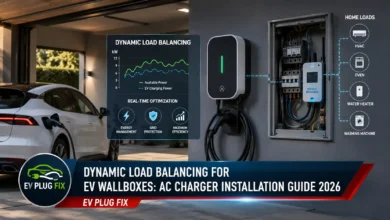
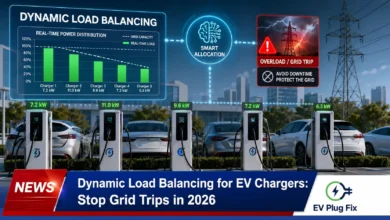
Homes with the same service rating can have very different electrical demands. If capacity is limited, possible solutions may include charging at a lower current or using compatible dynamic load balancing rather than immediately upgrading the service. Establish what the property can accommodate before selecting the charger’s maximum output.
Myth 4: Any 240-Volt Outlet Makes Plug-In Charging Simple
Plug-in and hardwired installations each have advantages. A plug-in EVSE is easier to remove or replace, which can be useful for renters or drivers who expect to move the equipment. Hardwiring eliminates the receptacle-and-plug connection and is commonly used for permanent installations and equipment that requires it.
But a receptacle is not automatically suitable for routine EV charging just because the charger’s plug fits. The circuit rating, wiring, breaker, receptacle type and condition all matter, as do the EVSE manufacturer’s instructions. Some models or higher output settings require hardwiring.
The same caution applies to an existing dryer outlet. Its presence does not establish that it can support the charging current you want to use, and an adapter does not change the circuit’s underlying capabilities. An existing circuit being considered for regular EV charging should be evaluated for that use; the appropriate solution may be a lower charging-current setting or a dedicated circuit.
Myth 5: You Need the Charger Made by Your Automaker
An automaker-branded wallbox may integrate well with a particular vehicle ecosystem, but the badge is not the main compatibility test. The charger needs the correct connector or supported adapter arrangement, usable electrical output and an installation that follows the equipment’s requirements.
Safety certification matters as well. In the United States and Canada, look for equipment certified by a recognized testing organization to the applicable standards. UL Solutions identifies ANSI/UL 2594 as the standard covering electric vehicle supply equipment, alongside related standards for charging-system components.
Connector choice deserves particular attention in North America because the market is changing. J1772 remains relevant to a large installed base of vehicles, while the Tesla-originated North American Charging System connector has been standardized by SAE as J3400 and is appearing on newer vehicles and charging equipment.
Choose around the vehicles you actually expect to charge rather than assuming one connector has already made every other option obsolete. Check your current vehicle, any adapter limitations and the likely needs of future vehicles before committing to a connector. Comparing EV charging connector types can clarify which plug arrangements fit different vehicles.
Myth 6: A Smart Charger Automatically Saves Money
Wi-Fi does not make electricity cheaper. Smart charging can reduce costs when its features let you take advantage of something that affects the bill, such as a time-of-use or other variable electricity tariff.
Some EVs already support scheduled charging through their own software. If your electricity rate is flat and the vehicle provides the scheduling you need, paying extra to duplicate that function in the wallbox may offer little benefit.
Other connected features can serve different purposes, including energy monitoring, access control, adjustable current, coordination between multiple chargers and integration with compatible load-management or home-energy systems. Check your tariff and the functions already available in your vehicle before deciding which features are worth paying for.
Myth 7: The Federal Home EV Charger Tax Credit Is Still Available for New 2026 Installations
This is one area where older buying guides can now be misleading. Under current IRS guidance, the federal Alternative Fuel Vehicle Refueling Property Credit under Section 30C is not available for property placed in service after June 30, 2026.
For qualifying personal-use property placed in service at a principal residence from January 1, 2023 through June 30, 2026, the credit was generally 30% of qualified costs, with a maximum credit of $1,000 for each qualifying item. Eligibility was not nationwide: among other requirements, the property had to be located in an eligible low-income or non-urban census tract.
If your equipment was placed in service within that period, use the current IRS guidance for individuals and the applicable Form 8911 instructions when determining whether it qualifies.
For a new installation after June 30, 2026, do not include the federal Section 30C credit in the budget. State, local and electric-utility programs are separate and may have different deadlines, eligible equipment or application procedures.
Myth 8: Renters Cannot Charge an EV at Home
Renting adds approval and infrastructure questions, but it does not create a universal ban on home charging. What is possible depends on the parking arrangement, lease, property owner, electrical infrastructure and applicable local or state law.
A renter with an assigned parking space, for example, may be able to seek approval for a dedicated installation, although responsibility for the cost and approval process varies by property and jurisdiction. Portable charging equipment can offer flexibility, but an existing receptacle should not be assumed suitable for routine EV charging without considering its circuit rating, wiring and condition.
What You Actually Need in a Home EV Charger
Before choosing equipment, work through five questions in this order:
- Calculate your normal charging need. Estimate the energy you usually need to replace between charging sessions rather than designing around an occasional nearly empty battery.
- Check your vehicle’s AC charging limit. Match charger output to what the vehicle can use, allowing extra capacity only when future-proofing has a clear purpose.
- Establish the property’s electrical capacity. Do this before committing to charger amperage or assuming that a service upgrade is needed.
- Choose the connector and installation method. Account for your current and likely future vehicles, adapter requirements and whether portability makes plug-in equipment worthwhile.
- Pay only for features you will use. Prioritize functions that solve a specific issue involving electricity rates, electrical capacity, access, monitoring or multiple vehicles.
For an outdoor installation, choose equipment rated for the environment where it will operate. If you plan to use a utility, state or local incentive, check the program before buying because equipment and application requirements can change. The full home EV charger installation guide covers the practical cable, breaker and installation considerations in more detail.
The Bottom Line
Start with the energy your driving requires, then check the vehicle and the property before choosing the charger itself. That decision order is more useful than shopping by maximum amperage, brand name or feature count.
Source Transparency
This North America-focused guide was checked against U.S. Department of Energy Alternative Fuels Data Center charging guidance, IRS Section 30C guidance, SAE information on J3400 and UL Solutions information on EVSE standards. Electrical codes, electricity tariffs and incentive rules vary by jurisdiction and can change, so requirements affecting a specific installation should be verified with the relevant authority, utility or qualified professional.