
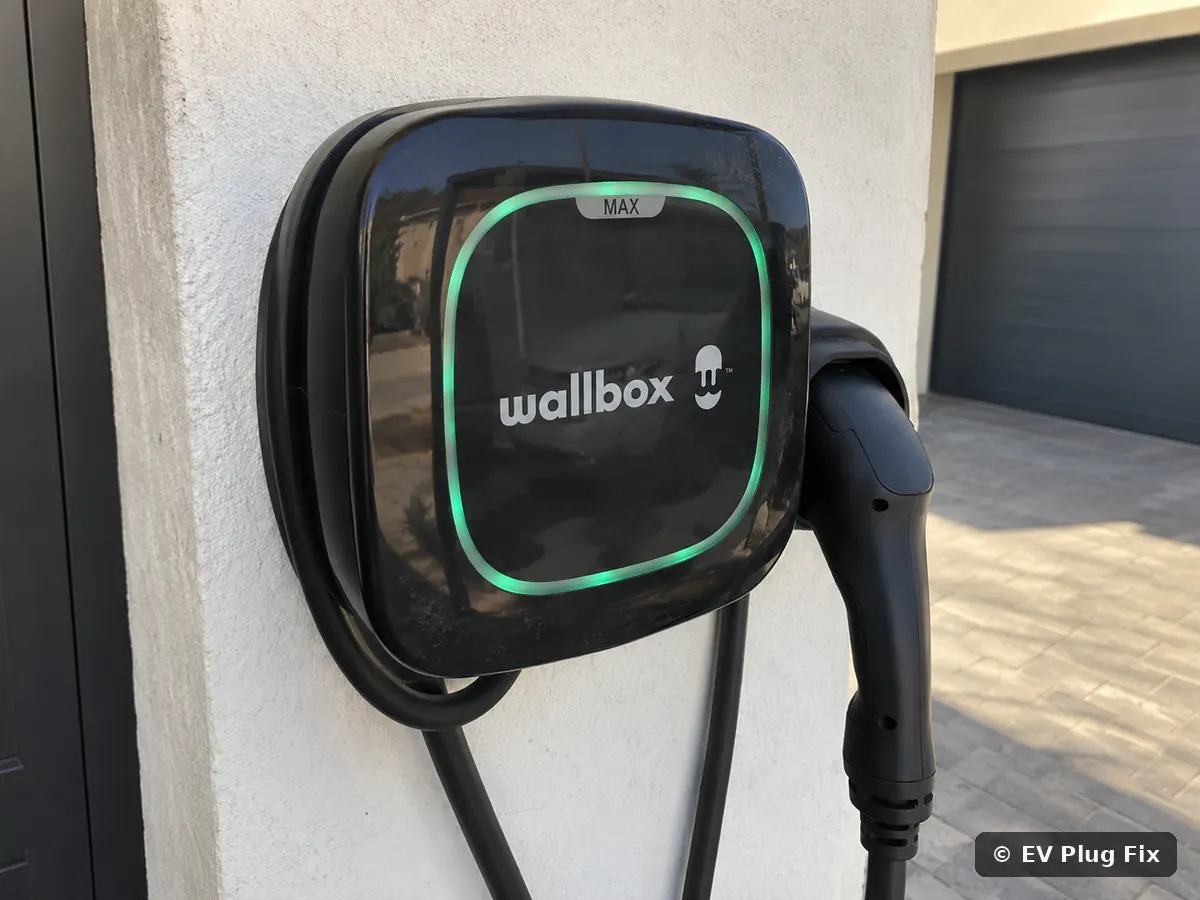
The defect may cause internal electrical connections to overheat during charging and could also reduce the charger’s service life. The reported corrective action includes a software update, inspection of affected units, and repairs or replacement parts where necessary.
Important: The warning applies to specifically identified UK-market units, not every Wallbox charger. Owners should verify their charger’s model and component identifiers before deciding whether their equipment is affected.
Read the official UK government safety report.
What Is the Wallbox Pulsar Max Overheating Problem?
According to the OPSS report, a manufacturing defect affects the internal output terminal block in certain Wallbox Pulsar Max UK charging points. This component forms part of the charger’s electrical connection system.
An affected terminal block may allow internal electrical connections to overheat during use. Excessive heat at an electrical connection can damage surrounding components and insulation, while severe electrical faults can create a fire hazard.
The report classifies the overall risk as low, but that classification does not mean owners should ignore the notice. It means the stated risk assessment is limited to the product and circumstances evaluated by the regulator.
Safety takeaway: Do not open the charger or attempt to repair its internal terminals yourself. Contact Wallbox support to confirm whether your unit is affected and follow the instructions provided for inspection and corrective action.
Which Wallbox Pulsar Max Chargers Are Affected?
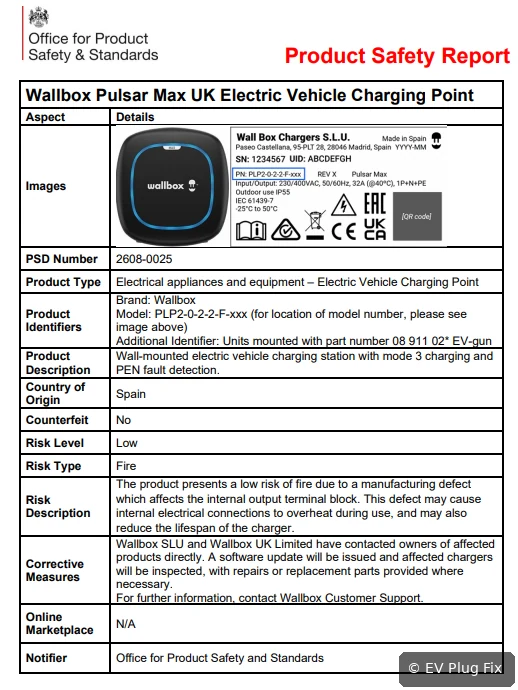
The official report identifies a particular UK-market product and provides model and component information to help distinguish affected units from other chargers.
| Identification field | Official report details |
|---|---|
| Brand | Wallbox |
| Product | Pulsar Max UK Electric Vehicle Charging Point |
| Model identifier | PLP2-0-2-2-F-xxx |
| Additional component identifier | Units fitted with part number 08 911 02* EV-gun |
| Country of origin | Spain |
| Report publication date | September 2, 2026 |
| Reported risk | Low risk of fire |
The model number and component identifier should be checked against the original notice. The xxx portion of the model identifier represents a variable part of the model designation, so it should not be treated as a complete serial number.
Do not assume that a charger is affected solely because it carries the Pulsar Max name. If the model or component number is difficult to locate, ask Wallbox support or your installer to verify the unit using its serial number and product documentation.
What Corrective Action Has Wallbox Announced?
The OPSS report states that Wallbox SLU and Wallbox UK Limited have contacted owners of affected products. The announced corrective programme includes a software update and inspection, with repairs or replacement parts provided where necessary.
| Corrective measure | What owners should know |
|---|---|
| Software update | Follow the manufacturer’s instructions and confirm the required update for your exact unit. |
| Product inspection | Allow the manufacturer or an appropriately qualified technician to assess the affected charger. |
| Repair or replacement parts | The appropriate remedy depends on the inspection findings and the manufacturer’s instructions. |
| Customer support | Contact Wallbox to confirm eligibility, the next steps, and whether the charger can safely remain in service. |
Do not assume a firmware update alone resolves a physical terminal-block defect. The regulator’s report includes inspection and potential hardware repair or replacement as part of the corrective action.
Owners can also consult the official Wallbox software release notes. However, a general software release note should not be interpreted as confirmation that the specific safety correction has been completed for an individual charger.
What Should You Do If Your EV Charger Gets Too Hot?
Not every warm charger indicates a dangerous defect. Charging equipment can become warm during normal operation, and permissible temperatures depend on the model, installation, ambient conditions, and operating specifications.
However, unusual heat accompanied by a burning smell, discoloration, melting, smoke, or repeated charging interruptions should be treated seriously.
Warning signs that need attention
- A burning or unusual electrical smell coming from the charger or its connection points.
- Visible discoloration, melted plastic, cracked housing, or damaged insulation.
- Smoke, sparks, or signs of charring near the charger or charging connector.
- Repeated charging shutdowns accompanied by unusual heat or visible damage.
- Physical damage to the charging cable, plug, connector, or enclosure.
Immediate safety steps
- Stop charging if it is safe to do so. Use the normal controls only if there are no signs of an immediate electrical or fire hazard.
- Keep away from damaged equipment. Do not touch a hot, melted, smoking, or visibly damaged connector.
- Do not dismantle the charger. Internal electrical work must be handled by qualified personnel.
- Contact the manufacturer or a qualified installer. Explain the symptoms and provide the model and serial number if it is safe to obtain them.
- Respond appropriately to smoke or fire. Move away, keep others clear, and call emergency services. Do not attempt to disconnect equipment that is smoking or burning.
Wallbox’s published Pulsar Pro and Pulsar Max safety instructions provide additional manufacturer guidance on damaged equipment and qualified servicing.
Why Can EV Charger Connections Overheat?
The reported Wallbox defect is a specific manufacturing issue. It should not be confused with every other possible cause of excessive heat in EV charging equipment.
In electrical systems generally, heat can develop when current passes through a connection with excessive resistance. Poor contact, damaged conductors, unsuitable components, or installation defects can contribute to this problem, depending on the equipment and circumstances.
Other charger faults can involve damaged cables, environmental exposure beyond the product’s operating limits, or problems in the supply circuit. These are general diagnostic possibilities, not additional causes confirmed by the OPSS investigation into the affected Pulsar Max units.
| Possible issue | Potential indication | Recommended response |
|---|---|---|
| Manufacturing defect | A product-specific safety notice or identified faulty component. | Check the manufacturer’s corrective programme. |
| Damaged connector or cable | Visible damage, discoloration, or abnormal heat. | Stop use when unsafe and arrange professional inspection. |
| Installation or supply problem | Repeated electrical faults or symptoms linked to the supply circuit. | Have a qualified electrician assess the installation. |
| Operating conditions | Heat associated with environmental conditions or operation outside specifications. | Check the product’s operating limits and installation requirements. |
For additional context on the technical requirements of EV charging installations, consult the UK government’s electric vehicle chargepoint and infrastructure specifications. Requirements vary by jurisdiction, so installations outside the UK must also comply with applicable local electrical regulations.
Can Smart Charging Features Prevent Overheating?
Smart charging can help manage electrical demand, but it is not a universal solution to hardware defects.
For example, dynamic load balancing can adjust charging power according to the available electrical capacity of a property. This can help prevent excessive combined demand from an EV charger and other household loads when the system is correctly designed and installed.
It does not, however, repair a defective internal terminal block or guarantee that every electrical connection will remain within safe temperature limits. Product-specific corrective action and professional inspection remain necessary when a safety notice applies.
Learn more in our guide to Dynamic Load Balancing for EV Chargers: Complete Wallbox Guide.
For operators managing multiple charging points, data analytics can also help identify repeated faults, unexpected interruptions, and changes in charger availability. Monitoring is useful for maintenance planning, but it should supplement rather than replace physical inspection and manufacturer safety procedures.
Explore our guide to EV Charging Station Data Analytics: 12 Metrics That Drive Profit and Uptime.
Does the Wallbox Warning Apply Outside the UK?
The published OPSS notice concerns the specified Wallbox Pulsar Max UK charging point and its identified component. It does not establish that every Pulsar Max sold internationally is affected.
Owners in Europe, North America, Asia, or other markets should not assume either that their charger is affected or that it is automatically exempt. Product revisions, regional versions, and component identifiers can differ.
If you purchased a Pulsar Max outside the UK, contact Wallbox support with the exact model, serial number, country of purchase, and any relevant component information. Ask the manufacturer whether the UK corrective programme applies to your unit or whether a separate regional notice exists.
For buyers and installers evaluating charging hardware, our Type 2 EV Charger Supply: OEM, Certifications and Bulk Buyer’s Guide explains why product documentation, certification, and supplier verification matter when sourcing charging equipment.
Frequently Asked Questions
1. Which Wallbox charger is named in the safety report?
The report identifies the Wallbox Pulsar Max UK Electric Vehicle Charging Point, model designation PLP2-0-2-2-F-xxx, with the specified additional component identifier 08 911 02* EV-gun.
2. What causes the reported overheating risk?
The OPSS report identifies a manufacturing defect affecting the internal output terminal block. It states that the defect may cause internal electrical connections to overheat during use and may reduce the charger’s service life.
3. Has Wallbox recalled every Pulsar Max charger?
No such conclusion is supported by the report. The notice describes a modification programme for specifically identified units, including a software update, inspection, and repairs or replacement parts where necessary.
4. Is it safe to continue using an affected charger?
Do not make that decision based solely on the overall low-risk classification. Contact Wallbox support and follow the instructions provided for your specific unit. If there are signs of burning, smoke, melting, or unusual heat, stop use when safe and seek professional assistance.
5. Will a software update fix the terminal block defect?
The report says a software update will be issued and that affected chargers will be inspected, with repairs or replacement parts provided where necessary. It does not establish that a software update alone resolves the physical defect.
6. What should I do if I bought the charger outside the UK?
Contact Wallbox with the charger’s model and serial number and ask whether your specific unit is covered by the corrective action or any regional safety notice. The UK report alone does not establish the status of every international version.
7. Can dynamic load balancing prevent this particular fault?
No. Dynamic load balancing manages electrical demand but cannot correct a manufacturing defect in an internal terminal block. It may improve load management, but product-specific safety action must still be followed.
Sources and Further Reading
- UK Office for Product Safety and Standards: Wallbox Pulsar Max Product Safety Report, September 2, 2026 — primary source for the reported defect, product identifiers, risk assessment, and corrective action.
- Wallbox Help Center: Pulsar Pro/Pulsar Max Safety Instructions — manufacturer safety guidance.
- Wallbox Software Release Notes — official product software updates and release information.
- UK Government: Electric Vehicle Chargepoint and Infrastructure Specifications — installation and infrastructure requirements.
Editorial note: This article is based on the published regulator notice and manufacturer documentation available at the time of writing. It does not replace a product-specific assessment, professional electrical inspection, or the manufacturer’s latest safety instructions.