
How Often Should You Charge an Electric Car? A Practical Guide

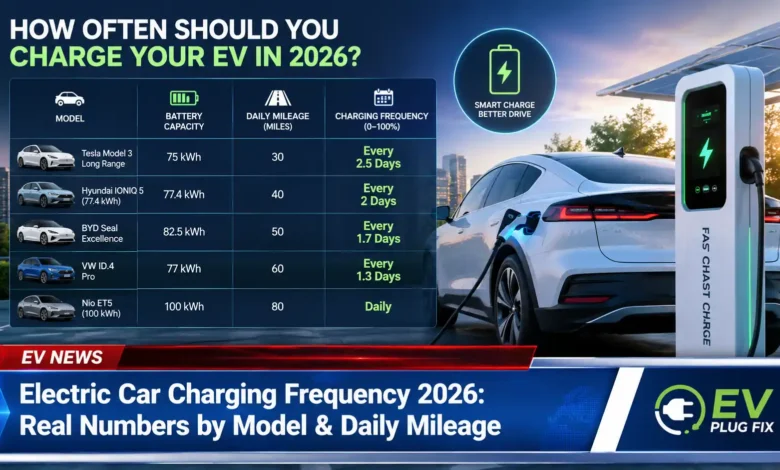
How often should you charge an electric car? There is no universal schedule. A low-mileage driver may comfortably charge every few days, while someone with a long daily commute and home charging may sensibly plug in every night. The right routine depends on four things: how far you normally drive, where you can conveniently charge, the normal charge target recommended for your car and how much reserve you want for the next journey.
You do not need to wait until an EV battery is nearly empty before charging. With convenient home or workplace charging, it is often easier to replace the energy you have used while the car is parked rather than treat charging like a petrol-station visit.
Work Out How Often Your EV Needs Charging
A useful estimate starts with your typical mileage and the portion of the battery you expect to use between charging sessions. Do not simply divide the car’s official range by your daily mileage and assume you will routinely drive from 100% to almost empty.
For illustration, consider a 300-mile EV operated between roughly 80% and 20%. That 60% battery window corresponds to about 180 miles of rated range. At 30 miles per day, it represents about six days of driving; at 60 miles per day, about three days.
| Rated range | Illustrative 20–80% window | 30 miles/day | 60 miles/day | 100 miles/day |
|---|---|---|---|---|
| 200 miles | About 120 miles | About 4 days | About 2 days | About 1 day |
| 250 miles | About 150 miles | About 5 days | About 2–3 days | About 1–2 days |
| 300 miles | About 180 miles | About 6 days | About 3 days | About 2 days |
| 350 miles | About 210 miles | About 7 days | About 3–4 days | About 2 days |
These are planning examples, not recommended charging intervals. Real consumption changes with temperature, speed, cabin heating or cooling, towing, hills and other driving conditions. Your observed energy use is therefore more useful for deciding when to plug in than rated range alone.
Follow Your Car’s Charge Target, Not a Universal Percentage
There is no benefit to deliberately running a modern EV close to empty before connecting it to a charger. The more useful question is what charge target the manufacturer recommends for normal use.
Those recommendations are not identical across vehicles. Chevrolet currently recommends an 80% charge target for the Blazer EV, Equinox EV and Silverado EV, while its guidance for the 2027 Bolt says to charge regularly to 100%. Tesla likewise tells owners to follow the daily and trip limits shown by the vehicle, with different instructions depending on battery configuration.
There is no universal 80% rule that should override the instructions for your car. Check the current owner’s manual, in-vehicle charging screen or manufacturer app and use the recommended normal target for your exact model and battery. Keeping a vehicle at an unnecessarily high state of charge for extended periods can matter for some batteries, as explained in our guide to high state-of-charge battery degradation.
When Nightly Charging Makes Sense
Charging every night is perfectly practical when you have convenient home charging, but plugging in nightly does not mean charging to 100% nightly. Set the appropriate charge limit and the vehicle can stop automatically at that target.
For a high-mileage commuter, connecting each evening may be the simplest way to ensure the energy used that day is restored before morning. A low-mileage driver has more flexibility and may prefer to connect only every few days.
Nightly charging can also suit homes with time-of-use electricity tariffs because compatible cars and chargers can schedule charging for cheaper periods. Drivers who depend primarily on public charging will usually adopt a different routine, allowing more battery capacity to be used before making a deliberate charging stop.
Charging Speed Determines How Easy the Routine Is
The amount of driving determines how much energy must be replaced; the charging equipment determines how easily that can be done before the car is needed again.
In North America, Level 1 charging uses a 120-volt AC supply and may be sufficient for drivers whose daily energy use is modest and whose cars remain parked for long periods. Level 2 charging replaces energy faster, making it more practical for longer commutes or shorter overnight charging windows. The broader trade-offs between charging speeds, safety and scheduling are covered in our home EV charging guide.
The important test is simple: can your usual charging setup restore the energy you normally consume before the next departure? If it can, plugging in frequently may require little thought even for a relatively high-mileage driver.
Use Real Consumption Instead of Official Range Alone
Official range figures are useful for comparing EVs, but they do not tell you exactly how many days you can drive between charges. Temperature, motorway speeds, heating or air conditioning, hills and heavy loads can all change energy consumption.
Watch how much battery your normal journeys actually use. If winter commuting consumes noticeably more energy than summer driving, shorten the interval between charges or leave a larger reserve rather than relying on a fixed schedule based on the advertised range.
Road Trips Require a Different Charging Strategy
Long-distance travel changes the objective. Instead of keeping enough energy for tomorrow’s commute, you are balancing charging time against the distance required to reach the next suitable stop.
Many EVs charge fastest across a relatively low-to-mid state-of-charge region and taper as the battery fills. As a result, road-trip planning may favor several well-timed DC fast-charging stops rather than charging to a very high percentage at every station.
Actual charging time depends on the vehicle’s charging curve, battery temperature, state of charge and the power the charger can deliver. The car’s advertised peak DC charging rate should not be treated as the speed it will maintain throughout an entire session.
Frequent Plugging In Is Not the Same as Deep Cycling
The number of times you connect a charging cable is not, by itself, a useful measure of battery wear. A small top-up after a short commute is very different from repeatedly using most of the battery’s available capacity.
For everyday battery care, the practical steps are straightforward: use the normal charge target recommended for your vehicle, avoid deliberately running the battery extremely low, and use higher charge levels when additional range is needed if the manufacturer permits it. Other routine behaviors that can affect long-term battery health are covered in our guide to EV charging habits and battery degradation.
Battery capacity also declines gradually with age, so an older EV may eventually need charging somewhat more often for the same journey. A sudden or unusually large loss of usable range, however, should be investigated rather than automatically attributed to normal degradation.
Charging Access Can Matter More Than Maximum Range
For everyday ownership, convenient charging can be more important than a modest difference in headline range. A driver with dependable overnight charging can regularly begin the day at the desired charge level, while someone with a longer-range EV but no home or workplace charging may need to plan charging stops much more carefully.
Before buying an EV, consider where it will normally charge as well as how far it can travel. Your regular mileage, longest recurring journeys, winter use and dependence on public charging all affect how often charging will demand your attention. If home charging is uncertain, comparing the benefits and alternatives to a home charger can help determine what routine is practical.
A Simple Charging Routine
Start with the normal charge target recommended for your vehicle. Then observe how much battery your typical journeys consume and maintain enough reserve for the next planned trip plus a reasonable margin for unexpected driving.
If convenient charging is available where the car normally sits, connect whenever it suits your routine. That might mean nightly charging for a long commute or charging every few days for lighter use. There is no advantage in running the battery close to empty merely to reduce the number of charging sessions.
Bottom Line
How often to charge an electric car depends far more on daily mileage and charging access than on a universal number of days. Low-mileage drivers may have several days of flexibility, while higher-mileage drivers with home charging may sensibly plug in most nights.
The best routine keeps enough energy available for upcoming journeys without ignoring the charge guidance for your exact vehicle. Instead of trying to stretch every charge from full to nearly empty, think in terms of replacing the energy you use and maintaining a useful reserve.
Essential Questions & Expert Answers
Should I charge my electric car every night?
You can if it is convenient, particularly with home charging, but it is not mandatory. Set the charge target recommended for your vehicle and let the car stop automatically. Drivers who use only a small portion of the battery each day may prefer to charge every few days.
Should I always stop charging at 80%?
No. An 80% daily target is appropriate for some vehicles, including Chevrolet’s current guidance for the Blazer EV, Equinox EV and Silverado EV, but it is not universal. Chevrolet’s guidance for the 2027 Bolt, for example, says to charge regularly to 100%. Follow the instructions for your specific model and battery rather than applying one percentage to every EV.
Is it bad to charge an EV to 100%?
Not necessarily. A full charge can be appropriate before a journey when the extra range is useful, and some vehicles specifically recommend regular charging to 100%. Other EVs recommend a lower target for normal daily use. Vehicle-specific guidance takes precedence.
How low should I let my EV battery get before charging?
You do not need to deliberately run the battery low. Keep enough reserve for your planned driving and, when travelling away from familiar charging locations, enough flexibility to reach another suitable charger if necessary.
Do I need a Level 2 charger if I drive every day?
Not necessarily. Level 1 charging can meet the needs of some lower-mileage drivers, while Level 2 becomes more useful when you drive farther each day or have less time available to recharge. What matters is whether the charging setup can reliably replace your normal energy use before the car is needed again.
Source Transparency
This article was checked against current U.S. Department of Energy Alternative Fuels Data Center guidance on home charging and factors affecting EV range, current Tesla owner guidance on charge limits and charging practices, and Chevrolet guidance covering charge targets for the Blazer EV, Equinox EV, Silverado EV and 2027 Bolt. Manufacturer recommendations can vary by battery chemistry, model year and software, so owners should consult the current manual or in-vehicle guidance for their exact vehicle rather than treating a generic percentage as universal.