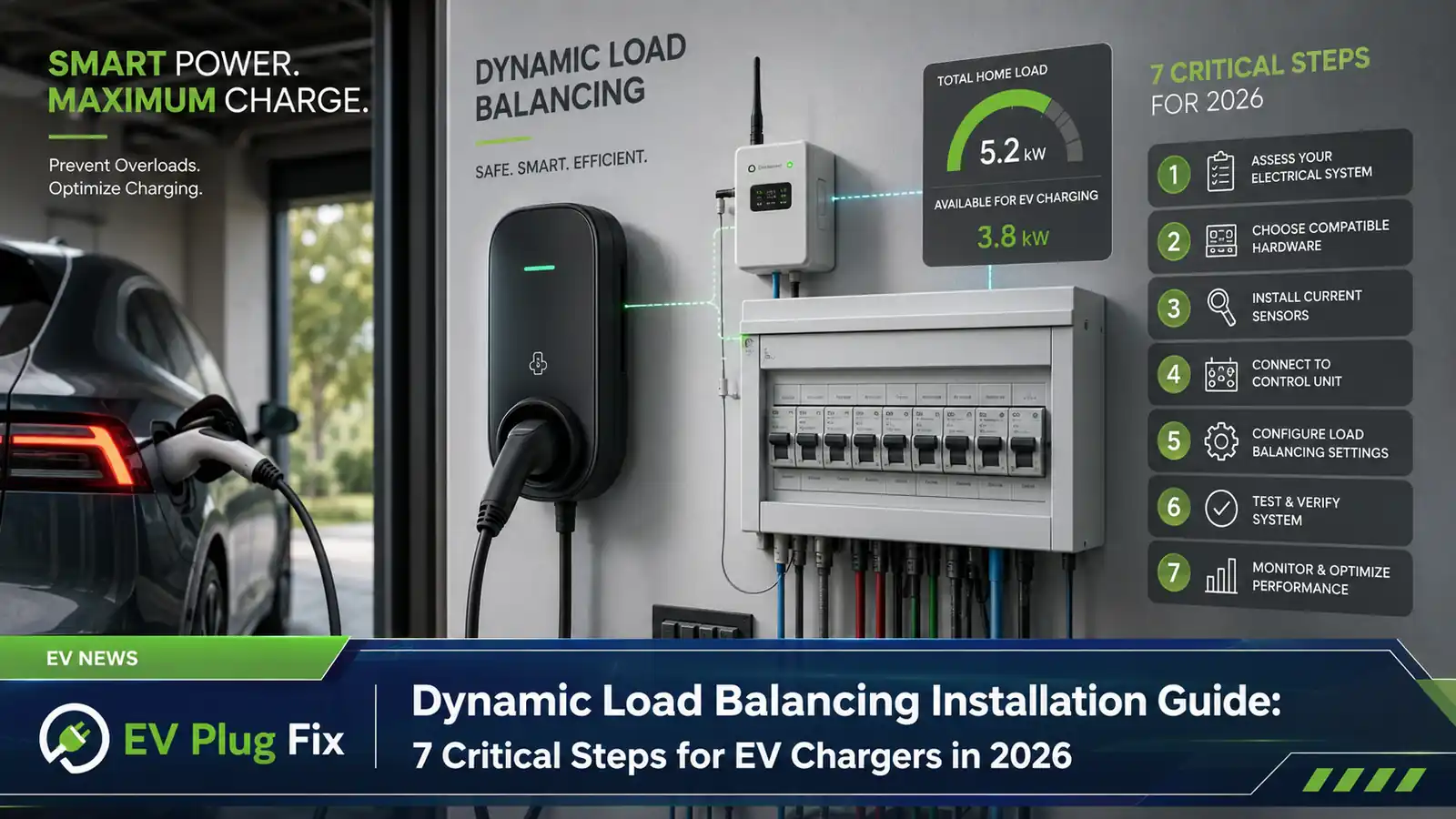
Dynamic load balancing can make an EV charger easier to add where spare electrical capacity is limited. Instead of allowing the charger to draw its configured maximum regardless of what the rest of the property is doing, the system measures site demand and reduces EV charging when capacity becomes constrained.
That can help avoid an electrical service or panel upgrade in suitable installations, but it does not make capacity limits disappear. The service, panel, branch circuit, conductors and protective devices still need to be correctly designed, and the load-management equipment must be compatible with the charger and electrical system.
Key Takeaways
- Dynamic load balancing adjusts EV charging according to available electrical capacity.
- The meter or current transformers must measure the loads the control system is intended to manage.
- Meter compatibility, communication wiring and configuration are product-specific.
- Solar and multi-charger installations may require additional planning.
- Commissioning should prove that charging power actually falls when site demand rises.
Start With the Electrical Capacity, Not the Charger
Before choosing load-management hardware, establish what the electrical installation can support. That means identifying the service and panel ratings, the proposed EV charging circuit and the loads already supplied by the site.
In the United States, EV charging equipment is subject to electrical load-calculation and installation requirements. The National Electrical Code includes provisions for energy-management systems that limit EV charging loads, but the applicable code edition, local amendments and approval requirements depend on the jurisdiction. Load management should therefore be treated as part of the electrical design rather than as a workaround for an inadequate installation.
The practical question is whether the selected charger and load-management system can operate within the permitted site limit as demand changes. A qualified electrician should make that determination before equipment is purchased.
How Dynamic Load Balancing Actually Works
A typical system has three functional parts: a device that measures electrical demand, a controller or control logic that determines how much capacity remains, and an EV charger capable of changing its charging current in response.
When other loads increase, the system reduces the current available to the vehicle. When those loads fall, charging can increase again, subject to the charger’s configured maximum and the limits of the electrical installation.
This differs from setting a charger to a permanently lower current. A fixed setting imposes the same charging limit regardless of what other loads are doing, while dynamic management can make more charging capacity available when site demand is lower.
Place the Meter or CTs Where They Can See the Managed Load
The measurement point is fundamental. If the objective is to protect a service or feeder based on total site demand, the meter or current transformers need to measure the relevant conductors and loads. A sensor placed only around the EV charging branch circuit cannot provide the same whole-site information.
Systems may use current transformers around incoming conductors or a compatible energy meter installed at the required measurement point. For more detail on sensor placement and wiring, the EV charger CT installation guide covers load-balancing and solar-charging applications. Current manufacturer documentation from both Tesla and Wallbox illustrates this whole-site measurement principle, although the approved hardware and exact arrangement differ between products.
CT-based installations also require correct orientation and phase assignment. A reversed CT can produce an incorrect direction or sign of power measurement, while incorrect phase mapping can corrupt the readings used by the controller. These details are particularly important on split-phase and three-phase systems.
Rather than moving or reversing a clamp until the reading appears plausible, verify the required CT direction, phase association and expected import or export readings during installation.
Plan the Measurement and Communication Path Together
The meter must deliver its measurements to the charging system, and the required method depends on the equipment. Some systems use a dedicated wired interface; others use different local communication architectures for particular power-management functions.
For example, Wallbox documents RS communication with compatible energy-management equipment. Tesla’s Dynamic Power Management documentation specifies the supported meter and communication arrangement for the Wall Connector, while its separate Group Power Management feature uses communication between multiple compatible Wall Connectors.
The important installation decision is therefore not whether wired communication is universally preferable to wireless communication. It is whether the selected meter, charger and communication path form a supported system. Cable type, routing, termination and permitted distances should be established before wiring begins.
Confirm Compatibility and Configure the Electrical Limit
“Supports load management” is not enough information to specify an installation. Confirm the exact charger model, approved meter or CT hardware, electrical configuration, communication method and required firmware or software before purchasing components.
- Charger support: Confirm that dynamic load management is available on the exact charger version being installed.
- Measurement hardware: Use a supported meter or CT assembly and determine whether it must be purchased separately.
- Electrical system: Verify support for the site’s single-phase, split-phase or three-phase arrangement as applicable.
- Communication: Use the interface and wiring specified for the selected charger and meter.
- Additional modes: If solar generation or multiple chargers are planned, confirm that the required combination of features is supported.
Once the hardware is installed, the controller also needs the correct electrical limit. That value should come from the electrical design and the commissioning procedure, not from estimated household consumption or the charger’s advertised maximum output.
Tesla provides a useful example of why the setting is product-specific. In its current Dynamic Power Management instructions, the Max Conductor Limit is set to 80% of the panel supply conductor rating or the main disconnect/disconnector rating, whichever is lower. Tesla’s current application note also describes the setting as 80% of the electrical panel’s rated limit. Installers should follow the instructions applicable to the specific Wall Connector, meter arrangement and market being commissioned.
Other systems use their own configuration procedures. Wallbox, for example, documents setting the applicable maximum current per phase for its Dynamic Load Management setup. These differences make a generic rule such as “set the charger slightly below the main breaker” unsuitable as a commissioning method.
Solar Changes What the Meter Sees
Photovoltaic generation adds another variable because power can flow from the grid, from the solar inverter or back toward the grid depending on the installation and operating conditions.
A system intended to match charging to surplus solar generation may need to distinguish grid import from export, while service-capacity management is concerned with keeping the monitored electrical system within its configured limit. Those are related energy-management tasks, but they are not automatically the same feature. The distinction is explored further in this guide to dynamic load balancing with solar.
Some charging ecosystems support both functions but place restrictions on particular combinations. For example, Wallbox’s documentation for certain multiple-charger configurations identifies limitations on combining Dynamic Load Management with Solar Charging. If photovoltaic generation is present, establish the required operating mode and supported meter arrangement before installation rather than treating solar as an afterthought.
Commission the System Under Changing Loads
Successful communication between a meter and charger does not prove that load management is working correctly. Commissioning should demonstrate that the measurement and control loop behaves as intended.
Start by checking that meter readings are plausible and that CT direction and phase assignment are correct. Then operate the charger while introducing other significant site loads. As monitored demand approaches the configured limit, EV charging should reduce according to the system’s control logic. When those loads are removed, available charging current should recover appropriately.
Tesla’s Dynamic Power Management commissioning guidance uses this type of test, instructing installers to introduce large panel loads and confirm that the Wall Connector adjusts its charging rate. The same principle is useful more broadly: test the system dynamically rather than relying only on configuration screens.
The installer should also complete the electrical tests required for the charger, circuit and local installation. Load management is a control function and does not replace the protective devices or other electrical safeguards required for EV charging.
If More Than One EVSE Is Planned
A home with two or more chargers introduces a second allocation problem: available site capacity may need to be distributed among several active charging points as well as managed against the building’s overall demand.
How that capacity is shared depends on the charging ecosystem. Some systems divide available current automatically, while others provide different site-level controls. A single-charger dynamic load-management feature should not be assumed to support multiple EVSE.
For a residential installation, decide during the design stage whether simultaneous reduced-power charging will meet normal vehicle needs. Larger sites require a more deliberate allocation strategy based on the number of charging points and their operating requirements.
Pre-Commissioning Checklist
- Measurement: Confirm that the meter or CTs see every load required by the load-management design.
- CT installation: Verify orientation, conductor assignment and phase mapping.
- Compatibility: Confirm the exact charger, meter and communication arrangement are supported.
- Configured limit: Check the value against the electrical design and the product’s commissioning instructions.
- Functional test: Apply changing site loads and confirm that EV charging responds correctly.
FAQ
Can dynamic load balancing avoid a panel upgrade?
Sometimes. It can limit EV charging when other loads are using the available electrical capacity, which may make an installation possible without increasing service capacity. Whether that is acceptable depends on the existing electrical system, the proposed charger, the load-management equipment and applicable electrical rules.
Does every EV charger support dynamic load balancing?
No. The feature depends on the charger and its supported energy-management ecosystem. Check the exact model and approved meter or sensor hardware before purchase.
Where should CT clamps for an EV charger be installed?
They must be positioned where they measure the conductors required by the load-management design. For whole-site management, that generally means measuring the relevant incoming supply conductors rather than only the EV charging circuit. Exact placement, orientation and phase mapping must follow the applicable equipment instructions.
Is Wi-Fi required for dynamic load balancing?
Not universally. Communication architecture varies by product. Some systems use wired meter communication, while other charging or power-sharing functions may use local wireless links. Internet access and local communication are also separate requirements, so a system may perform local load management without relying on a continuous internet connection.
Can dynamic load balancing work with solar panels?
It can in supported systems, but compatibility varies. Solar charging, grid import/export measurement and service load management may be separate operating modes, and some products restrict particular combinations. Check the exact charger, meter arrangement and supported operating modes before installation.
Bottom Line
Dynamic load balancing is most useful when an EV charger needs to coexist with other significant electrical loads and available capacity is constrained. Its value comes from measuring the right part of the electrical system and automatically reducing charging demand when necessary—not from increasing the capacity of the service itself.
Start with an electrical assessment, then select a compatible charger and measurement system, establish the correct measurement and communication arrangement, configure the permitted limit and test the installation under changing loads. Solar generation and multiple chargers should be treated as additional design requirements when they are part of the project.
Because EV charging equipment involves sustained high-power electrical loads, final equipment selection, wiring, protection and commissioning should follow the manufacturer’s current instructions and the electrical requirements applicable where the equipment is installed.
Source Transparency
This guide focuses on installation principles rather than presenting one manufacturer’s procedure as universal. Technical details were checked against primary documentation from the National Fire Protection Association and EV charging manufacturers.
- Tesla — Wall Connector Power Management: descriptions and limitations of Static, Dynamic and Group Power Management.
- Tesla Energy Library — Dynamic Power Management Application Note: meter installation, conductor-limit configuration, CT setup and commissioning guidance.
- Wallbox — Dynamic Load Management for Single-Charger Installations: meter requirements, configuration and troubleshooting guidance.
- Wallbox — Dynamic Load Management for Multiple Chargers: multi-charger requirements and feature-compatibility information.
- NFPA — NEC Article 625.42 development material: technical context for EVSE load management and energy-management systems.
Manufacturer features, supported meters, firmware requirements and installation procedures can change. Installers should use the documentation for the exact charger and meter being commissioned, along with the electrical code and requirements adopted by the local authority having jurisdiction.