
How AI Is Changing EV Design, Driving and Charging

Artificial intelligence is becoming part of the electric-vehicle ecosystem in ways that are often less dramatic — and more useful — than the marketing suggests. It can help engineers evaluate designs, interpret sensor data, estimate battery condition, detect unusual equipment behavior and coordinate when vehicles charge.
Those jobs are very different from one another. An AI model used during vehicle development has little in common with an onboard perception system or a charging platform deciding how to share limited electrical capacity among a fleet of EVs.
For drivers and buyers, the useful question is not whether a product is described as “AI-powered.” It is what the software actually decides, which data it needs and whether that decision improves safety, reliability, charging or energy use.
Where AI Fits Into an Electric Vehicle
AI can enter the EV lifecycle before the vehicle is built, operate onboard while it is driven and appear again in the systems used to charge it. These applications are connected by data, but they are not one continuous intelligence running the entire vehicle and charging network.
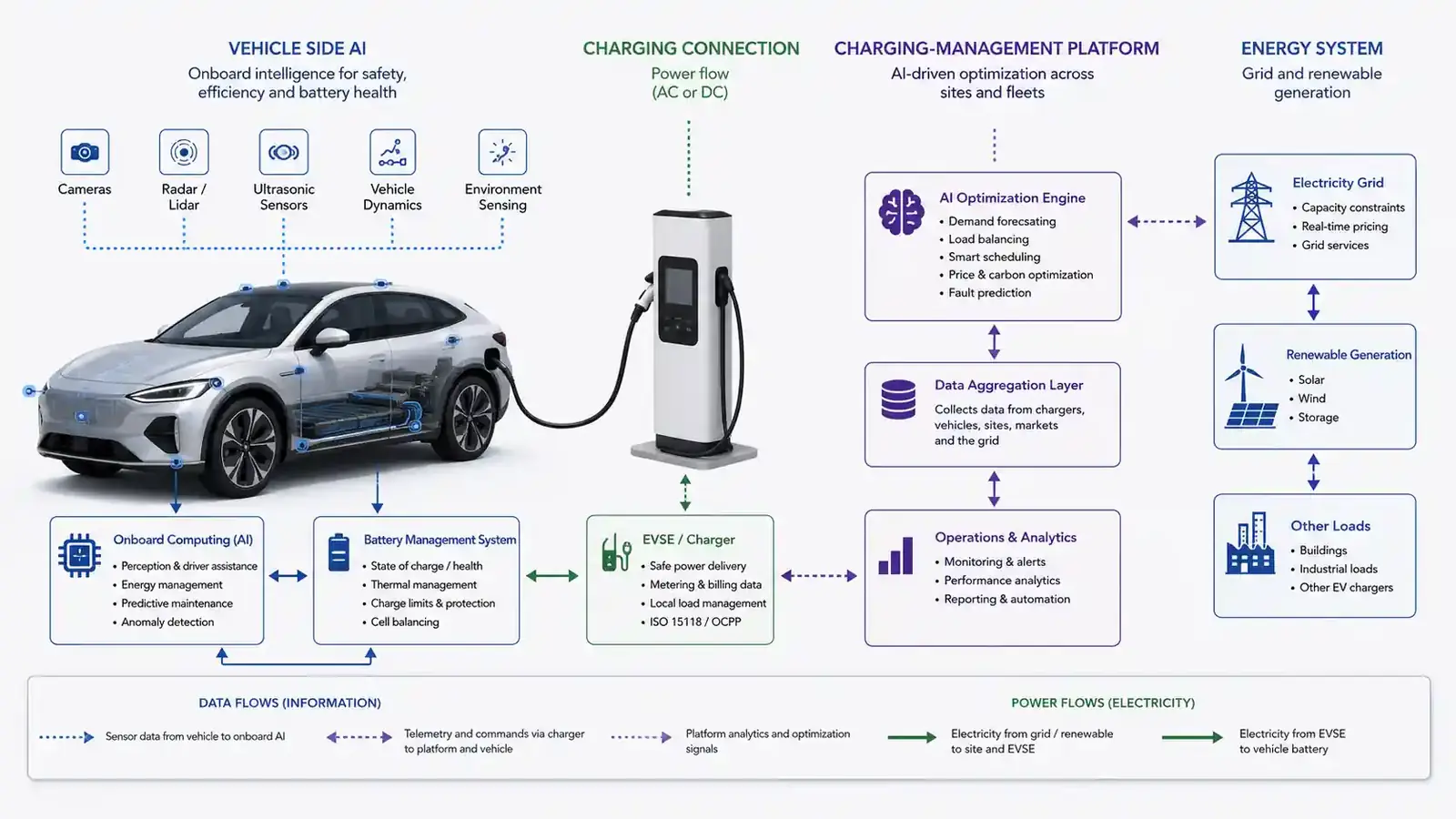
Inside the EV, the battery-management system and other vehicle controllers remain responsible for critical vehicle functions. The charging equipment manages electrical delivery within its capabilities, while a separate charging-management platform may decide when vehicles charge or how available site power is divided.
The International Energy Agency’s 2026 analysis of artificial intelligence and EVs discusses applications spanning vehicle design and testing, automated driving, integrated vehicle control and charging coordination.
How AI Changes EV Design and Production
One practical way to understand AI in vehicle development is to follow a design problem. Suppose engineers are trying to reduce the mass of a structural component without sacrificing required strength or making it impractical to manufacture. Instead of manually testing only a small number of alternatives, computational tools can explore many candidate geometries and help engineers identify promising options for further simulation and physical validation.
The same approach can support work involving aerodynamics, thermal management and production processes. Engineers still define the requirements and decide whether a proposed solution meets safety, cost, regulatory and manufacturing constraints; software expands the number of possibilities they can examine efficiently.
Virtual production tools extend this idea from individual components to factories. BMW Group, for example, describes a Virtual Factory using digital twins and simulation to plan layouts, robotics and logistics. BMW has also said it is adding generative and agentic AI capabilities to that environment. This is a manufacturer-reported example rather than evidence that digital-twin systems inherently depend on AI.
Once production begins, machine vision can assist inspection and data analysis can help identify abnormal equipment behavior. In this setting, AI is less about designing a car autonomously and more about giving engineers and production teams better tools for finding patterns, testing options and identifying problems.
Driver Assistance Is Where AI Becomes Visible
Driving is the EV application in which AI is easiest for consumers to notice. Cameras, radar and other sensors can feed perception and control systems that recognize road users, lane markings and changing traffic conditions.
That technology supports functions such as automatic emergency braking, adaptive cruise control and lane assistance. None of those features, by itself, makes a vehicle an autonomous electric vehicle.
The U.S. National Highway Traffic Safety Administration’s driver-assistance guidance distinguishes driver support from higher levels of automated driving. At Level 2, a system can continuously assist with steering and acceleration or braking while the driver remains responsible for driving and monitoring the road.
At higher automation levels, responsibility changes. NHTSA describes Level 3 as conditional automation, while Level 4 automation can perform the driving task within defined operating conditions or service areas. The capabilities and limitations of the specific vehicle therefore matter far more than broad terms such as “self-driving.”
Much of the computation needed for safety-related perception and control also takes place onboard. A vehicle cannot assume that a cloud connection will always be available when an immediate driving decision is required.
Where AI Adds Value to EV Charging
Charging provides a good example of where the word “AI” can either describe something useful or simply decorate an ordinary software feature. Scheduled charging, fixed site power limits and straightforward tariff rules can all be implemented with conventional control logic.
Advanced forecasting becomes more valuable when conditions are uncertain. A charging-management platform might estimate vehicle arrival and departure times, future site demand, renewable generation or electricity prices, then use those forecasts when allocating available charging power.
This becomes particularly useful at workplaces and fleet depots. If a site has limited electrical capacity and many vehicles need energy before different departure times, charging every EV at maximum power as soon as it connects may be unnecessary or undesirable. Software can instead prioritize vehicles according to their energy requirements and operating schedules while keeping total demand within the site’s limits through strategies such as dynamic load balancing.
The same principle can help flexible charging follow periods of lower demand, favorable tariffs or available renewable generation where the electricity plan, charging equipment and management system support those conditions. More broadly, smart EV charging can coordinate vehicles with wider home and grid energy systems.
For an individual driver, however, an “AI charger” is not automatically better than a well-designed smart charger. Load management, tariff scheduling, reliability, compatibility and offline behavior are more useful buying criteria than the label attached to the software.
What the Vehicle Still Controls
An external charging platform does not take over the EV’s battery protection strategy. The vehicle uses its battery-management and charging systems to establish important battery-side limits based on factors such as state of charge, temperature and cell conditions. Charging equipment supplies power within the electrical and communication constraints of the system, while network software may influence timing or the amount of site capacity allocated to the session.
Machine learning can support battery-state estimation, degradation analysis and energy-management research, but a generic home or public charger cannot simply override the vehicle’s electrical or thermal limits to make it charge faster.
Smart Communication Is Not Automatically AI
Some advanced charging functions are intelligent in the everyday sense without being artificial intelligence. Plug & Charge is a useful example: compatible implementations can use digital credentials and vehicle-to-charger communication to automate identification and authorization. That functionality belongs to the ISO 15118 communication ecosystem; it does not require AI merely to authenticate a charging session.
Similarly, ISO 15118:2022 includes communication requirements for bidirectional power transfer. Support for the standard does not guarantee that every vehicle or EVSE offers every bidirectional function. Actual capability depends on the vehicle, charging equipment, implementation and market.
Battery Health and Predictive Maintenance
Another less visible application is finding patterns that may indicate degradation or abnormal equipment behavior. Vehicle sensor and diagnostic data can support battery-state estimation or help flag components that deserve investigation. Charging operators can perform similar analysis on station telemetry to identify equipment behaving differently from its normal pattern.
The useful outcome is earlier attention to a potential problem, not an automatic diagnosis. A predicted fault still needs appropriate verification before parts are replaced or repairs are made.
For charging networks, this type of analysis can be particularly valuable when operators are responsible for many geographically distributed stations. At that scale, understanding EV charger maintenance costs and prioritizing equipment that requires attention become important parts of network operation.
AI in EVs Also Creates a Data Question
The more a system learns from how vehicles are driven and charged, the more important its data practices become. An EV service could potentially process charging-session histories, vehicle location, predicted departure times, driver profiles or battery and vehicle-status information. Fleet platforms may combine data from many vehicles to forecast when they will return to a depot and how much energy they will need.
That can improve scheduling, but buyers and fleet operators should understand what information is sent to cloud services, why it is required, how long it is retained and who can access it. Charging history and location-linked data can reveal more about vehicle use than a simple energy total.
Connectivity also affects reliability. A charging platform should have defined behavior if its backend becomes unavailable, and safety-critical vehicle functions cannot depend on continuous access to a remote AI service.
How to Judge an “AI-Powered” EV or Charger
Marketing terminology is a poor way to compare EV technology. A better evaluation begins with the decision the software is supposed to improve.
- Identify the job: Is the system recognizing road objects, estimating battery condition, predicting charger faults or deciding when vehicles should charge?
- Look for a useful outcome: The feature should improve something measurable or operationally relevant, such as charging coordination, equipment uptime, diagnostic insight or driver assistance.
- Check what works offline: Find out which functions remain available when internet connectivity or a cloud service is unavailable.
- Verify compatibility separately: AI cannot make an unsupported connector, vehicle, communication protocol or electrical installation compatible.
- Respect physical limits: Software cannot bypass the charging limits imposed by the vehicle, battery, EVSE or electrical supply.
- Review the data requirement: Understand whether charging history, location, vehicle status or driver information leaves the vehicle or charger and what the provider does with it.
This framework also helps separate genuine improvements from features that could have been implemented perfectly well with conventional automation.
FAQ
Do EV chargers need AI?
No. Scheduled charging, fixed load limits and straightforward tariff rules do not inherently require AI. Machine learning is more relevant when a system needs to forecast uncertain conditions, detect unusual behavior or optimize changing inputs.
Can AI make an EV charge faster?
It cannot bypass the electrical and thermal limits of the vehicle, battery, charging equipment or power supply. Software may improve when charging occurs or how available site power is allocated, but it cannot remove those physical constraints.
Does an 11kW or 22kW smart charger use AI to protect the battery?
Not necessarily. The vehicle’s onboard systems determine important battery-side charging limits. A smart charger may control scheduling and available electrical power without using AI at all.
Is Plug & Charge an AI technology?
No. Plug & Charge uses compatible vehicle-to-charger communication and digital credentials within the ISO 15118 ecosystem. An operator may use AI elsewhere in its charging platform, but AI is not required for Plug & Charge authentication itself.
Are today’s driver-assistance systems autonomous?
Not automatically. Adaptive cruise control, lane assistance and automatic emergency braking are driver-assistance technologies. Driver responsibility depends on the specific system and automation level, so the manufacturer’s instructions and applicable regulations remain essential.
Bottom Line
AI in electric vehicles is broader than autonomous driving. It is helping engineers explore designs, supporting onboard perception and battery analysis, identifying unusual equipment behavior and improving the way complex charging operations are planned.
Its strongest applications share a common characteristic: there is enough complex or uncertain data that forecasting, pattern recognition or optimization can improve a useful decision. Simpler functions such as timers, basic load limits and charging authentication may work without AI and should be judged on their actual capabilities instead.
For drivers and businesses, the best test is practical. Identify what the technology improves, verify compatibility and physical limits, understand what happens without connectivity and check what data the service needs. Those questions reveal far more about an EV technology than an “AI-powered” label.
Source Transparency
This article distinguishes established standards and regulator guidance from manufacturer claims and broader industry applications. Technical references were checked against the International Organization for Standardization’s published information on the ISO 15118 family, the U.S. National Highway Traffic Safety Administration’s guidance on driver assistance and automated driving, and the International Energy Agency’s 2026 analysis of artificial intelligence and EVs. BMW Group material is used only as an attributed example of a manufacturer’s virtual-production implementation.
- International Energy Agency — Artificial Intelligence and EVs (2026)
- BMW Group — Virtual Factory Simulation
- U.S. NHTSA — Driver Assistance Technologies
- ISO 15118-20 Road Vehicles Communication Interface
AI capabilities, automated-driving availability, Plug & Charge support, bidirectional charging and smart-charging functions vary by vehicle, charging equipment, software platform and market. Product-specific compatibility should therefore be verified with the relevant vehicle, charger and service provider before purchase or deployment.