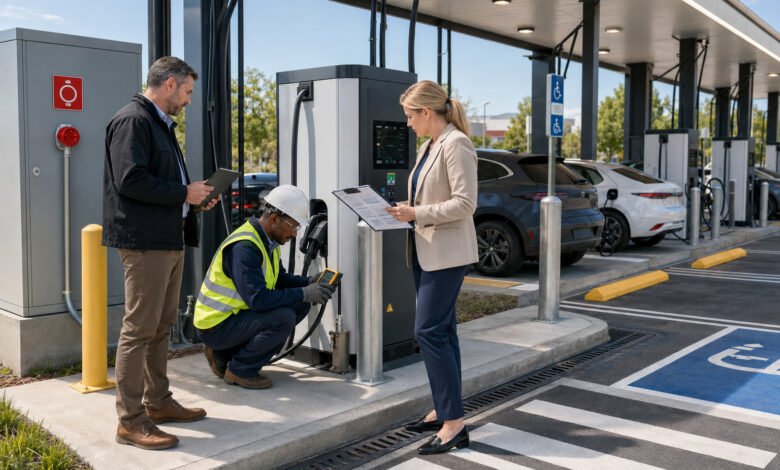
Adding EV chargers to a commercial property creates responsibilities that go well beyond insuring the hardware itself. Drivers and pedestrians move around electrical equipment and charging cables, vehicles can strike chargers, and public stations may depend on payment terminals, cloud platforms, mobile apps and remote network services to operate.
The important question is therefore not simply, “What insurance does an EV charger need?” It is who owns each risk when something goes wrong.
A landlord hosting two chargers, a charge point operator running a public network, an electrical contractor and a charging-software provider do not have the same exposures. Before a site opens, ownership, operational responsibility, contracts and insurance need to tell the same story.
This guide provides a practical risk-management framework for commercial EV charging. It is not legal or insurance advice, and individual policies and local requirements need to be reviewed for the specific project.
Start With the Incidents That Could Actually Happen
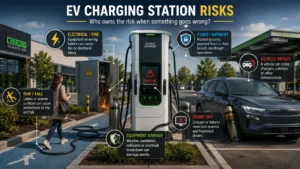
Insurance discussions are more useful when they begin with realistic loss scenarios rather than policy names.
| Risk | What could happen | What deserves attention |
|---|---|---|
| Electrical or fire | Equipment, wiring or another electrical component fails | Installation, applicable codes, inspection, protection and maintenance |
| Trip or fall | A pedestrian encounters a charging cable or unsafe walking surface | Cable management, layout, lighting and routine inspections |
| Vehicle impact | A vehicle strikes a charger, cabinet or other infrastructure | Equipment placement and appropriate physical protection |
| Equipment damage | Weather, vandalism, collision or electrical breakdown damages assets | Property protection, maintenance and applicable coverage |
| Cyber or payment incident | A connected system is compromised or payment services are disrupted | Cybersecurity, payment architecture and vendor responsibilities |
| Downtime | A charger or an entire site cannot provide service | Repair plans, network dependencies and insurance triggers |
These risks overlap. A vehicle might damage a charger owned by one company on property controlled by another and maintained by a third. If the damaged equipment is not isolated quickly and somebody is later injured, determining responsibility becomes more complicated than identifying the name on the charger.
Who Owns, Operates and Controls the Charger?
This is one of the most useful questions to answer before discussing coverage.
A commercial project can involve a site owner, charge point operator, installer, equipment supplier, maintenance contractor, network provider and payment processor. The contracts should identify what each party actually controls.
Consider four separate questions:
- Who owns the charger and supporting electrical equipment?
- Who controls the parking area and pedestrian environment?
- Who inspects, maintains and repairs the equipment?
- Who operates the software, customer authentication and payment services?
The answers may point to different companies.
That matters because transferring operation of the charger does not necessarily transfer every responsibility associated with the property, and owning the hardware does not necessarily make the owner responsible for every network or payment failure.
Which Types of Insurance May Matter?
There is no universal policy that covers every EV charging risk. Rather than searching for a product simply marketed as “EV charging insurance,” businesses should map their actual loss scenarios against their insurance program.
Commercial general liability
Commercial general liability may respond to covered claims involving third-party bodily injury or property damage. At a charging site, examples could include a pedestrian injured around the charging area or third-party property damaged in an incident connected with the operation.
The useful question for a broker is not whether the business “has liability insurance.” Ask how the policy would respond to the actual charging activities, locations and parties involved.
Cyber incidents, employee injuries, professional errors and equipment failures can raise different coverage questions, so general liability should not be treated as an all-purpose answer.
Property and equipment breakdown
The charging unit may be only a fraction of the physical investment. A project can also include switchgear, transformers, electrical cabinets, payment equipment, canopies and other infrastructure.
Those assets should be identified and valued appropriately. This is particularly important for outdoor equipment and businesses operating chargers across multiple properties.
The distinction between ordinary property coverage and equipment breakdown also deserves attention. External damage, electrical or mechanical breakdown, wear, poor maintenance and defective components are not necessarily treated the same way under an insurance program.
The value at risk can be much greater than the charger purchase price alone. Our guide to commercial EV charging installation costs explains why switchgear, electrical work, civil works and other infrastructure can form a substantial part of the total investment.
Business income and downtime
A busy public charger can lose revenue while it is offline, but lost charging revenue does not automatically mean that business-income insurance will pay.
Coverage normally depends on the policy wording and the event that caused the interruption. A fire damaging charging equipment, an electrical breakdown and an outage at a third-party network platform can all leave a charger unavailable while raising very different insurance questions.
The operator should therefore test specific scenarios with its broker or insurer rather than asking only whether “downtime” is covered.
Maintenance planning matters here too. Preventive servicing and faster repair can reduce downtime regardless of whether a particular incident is insured. Operators budgeting for the full lifecycle of a site can see our breakdown of EV charger maintenance costs.
Cyber insurance
A networked charger is part of a larger technology system. Depending on the setup, that system can include the charger, local communications, a cloud platform, customer accounts, mobile applications, payment services and remote administration.
A failure elsewhere in that chain can make an electrically functional charger commercially unusable.
Cyber policies vary significantly in what they cover. Depending on the wording, relevant areas can include network-security liability, incident response, data restoration or cyber-related business interruption.
Third-party dependencies are especially important. If the charging hardware works but the network provider goes offline, the operator should know in advance whether and how its insurance addresses dependent-system interruption.
Professional liability
Professional exposure becomes more relevant when a business designs charging installations, provides engineering services, configures charging-management systems or supplies software whose errors could cause financial loss.
An electrical engineer designing a high-power installation has a different exposure from a software company configuring charging or billing. Insurance should reflect the work the company actually performs rather than the broad fact that it operates in the EV industry.
Product liability
Manufacturers, importers, distributors and businesses that modify charging hardware can face product-related claims involving alleged defects, instructions or warnings. Responsibility depends on the facts, the business’s role in the supply chain and applicable law.
Workers’ compensation, commercial auto and excess coverage
Installation and maintenance also happen in physical environments where technicians may work around electrical equipment, parking traffic and service vehicles.
Businesses employing field crews should therefore consider the workers’ compensation requirements and commercial auto exposures relevant to their operations. Larger networks or contracts may also call for umbrella or excess limits above specified underlying policies.
Across all of these categories, policy wording matters more than the policy’s marketing name. Definitions, exclusions, endorsements, deductibles, limits and coverage triggers determine how the policy actually responds.
The Contract and the Insurance Policy Need to Match
A contract can create a financial obligation that the insurance policy does not automatically cover.
Suppose an operating agreement makes one party responsible for maintaining chargers and indemnifying the property owner for certain losses. That obligation should be compared with the contractor’s actual insurance rather than assuming the policy will follow whatever the contract says.
The same review should cover practical responsibilities: who obtains permits, who conducts inspections, who responds to damaged equipment, who handles software updates, who maintains payment systems and who must report incidents.
Insurance provisions deserve the same specificity. Contracts may address required coverage, policy limits, additional-insured status, indemnification, waivers of subrogation and limitations of liability.
A certificate is not the same as additional-insured coverage
A certificate of insurance is generally evidence that insurance exists. It should not automatically be treated as proof that another party has the additional-insured protection required by a contract.
That protection depends on the relevant policy language and endorsement. Where additional-insured status is required, the contract, certificate and actual endorsement should be checked for consistency.
Good Site Design Prevents Claims Before Insurance Becomes Relevant
Insurance is a financial backstop. It is not a substitute for designing and operating a safe charging site.
In the United States, Article 625 of NFPA 70, the National Electrical Code, addresses equipment and conductors used to connect electric vehicles to premises wiring for charging and related functions. The adopted code, permitting process and inspection requirements for an individual project are determined by the applicable jurisdiction and authority having jurisdiction.
Operators should also keep the relevant installation, inspection, commissioning and equipment records. Where applicable codes or the authority having jurisdiction require listed or certified equipment, that requirement should be addressed during equipment selection rather than after installation.
For businesses planning a project across different jurisdictions, our EV charger permit requirements guide provides additional context on how approval processes can differ by region.
Some of the most effective risk controls are simpler than the electrical engineering. Charging cables should not unnecessarily obstruct pedestrian routes. Lighting should make chargers, curbs and walking areas visible. Drainage and surface condition matter. Where vehicle impact is a credible risk, charger placement and appropriate physical protection deserve attention.
These measures can reduce the chance of an incident rather than merely determining who pays afterward.
Payment Processing Still Creates Responsibilities When It Is Outsourced
Public charging increasingly relies on electronic payments, but sending card processing to a third party does not automatically remove every payment-security responsibility from the charging operator.
PCI DSS scope depends on the payment architecture and on which organizations store, process or transmit payment account data, as well as systems or service providers that can affect the security of the cardholder data environment.
Depending on the arrangement and the requirements of the relevant compliance-accepting entity, an operator using an outsourced payment provider may still have responsibilities involving service-provider oversight, agreements and compliance validation.
The useful exercise is to map the complete payment path:
- Who provides the payment terminal?
- Who configures and updates it?
- How does it communicate?
- Who processes the transaction?
- Which organization can access the relevant systems?
- Who investigates a suspected payment-security incident?
That is far more informative than simply noting that “payments are outsourced.”
Cybersecurity Is Also an Availability Problem
A charger does not have to suffer physical damage to become unavailable.
If it cannot authenticate a customer, reach its back-office service or complete a payment, the driver may still be unable to charge. Cybersecurity therefore affects operational reliability as well as data protection.
Reasonable controls depend on the equipment and threat model, but common areas to examine include administrative access, default credentials and unnecessary services, vendor-supported updates, asset inventories, network segmentation where appropriate, monitoring, payment-system protection and incident response.
Vendor responsibilities should be documented as carefully as internal responsibilities. If a supplier provides remote management or software updates, the operator should know who responds to vulnerabilities and what happens when support for the product ends.
For networked charging deployments, understanding the technology architecture also helps clarify which failures belong to the charger, the communications network or the back-office platform. Our comparison of networked and non-networked EV chargers explains the practical differences between these approaches.
What to Check Before the Site Opens
A pre-launch review does not need to become a paperwork exercise. It should answer the questions that would matter after an incident.
- Map ownership and control. Record who owns, operates, maintains and connects the charger and its supporting systems.
- Walk the physical site. Check pedestrian routes, cables, lighting, drainage and potential vehicle-impact areas as well as the electrical installation.
- Keep the project records. Retain applicable permits, inspections, commissioning information, equipment documentation and warranties.
- Describe the real operation to the insurer. Include charger types, locations, public access, payment functions, network dependencies and maintenance activities.
- Test realistic claims scenarios. Ask what happens after a trip-and-fall, vehicle strike, equipment breakdown, fire, network outage or payment-security incident.
- Compare contracts with policies. Look closely at indemnification, additional-insured requirements, limits and technology responsibilities.
- Set a damaged-equipment procedure. Staff should know how unsafe equipment is isolated, reported, inspected and returned to service.
- Map cybersecurity and payments. Know which vendors and systems can interrupt charging or affect payment security.
- Review the program when the business changes. New locations, charger types, battery storage, payment methods or in-house maintenance can materially alter the exposure.
Keep Records That Explain What Happened
Documentation becomes particularly valuable after a failure or claim. It can show how equipment was installed, when it was inspected, what maintenance was performed and how the business responded to earlier faults.
Depending on the project, useful records can include permits, inspection approvals, commissioning documents, manuals, certification information where applicable, maintenance history, repairs, warranties, contracts, insurance policies and endorsements, incident reports and relevant system logs.
There is no sensible universal retention period for every EV charging business. Legal, regulatory, contractual, privacy and insurance requirements vary. The retention policy should therefore be set for the actual organization and the information it holds.
Three Questions Worth Resolving With Your Broker
Does an existing commercial policy automatically cover new EV chargers?
It should not be assumed. Existing insurance may address some exposures, while the new operation could require different limits, endorsements or additional policies. The important step is to describe the chargers, public access, payment functions, equipment ownership and operating responsibilities accurately to the broker or insurer before relying on existing coverage.
What happens if the chargers go offline but are not physically damaged?
That depends on both the cause and the policy. A network-platform outage, cyber incident and electrical equipment failure can all interrupt charging without producing the same insurance response. Ask about those scenarios individually, including any waiting periods, exclusions and third-party dependency provisions.
Who is responsible if someone trips over a charging cable?
There is no universal answer. Relevant factors can include who controlled the premises and equipment, who was responsible for inspections and cable management, the condition of the site, applicable law and contractual allocation of responsibilities. This is exactly why ownership, operations, contracts and insurance should be reviewed together before the site opens.
Bottom Line
The most useful way to approach EV charging station insurance is to stop thinking about the charger as an isolated piece of equipment.
Instead, imagine the incidents that could disrupt the real operation. A driver hits a charging pedestal. Someone trips near a cable. Switchgear fails. A cloud platform becomes unavailable. A payment environment is compromised. A damaged charger is not isolated quickly enough.
For each scenario, identify who controls the risk, what the contract says, which policy is expected to respond and what practical control could have reduced the likelihood or severity of the incident.
That exercise is more valuable than searching for a generic “EV charger insurance” package because it exposes gaps between the physical site, the technology stack, contractual obligations and actual coverage.
Insurance wording and liability rules vary by policy, business role and jurisdiction. Site owners, operators, contractors and technology providers should therefore have qualified insurance and legal professionals review their specific arrangements rather than relying on a general coverage framework.
Sources and Methodology
This guide draws on public technical, electrical-safety, cybersecurity and payment-security material rather than manufacturer marketing or claimed first-hand experience. Relevant technical frameworks include National Electrical Code Article 625 and PCI Security Standards Council guidance concerning PCI DSS scope and third-party service providers.
Insurance descriptions are intentionally conditional. Policy forms, endorsements, exclusions, deductibles, limits, contractual obligations and legal interpretations differ between businesses and jurisdictions. No single insurance package, premium or liability limit is presented here as appropriate for every EV charging project.