
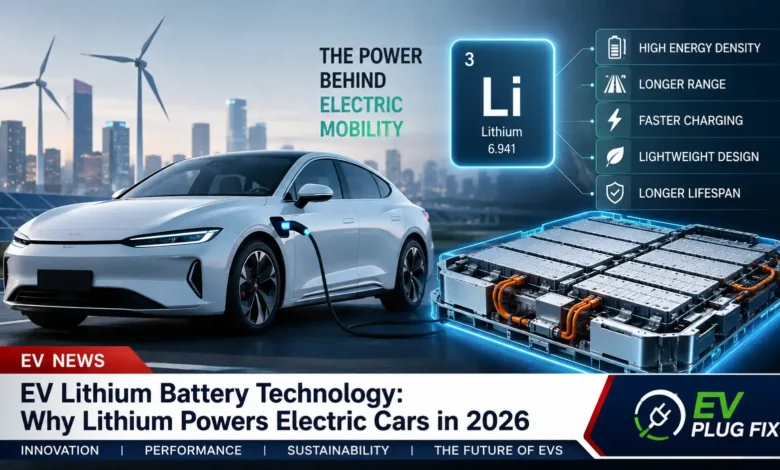
Lithium-ion batteries dominate modern electric cars because they solve several problems at once. An EV battery needs to store enough energy for useful driving range without making the vehicle impractically heavy, deliver substantial power when the driver accelerates, accept energy during charging and regenerative braking, and tolerate years of repeated use.
No single lithium-ion chemistry is ideal for every vehicle. Lithium iron phosphate (LFP) and nickel manganese cobalt (NMC) batteries, for example, make different compromises between energy density, material requirements, cost and thermal behavior. Their widespread use shows why the answer to “why do electric vehicles use lithium-ion batteries?” is not one specification, but a combination of useful properties and a mature manufacturing ecosystem.
What an EV Battery Has to Do
A traction battery faces requirements that are very different from those of a small consumer battery. It must carry a large amount of energy while fitting into a vehicle with strict limits on weight and space. It also has to provide power repeatedly, operate in changing temperatures and work safely with the vehicle’s electrical and thermal-management systems.
Lithium-ion technology suits those requirements for several reasons:
- High energy density: Lithium-ion batteries can store considerably more energy for their weight and volume than older rechargeable technologies such as lead-acid batteries.
- Strong power capability: Properly designed EV packs can deliver the power required for acceleration and accept energy recovered through regenerative braking.
- Good efficiency: Lithium-ion cells can charge and discharge with relatively low internal energy losses.
- Rechargeability: They are suited to repeated partial charging and do not need to be routinely discharged to empty.
- Manageable service life: With suitable battery and thermal management, lithium-ion packs can support long vehicle service, although degradation depends on chemistry, temperature, charging patterns and other operating conditions.
- Mature production: Lithium-ion cells benefit from an established global manufacturing and materials supply chain.
Other rechargeable technologies can perform well in individual areas. Lithium-ion became the mainstream EV choice because it combines these characteristics in a package that can be engineered and manufactured at automotive scale.
Energy Density Helps Make Long-Range EVs Practical
Energy density describes how much energy a battery stores relative to its mass or volume. For an electric car, both measurements matter. Increasing battery capacity can extend driving range, but a larger battery also occupies more space, adds weight and can raise vehicle cost.
Lithium-ion technology allows automakers to package substantial battery capacity into the floor or structure of a passenger vehicle while retaining usable cabin and cargo space. That is a major advantage over lower-energy-density technologies such as lead-acid batteries.
Higher energy density is not automatically better in every application, however. A manufacturer designing an affordable urban EV may accept lower energy density in exchange for other advantages. A long-range or performance vehicle may place a higher value on reducing battery mass or fitting more energy into a limited space.
That trade-off helps explain why different types of lithium-ion batteries coexist in the EV market.
LFP vs NMC: Different Priorities Within Lithium-Ion
LFP and NMC are two important lithium-ion cathode families used in electric vehicles. Both rely on lithium-ion movement during operation, but their material compositions give them different characteristics.
| Consideration | LFP | NMC |
|---|---|---|
| Energy density | Generally lower | Generally higher |
| Cathode materials | Iron and phosphate; no nickel or cobalt in the cathode | Nickel, manganese and cobalt |
| Thermal stability | Generally stronger | Requires careful thermal and battery management |
| Common engineering priorities | Cost, durability and material availability | Higher energy density and compact packaging |
These differences should not be interpreted as a simple ranking. LFP can be an effective choice when cost, durability and thermal stability are important, while NMC can make sense when higher energy density helps meet range, weight or packaging targets.
Cell design, pack architecture and battery-management strategy also matter. Two EVs using the same broad chemistry can still differ significantly in usable capacity, charging performance, thermal control and degradation behavior.
Efficiency Matters Beyond Driving Range
An EV does not convert every unit of electricity from the grid into energy at the wheels. Losses occur in the charger, battery, power electronics, electric motor, climate-control system and other components.
Lithium-ion batteries help because their internal charge and discharge losses can be relatively low. Less energy wasted as heat improves overall system efficiency and reduces the amount of heat that the battery’s thermal-management system must handle.
Battery-cell efficiency should not be confused with complete charging efficiency. Electricity measured at a home meter or public charger also accounts for losses elsewhere in the vehicle’s charging system. For that reason, a laboratory efficiency figure for a cell cannot simply be treated as the wall-to-battery or wall-to-wheel efficiency of an EV.
Why You Do Not Need to Run an EV Battery Empty
Some charging habits associated with older rechargeable batteries do not apply to modern EVs. Lithium-ion batteries do not need to be completely discharged before being plugged in again, and partial charging is a normal part of electric-car use.
That convenience matters in everyday driving. An owner can plug in after a commute even when substantial charge remains instead of deliberately waiting until the battery is nearly empty.
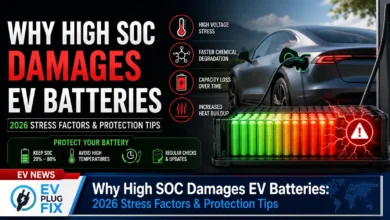
This does not mean state of charge is irrelevant to battery aging. Temperature and the amount of time a battery spends at very high or very low states of charge can affect degradation. High state of charge can be particularly relevant to long-term battery degradation, while recommended charging practices can also vary between vehicles and battery chemistries.
The owner’s manual and manufacturer guidance for the specific vehicle are therefore more useful than a universal rule about the ideal charging percentage.
The Battery Management System Is Just as Important as the Cells
Lithium-ion cells do not operate independently inside an EV. They form part of a complete battery system controlled by electronics and software.
The battery management system can monitor parameters such as cell voltage, pack current and temperature. It also estimates battery state, manages charging and discharging limits, and can reduce available power when operating conditions require protection.
This control is essential because lithium-ion cells have defined operating limits. Excessive heat, unsuitable charging conditions, overvoltage or excessive discharge can harm performance, accelerate degradation or create safety concerns.
The success of lithium-ion in electric cars therefore depends not just on chemistry but on the engineering around it.
Temperature Changes How an EV Battery Behaves
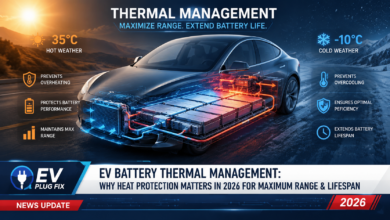
Lithium-ion batteries are sensitive to temperature. In cold conditions, electrochemical processes slow and the battery may temporarily provide less power or accept charge more slowly. High temperatures can accelerate reactions that contribute to long-term degradation.
Many EVs address this with active thermal management. Depending on the vehicle, the system can cool the battery when it becomes hot and heat it when operating conditions require it. Liquid-based thermal systems are common, although designs vary considerably.
Battery preconditioning is particularly useful before high-power DC charging. An equipped vehicle can bring the pack toward a more suitable temperature before arriving at a fast charger, allowing the charging system to manage the session more effectively.
This is one reason an EV’s advertised peak charging power tells only part of the story. Actual charging power can change with battery temperature, state of charge, charger capability, battery condition and the charging strategy programmed by the manufacturer.
Manufacturing Scale Gives Lithium-Ion Another Advantage
Lithium-ion’s dominance is not based solely on what happens inside the cell. The technology has benefited from years of commercial development and large investment in mining, materials processing, cell production, battery-pack manufacturing and automotive integration.
That industrial base matters when automakers need batteries in very large volumes. A competing chemistry must offer more than promising laboratory performance. It also needs repeatable manufacturing, acceptable cost, reliable materials, automotive validation, quality control and a supply chain capable of supporting mass production.
Manufacturing experience can also lead to improvements in cell design, pack integration and production efficiency. These advantages reinforce lithium-ion’s position even as alternative chemistries continue to develop.
Why EVs Do Not Use Lead-Acid Batteries for Main Traction Power
Lead-acid batteries remain useful where low initial cost, simplicity and established manufacturing matter more than weight. They are still used in many automotive and stationary applications.
The problem is energy density. A lead-acid battery large enough to provide the traction energy expected from a modern passenger EV would impose a substantial weight and packaging penalty. Lithium-ion batteries can store far more energy in a practical vehicle-sized pack.
This does not mean lead-acid technology is obsolete. It means its strengths are better suited to applications other than powering a long-range battery-electric passenger vehicle.
Why Nickel-Metal Hydride Works Better in Hybrids
Nickel-metal hydride (NiMH) batteries have an established automotive history, particularly in hybrid vehicles. A hybrid typically needs a much smaller battery than a battery-electric vehicle because the combustion engine supplies part of the vehicle’s energy.
That allows a NiMH pack to be optimized for frequent power delivery and energy recovery without storing enough electricity for long all-electric journeys.
A battery-electric car places much greater emphasis on energy storage per unit of mass and volume. Lithium-ion technology is generally better suited to that requirement, which is why it became the dominant choice for modern passenger EV traction batteries.
Could Sodium-Ion Batteries Challenge Lithium-Ion?
Sodium-ion is one of the most closely watched alternatives to conventional lithium-ion batteries. The chemistry replaces lithium ions with sodium ions and can use different material combinations that may offer supply-chain or cost advantages in suitable applications.
Its main challenge for passenger EVs is energy density. Current sodium-ion technology generally stores less energy for a given battery mass than leading lithium-ion chemistries. That creates a disadvantage when manufacturers are trying to maximize driving range without adding excessive battery weight or volume.
That does not rule sodium-ion out of the EV market. It could be useful for vehicles where affordability, material availability, cold-weather characteristics or moderate driving range matter more than maximizing energy density.
Rather than replacing lithium-ion across the entire industry, sodium-ion may initially compete most effectively in vehicle segments and stationary applications where its particular trade-offs make sense.
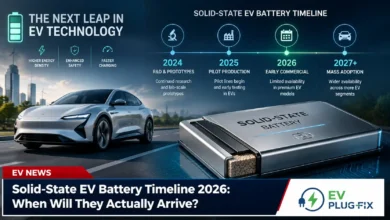
Solid-State Batteries May Change the Design, Not Necessarily the Element
Solid-state batteries are often discussed as a future alternative to today’s EV batteries, but the terminology can be misleading. Many solid-state designs still use lithium. The major difference is the use of a solid electrolyte instead of the liquid or gel-type electrolyte found in conventional lithium-ion cells.
Developers are pursuing solid-state batteries with goals that include higher energy density, different safety characteristics and improved battery performance. Turning those goals into mass-produced automotive batteries remains an engineering and manufacturing challenge.
A commercially successful automotive cell must perform reliably over repeated use, charge at useful speeds, tolerate real operating temperatures, be manufacturable with consistent quality and reach an acceptable cost.
For buyers, the solid-state battery timeline for production-ready technology is therefore more meaningful than laboratory records or projected capabilities announced years before mass production.
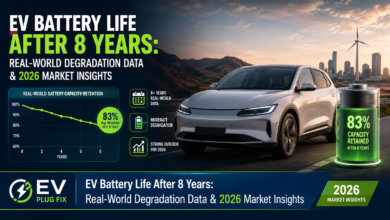
How Long Does a Lithium-Ion EV Battery Last?
No rechargeable battery keeps its original capacity forever. Lithium-ion batteries gradually lose usable capacity through both calendar aging and repeated operation.
The rate is not identical for every EV. Battery chemistry, temperature exposure, charging habits, operating state of charge, power demand and battery-management strategy can all affect degradation.
Automakers can manage these effects through thermal control, software limits and buffers between the battery’s physical capacity and the capacity made available to the driver.
This is why universal claims that an EV battery will last a specific number of cycles or years should be treated cautiously. Laboratory cell tests and complete battery packs operating in real vehicles are not exposed to identical conditions.
What Matters More Than the Chemistry Label?
Knowing whether an EV uses LFP, NMC or another chemistry can be useful, but chemistry alone does not tell you whether one vehicle has a better battery than another.
A buyer should also consider usable battery capacity, vehicle efficiency, charging performance across the battery’s state-of-charge range, thermal management, warranty coverage and how those characteristics fit the intended driving pattern.
Pack engineering can make a major difference. A well-managed battery using a less energy-dense chemistry may be a better fit for a particular vehicle than a higher-energy-density chemistry paired with different cost, thermal or packaging compromises.
Essential Questions & Expert Answers
Why do electric vehicles use lithium-ion batteries?
Lithium-ion batteries provide a useful combination of energy density, efficiency, power capability, rechargeability and relatively low weight. They also benefit from a mature manufacturing industry capable of producing automotive batteries at large scale.
Is LFP better than NMC for an electric car?
Not universally. LFP generally sacrifices some energy density in exchange for advantages that can include thermal stability and reduced dependence on nickel and cobalt. NMC generally offers higher energy density, which can be valuable when range, battery weight or packaging space is a priority. The better choice depends on how the vehicle is designed.
Should you completely discharge an EV before charging?
No. A lithium-ion EV battery does not need to be fully discharged before recharging. Partial charging is normal. Owners should follow the charging recommendations provided for their particular vehicle because recommended charge limits and routines can differ.
Are all electric-car batteries lithium-ion?
No, although lithium-ion technologies dominate modern passenger battery-electric vehicles. Other rechargeable chemistries exist, and technologies including sodium-ion and solid-state batteries are being developed or introduced for particular applications.
Why does an EV sometimes charge more slowly when it is cold?
Low temperature changes the electrochemical behavior of lithium-ion cells and can limit how quickly they can accept energy. The battery management system may reduce charging power until the pack reaches a more suitable temperature. EVs equipped with battery preconditioning can warm the battery before fast charging.
Does fast charging damage a lithium-ion EV battery?
DC fast charging places different thermal and electrical demands on a battery than lower-power charging, but its long-term effect depends on factors including cell chemistry, temperature, charging power, state of charge and the vehicle’s battery-management strategy. Modern EVs actively control charging power to keep the battery within designed operating limits. Owners should follow the manufacturer’s charging guidance rather than assuming that all fast charging has the same effect on every battery.
Bottom Line
Electric vehicles use lithium-ion batteries because they offer a combination that competing rechargeable technologies have struggled to match at automotive scale: substantial energy storage for their weight and volume, strong power capability, efficient charging and discharging, practical durability and an established manufacturing base.
The lithium-ion label also covers technologies with different strengths. LFP can suit vehicles where cost, material choices and thermal stability are important, while NMC and related nickel-based chemistries remain useful when manufacturers place greater emphasis on energy density and compact packaging.
Alternatives such as sodium-ion and solid-state batteries could expand the choices available to automakers, but a promising chemistry must prove itself in production as well as in the laboratory.
For an EV buyer, chemistry is therefore one part of a larger battery story. Usable capacity, vehicle efficiency, charging behavior, thermal management, warranty coverage and overall pack engineering are usually more informative than choosing a vehicle based on the battery chemistry label alone.