
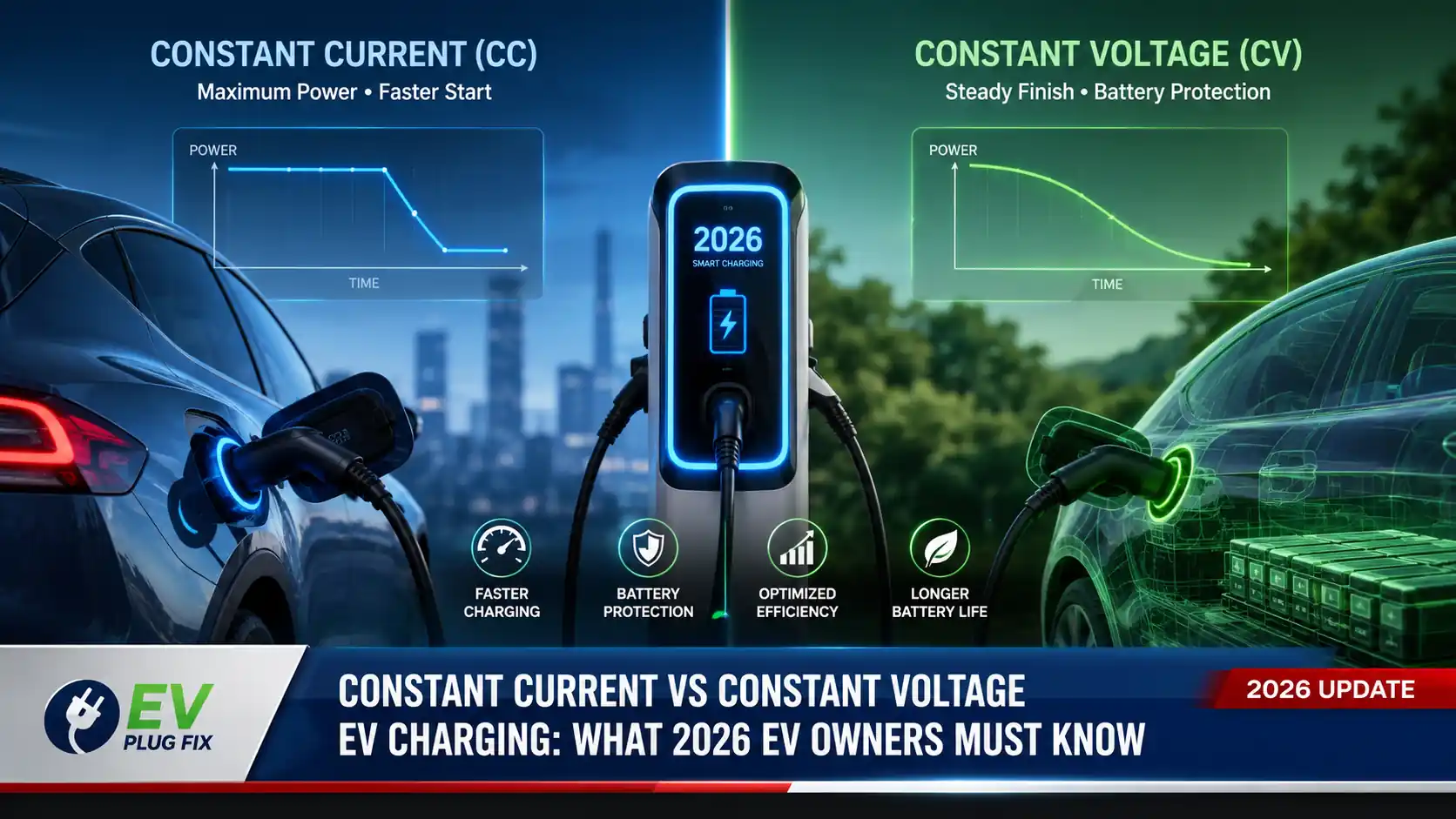
Constant-current and constant-voltage charging are two basic ways of controlling how electrical energy enters a rechargeable battery. In the familiar CC-CV model used with lithium-ion cells, charging begins with current as the controlled quantity. Battery voltage rises until an upper voltage limit is reached, after which voltage is constrained and charging current falls.
For an EV owner, the most important point is that this is an underlying battery-charging model rather than a rigid description of every charging session. A modern EV’s battery management system can alter the current it will accept as state of charge, cell voltage, temperature and other operating conditions change. The result is a charging curve that may taper in several steps rather than making one clean switch from CC to CV.
That also explains why 80% state of charge should be treated as a useful trip-planning reference rather than a universal electrical transition point. Drivers normally do not need to select or manage CC and CV modes themselves; the vehicle and charging system handle them automatically.
Constant current vs constant voltage at a glance
| Charging concept | What is controlled | What happens to the other value | Purpose |
|---|---|---|---|
| Constant current (CC) | Charging current | Battery voltage rises | Transfers energy while keeping current within the chosen limit |
| Constant voltage (CV) | Upper charging voltage | Current falls as charging continues | Prevents battery voltage from continuing to rise beyond the intended limit |
| CC-CV | Current first, voltage later | The limiting parameter changes during charging | Combines useful charging speed with voltage control near the upper limit |
In a textbook CC phase, the charger maintains a defined current while the battery voltage gradually increases. The C-rate is one way engineers express that current relative to battery capacity. For example, 1C for a 100 Ah cell corresponds to 100 A. In an EV, however, C-rate cannot be translated directly into charging power without accounting for pack voltage, cell arrangement and electrical losses.
Once the specified upper charging voltage becomes the limiting factor, the process enters the conventional CV phase. Voltage is held within its permitted range and current progressively declines. The exact limits depend on the cell design and chemistry, which is why there is no single cell voltage or charging current that applies to every EV battery.
How CC-CV relates to a real EV charging curve
A laboratory CC-CV graph may show two clean stages. An EV battery pack is considerably more complicated. It contains many cells monitored by a battery management system, along with temperature sensing and, in many vehicles, active heating or cooling. The vehicle continually determines how much current the pack can accept within its operating limits.
Several factors can reduce charging power during a session:
- Cell voltage: current is reduced as cells approach their permitted upper voltage.
- Battery temperature: a battery that is too cold or too hot may be restricted to a lower charging rate.
- State of charge: the amount of power the battery can accept changes as it fills.
- Cell balance: differences among cells can affect the pack-level charging limit.
- Battery condition: charging limits can change as the pack ages or its operating condition changes.
- Charging equipment: station voltage, current and power capabilities can limit what reaches the vehicle.
Because these limits overlap, the point at which charging power begins to fall is not necessarily the start of a pure constant-voltage stage. A vehicle may reduce requested current well before the upper state-of-charge range, hold a plateau for part of the session and taper again later.
This is also why an EV’s advertised peak DC charging power should be read as a maximum that may be reached under suitable conditions. It is not a promise that the car will remain at that power from a low state of charge until the battery is full.
Why 80% is not the CC-to-CV switch
The familiar 80% figure comes largely from practical fast-charging behavior rather than from a universal battery threshold. Many EVs are already charging more slowly by the upper part of the battery gauge, making a low-to% charging time useful for comparing road-trip performance.
The actual curve varies by vehicle and conditions. One EV may begin tapering noticeably below 80%, while another may retain comparatively high power beyond that point. The same vehicle can also charge differently when the battery arrives cold, hot or at a different starting state of charge.
Near the upper operating limit, reducing current helps keep individual cell voltages and other battery conditions within the limits set by the charging system. The declining current associated with conventional CV charging is therefore part of the reason the final portion of a charge can take much longer, but it is not the only reason an EV’s displayed charging power may fall.
Where charging control happens with AC and DC
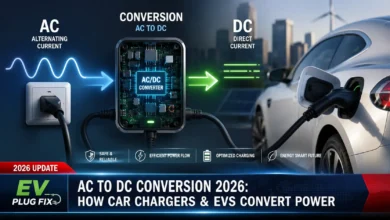
During normal AC home or destination charging, the charging point supplies AC electricity within the available electrical limit. The vehicle’s onboard charger converts that AC to DC, while the vehicle’s battery and charging controls determine how the traction battery is charged. A higher-rated AC wallbox therefore cannot make a vehicle exceed its own onboard AC charging capability. For a closer look at this part of the charging process, see how AC-to-DC conversion works in EV charging.
DC fast charging moves the major AC-to-DC conversion into the external charging station. The station supplies regulated DC power, but the vehicle still plays a central role in determining what the battery can accept. The charger and vehicle coordinate voltage and current during the session, allowing the requested power to change as battery limits change.
IEC 61851 covers DC EV supply equipment, while IEC 61851 covers digital communication between DC charging equipment and an EV for control of DC charging. Charging systems may also use communication defined within the ISO 15118 family.
What this means for EV owners
Most owners never need to think about CC and CV as settings. Their practical effect appears in the charging curve: power can be high when the battery is in a favorable condition and then decline as the pack approaches limits set by its cells and control system.
Battery chemistry and temperature help determine those limits. Different lithium-ion chemistries use different operating windows, and cold or excessive battery temperatures can restrict charging current. Vehicles equipped with battery preconditioning may heat or cool the pack before a fast-charging stop so it can arrive closer to a temperature suitable for higher charging power. This relationship between temperature, charging performance and pack protection is explored further in the guide to EV battery thermal management.
CC-CV control also should not be treated as proof that a particular charging speed is universally harmless or harmful. Battery aging depends on several interacting factors, including temperature, state of charge, chemistry and operating conditions. Owners are better served by following the charge-limit and battery-conditioning guidance supplied for their specific vehicle than by applying one generic percentage rule to every EV. The broader effects of charging behavior are covered in EV charging habits and battery degradation.
For road trips, the charging curve can affect when it makes sense to leave a station. If power has fallen substantially near the top of the battery, another stop later at a lower state of charge may sometimes be quicker than waiting for 100%. Range to the next reliable charger, weather and desired reserve still matter, so 80% is a planning reference rather than a mandatory stopping point.
Constant current vs constant voltage: common assumptions
| Common assumption | More accurate explanation |
|---|---|
| CC charging always ends at 80% | CC-CV operation is based on battery limits, not a universal state-of-charge percentage. EV charging can also taper for reasons other than a textbook CV transition. |
| A 350 kW charger sends 350 kW into any EV | The vehicle must be able to request and accept that power, and the charger must support the required voltage and current at that point in the session. |
| Charging power drops only because the battery enters CV mode | Cell voltage is one factor, but temperature, state of charge, cell conditions and charging-equipment limits can also reduce power. |
| A home wallbox directly manages the battery’s CC-CV cycle | With AC charging, the wallbox supplies AC within its available limit, while the vehicle’s onboard charger and battery controls manage charging of the traction battery. |
| More charger power always means a faster session | A higher station rating helps only when the vehicle can use the additional voltage, current and power available. |
| Every EV should use the same daily charging percentage | Charge-limit recommendations depend on the vehicle and battery. Follow the manufacturer’s guidance for the specific model. |
Bottom Line
Constant current and constant voltage are complementary stages of battery charging, not competing types of EV charger. In the conventional CC-CV model, current is controlled while battery voltage rises. Once the upper voltage limit becomes dominant, voltage is constrained and current falls.
A real EV adds dynamic battery management on top of that model. Charging power can change because of cell voltage, temperature, state of charge, battery condition and limits imposed by the charging equipment. That is why a fast-charging curve rarely resembles a perfect two-stage laboratory graph.
For an EV owner, the useful conclusions are straightforward: 80% is not a universal CC-to-CV switch, a charger’s headline rating is not the power every car will receive throughout a session, and the vehicle normally manages these charging modes without driver intervention.
FAQ
Why does my EV usually charge faster at a low state of charge?
At a lower state of charge, the battery may have more room to accept high current before cell voltage or other limits require the vehicle to reduce power. Battery temperature and charger capability still influence the actual rate.
Is charging from 80% to 100% always slower?
Many EVs charge more slowly in the upper part of the battery range, but the amount of taper and the point at which it begins vary by vehicle and conditions. The charging curve for the specific model is more useful than assuming every EV behaves identically after 80%.
Does a Level 2 home charger use constant current or constant voltage?
During AC charging, the EV supply equipment provides AC power within the available current limit. The vehicle’s onboard charger converts that electricity to DC, and the vehicle’s battery-management and charging systems control how the traction battery is charged.
Does DC fast charging bypass the battery management system?
No. DC fast charging bypasses the onboard AC charger for the main power conversion, but the vehicle’s battery management remains involved in determining acceptable charging limits. The external charger adjusts its DC output in coordination with the vehicle.
Should I stop DC fast charging at 80%?
Not as a fixed rule. Leaving around that point can be efficient on some road trips because charging power may already have tapered, but the sensible departure state of charge depends on the vehicle’s charging curve, the route, weather and the distance to the next dependable charging opportunity. Drivers unfamiliar with fast-charging stops can also review how to use a public EV charging station.
Source Transparency
The distinction between textbook CC-CV charging and the dynamic control used in complete EV battery systems is based on established lithium-ion charging principles. Descriptions of DC charging equipment and charger-to-vehicle control were checked against IEC 61851:2023 and IEC 61851:2023. Vehicle-specific charging limits, battery conditioning behavior and charging curves can differ, so owners should use the current manual or in-vehicle guidance for their own model.