
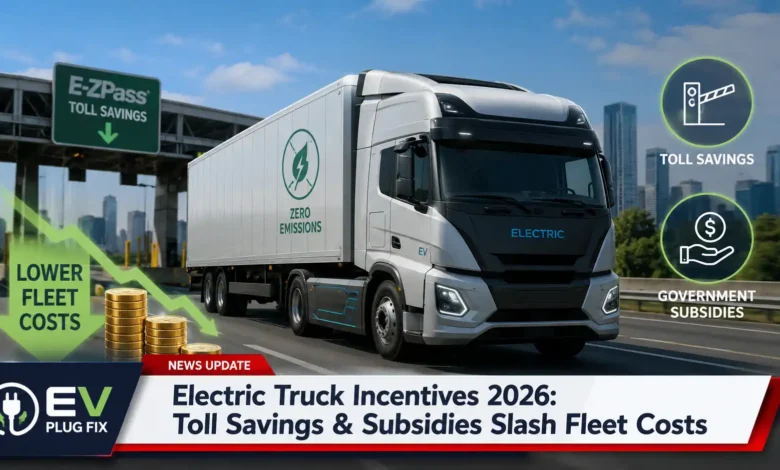
Electric truck incentives can change a fleet investment from difficult to viable, but the value rarely comes from one subsidy alone. Purchase grants reduce the acquisition cost, favorable toll treatment can lower recurring expenses, and charging-infrastructure support may reduce part of the depot investment.
There is no single European incentive package, however. National governments set most purchase-support programmes, individual countries implement road-charging rules, and infrastructure funding follows separate eligibility requirements. This guide uses the UK and Netherlands as practical examples of national purchase support while also covering EU rules that can affect fleets operating across borders.
| Support | How it affects the business case | Key variable |
|---|---|---|
| Truck purchase grant | Reduces initial vehicle expenditure | Vehicle, buyer, order date and available budget |
| Toll reduction or exemption | Reduces recurring route costs | Tolled distance and national tariff |
| Charging support | Offsets some depot infrastructure expenditure | Eligible site costs and funding programme |
Start With TCO, Not the Headline Grant
A large maximum grant does not automatically produce a strong electric-truck business case. Fleet managers need to compare the full cost of operating the electric truck with the vehicle it will replace.
A useful framework is:
Electric-truck TCO = vehicle purchase price − confirmed purchase support + charging infrastructure + energy + tolls + maintenance + financing + other operating costs − residual value
The comparison vehicle should be modelled on the same basis. Mileage, payload requirements, route profile and ownership period need to match closely enough for the result to be meaningful.
Consider a hypothetical fleet evaluating an electric tractor. Instead of beginning with the maximum advertised subsidy, the fleet would first establish the actual vehicle price and then subtract the grant for which that specific purchase qualifies. It would add the fleet’s share of chargers, civil works and grid upgrades using realistic commercial
charging installation costs, estimate electricity consumption on the planned routes and calculate toll charges under the applicable national tariffs.
The same exercise is performed for the diesel alternative. The difference between the two lifecycle totals is more useful than comparing sticker prices or maximum subsidies.
It is also worth running at least two electric-truck scenarios: one using support that has already been confirmed and another excluding temporary or uncertain incentives. This shows how dependent the investment is on policy.
EU Toll Rules Can Favor Zero-Emission Trucks
Toll treatment can be particularly important for high-mileage electric trucks because the benefit is recurring rather than limited to the purchase date.
Under the EU Eurovignette framework, member states may apply reduced infrastructure or user charges, including exemptions, to zero-emission heavy-duty vehicles through 30 June 2031. From 1 July 2031, such reductions are limited to 75% compared with the charge for CO2 emission class 1 vehicles.
The provision gives member states an option; it does not create an automatic EU-wide toll exemption. National implementation determines what a truck actually pays.
The consolidated legislation is available through EUR-Lex.
Calculate Toll Savings by Route
A Europe-wide annual toll-saving figure is not useful for an individual fleet. The calculation needs the kilometres driven on tolled roads and the tariffs that apply to the truck in each country.
Annual toll benefit = annual tolled distance × difference between the comparison-vehicle and zero-emission toll rates
For cross-border operations, the calculation can be divided by country or corridor. A vehicle covering extensive tolled motorway mileage may gain much more from favorable toll treatment than a truck used mainly on untolled local roads.
UK Zero-Emission Truck Grants
For fleets buying eligible vehicles in the UK, the Zero Emission Truck Grant reduces the purchase price through the seller. The temporary headline grant of up to £120,000 announced in January 2026 applied only until March 2026. From April 2026, a different grant structure applies.
| Truck weight | Maximum grant |
|---|---|
| 4.25 to 12 tonnes | Lower of £15,000 or 20% of upfront vehicle cost |
| 12 to 18 tonnes | Lower of £37,000 or 40% of upfront vehicle cost |
| 18 to 26 tonnes | Lower of £52,000 or 40% of upfront vehicle cost |
| Over 26 tonnes | Lower of £81,000 or 40% of upfront vehicle cost |
For large enterprises in Northern Ireland, the percentage limit differs: GOV.UK lists a 20% maximum for trucks from 4.25 to 12 tonnes and 30% for the heavier categories.
Eligibility is model-specific. GOV.UK requires qualifying trucks to meet the scheme’s technical conditions and publishes the eligible vehicle list by weight category. The current scheme is scheduled to run from 1 April 2026 to 31 March 2030, although the government states that grant levels and other aspects of the scheme may be changed during its lifetime.
The latest eligible models and grant conditions are listed on the GOV.UK truck grant page.
Netherlands: AanZET Purchase Support
The Netherlands provides another example of how national support can change electric-truck acquisition costs. The Aanschafsubsidie Zero-Emissie Trucks, or AanZET, supports businesses and qualifying non-profit organisations buying or financially leasing new fully zero-emission trucks.
For 2026, eligible vehicles include N3 trucks and N2 trucks with a technical maximum mass of at least 10,000 kg. The subsidy percentage and maximum payment vary with the vehicle category and size of the organisation.
| 2026 vehicle category | Large enterprise maximum | Medium enterprise maximum | Small enterprise or qualifying non-profit maximum |
|---|---|---|---|
| N2 rigid chassis from 10,000 kg | €15,200 | €29,900 | €36,900 |
| N3 rigid chassis or tractor | €43,900 | €83,200 | €115,200 |
The maximum is also limited by a percentage of the eligible sales price. For N3 rigid trucks and tractors, RVO lists 11.1% for large enterprises, 21% for medium enterprises and 29% for small enterprises and qualifying non-profit organisations.
RVO lists a total 2026 AanZET budget of €119.2 million and an autumn application period from 29 September to 16 October 2026. Funding is not equivalent to a guaranteed allocation: application rules, timing and remaining programme budget still determine whether support is awarded.
The latest details are published on the official RVO AanZET page.
Can AanZET Be Combined With Dutch Tax Benefits?
Not every form of support can be added together. RVO states that AanZET and the MIA environmental investment tax benefit cannot both be used for the same truck purchase.
EIA treatment is different. RVO says AanZET and EIA can be used where the relevant EIA conditions are met, although the subsidy affects the costs on which the tax deduction is calculated. MIA and EIA also cannot be applied to the same investment costs.
This is why incentive stacking belongs in the financial model only after the interaction between the programmes has been established. RVO provides further guidance on its electric-truck financial support page.
Zero-Emission Zones Can Add Operational Value
Some incentives do not appear as a cheque or tax credit. Access rules can affect which truck is suitable for an urban contract and when a fleet needs to replace existing vehicles.
The Netherlands, for example, has introduced zero-emission zones for commercial traffic in multiple municipalities. Transition arrangements mean that existing combustion vehicles are not all excluded on the same date; treatment can depend on factors such as vehicle category, emissions class and registration date.
For a fleet serving affected city centres, access should be included as an operational constraint in vehicle planning. The value is contract-specific: unrestricted access can matter greatly to one urban distribution operation while having almost no effect on another fleet that never enters those zones.
Charging Infrastructure Can Change the Result
A truck subsidy covers only one part of fleet electrification. Depot projects can require chargers, electrical distribution equipment, civil works, software, load management and a larger grid connection. Those costs need to be added before comparing the electric and diesel alternatives.
EV
charging grants and funding can reduce the figure when the fleet’s own project qualifies under a national programme. The important distinction is between funding awarded to the operator’s depot and government spending on the wider public charging network. A publicly funded motorway charger may improve route feasibility, but it is not a direct subsidy toward the fleet’s depot installation.
EU programmes such as the Alternative Fuels Infrastructure Facility have funded public and strategic charging deployment along the TEN-T network. In November 2025, the European Commission announced more than €600 million for 70 alternative-fuels infrastructure projects, including new lorry-charging locations and megawatt chargers.
That investment can expand the routes available to electric trucks, but fleets should not deduct those EU project awards from their own capital expenditure unless they are themselves beneficiaries of an applicable funding programme. Background on the public infrastructure framework is available from the European Commission.
A Short Note on Megawatt Charging
Megawatt-class charging may help compatible heavy trucks recover substantial energy during scheduled stops, but connector capability alone does not determine turnaround time. Battery size, state of charge, temperature, the truck’s accepted charging power, charger output and the charging curve all affect the result.
For TCO purposes, use the charging performance of the truck and infrastructure being purchased rather than assuming a standard charging time from the maximum rating of a charging system.
Other Costs That Belong in the Fleet Model
Incentives can attract most of the attention, but several non-subsidy assumptions can move the TCO result just as strongly. Energy should reflect the mix of depot and public charging the truck will actually use, including the pricing
structure of public chargers on its routes. Maintenance should come from appropriate fleet, manufacturer or contract data rather than a universal percentage reduction.
Payload and utilisation deserve particular attention. Charging stops, route length, battery configuration and available payload can determine whether one electric truck can perform the same work as the vehicle it replaces. Financing costs and residual value also need scenario testing because they can change the economics over a multi-year ownership period.
What Fleet Operators Should Check Before Ordering
- Confirm that the exact truck model, weight category and buyer qualify for the intended purchase programme.
- Establish whether the application must be submitted or approved before a binding purchase commitment is made.
- Check the current grant amount, application window and available programme budget.
- Identify limits on combining the grant with tax incentives or other subsidies.
- Calculate toll costs using the vehicle’s real routes and applicable national classifications.
- Price the depot project, including chargers, electrical work, civil work, software and any grid upgrade.
- Separate direct fleet subsidies from public-network investments that merely improve charging availability.
- Model energy, maintenance, utilisation, payload, financing and residual value consistently for both powertrains.
- Run the business case with confirmed incentives and again without temporary or uncertain support.
Essential Questions & Expert Answers
Can electric truck incentives be combined?
Sometimes, but stacking rules differ by programme. A purchase grant may be compatible with one tax incentive and incompatible with another. In the Netherlands, for example, RVO says AanZET cannot be combined with MIA for the same purchase, while EIA may be available for qualifying costs subject to its own rules. Each incentive should be checked individually before multiple benefits are added to the TCO model.
Do I need grant approval before ordering an electric truck?
It depends on the scheme. Some programmes require an application, conditional agreement or other procedure before a purchase becomes unconditional. Signing the wrong type of contract too early can affect eligibility. The programme’s ordering and application sequence should be checked before the fleet makes a binding commitment.
What happens if an incentive programme runs out of money?
A published maximum grant does not necessarily mean funding will remain available throughout the application window. Budget-limited programmes can become oversubscribed or close when funds are committed. A fleet should distinguish between a potential incentive, an application already submitted and funding that has actually been awarded.
How should a fleet model an incentive that may expire?
Separate temporary support from the underlying vehicle economics. One scenario can include the incentive expected for the planned purchase date, while another removes it or applies a less favorable assumption. This shows whether delaying procurement, missing an application window or encountering a policy change would materially alter the investment decision.
Are zero-emission trucks automatically exempt from tolls across the EU?
No. EU legislation permits favorable toll treatment for zero-emission heavy-duty vehicles, but national implementation determines the actual charge. Cross-border fleets need to calculate toll costs country by country using the roads and vehicle classifications relevant to their operation.
Does public funding for truck chargers reduce my depot costs?
Only when the fleet or its project qualifies for funding that applies directly to the installation. Government investment in public motorway or TEN-T charging may improve vehicle usability without paying any part of a fleet’s private depot bill. Treat those two benefits separately.
Bottom Line
Electric truck incentives can materially change the economics of fleet electrification, particularly where a purchase grant is combined with recurring toll advantages and intensive vehicle utilisation. The size of the headline subsidy, however, is not the business case.
The dependable approach is to model only support that can be verified for the specific vehicle, buyer, route and purchase date. Add the real charging-infrastructure requirement and operating costs, then test the investment again without temporary benefits. A truck that still performs acceptably under the less generous scenario gives the fleet a more resilient basis for making the purchase.
Source Transparency
This article was updated using primary government and EU sources available in August 2026. UK truck-grant amounts and eligible models were checked against GOV.UK guidance and information on the Zero Emission Truck Grant. Dutch AanZET amounts, percentages, application dates, budget and incentive-stacking rules were checked against the Netherlands Enterprise Agency, RVO. EU toll provisions were checked against the Eurovignette legislation on EUR-Lex, including the extension of optional favorable treatment for zero-emission heavy-duty vehicles through 30 June 2031. EU public charging-infrastructure information was checked against European Commission transport material.
Grant levels, vehicle lists, programme budgets, tax treatment, application windows and national toll arrangements can change. Before placing an order, fleets should use the current official programme terms and treat funding as committed in a financial model only when the relevant eligibility and award conditions have been satisfied.