
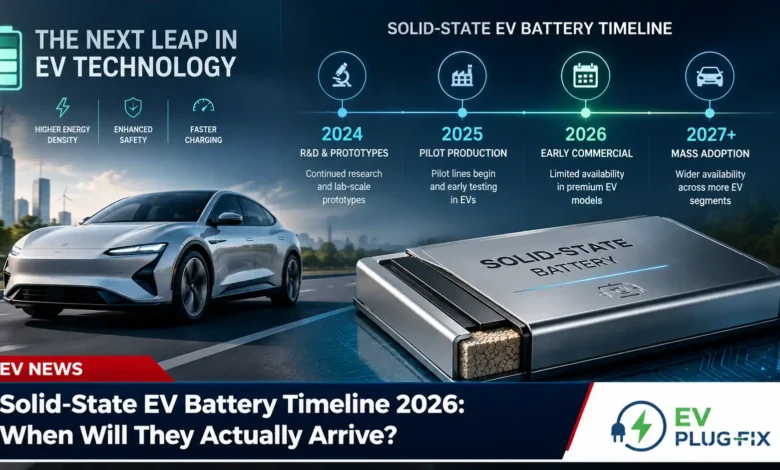
Solid-state EV batteries are no longer confined to laboratory cells. Automakers have built pilot production lines, prototype packs are being tested in road-going vehicles, and several companies now have public targets for putting the technology into production vehicles.
That does not mean a wave of affordable solid-state EVs is about to reach dealerships. As of August 2026, the clearest manufacturer timelines still point mainly to 2027 through the end of the decade for initial vehicle applications. Large-scale adoption is likely to take longer because producing a promising cell is very different from manufacturing millions of automotive cells reliably, safely and at an acceptable cost.
The most useful way to understand the solid-state EV battery timeline is therefore to separate three milestones: prototype cells that work, vehicles being tested with those cells, and batteries being manufactured at commercial automotive scale.
When Will Solid-State EV Batteries Actually Arrive?
For buyers waiting for a production EV with an all-solid-state battery, 2027 to 2028 is currently one of the most credible early windows. Toyota continues to target a market launch in that period, while Nissan has identified fiscal 2028 for an EV using its proprietary all-solid-state battery technology. Honda gives a broader target of applying its batteries to electrified models introduced in the second half of the 2020s.
Other programs have already reached vehicles without committing to a specific retail model and on-sale date. BMW has been testing large-format all-solid-state cells developed with Solid Power in an i7 development vehicle. Mercedes-Benz has tested Factorial lithium-metal solid-state cells in an EQS-based vehicle and completed a 1,205 km road journey on one charge. Mercedes says its goal is to bring technology of this type into series production by the end of the decade, but that remains a company target rather than a confirmed customer-model launch date. Volkswagen’s PowerCo, meanwhile, has a collaboration intended to create a pathway for licensing and industrializing QuantumScape’s technology once specified milestones and other conditions are satisfied.
| Company or program | Where it stands | Published timing | What buyers should take from it |
|---|---|---|---|
| Toyota | Developing all-solid-state BEV batteries and mass-production methods with material partners | Market launch targeted for 2027 | One of the clearest stated production-vehicle targets, but initial volume may be limited |
| Nissan | Developing proprietary all-solid-state cells and a production process | Aiming for an EV using ASSB technology in fiscal 2028 | A concrete automaker target, though final vehicle details and production volume remain uncertain |
| Honda | Operating a demonstration production program to establish manufacturing technology | Targeting application to models introduced in the second half of the 2020s | Commercialization work is underway, but Honda has not tied the battery to a specific retail model and date |
| Mercedes-Benz and Factorial | EQS-based solid-state test vehicle completed a 1,205 km road journey on one charge | Mercedes targets series production of technology of this type by the end of the decade; no specific retail-model launch date confirmed | Long-distance vehicle validation is an important milestone, but the production target is not a confirmed showroom date |
| BMW and Solid Power | Large-format all-solid-state cells installed in a BMW i7 development vehicle | No confirmed customer-vehicle launch date | The program has moved beyond individual cell tests, while further development is still required |
| Volkswagen PowerCo and QuantumScape | Collaboration creating a pathway toward licensing and industrialization of QuantumScape solid-state lithium-metal technology, subject to specified milestones and conditions | No confirmed Volkswagen production-model date | Potential manufacturing scale is substantial, but neither the licensing framework nor its capacity figures constitute current mass production or a showroom launch |
Why 2026 Is Important Even Without a Mass-Market Launch
Calling 2026 the year solid-state batteries reach ordinary EV buyers would be premature. It is more accurately a period in which several programs are moving deeper into the difficult transition between development and industrialization.
That distinction matters. A laboratory cell may demonstrate excellent energy density or cycle performance under controlled conditions. An automotive battery must reproduce acceptable performance across thousands of cells, survive vibration and temperature extremes, charge repeatedly, meet safety requirements and remain manufacturable with tight quality control.
Automakers and battery developers are now attacking those production problems directly. Honda’s demonstration line was created to verify manufacturing processes and costs. Toyota and its partners are working on mass production of materials required for its all-solid-state batteries. Solid Power reported in August 2026 that work on its continuous sulfide-electrolyte manufacturing pilot line remained on schedule, with operational startup planned for the fourth quarter of 2026.
These are less spectacular milestones than a headline promising an exceptionally long-range EV, but they are more useful for judging when the technology might actually leave the development stage.
What Makes a Solid-State Battery Different?
A conventional lithium-ion EV battery generally uses a liquid electrolyte that allows lithium ions to move between the electrodes. Solid-state designs replace some or all of that liquid-electrolyte function with solid materials.
The phrase solid-state battery covers several architectures rather than one standardized chemistry. Developers are working with materials including sulfide and oxide-based solid electrolytes, while other designs may use different solid or hybrid approaches. Some programs also pair the solid-electrolyte system with a lithium-metal anode.
The attraction is not simply that the electrolyte is solid. Developers are trying to use these architectures to improve several characteristics at once:
- Higher energy density: More usable energy could potentially be stored for a given battery weight or volume.
- Faster charging: Some designs are being developed for substantially higher charging rates, although vehicle cooling, charging curves and charger capability will still matter.
- Improved safety potential: Reducing or eliminating flammable liquid electrolyte can address some hazards found in conventional cells, but it does not make a battery incapable of failure or eliminate the need for thermal management and safety engineering.
- Different packaging opportunities: Greater cell-level energy density could allow a manufacturer to pursue more range, a smaller battery pack, lower vehicle weight or some combination of those benefits.
The final production EV may therefore use solid-state technology to reduce battery size rather than simply chasing the longest possible range.
Toyota: 2027 Remains the Key Target
Toyota has one of the most explicit public all-solid-state battery schedules among major automakers. The company has continued to state that it is aiming for a market launch of battery-electric vehicles using all-solid-state batteries in 2027.
The company is also working with suppliers on the materials needed to make that target practical. Its collaboration with Idemitsu focuses on developing and mass-producing sulfide solid electrolytes. Toyota and Sumitomo Metal Mining have separately worked on cathode materials intended for all-solid-state batteries.
Toyota has described ambitious development targets, including rapid charging from 10% to 80% in 10 minutes or less for one planned all-solid-state specification. That figure should be understood as a Toyota development target, not a specification guaranteed for every future Toyota solid-state EV.
Likewise, claims about large range gains should not be converted automatically into a specific number of miles. Driving range depends on the battery capacity chosen for the vehicle as well as efficiency, aerodynamics, mass, tires, climate and the usable state-of-charge window.
Nissan: Targeting Fiscal 2028
Nissan has also attached a specific period to its development program. Its battery roadmap calls for an EV using the company’s proprietary all-solid-state battery technology in fiscal 2028.
Nissan has been developing manufacturing technology alongside the cells themselves, an important part of the commercialization process. The company has previously described the technology as a way to increase energy density and potentially reduce charging time and battery cost, but those remain development objectives until validated in a production vehicle.
The practical point for consumers is that Nissan belongs in the group of automakers targeting the late 2020s for an initial commercial application rather than promising a mass-market solid-state model immediately.
Honda: Building the Production Process Before Naming a Car
Honda has taken a manufacturing-focused approach. It built a demonstration production line in Sakura City, Japan, specifically to develop and verify processes required for all-solid-state battery mass production.
Honda has said it wants to apply its internally developed all-solid-state batteries to electrified vehicles introduced during the second half of the 2020s. That leaves more flexibility than Toyota’s 2027 target and does not establish a particular model as the first recipient.
The demonstration line is important because solid-state commercialization depends heavily on processes such as forming thin, uniform layers and maintaining reliable contact between solid materials. Solving the chemistry without solving those manufacturing problems would not be enough for automotive-scale production.
BMW and Solid Power: Real Cells in a Real Test Vehicle
BMW announced in May 2025 that large-format, all-solid-state cells developed with Solid Power had been installed in a BMW i7 test vehicle operating in the Munich area.
That does not make the i7 a forthcoming solid-state production model. BMW described the vehicle as a development platform for evaluating issues such as cell expansion, operating pressure and temperature conditions inside a complete automotive battery system.
The companies have continued their work. Solid Power’s 2026 updates show that commercialization efforts remain focused heavily on electrolyte development, manufacturing capability and partnerships. Solid Power also works with Samsung SDI and BMW on further all-solid-state battery evaluation.
This program illustrates why prototype vehicles are an important milestone without being evidence that retail production is imminent.
Mercedes-Benz and Factorial: From Road Testing to a 1,205 km Validation Drive
Mercedes-Benz has moved its solid-state development program well beyond cell-level testing. The company has been evaluating an EQS-based prototype fitted with lithium-metal solid-state cells supplied by Factorial Energy, with the battery system developed in collaboration with Mercedes-AMG High Performance Powertrains.
Mercedes said the experimental battery provides about 25% more usable energy than the standard EQS battery while remaining comparable in weight and size. That is a result from a development vehicle, not a promise that a future production EQS or another Mercedes model will automatically gain the same percentage in range.
A more recent milestone came when the modified EQS completed a 1,205 km journey from Stuttgart to Malmö on a single charge, finishing the trip without a charging stop. The demonstration gives Mercedes additional real-world data on how the battery system behaves during sustained vehicle operation rather than only under laboratory conditions.
The company has also said its goal is to bring innovations of this type into series production by the end of the decade. That wording is important: it is a Mercedes-Benz development and commercialization target, not confirmation that a particular solid-state Mercedes will reach dealerships in a specified year.
Vehicle testing still has to address durability, battery management, packaging, pressure control, charging behavior and thermal performance before a customer program can be considered established.
Volkswagen, PowerCo and QuantumScape: A Conditional Path Toward Industrialization
Volkswagen Group’s PowerCo and QuantumScape are pursuing a licensing-based route toward larger-scale manufacturing, but the legal status of that arrangement requires careful wording. Their collaboration provides a pathway for PowerCo to license and manufacture QuantumScape technology subject to specified technical milestones and other conditions. QuantumScape’s July 2026 disclosure says the parties intend to enter into the PowerCo IP License Agreement once the relevant milestones are completed, so it should not be described as an unconditional, fully effective mass-production license today.
The capacity framework is also larger than the original figures alone suggest. The original arrangement contemplated facilities with up to 40 GWh of annual capacity, expandable by another 40 GWh. A subsequent amendment added rights covering up to another 5 GWh annually for additional applications, including potential customers outside Volkswagen Group. That brings the potential maximum PowerCo production contemplated under the license framework to 85 GWh per year.
Those numbers describe permitted future manufacturing capacity under the proposed licensing framework. They do not mean PowerCo is currently producing 85 GWh, or even 40 GWh, of QuantumScape solid-state cells each year. They also do not establish a confirmed launch date for a Volkswagen production model.
The companies continue to work on development, validation and technology transfer around QuantumScape’s QSE solid-state lithium-metal platform. For buyers, the important missing pieces remain a confirmed production vehicle, manufacturing ramp, market availability and customer sale date.
Why Solid-State Batteries Keep Taking Longer Than Expected
The long development cycle is not evidence that solid-state batteries are fictional. It reflects how difficult automotive battery manufacturing is.
Keeping Solid Materials in Contact
Liquid electrolyte naturally fills small spaces inside a conventional cell. Solid materials do not behave in the same way. Maintaining intimate contact between layers as the battery charges, discharges, heats, cools and ages is a major engineering challenge.
Controlling Expansion and Pressure
Some cell architectures change dimensions during operation. Battery developers may need carefully controlled pressure to maintain performance, adding another variable that must be managed at cell, module and pack level.
Producing Thin Layers Without Defects
A process that successfully produces a small number of laboratory cells can behave very differently when equipment has to run continuously at industrial speed. Layers must be formed consistently across large numbers of cells, materials have to remain within tight tolerances and defects that were manageable during development can become serious yield problems when production scales.
That is why pilot and demonstration lines matter. They allow developers to discover whether a cell architecture can be manufactured repeatedly rather than merely proving that individual cells can work.
Raising Manufacturing Yield
Battery factories cannot rely on a process that produces excellent cells only some of the time. If too many cells fail inspection or perform outside specification, the usable output of an expensive production line falls and the cost of every acceptable cell rises.
Solid-state manufacturers therefore need processes that can deliver high consistency across electrode preparation, electrolyte layers, interfaces, cell assembly and final quality control. Improving factory yield can be just as important commercially as improving a laboratory performance metric.
Reducing Cost
A technically successful battery is not automatically a commercially competitive battery. Materials, production speed, specialized equipment, energy consumption, factory yield and quality-control requirements all affect cell cost.
The first production applications may therefore appear in vehicles where customers or manufacturers can tolerate a higher battery cost before the technology is economical enough for broader use.
Proving Automotive Durability
EV batteries must operate through years of charging cycles, temperature changes, vibration and high power demand. Manufacturers also need to understand how cells age, how pack-level pressure or thermal systems behave over time and what failure modes emerge after extended operation.
That requires substantial validation before an automaker can confidently commit the technology to customer vehicles and long battery warranties. A successful road test is useful evidence, but it is only one part of that process.
Will Solid-State Batteries Make EVs Fireproof?
No. Describing solid-state batteries as eliminating battery fires is too strong.
Replacing flammable liquid electrolyte can potentially improve aspects of cell safety, and several developers identify safety as one of the advantages they are pursuing. But a solid-state battery remains an electrochemical energy-storage device containing substantial stored energy. Different designs can have different failure mechanisms, and lithium-metal systems introduce their own engineering challenges.
The relevant question is whether a finished automotive battery can demonstrate an improved safety profile after its cells, pack structure, battery-management system and thermal controls are considered together.
Will Every Solid-State EV Have 500 or 600 Miles of Range?
No. Solid-state technology does not dictate a specific driving range.
If a new cell stores more energy for the same weight, an automaker could build a very long-range EV. It could instead keep roughly the same range while installing a smaller and lighter battery. A manufacturer might also use the available energy-density improvement to improve performance or packaging.
This is why claims that solid-state batteries inherently mean 500-mile or 600-mile EVs are misleading. A vehicle’s final EPA, WLTP or other certified range cannot be known until a specific production vehicle has been engineered and tested.
Will Solid-State Batteries Charge in 10 Minutes?
Some developers are targeting charging times around this level, but there is no universal 10-minute specification for solid-state batteries.
Toyota, for example, has published a development target of 10% to 80% charging in 10 minutes or less for its planned all-solid-state technology. Other cells may behave differently.
Even if the battery accepts very high power, actual charging time also depends on battery size, temperature, the vehicle’s voltage architecture, its charging curve, the charger’s maximum output and whether the charging site can continuously deliver the required power.
Solid-state batteries therefore could enable faster charging without making existing charging infrastructure obsolete overnight.
Do You Need to Wait for Solid-State Batteries Before Buying an EV?
For most buyers, probably not. Current lithium-ion EV batteries continue to improve, and manufacturers are simultaneously developing lithium iron phosphate, high-nickel, silicon-enhanced and other battery technologies. Solid-state development will not cause conventional lithium-ion batteries to disappear as soon as the first commercial solid-state vehicle launches.
Waiting makes more sense if you do not currently need a new vehicle and you specifically want to see how the first production solid-state systems perform. But postponing an EV purchase solely because inexpensive solid-state models are assumed to be one year away is risky. The earliest vehicles may have restricted production, premium positioning or limited geographic availability.
Production schedules can also move. Until an automaker names a vehicle, factory, production volume, market and on-sale date, a battery roadmap should be treated as a target rather than a guaranteed launch.
What a Real Commercial Breakthrough Will Look Like
The strongest signal will not be another record laboratory result or prototype road trip. It will be an automaker announcing a production vehicle with validated cells, a defined manufacturing site and supply chain, customer deliveries and enough output to move beyond demonstration quantities.
After that first phase, the next question will be whether manufacturing yields and costs improve sufficiently for the technology to move from high-value or limited-volume applications into mainstream EVs.
That transition could take several years. Conventional lithium-ion production has an enormous manufacturing base and continues to improve at the same time. Solid-state batteries therefore have to compete against a moving target rather than the batteries available when many solid-state programs began.
Bottom Line
Solid-state EV batteries are becoming real automotive hardware, but mass-market availability is not here yet. The evidence available in August 2026 supports a gradual introduction rather than a sudden industry-wide switch.
Toyota is targeting 2027 for a BEV market launch, Nissan is aiming for fiscal 2028, and Honda is working toward applications in vehicles introduced during the second half of the 2020s. BMW has installed Solid Power cells in an i7 development vehicle, while Mercedes-Benz’s Factorial-powered EQS test vehicle has completed a 1,205 km journey on one charge. Mercedes says it wants technology of this type in series production by the end of the decade, but that remains a target rather than a confirmed retail launch.
QuantumScape and PowerCo are also working toward industrialization, with a proposed licensing framework that could eventually permit PowerCo production of up to 85 GWh annually. That potential capacity is conditional on the licensing pathway and technical milestones and should not be confused with current solid-state cell production.
The safest expectation is that the late 2020s will bring some of the first important production applications. Broader adoption will depend on whether manufacturers can turn today’s prototype performance into high-volume cells with acceptable cost, durability, safety and factory yield.
In other words, the solid-state battery race has reached the industrialization stage, but it is too early to declare an exact date when the technology will become standard equipment in ordinary EVs.
FAQ
Are solid-state EV batteries available to buy now?
Not as a mainstream battery technology in ordinary mass-produced passenger EVs. Several automakers have solid-state test vehicles and pilot or demonstration production programs, but the major all-solid-state programs discussed here are still progressing toward commercial vehicle deployment.
Which automaker is expected to launch a solid-state EV first?
There is no guaranteed winner. Toyota publicly targets 2027, Nissan targets fiscal 2028, and Honda is working toward vehicle applications in the second half of the 2020s. Mercedes-Benz has stated an end-of-decade series-production goal for technology of the type demonstrated in its EQS test vehicle, but development schedules can change before customer production begins.
Does PowerCo already have an 85 GWh QuantumScape solid-state battery factory?
No. The figure refers to potential annual manufacturing capacity permitted under the proposed licensing framework if the required milestones and conditions are satisfied. The framework contemplates an initial 40 GWh, another potential 40 GWh of expansion and an additional 5 GWh covered by a later amendment. It does not mean 85 GWh of QuantumScape-based cells are currently being produced.
Are semi-solid-state and all-solid-state batteries the same?
No. The terminology is sometimes used loosely, but a battery described as semi-solid or solid-state may retain liquid or gel components that would not be present in a true all-solid-state architecture. Buyers should check what a manufacturer means rather than relying on the marketing label alone.
Will solid-state batteries replace lithium-ion batteries?
Many solid-state designs are still lithium-based batteries, so solid-state should not simply be viewed as the opposite of lithium-ion. The major change is primarily the electrolyte and associated cell architecture. Conventional liquid-electrolyte lithium-ion cells are also likely to remain in production for years because of their mature supply chains and continuing improvements.
Should home EV chargers be upgraded for solid-state batteries?
Not merely because a future EV has a solid-state battery. Home AC charging power is determined by the vehicle’s charging hardware, the EVSE and the home’s electrical capacity. Very fast solid-state charging claims mainly concern high-power DC charging, not the need for dramatically higher home charging power.
Source Transparency
This article distinguishes manufacturer targets from confirmed production events. The timeline and technical details were checked against primary information published by Toyota Motor Corporation and its battery-material partners, Nissan Motor Corporation, Honda Motor Co., BMW Group, Mercedes-Benz Group, Volkswagen Group and PowerCo, QuantumScape, Solid Power and Factorial, including QuantumScape’s 2026 regulatory disclosures. Company performance figures are described as targets, test results or manufacturer claims where appropriate rather than presented as guaranteed specifications for future customer vehicles.
Commercialization dates can change as cell validation and manufacturing programs progress. This article reflects publicly available information through August 2026 and avoids assigning a launch date where the manufacturer or developer has not announced one.