
Microlino Electric Microcar Review: Price, Range, Charging and Practicality

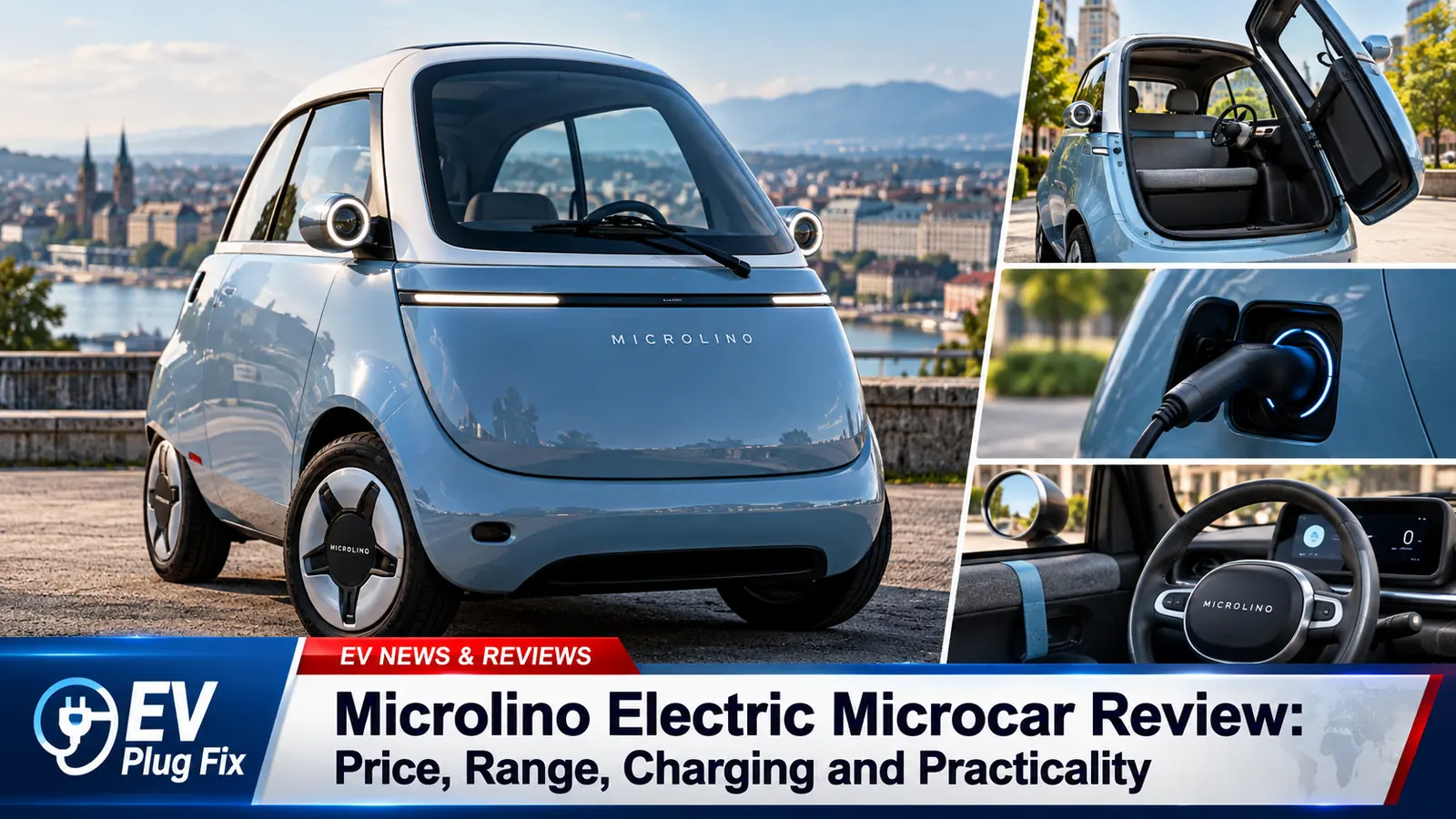
The Microlino electric microcar takes a different approach to urban transport. Instead of shrinking a conventional electric car into a smaller package, it prioritises compact dimensions, a distinctive front-opening cabin and the ability to fit into tight parking spaces. Its appeal is straightforward: for drivers making short city journeys, a smaller vehicle can be easier to park and potentially simpler to charge at home.
However, buyers considering the Microlino need to distinguish its design appeal from the practical details that determine whether it represents good value. The UK purchase price, available battery configuration, real-world range, charging equipment and vehicle classification all matter. The research material available for this review does not establish a verified UK price for the 2026 model, an independently measured driving range or a confirmed charging-time figure. These details should be checked against the current specification and a written dealer quotation before making a purchase decision.
What Is the Microlino Electric Microcar?
The Microlino is a compact electric vehicle designed around short journeys and space-efficient urban mobility. Its most recognisable feature is the front-opening door, which changes how occupants enter and leave the vehicle compared with a conventional car. Its small footprint is intended to reduce the space required for parking and manoeuvring.
That design makes the Microlino different from both a conventional electric city car and a low-speed electric quadricycle. It is aimed at drivers who value compact dimensions and straightforward local transport over the flexibility of a larger vehicle.
Why its dimensions matter
The existing draft gives a vehicle length of 2.52 metres. That figure should be confirmed against the precise version being sold, but it illustrates the intended design philosophy: use less road and parking space rather than maximise passenger capacity.
- Urban parking: A shorter vehicle may fit into spaces that cannot accommodate a conventional car, subject to the actual dimensions of the space and local parking rules.
- Manoeuvrability: Compact dimensions can make tight streets and small parking areas easier to negotiate.
- Passenger capacity: The Microlino is a two-seat vehicle, making it better suited to individuals and couples than families requiring several passenger seats.
- Everyday utility: Its usefulness depends on how much luggage you carry and whether your normal journeys require access to faster roads.
The front-opening door is also a practical consideration. Before buying, try entering and leaving the vehicle in a realistic parking space. A design that works well in an open showroom may feel different when another vehicle is parked close by or when the car is positioned against a wall.
Microlino Price: Is It Really Available for Under £20,000?
The headline price is an important part of the Microlino’s appeal, but a sub-£20,000 UK price cannot be confirmed from the research information supplied for this article. The cost may depend on the model version, battery configuration, equipment, delivery charges, taxes and the terms of any finance agreement.
Buyers should obtain a current, itemised quotation rather than relying on a headline figure from an older article or a price advertised in another European market.
What to check before placing an order
- Vehicle price: Confirm the price of the exact specification you intend to buy, including VAT where applicable.
- Battery version: Check which battery is fitted and the corresponding official range figure.
- Included charging equipment: Ask whether a portable charging cable is supplied and which connectors it supports.
- Delivery and registration: Establish whether these costs are included in the advertised price.
- Warranty: Obtain the vehicle and traction-battery warranty terms, including duration, mileage limits and capacity-related conditions.
- Servicing and repairs: Confirm where the vehicle can be serviced and whether authorised support is available within a reasonable distance.
A low purchase price is only one part of the ownership calculation. If the Microlino meets your daily transport needs, its compact size and ability to use suitable home charging may help keep running costs manageable. However, insurance, depreciation, tyres, maintenance and electricity costs still need to be considered.
Microlino Charging: Home Sockets, Wallboxes and Charging Time
Charging compatibility is one of the most important practical questions for prospective owners. The existing draft refers to Type 2 charging and a standard 230-volt household socket, but the available research plan contains no verified specification confirming the supplied cable, maximum AC charging power or exact charging times for the relevant 2026 vehicle.
Before relying on either charging method, ask the seller to confirm the vehicle’s charging inlet, supported AC charging power, cable requirements and the manufacturer’s instructions for domestic charging.
Can you charge the Microlino from a household socket?
A compatible portable charger may allow charging from a suitable domestic socket where the vehicle manufacturer explicitly permits this arrangement. However, compatibility should never be assumed simply because the vehicle has a small battery.
Charging from a household outlet creates a sustained electrical load. The condition of the socket, wiring, protective devices, earthing arrangements and the circuit’s other loads all affect whether the installation is suitable.
- Use only a charging cable or portable charging device approved for the vehicle and the intended supply.
- Have a qualified electrician assess the circuit if its condition or suitability is uncertain.
- Avoid damaged sockets, extension leads and improvised adapters unless the manufacturer explicitly permits the particular arrangement.
- Follow the manufacturer’s instructions on charging current, ventilation, cable routing and fault indications.
- Do not assume that a household socket can deliver its theoretical maximum power continuously under every installation condition.
A dedicated home charging point may provide a more convenient and controlled arrangement for regular charging. Whether it will charge the Microlino faster depends on the vehicle’s onboard AC charger and the limits of the charging equipment. Installing a more powerful wallbox does not automatically increase the vehicle’s charging speed.
How long does the Microlino take to charge?
An exact charging time should not be quoted without confirming the battery capacity, the vehicle’s maximum charging power and the relevant charging method. The four-to-five-hour estimate in the existing draft has not been substantiated by the supplied research plan and should not be treated as a verified 2026 specification.
For an approximate calculation, the basic relationship is:
Charging time (hours) ≈ energy required (kWh) ÷ average charging power (kW)
This is a simplified estimate, not a manufacturer charging specification. It assumes a reasonably constant average charging power and excludes additional losses and changes in charging rate.
For example, if a hypothetical vehicle needed 10 kWh of energy and received an average of 2 kW from the supply, the idealised calculation would be:
- Energy required: 10 kWh (illustrative assumption).
- Average charging power: 2 kW (illustrative assumption).
- Calculated time: 10 kWh ÷ 2 kW = 5 hours.
This example is not a claim about the Microlino’s actual battery size or charging performance. Real charging time can be longer because of conversion losses, temperature, charging limits and the difference between energy drawn from the socket and energy stored in the battery.
Is a public charger necessary?
Not necessarily. Drivers who have a suitable home charging arrangement and make relatively short daily journeys may rarely need public charging. Those living in flats, relying on on-street parking or travelling beyond their usual local area should investigate charging access before purchasing.
Check whether your normal destinations have compatible charging facilities and whether public charging is convenient enough to support your routine. The Microlino’s compact size does not remove the need to plan around battery capacity and charging availability.
Driving Performance and Everyday Practicality
The Microlino is designed for a particular type of journey, and its suitability should be judged against that use case rather than against the performance of a larger electric hatchback.
The existing draft quotes a top speed of 55 mph. Because the supplied research plan does not verify the figure for a specific model year or configuration, buyers should check the official technical specification before assuming the vehicle can sustain a particular road speed.
City driving and faster roads
For short urban trips, compact dimensions can be an advantage. Parking, low-speed manoeuvres and navigating narrow streets may be easier than in a larger car. Electric propulsion also eliminates tailpipe emissions while driving, although electricity generation and vehicle manufacturing still have environmental impacts.
Faster roads require a more careful assessment. A vehicle’s quoted maximum speed does not establish that it is comfortable or suitable for every road where that speed is permitted. Traffic speed, acceleration, road gradients, weather, occupant protection and the vehicle’s legal classification all affect suitability.
- Short city journeys: Potentially a good match for errands, local commuting and trips where parking is difficult.
- Suburban commuting: Depends on journey length, road speeds, charging access and the vehicle’s approved operating limits.
- Motorway travel: Do not assume suitability from a headline top-speed figure. Verify the vehicle’s classification, approval and permitted road use.
- Long-distance trips: Assess the official range, charging options, comfort and the availability of suitable routes before relying on the vehicle as your only transport.
Cabin layout and passenger space
The two-seat layout limits the Microlino’s flexibility compared with a conventional four- or five-seat car. It may work well for a solo commuter or a couple, but households transporting children, friends or several passengers will need another solution.
As with any small vehicle, the best way to judge the cabin is to sit in it before purchasing. Check seat adjustment, visibility, access, driving position and storage for the items you routinely carry.
Boot space and luggage
The existing draft quotes a 230-litre boot, but that capacity has not been independently verified by the supplied research plan. Confirm the official luggage capacity and inspect the boot opening and usable dimensions rather than relying on litres alone.
Small-item storage and the shape of the luggage compartment can matter as much as its nominal volume. Consider whether it can accommodate your normal shopping bags, work equipment, groceries or luggage without obstructing access to the cabin.
- Try loading your regular shopping bags into the boot.
- Measure larger items before assuming they will fit.
- Check whether the boot opening limits access to bulky objects.
- Consider delivery services or a second vehicle for occasional furniture and large purchases.
Microlino vs Conventional Electric Cars: Which Should You Choose?
The right comparison is not simply which vehicle has the lowest purchase price. It is which vehicle can complete your usual journeys safely and conveniently while meeting your passenger, luggage and charging requirements.
Three factors are particularly important when comparing the Microlino with a conventional electric city car or a smaller low-speed electric vehicle.
Vehicle capability
A conventional electric city car generally offers a different balance of passenger capacity, luggage space, road capability and equipment. A low-speed electric vehicle may prioritise very short journeys and lower acquisition costs but can have more restrictive operating limits. The precise differences depend on the models being compared.
Cost and ownership
Compare current, like-for-like prices and include insurance, financing, servicing, charging equipment and expected depreciation. Do not compare an advertised entry-level price for one vehicle with the fully equipped price of another.
Charging convenience
Confirm the charging connector, supported power, included cables and charging options for every candidate. A vehicle with a smaller battery is not necessarily faster to charge if its charging power is limited or its charging equipment is less convenient for your circumstances.
Because the supplied research plan contains no verified competitor specifications or current prices, a numerical comparison table would risk presenting unconfirmed information as fact. The following decision guide focuses on the requirements that buyers should verify.
| Buying consideration | Microlino | Conventional electric city car | Low-speed electric vehicle |
|---|---|---|---|
| Parking footprint | Compact design is a central attraction; verify exact dimensions. | Compare the length and width of the specific model. | Often designed for compact local transport; check dimensions. |
| Passenger capacity | Two seats according to the existing draft; confirm the version. | Varies by model, often offering more seats. | Varies by vehicle and legal classification. |
| Faster-road suitability | Check approved classification, road restrictions and performance. | Check the model’s approved capabilities and specifications. | May be restricted to lower-speed roads. |
| Luggage capacity | Verify official capacity and usable boot dimensions. | Compare official luggage capacity and loading access. | Storage may be limited; inspect the actual compartment. |
| Charging requirements | Verify connector, charging power and included equipment. | Check AC and, where applicable, DC charging support. | Check the specific charging system and approved supply. |
| Purchase cost | Obtain a current UK quotation for the exact specification. | Compare equivalent equipment and purchase terms. | Compare the full cost, including any required equipment. |
Who Should Buy the Microlino?
The Microlino makes the most sense when its specific advantages solve a real transport problem. A small footprint is useful if parking is difficult, but that advantage matters less if your regular journeys require several passenger seats, substantial luggage capacity or sustained high-speed driving.
Good potential matches
- Urban commuters: Drivers whose daily journeys are relatively short and whose routes suit the vehicle’s approved capabilities.
- Second-car households: Families that already own a larger vehicle for holidays, school runs and trips requiring additional passenger space.
- Drivers with limited parking: People who can take advantage of a genuinely small parking space at home or near work.
- Home-charging users: Owners who have a suitable charging arrangement and can replenish the battery between journeys.
- Minimalist drivers: People who value compact design and simple local transport more than the flexibility of a conventional car.
Who should consider another vehicle?
- Families needing multiple seats: A two-seat vehicle cannot replace a family car for journeys involving several passengers.
- Frequent motorway commuters: Confirm legal eligibility, road suitability, performance and occupant protection before considering it for these routes.
- Drivers without dependable charging: Public charging may be workable, but its cost and convenience need to fit your routine.
- People who regularly carry bulky loads: A larger boot and wider loading opening may be more useful than a compact parking footprint.
- Buyers who need verified low-cost ownership: Obtain insurance quotations, warranty details and a full purchase price before concluding that the Microlino is cheaper to own.
What to Verify Before Buying a Microlino in the UK
The most useful next step is to confirm the specifications and ownership conditions of the exact vehicle being offered. A model name alone is not enough to establish price, charging speed, range or road eligibility.
- Confirm the UK price. Request a dated, itemised quotation showing the vehicle specification, VAT, delivery charges and any optional equipment.
- Verify the battery and range. Ask for the official range figure for the selected version and the conditions under which it was established. Treat official test-cycle range and actual driving range as different measures.
- Check charging compatibility. Confirm the inlet type, onboard AC charging limit, supplied cable and permitted domestic charging arrangements.
- Ask for charging-time information. Request the manufacturer’s estimates for the relevant charging methods, including the starting and ending battery levels.
- Check legal classification and road use. Verify the vehicle’s approval, registration requirements, licence requirements and permitted road use for the UK specification.
- Review safety and insurance. Obtain insurance quotations and review the safety information applicable to the exact model and market.
- Inspect practicality in person. Test entry and exit, seating, visibility, boot access and the ability to park in your intended space.
- Review after-sales support. Confirm warranty coverage, servicing arrangements, parts availability and the process for handling faults.
These checks are particularly important when buying a vehicle whose design and dimensions differ substantially from those of an ordinary passenger car. The objective is to establish whether the Microlino fits your needs, not simply whether its headline specifications look attractive.
Final Verdict: Is the Microlino Worth Considering?
The Microlino electric microcar offers a distinctive alternative to conventional urban transport. Its compact design, two-seat layout and emphasis on parking convenience make it an interesting candidate for short city journeys, local errands and households that already have access to a larger vehicle.
Its limitations are equally important. Passenger capacity is restricted, luggage practicality must be checked in person, and suitability for faster roads depends on the exact vehicle specification and legal classification. Home charging can be convenient, but the charging connector, permitted supply and charging time should be confirmed rather than assumed.
The available research information does not establish a verified 2026 UK price below £20,000, a confirmed 55 mph top speed, a 230-litre boot or a four-to-five-hour full charge. Those figures should not be treated as confirmed facts until they are supported by the relevant manufacturer’s specification or a current UK dealer quotation.
Our recommendation: Consider the Microlino if you primarily need a compact vehicle for local journeys, can charge it conveniently and rarely need to carry more than one passenger. Before committing, confirm the actual purchase price, official range, charging compatibility and road-use eligibility. If you need a more versatile everyday car, compare it with conventional electric city cars on total ownership cost and practical capability rather than purchase price alone.