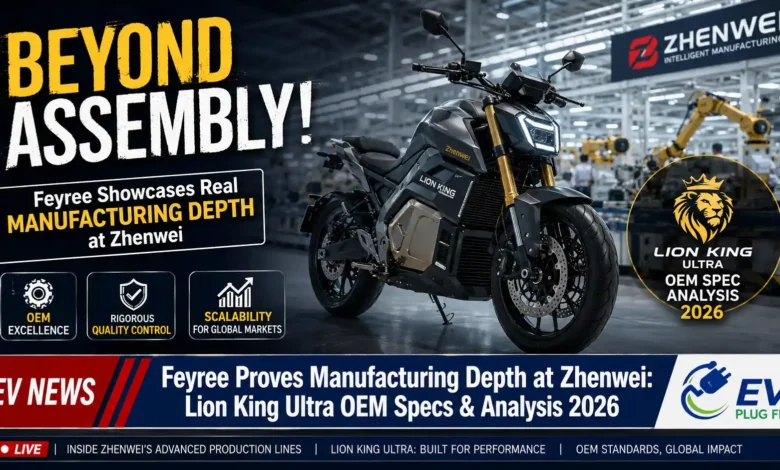
A 4.3-inch touchscreen looks impressive on a portable EV charger, but it is not the feature that should decide whether a distributor, fleet operator or private-label brand buys it in volume.
The harder questions come after the specification sheet: Does the charger manage heat safely at sustained current? What exactly does its leakage protection do? Which features depend on the mobile app? Can the same product platform be adapted for different markets? And, for an OEM buyer, can the supplier reproduce the approved configuration across later production batches?
Feyree’s Lion King Ultra is an interesting case because it combines features more commonly associated with smart wallboxes—including a large touchscreen, app connectivity, OTA updates and multiple protection functions—with a portable EVSE format. Feyree currently offers Lion King Ultra variants across Type 2, Type 1/J1772, NACS and GB/T configurations, with different power levels depending on the model.
The Lion King Ultra has a stronger feature set than a basic portable charging cable, particularly for buyers who value the touchscreen, smart controls and OEM potential. But the feature list alone is not enough to qualify it for a commercial or private-label order. The exact model’s compliance documents, protection architecture, thermal behavior, app dependencies and production configuration should be verified before volume procurement.
What Is the Feyree Lion King Ultra?
The Lion King Ultra is Feyree’s touchscreen-equipped portable EV charger family rather than one single universal specification.
That distinction is important.
Feyree currently lists Lion King Ultra configurations including a 7 kW 32 A single-phase Type 2 model and an 11 kW 16 A three-phase Type 2 version, alongside Type 1/J1772, NACS and GB/T variants.
The official Feyree Lion King Ultra product range shows that specifications vary across configurations. Buyers should therefore qualify the exact SKU rather than assuming every Lion King Ultra has identical electrical characteristics.
Core Features in Feyree’s Current Product Listings
| Feature | Published Lion King Ultra Specification | EV Plug Fix View |
|---|---|---|
| Display | 4.3-inch HD tempered-glass touchscreen | Useful for local setup and monitoring without relying entirely on a phone |
| Charging Data | Voltage, current, power, temperature and charging information | Useful for diagnostics and everyday visibility |
| Current Control | Adjustable, with range depending on model | Useful only when settings remain within the electrical supply’s safe capacity |
| Connectivity | Wi-Fi/app control on supported variants | Worth checking for cloud dependency and long-term app support |
| Temperature Monitoring | Monitoring at plug and control box | More meaningful than simply displaying internal box temperature |
| Leakage Protection | Published as Type B, AC 30 mA + DC 6 mA | Exact implementation should be verified against local installation requirements |
| Ingress Protection | IP66 advertised for selected units | Confirm ratings separately for control box, connector and mains plug |
| Operating Temperature | -30°C to +55°C on current Type 2 listings | Useful range, but thermal derating under sustained load still matters |
| OTA | Remote firmware updates advertised | Useful if update ownership and support policy are clear |
Feyree’s current Type 2 listings confirm the 4.3-inch touchscreen, dual-temperature monitoring and smart controls, while its 7 kW Type 2 model advertises IP66 protection and operation from -30°C to +55°C.
The 4.3-Inch Touchscreen: Useful or Just Marketing?
The touchscreen is the most visually distinctive part of the Lion King Ultra, but its value depends on what the owner can actually do from the charger itself.
Feyree’s current product information says the display provides access to charging statistics and settings while showing information such as voltage, current, power and equipment temperature.
For a portable EVSE, that has a practical advantage: basic charging information remains visible at the unit instead of forcing the driver to open an app every time.
Where the Screen Adds Real Value
- checking charging current before starting a session;
- seeing live electrical information;
- checking temperature information;
- setting supported charging parameters;
- viewing charging status without a phone; and
- providing a more differentiated interface for private-label products.
A larger or more colorful screen should not outweigh the charger’s electrical design, protection and compatibility.
For an EVSE, protection design, cable and connector quality, thermal management and electrical compatibility remain more important than display quality.
Dual-Temperature Monitoring May Matter More Than the Touchscreen
Heat is one of the practical concerns with portable charging equipment, particularly during long charging sessions at relatively high current.
Feyree says the Lion King Ultra monitors temperature at both the plug and the control box and can reduce charging power when overheating is detected.
That is a more useful design concept than monitoring only the electronics enclosure because poor socket contact or a deteriorating connection can generate heat away from the main control box.
Thermal-Safety Questions Worth Asking
For volume deployment, confirming that two sensors exist is only the beginning. Buyers should also ask:
| Question | Why It Matters |
|---|---|
| Where are both temperature sensors located? | Determines which heat sources the system can actually detect |
| At what temperature does derating begin? | Shows how the charger responds before reaching shutdown conditions |
| Does current decrease progressively or stop immediately? | Affects charging continuity and protection behavior |
| What happens after temperature falls? | Determines whether charging resumes automatically |
| Is the event recorded in the app? | Useful for fleet diagnostics and recurring-fault investigation |
| Has sustained full-current operation been documented? | More useful than a short functional demonstration |
Procurement rule: A temperature sensor is a feature. A documented thermal-protection strategy is an engineering control. Commercial buyers should distinguish between the two.
Understanding the Lion King Ultra’s Leakage Protection
Feyree describes current Lion King Ultra configurations as using Type B leakage protection with AC 30 mA + DC 6 mA detection.
That sounds reassuring, but protection terminology in EV charging equipment deserves careful verification because the installation requirements can vary by product design and jurisdiction.
The official IEC 61851-1 standard covers general requirements for conductive EV charging equipment, including operating characteristics, the EV-to-EVSE connection and electrical safety.
For an OEM or commercial order, buyers should request the exact protection specification and relevant test documentation rather than assuming that a marketing description eliminates the need for upstream electrical protection.
Integrated leakage detection does not automatically determine how a charger may be connected in every country. The final installation must follow the charger’s instructions and applicable local electrical rules.
For a broader look at EVSE protection design, see our EV charger ground-fault protection guide.
Lion King Ultra Power Options: Don’t Treat Them as One Charger
The original specification table can easily create the impression that one Lion King Ultra operates at 3.5, 7, 11 and 22 kW. In practice, those power levels represent different configurations within Feyree’s broader portable charging range.
For example, the current Lion King Ultra lineup includes a 7 kW 32 A single-phase Type 2 model and an 11 kW 16 A three-phase Type 2 model.
| Example Configuration | Supply | Maximum Current | Nominal Power Class |
|---|---|---|---|
| Type 2 Lion King Ultra | Single-phase | 32 A | 7 kW |
| Type 2 Lion King Ultra | Three-phase | 16 A | 11 kW |
This distinction matters for procurement because changing power level can change the input connection, cable requirements, internal components and target installation.
How Fast Will It Actually Charge an EV?
The charger’s maximum rating does not determine charging speed by itself.
Actual AC charging power is limited by the weakest link among:
- the electrical supply;
- the outlet or circuit;
- the portable EVSE;
- the vehicle’s onboard AC charger; and
- any current limit selected by the user or vehicle.
A 7 kW portable charger connected to an EV that accepts only 3.6 kW AC will not force the vehicle to charge at 7 kW.
Likewise, a charger capable of 32 A should not be treated as permission to draw 32 A from an unsuitable household socket or circuit.
Portable EVSE vs Fixed Wallbox: Where Does Lion King Ultra Fit?
The Lion King Ultra occupies an interesting middle ground.
It offers a richer interface than many basic portable charging cables, but portability does not automatically make it a substitute for a permanently installed wallbox.
| Consideration | Lion King Ultra Portable EVSE | Fixed Smart Wallbox |
|---|---|---|
| Portability | Strong advantage | Designed to remain installed |
| Touchscreen | Available on Lion King Ultra | Varies widely |
| App Features | Available on supported models | Common on smart wallboxes |
| Installation | Depends on appropriate supply/outlet | Dedicated installation |
| Load Management | Model/ecosystem dependent | Often stronger on commercial smart systems |
| Fleet Backend Integration | Must be confirmed for exact configuration | Common on purpose-built commercial EVSE |
| Travel Use | Major advantage | Not applicable |
For a driver who needs one permanent home charging point, a properly installed wallbox may still be the cleaner solution. The Lion King Ultra becomes more compelling when portability itself has real value.
Who Is the Lion King Ultra Best Suited For?
1. Drivers Who Regularly Charge in More Than One Location
A portable smart EVSE makes more sense if the charger regularly travels between properties or approved charging locations.
2. Buyers Who Want Local Controls
The touchscreen is useful for owners who prefer not to depend entirely on a mobile phone for routine charging information.
3. Distributors Looking for a Differentiated Portable Product
The screen, multiple enclosure colors and connector variants give the product more room for differentiation than a generic black portable charging box.
4. Private-Label and OEM Projects
The product is potentially interesting for brands seeking hardware and presentation customization, provided the supplier can document exactly which elements can be modified and how those changes affect compliance.
App Control and OTA Updates: Useful, but Ask Who Controls the Software
Feyree advertises Smart Life/Tuya-based smart control on current touchscreen portable models, including remote monitoring, charging schedules, current adjustment and charging history. It also advertises remote OTA firmware updates.
For an individual owner, those are convenience features.
For an OEM buyer, they create a second due-diligence category: software lifecycle.
Smart-Charger Software Checklist
- Which app is used for the exact SKU?
- Can the charger operate normally if internet access is unavailable?
- Which functions work locally and which require cloud access?
- Who controls firmware releases?
- How long are OTA updates expected to remain available?
- What happens if an update fails?
- Can OEM partners customize the app, or only the hardware?
- Who owns user and charging-session data?
- Is an API available for the exact OEM configuration?
- Does the claimed commercial integration require different hardware or firmware?
This is particularly important for fleet applications. A consumer smart-home app and a full commercial charge-management platform solve different problems.
Our guide to networked vs non-networked EV chargers explains why backend visibility becomes increasingly important as the number of deployed chargers grows.
OEM/ODM Potential: What Should a Brand Owner Verify?
Feyree promotes OEM/ODM services across its charging portfolio. For the Lion King Ultra, the visual design and software-controlled interface create obvious private-label possibilities.
But there is a major difference between printing a logo and creating a genuinely customized EVSE.
Four Levels of Charger Customization
| Level | Typical Changes | What the Buyer Should Verify |
|---|---|---|
| Branding | Logo, packaging, manual | Artwork approval and MOQ |
| Cosmetic | Color, screen graphics, cable appearance | Material and production consistency |
| Software | App branding, UI, firmware behavior | Ownership, updates, testing and support |
| Engineering | Electrical or hardware modifications | Whether new testing or certification is required |
OEM rule: The deeper the customization, the more important it becomes to re-check compliance. A certificate for the standard retail product should not automatically be assumed to cover a materially modified private-label version.
For more on the sourcing process, see our volume Type 2 EV charger sourcing guide.
Connector Options and Market Fit
One advantage of Feyree’s broader Lion King Ultra platform is that it is offered with different vehicle-side connector standards.
| Connector | Typical Market Relevance | Buyer Consideration |
|---|---|---|
| Type 2 | Europe and many other AC charging markets | Confirm exact supply plug and local electrical requirements |
| Type 1 / J1772 | Legacy and applicable North American-market vehicles | Confirm vehicle and installation compatibility |
| NACS | North American EV market | Connector compatibility alone does not establish complete regulatory approval |
| GB/T | Chinese-market applications | Confirm exact vehicle and local-market configuration |
For a global distributor, this can simplify product-family planning, but different connector variants should still be treated as separate configurations during compliance review.
IP66 Doesn’t Mean “Use It Anywhere”
Feyree advertises IP66 protection for current Lion King Ultra units, indicating strong resistance to dust and water ingress for the rated enclosure.
That is useful for equipment intended to travel and operate outdoors.
It should not be interpreted as permission to ignore the condition of the electrical outlet, adapter, mains plug or connector.
In fact, one of the most useful questions when evaluating any portable charger is:
“Which part of the complete charging assembly carries the advertised IP rating?”
The control box, vehicle connector and supply-side connection may not have identical environmental ratings.
Material Claims: What Actually Matters?
The source material supplied for this article includes detailed claims about 99.95% copper conductors, TPU cable construction and silver-plated contacts. Those characteristics could be useful, but we would not use them alone to declare the charger more durable than competing products.
For a commercial buyer, material claims become valuable when they are linked to specifications and test evidence.
What to Verify
- conductor cross-sectional area;
- cable specification and certification;
- connector temperature-rise performance;
- contact resistance;
- strain-relief design;
- flexibility at low temperature;
- UV/weathering performance where applicable;
- insertion-cycle requirements; and
- production-batch consistency.
This approach avoids the common procurement mistake of assuming one premium-sounding material specification proves the reliability of the complete charger.
Feyree Lion King Ultra vs a Basic Portable EV Charger
Instead of claiming that “generic chargers” always have weaker protection or lower IP ratings, the more useful comparison is to look at what the Lion King Ultra adds beyond the minimum portable-charging experience.
| Feature | Basic Portable EVSE | Lion King Ultra |
|---|---|---|
| Primary purpose | Provide portable AC charging | Portable charging with richer local controls |
| Display | Often LEDs or small display | 4.3-inch touchscreen |
| Live charging information | Varies | Displayed locally |
| App control | Varies | Available on supported models |
| OTA firmware updates | Not universal | Advertised on smart versions |
| Dual-temperature monitoring | Varies | Advertised at plug and control box |
| OEM differentiation | Often limited | Potentially broader depending on project |
This is a fairer comparison because there is no technically meaningful specification for a single “generic portable charger.” Competing products vary widely.
Lion King Ultra Readiness Check for Commercial Buyers
For a consumer buying one unit, product features may be enough to create a shortlist. A distributor or OEM buyer needs a stricter qualification process.
| Evaluation Area | Current Position | What Still Needs Buyer Verification |
|---|---|---|
| Product definition | Multiple Lion King Ultra SKUs are publicly listed | Freeze the exact model and configuration |
| Smart interface | 4.3-inch touchscreen verified in current listings | Test all required functions on sample |
| Thermal monitoring | Dual-temperature monitoring advertised | Request thresholds and test behavior |
| Leakage protection | AC 30 mA + DC 6 mA published | Verify documentation and local installation requirements |
| Environmental protection | IP66 published for selected units | Confirm ratings for every relevant component |
| Software | Smart app and OTA functions advertised | Verify lifecycle, cloud dependency and OEM rights |
| OEM suitability | Feyree markets OEM/ODM services | Approve exact customization and compliance impact |
| Production consistency | Cannot be established from product page alone | Verify with sample, QC records and pilot batch |
Editorial assessment: Lion King Ultra has enough differentiating features to justify deeper evaluation for an OEM or distribution project, but public specifications alone are not enough for final supplier approval.
How to Qualify It Before a Bulk Order
A sensible procurement process goes beyond reviewing the product page:
Document review → engineering sample → functional testing → software validation → pilot batch → production approval.
Stage 1: Documentation
- exact model number;
- electrical specification;
- declaration/certification documents;
- protection architecture;
- IP documentation;
- cable and connector specification;
- warranty terms; and
- software/firmware specification.
Stage 2: Engineering Sample
Test the actual unit that will become the approved reference for production.
Stage 3: Software Validation
Verify app pairing, scheduling, current control, OTA behavior and any API or fleet integration that forms part of the commercial requirement.
Stage 4: Pilot Batch
A pilot is where you begin testing something a perfect sample cannot prove: repeatability across multiple units.
Stage 5: Production Freeze
Once approved, record the hardware configuration, firmware revision, accessories, labels, packaging and any controlled components that cannot be changed without authorization.
For a volume EVSE order, the “best” sample is less important than the supplier’s ability to reproduce the approved sample. Do not scale an order until product configuration, compliance, software behavior and change control are documented.
Is the Lion King Ultra a Good OEM Candidate?
On paper, yes—it deserves consideration.
The large touchscreen creates room for brand differentiation, the product family spans multiple connector formats, smart features add software value, and Feyree promotes OEM/ODM services around its charging portfolio.
But an OEM buyer should separate product attractiveness from supplier qualification.
The Lion King Ultra can be an attractive product and still require extensive due diligence before a 500- or 1,000-unit order.
For fleet-oriented projects, our guide to EV charging network scaling covers the broader infrastructure decisions that should be considered alongside the charger itself.
What a Private-Label Buyer Should Lock Down Before Launch
This is where a private-label evaluation becomes more useful than repeating the manufacturer’s specification sheet.
Before putting a new brand on the Lion King Ultra, the buyer should lock down several details:
- Freeze the exact electrical configuration. Do not create too many regional variants before demand is proven.
- Validate the app experience. A premium touchscreen charger should not be paired with a confusing onboarding process.
- Make protection information explicit. Installation documentation should clearly state what protection is integrated and what may still be required upstream.
- Clarify IP ratings by component. Avoid presenting one enclosure rating as though it automatically applies to every plug and connector.
- Document thermal behavior. Buyers should know how the charger responds when plug or control-box temperature rises.
- Control firmware revisions. Production units should not silently ship with materially different behavior from the approved sample.
- Build a replacement process before launch. RMA logistics become much harder after hundreds of units are already with customers.
Those changes do not require claiming the underlying product is unsafe or unreliable. They are sensible controls before turning any third-party EVSE platform into a long-term branded product.
The Bottom Line
The Feyree Lion King Ultra is more interesting than a portable EV charger with a touchscreen attached to the front.
Its combination of local controls, live charging information, dual-temperature monitoring, smart connectivity, OTA capability and multiple connector configurations gives it a credible position between basic portable EVSE and more feature-rich fixed charging equipment.
For an individual buyer, the decision is relatively simple: confirm that the exact model matches the vehicle, electrical supply and local requirements, then decide whether the touchscreen and smart features justify the cost.
For an OEM, distributor or fleet buyer, the decision is different.
Do not ask only:
“Does the Lion King Ultra have the features we want?”
Ask:
“Can this exact configuration be documented, tested, reproduced and supported at the scale we need?”
That is the question that separates an attractive sample from a product suitable for a long-term commercial program.
Buyers considering Feyree can review the current Lion King Ultra configurations directly on Feyree’s official website.
Product specifications in this guide are based primarily on Feyree’s current published Lion King Ultra product information and should be verified against the exact SKU before purchase or commercial deployment. IEC information is linked to the official standards body. EV Plug Fix readiness checks, OEM recommendations and procurement frameworks are editorial analysis based on published information. This article does not present the Lion King Ultra as independently lab-tested by EV Plug Fix, nor does it claim a physical factory audit.