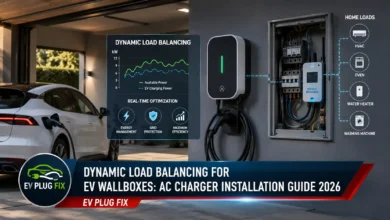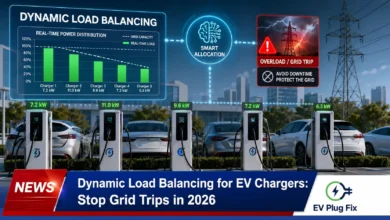
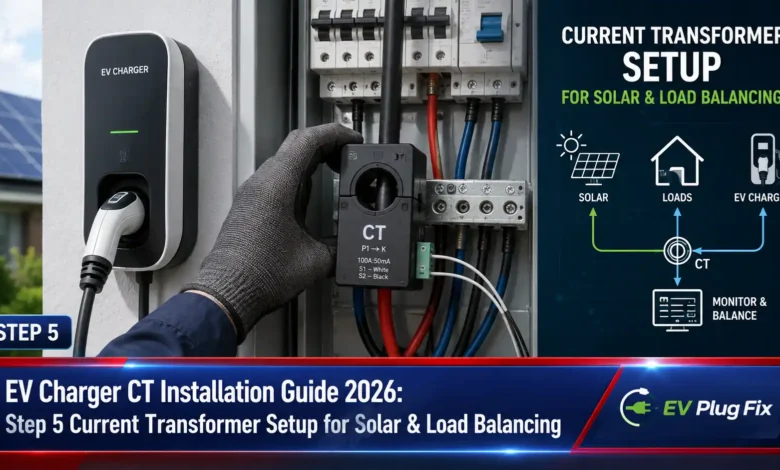
Current transformers allow a compatible EV charging system to measure electrical current at key points in a home or building. That measurement can be used to reduce charging when other loads are high, track grid import and export, or adjust charging around available solar generation.
The important point is that the CT must measure the right conductor in the right direction and feed a compatible meter or controller. There is no universal EV charger CT wiring diagram: CT specifications, polarity conventions, phase assignments and metering architectures vary between products.
Safety comes before placement. Installing CTs often means working inside a distribution board, panel or service equipment containing hazardous voltages. The work must follow applicable electrical rules and the instructions for the exact CT, meter and EVSE. Conventional current-output CTs also require special care because an energized CT secondary must not simply be opened.
What a CT Does in an EV Charging System
A current transformer measures alternating current flowing through a conductor and provides a corresponding signal to compatible measuring equipment. That equipment might be a separate energy meter, a load-management controller or part of the EV charging system.
The CT does not regulate charging by itself. It provides measurement data; the charger or controller decides how to respond.
Common uses include:
- Dynamic load management: reducing EV charging demand when other electrical loads increase.
- Main-supply monitoring: measuring current at the site’s incoming electrical supply.
- Grid import/export measurement: determining whether the property is drawing power from or sending power to the grid.
- Solar monitoring: measuring PV output separately where the system architecture requires it.
- Energy monitoring: combining current measurements with voltage information to calculate power and energy.
EV Charger CT Installation: A Practical Workflow
Before opening the electrical panel, establish what the charging system is actually trying to measure. A useful installation sequence is:
- Define the measurement objective. Decide whether the system needs total site demand, grid import/export, dedicated PV production or another supported measurement.
- Identify the specified CT and meter. Confirm the required CT model, current range, output or ratio, connector and compatible meter or controller.
- Locate the measurement point. For whole-site load balancing, this is commonly the incoming supply conductors. A dedicated PV CT, where required, normally measures the relevant inverter output rather than the EV circuit.
- Identify the correct conductors and phases. Determine which conductor corresponds to each measurement channel before fitting the CTs.
- Check CT polarity. Use the arrow, P1/P2, K/L, source/load or other direction convention specified for that equipment.
- Fit and connect the CTs. Close each CT fully around the intended conductor and connect it to the correct meter or controller channel.
- Complete meter configuration. Configure phase assignments, CT functions and other required parameters in the installer interface.
- Commission the installation. Check current readings, phase response, import/export direction and the charger’s actual load-management or solar-control behavior.
Most installation problems can be traced to one of those steps rather than to the CT clamp itself.
Choose the Correct CT Before Installing It
A CT is not compatible with a charger simply because it physically fits around the conductor. The receiving meter or controller is designed for particular electrical characteristics.
The most important compatibility checks are the CT type, primary current range, output or transformation ratio and the input specification of the meter or controller. Using an electrically incompatible CT can make every subsequent reading wrong even when its placement and orientation are correct.
Mechanical details matter too. The CT window must accommodate the conductor, and its insulation and environmental ratings must suit the installation.
Split-core and solid-core CTs
A split-core CT opens so it can be fitted around an existing conductor without threading the conductor through a closed core. This makes split-core sensors convenient for retrofit installations.
A solid-core CT has a closed magnetic core, so the conductor must pass through its window. That can require more installation work where conductors are already terminated.
Neither construction type tells you whether the CT will work with a particular EV charging system. Electrical compatibility must be established separately.
Where Should an EV Charger CT Be Installed?
For whole-site dynamic load balancing, CTs are commonly installed on the incoming supply conductors so the controller can see the site’s overall electrical demand. For solar charging, a system may use that same grid-connection measurement to detect import and export. A CT on the PV inverter output is required only when the supported metering architecture calls for separate solar measurement.
| Measurement objective | Typical measurement point | What is being measured |
|---|---|---|
| Whole-site load balancing | Incoming supply conductors | Total current or power at the electrical service |
| Grid import/export | Grid connection or service conductors | Net power entering or leaving the property |
| Separate PV monitoring | Solar inverter AC output where specified | Solar generation independently of site demand |
| Specific load monitoring | Relevant branch circuit where supported | Consumption of that individual load |
For example, Tesla’s Dynamic Power Management documentation for compatible Wall Connector installations shows CT measurement on panel service conductors through the associated energy-meter arrangement. That is a useful example of whole-site measurement, not a universal layout for other EVSE products.
A common mistake is to assume that solar charging automatically requires a CT around the PV cable. If a bidirectional meter already measures net flow at the grid connection, the controller may be able to identify surplus without a separate solar CT.
Single-Phase, Split-Phase and Three-Phase Installation
A straightforward single-phase installation may need one CT on the appropriate line conductor. Split-phase supplies can require measurements on both line conductors. Three-phase systems commonly require phase-aware measurements, with the exact arrangement determined by the meter and charging system.
Three-phase installations introduce an additional source of error: each current reading may need to be matched to the corresponding voltage phase.
For example, suppose the meter treats channel 1 as L1 voltage. If the CT connected or configured as channel 1 is actually around the L2 conductor, the current magnitude may look believable while the calculated power is wrong because the meter is pairing current from one phase with voltage from another.
Keep phase mapping consistent
For each measured phase, verify this chain:
- The CT surrounds the intended phase conductor.
- The CT signal reaches the intended meter channel.
- The channel is associated with the correct voltage phase where required by the meter design.
Labels such as CT1, CT2 and CT3 should not automatically be interpreted as L1, L2 and L3 unless the product documentation defines them that way.
CT Orientation and Polarity
Polarity matters whenever the system needs to know the direction of power flow rather than current magnitude alone. CTs may identify direction using an arrow, source/load marking, P1/P2, K/L or another convention.
There is no universal rule that an EV charger CT arrow always points toward the grid or always toward the load. Use the convention specified for the exact sensor and meter.
If polarity is reversed in a system using signed power measurements, grid import can appear as export or generation can be reported with the wrong sign. That can produce incorrect solar-control decisions, misleading monitoring data or failed commissioning checks.
The best confirmation is therefore not the arrow alone. During commissioning, create a known change in electrical load and verify that the reported direction and magnitude respond logically.
CT Installation for Solar Surplus EV Charging
Solar surplus charging becomes easier to understand by looking at the grid connection as a balance point. The charging controller wants to know whether locally generated electricity remains after the building’s other loads have been supplied.
Consider a simple conceptual example. If the PV system is producing 6 kW while the rest of the house is consuming 2 kW, the property has 4 kW left over and would otherwise export that power to the grid. A compatible charger could increase EV demand toward that available surplus. If the EV then consumes 4 kW, net grid flow approaches zero.
If a 2 kW household load subsequently switches on while PV production stays unchanged, the available surplus falls. A solar-aware charging controller using the grid measurement can detect the change and reduce EV charging accordingly.
This illustrates why a correctly positioned bidirectional measurement at the grid connection can sometimes support solar charging without separate measurement of every household load.
Other systems deliberately meter PV production, batteries or selected loads separately. Those additional measurements should be installed only when they are part of the supported system architecture.
Battery storage changes the power-flow picture
A battery can charge from the site and later supply the site. The controller may therefore need to distinguish between grid power, PV production, battery charging or discharge and building consumption.
For example, a measurement point in the wrong location might make battery discharge look like additional solar generation or exclude part of the site’s demand. Systems combining EV charging, PV and storage therefore need the metering topology specified for that energy-management platform rather than a generic grid-plus-solar CT diagram.
Connecting the CT to the Meter or Charger
Some chargers accept CT-related measurements through a dedicated energy meter rather than taking CT wires directly. Others use proprietary connectors or controller inputs. Separate the checks that can invalidate the measurement from the secondary installation details.
Measurement-critical checks
- CT type and electrical compatibility: the sensor must suit the meter input.
- Ratio or output: the CT’s measurement characteristics must match the configured or specified value.
- Polarity: terminals and physical orientation must preserve the required direction.
- Channel assignment: each CT must reach the correct input and phase configuration.
- CT function: where configurable, the controller must know whether a sensor represents grid, solar or another supported measurement.
Installation constraints
Once those fundamentals are correct, check permitted cable length, conductor size, shielding or twisted-pair requirements, routing near power wiring, insulation and enclosure requirements, and whether CT leads may be extended or spliced.
Extension rules deserve particular attention because they vary with the sensor and meter design. Do not copy a maximum CT cable length or extension method from another manufacturer’s installation.
CT Safety: Electrical Panels and Energized Secondaries
CTs may look like simple clip-on sensors, but installing them can expose the installer to live busbars, terminals and conductors inside electrical equipment. Isolation, de-energization, verification of absence of voltage and other required safe-working practices are determined by the equipment, installation and applicable electrical rules. The broader electrical work involved in a home EV charger installation also depends on the property’s supply, circuit design and protective equipment.
There is also an important distinction between CT technologies. Traditional current-output CTs can develop dangerous secondary voltage if the secondary circuit is opened while primary current continues to flow. Schneider Electric’s PowerLogic installation guidance, for example, warns against opening an energized current-transformer secondary circuit.
That warning should not be converted into a universal procedure for every sensor sold with an EV charging system. Some products use low-power, voltage-output or internally burdened sensing arrangements with different requirements.
Identify the exact sensor before disconnecting, extending, shorting or otherwise modifying its secondary wiring.
Commissioning: How to Check That the CTs Are Measuring Correctly
Closing the clamps and seeing a number in an installer app does not prove that the measurement is correct. Commissioning should show that the reported values follow real changes at the site.
1. Check for plausible baseline readings
Start with the property in a known operating state. Look at the current or power reported for each monitored channel. Readings should be plausible for the loads that are actually operating.
A non-zero reading is not proof of correct installation. A CT on the wrong conductor can still produce a perfectly believable number.
2. Introduce a known electrical load
Switch on a substantial, identifiable load and watch the meter or installer interface. Site demand should change in the expected direction and by a plausible amount.
This test helps expose a CT installed on the wrong conductor or a channel that has been assigned incorrectly.
3. Verify phase assignment
On a phase-aware installation, determine which channel responds to a known load on each phase. The response should appear on the phase expected from the electrical installation and meter configuration.
If the current appears on an unexpected channel, investigate the physical CT location, channel wiring and phase configuration rather than assuming the software display is merely mislabeled.
4. Confirm import and export direction
For systems that report signed grid power, confirm that ordinary consumption without sufficient local generation appears as grid import.
Where PV can produce more than the site’s current demand, check that the reported flow changes toward export as generation increases. If the sign moves in the opposite direction from the known physical power flow, CT polarity or configuration is a likely area to investigate.
5. Start EV charging
Begin a charging session and watch the measured site demand. The reading should increase logically when grid power is supplying the additional EV load, subject to any simultaneous solar or battery contribution.
This is also a useful check that the charger is using the intended site measurement rather than an unrelated circuit.
6. Verify solar behavior
For a solar-aware installation, observe the system while PV output and building consumption change. More surplus generation should move the grid measurement toward export or reduce import. Additional household demand should consume some of that surplus.
If the charger is configured to follow surplus, its charging demand should respond according to the product’s control settings and operating limits.
7. Test dynamic load limiting
Finally, verify the feature for which the CTs were installed. Under the manufacturer’s commissioning procedure, increase other site demand or otherwise create the prescribed test condition and confirm that the charger reduces its permitted charging power when available capacity falls.
When capacity becomes available again, confirm that charging responds as expected. The objective is to test the complete chain: CT measurement, meter interpretation, communication and charger control.
Common EV Charger CT Installation Problems
The CT is around the wrong conductor
A CT can be correctly oriented and electrically compatible yet still provide useless data if it measures the wrong cable. Confirm the conductor against the site’s electrical layout rather than choosing it by physical proximity to the meter or charger.
The CT surrounds unintended conductors
Passing multiple conductors through a CT does not automatically produce the measurement an installer expects. Their phase and current direction affect the magnetic result. Multiple conductors should share a CT only where the equipment documentation explicitly supports that arrangement.
The CT polarity is reversed
This is especially noticeable in import/export monitoring. If a known increase in consumption makes the display move toward export, verify CT direction and configuration.
The phases are mismatched
Current magnitude may appear reasonable even when phase mapping is wrong. On phase-aware meters, confirm that each current measurement is paired with the intended phase.
The CT is electrically incompatible
A clamp that fits the cable may still have the wrong output, ratio or rating for the meter. If measurements are consistently implausible, verify the exact CT part and meter specification.
CT leads were extended incorrectly
Unsupported extensions or cable types can affect measurement performance or violate insulation and installation requirements. Use only the extension method permitted for that CT and meter.
Software configuration does not match the wiring
Some systems require CT phase, measurement role, service parameters or meter settings to be configured during commissioning. A correctly wired sensor can still be interpreted incorrectly if those settings do not match the physical installation.
What CTs Can and Cannot Do for Dynamic Load Management
A CT gives a compatible controller information about electrical current or power flow. It is not a substitute for circuit protection or a correctly designed electrical installation.
The effectiveness of dynamic load management depends on the complete system, including conductor sizing, overcurrent protection, charger configuration, metering accuracy, communications, control logic and the equipment’s specified behavior if measurement or communication is lost.
The same distinction applies to solar charging. The CT supplies measurement data; the software decides how quickly charging changes, whether a session pauses, what minimum charging current applies and how other energy resources are handled.
FAQ
How many CT clamps does a three-phase EV charger need?
The number cannot be determined from the charger’s three-phase rating alone. A phase-aware three-phase service measurement commonly monitors the relevant phases, but the exact CT count depends on the meter, supply arrangement and charging system. Solar or battery measurements may require additional sensors only where the supported architecture calls for them.
Which way should an EV charger CT arrow point?
Use the direction specified for the exact CT and meter. Depending on the product, polarity may be indicated by an arrow, source/load markings, P1/P2, K/L or another convention. Commissioning should then confirm that import, export and load changes are reported in the correct direction.
Can I use any CT clamp with an EV charger?
No. The CT’s electrical characteristics must be compatible with the meter or controller. Physical fit around the cable is only one requirement.
Does solar EV charging require a CT on the solar inverter?
Not always. Some systems determine available surplus from bidirectional grid measurement. Other architectures separately meter PV production. The required measurement points depend on the charging or energy-management system.
Why does my charger show export when the house is importing power?
Possible causes include reversed CT polarity, incorrect phase assignment, a CT around the wrong conductor or incorrect meter configuration. Compare the displayed reading with a known operating state before changing the installation.
Why does the CT show current but load balancing still not work?
A current reading only proves that the meter is receiving some measurement. The CT could still be on the wrong conductor, assigned to the wrong phase or configured for the wrong function. Communication between the meter and charger, load-management settings and commissioning parameters should also be checked.
Can a homeowner install EV charger CT clamps?
The fact that a split-core CT clips around a conductor does not make work inside electrical equipment safe for an unqualified person. Installation may require access to hazardous electrical parts, and local rules can restrict such work to qualified or licensed people. Applicable electrical requirements and the equipment instructions determine who may perform the work.
Bottom Line
A reliable EV charger CT installation starts by defining what must be measured. Whole-site load balancing commonly measures the incoming electrical supply, while solar-aware systems may either use net grid import/export or additional generation measurements depending on their architecture.
From there, the critical chain is straightforward: use the correct CT, place it around the correct conductor, preserve the required polarity, map it to the correct meter channel and phase, configure the controller correctly, and then prove the installation through commissioning.
Do not stop at a plausible-looking number on the screen. Test the system against known loads, verify import and export direction where applicable, check phase response and confirm that the charger actually reduces or increases charging when the measured electrical conditions change.
Source Transparency
This guide covers general CT measurement and EV load-management principles rather than presenting a universal wiring diagram. Product-specific installation details should be taken from current documentation for the exact charger, meter and sensor being installed.
Primary technical references used for the examples and safety guidance include:
- Tesla Wall Connector Dynamic Power Management application note
- Tesla CT orientation and phase-verification guidance
- Tesla Powerwall 2 AC installation manual
- Schneider Electric PowerLogic CT installation and safety guidance
EVSE firmware, supported meters and installation requirements can change. Local electrical rules, equipment ratings and utility requirements also take precedence over general guidance.