EV Charger Standards in Europe vs US: CCS2, J3400 and CCS1 Explained

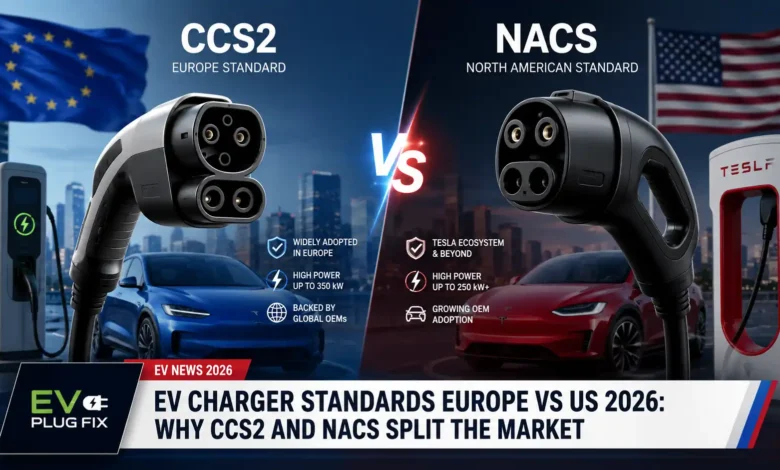
An EV sold in Europe can use a different charging inlet from the version of the same model sold in the United States. The simplest way to remember the difference is this: CCS2 is the mainstream European combined AC/DC interface, CCS1 is the established North American combined standard still widely in use, and SAE J3400 is the newer North American interface increasingly appearing on vehicles and charging equipment.
For drivers, the practical question is not which connector is theoretically better. It is whether the exact car, home charger, public network and any adapter you intend to use are compatible with one another.
Europe vs US EV charging standards at a glance
| Charging issue | Europe | United States and Canada |
|---|---|---|
| Common AC vehicle interface | Type 2 | J1772 on many existing EVs; SAE J3400 increasingly used on newer vehicles |
| Major DC fast-charging interface | CCS Combo 2 | CCS1 on many existing EVs; SAE J3400 increasingly deployed |
| Residential supply relevant to EV charging | 230 V single-phase; three-phase service is also available in many markets | 120/240 V split-phase is common in homes |
| Three-phase AC vehicle charging | Supported by Type 2 and common in suitable installations | Not the normal residential Level 2 arrangement |
| Public-charging landscape | Type 2 and CCS2 are established interoperability standards | CCS1 remains widespread while J3400 deployment expands |
| Best assumption for a buyer | Look for Type 2 AC and CCS2 DC support | Check the exact inlet, supported networks and approved adapters |
What to check before buying
The connector comparison becomes much easier if you start with the vehicle rather than the charging-station headline. Before choosing an EV, wallbox or adapter, confirm these points:
- The inlet fitted to the exact vehicle. Regional versions and model years can differ.
- The vehicle’s AC charging limit. A powerful wallbox cannot force the onboard charger to accept more AC power than it supports.
- The vehicle’s DC fast-charging capability. Peak charging power and charging curves vary between cars using the same connector.
- Public-network access. Connector compatibility, network authorization and software support can all affect where a vehicle can charge.
- Approved adapter options. Use adapters supported for the vehicle and intended charging system rather than judging compatibility by plug shape alone.
- The electrical installation. A home charger must suit the available supply, circuit capacity, local electrical rules and required protection equipment.
For most European buyers, that usually means choosing a modern EV with Type 2 AC and CCS2 DC capability. North American buyers need to look more closely because J1772/CCS1 and SAE J3400 will coexist during the market transition.
How Type 2 and CCS2 work in Europe
Type 2 is the familiar AC charging interface for modern European passenger EVs. CCS Combo 2 extends that layout with two larger DC contacts, allowing the same vehicle inlet to handle Type 2 AC charging and CCS2 DC fast charging. For a broader comparison of these interfaces and other EV charging connector types, compatibility needs to be checked against the specific vehicle and market.
One advantage of the European Type 2 system is its support for both single-phase and three-phase AC. Depending on the vehicle and electrical installation, a car may support common three-phase charging levels such as 11 kW or 22 kW. The car’s onboard charger remains the limiting factor, so connecting an EV that accepts 11 kW AC to a 22 kW charging point will not make it charge at 22 kW.
European Union rules also reinforce the Type 2 and CCS2 ecosystem for publicly accessible infrastructure. Regulation (EU) 2023/1804 specifies Type 2 and Combo 2 interfaces for relevant categories of publicly accessible charging points. The current regulatory text can be found on EUR-Lex.
This is best understood as an interoperability framework for applicable public infrastructure rather than a claim that every charger, specialist vehicle or private installation anywhere in Europe must use CCS2.
How J1772, CCS1 and SAE J3400 fit together in North America
North America is more complicated because two generations of mainstream charging hardware are now sharing the market.
Many existing non-Tesla EVs use SAE J1772 for AC charging. CCS1 adds two DC contacts below the J1772 portion of the vehicle inlet, allowing DC fast charging through the same combined port. Large numbers of CCS1 vehicles and charging stations remain in operation.
Tesla developed a smaller connector capable of carrying both AC and DC charging. The company opened the design to other manufacturers under the North American Charging Standard name, usually shortened to NACS. SAE International subsequently standardized the system as SAE J3400.
That history explains why both names appear in vehicle announcements. NACS remains common shorthand for the Tesla-originated connector, while SAE J3400 is the formal standards reference. Detailed information on the standard is available from SAE International, and Tesla’s original decision to open the connector design is documented on Tesla’s website.
The rise of J3400 is a transition rather than an overnight removal of CCS1. Existing CCS1 vehicles still need charging, and stations can support more than one connector. Federal infrastructure requirements have also evolved separately from automaker adoption, so drivers should not assume that every federally supported charger has switched from CCS1 to J3400.
Why Europe and North America use different connectors
The split is the result of regional standards and infrastructure developing along different paths. Europe built its modern charging ecosystem around Type 2 and CCS2, while North America developed around J1772, CCS1 and Tesla’s separate charging system before the latter evolved into SAE J3400.
Regional electrical systems helped shape those choices, especially for AC charging. European properties may have 230 V single-phase or access to 400 V three-phase supplies, making three-phase Type 2 charging practical in many locations. North American homes commonly use 120/240 V split-phase service, with residential Level 2 EV charging normally using the higher-voltage supply.
Grid frequency by itself does not dictate connector choice. Modern EV power electronics can be engineered for different electrical environments. Regulation, automaker decisions, standards development and the huge installed base of vehicles and chargers are more important reasons the two regions continue to use different physical interfaces.
Connector type versus charging speed
Plug type tells you how the vehicle physically and electrically connects to charging equipment. It does not tell you how quickly every vehicle using that plug will charge.
For AC charging, the important limit is the vehicle’s onboard charger together with the available electrical supply and EVSE. A European Type 2 charging point may offer more power than a particular EV can accept, while a suitable North American Level 2 installation can also provide substantial AC charging power. The U.S. Department of Energy provides an overview of Level 1, Level 2 and DC fast charging through its Alternative Fuels Data Center.
DC charging varies even more. Vehicles with CCS2, CCS1 or J3400 can have very different peak rates and charging times because performance depends on factors including battery architecture, charging curve, battery temperature, state of charge and the capabilities of the charger and cable.
When comparing two EVs, use their documented AC input and real DC charging specifications rather than assuming one is faster because of the connector fitted to it.
Adapters and cross-standard charging
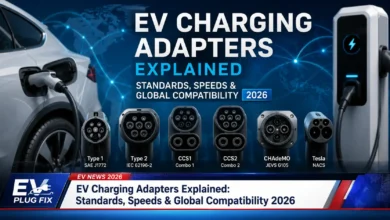
Adapters are becoming increasingly important in North America as CCS1 and J3400 coexist. A suitable adapter can bridge some connector differences, but the vehicle and charging network must also support the intended charging session. The broader EV charging adapter compatibility picture also depends on standards, supported charging speeds and the equipment on both sides of the connection.
For example, a CCS1 vehicle does not automatically gain access to every Tesla Supercharger simply because a J3400-to-CCS1 adapter can be connected. Manufacturer support, vehicle software, network authorization, the adapter itself and the charging-site hardware can all affect compatibility.
The reverse situation also matters. A vehicle equipped with J3400 may need a manufacturer-supported adapter to use existing CCS1 fast chargers.
SAE has also developed J3400-related adapter requirements, reinforcing the importance of using properly specified equipment. For buyers, the safest practical rule is simple: check the vehicle manufacturer’s current adapter and charging-network guidance before purchasing an adapter or depending on one for a journey.
A note about importing EVs
Importing an EV between Europe and North America deserves extra caution. Changing the physical connector is only one part of compatibility. The regional version of the vehicle may also differ in AC input requirements, charging communication, software, network support and regulatory approval.
Before importing a vehicle, obtain the charging specifications for that exact regional variant and confirm separately how it will handle local AC charging and DC fast charging. A simple travel-style adapter should never be assumed to solve every cross-market difference.
Choosing a home EV charger
Match the home EVSE to both the car and the property. In Europe, check whether the vehicle supports single-phase or three-phase AC, how much AC power its onboard charger can accept, and what the property’s electrical service can safely provide. Installing a higher-rated wallbox offers little immediate charging benefit if the vehicle cannot use the extra capacity.
In North America, connector choice increasingly depends on which vehicles the household owns now and expects to own later. A home with an existing J1772 vehicle and a future J3400 vehicle may need to consider supported adapters or choose equipment that fits its longer-term vehicle plans.
In either region, circuit sizing, protective devices, dynamic load balancing where required, locally compliant equipment and proper installation are fundamental parts of the decision.
Bottom Line
Europe and North America currently use different mainstream EV charging interfaces. In Europe, Type 2 is the established AC interface and CCS2 is the mainstream DC fast-charging standard. In North America, J1772 and CCS1 remain widely used, while SAE J3400 is becoming increasingly important on newer vehicles and charging infrastructure.
For a European EV, look first for Type 2 AC and CCS2 DC compatibility. For a North American EV, identify whether the exact vehicle has J1772/CCS1 or J3400, then check which public networks and manufacturer-approved adapters it supports.
The connector is only the starting point. The best purchasing decision comes from matching the vehicle’s actual AC and DC capabilities with the charging infrastructure you expect to use.
FAQ
Is CCS2 the standard EV fast-charging connector in Europe?
CCS Combo 2 is the mainstream interoperable DC fast-charging interface for modern European passenger EVs and is specified by EU rules for relevant publicly accessible DC charging infrastructure. Other connectors can still exist in legacy, private or specialist applications.
Are NACS and SAE J3400 the same thing?
They describe the same basic Tesla-originated charging interface, but the terminology comes from different stages of its development. NACS is the name Tesla used when opening its charging design, while SAE J3400 refers to the standardized system developed by SAE International.
Is CCS1 obsolete in the United States?
No. Many EVs and public charging stations still use CCS1. J3400 is expanding across newer North American vehicles and infrastructure, but CCS1 remains relevant because of the large installed base.
Can every CCS1 EV use a J3400-to-CCS1 adapter at a Tesla Supercharger?
No. The adapter must be suitable for the vehicle, and access can also depend on manufacturer support, software, network authorization and Supercharger hardware. Check the automaker’s current compatibility guidance before relying on this arrangement.
Why can Type 2 support three-phase AC charging?
Type 2 includes the contacts required for either single-phase or three-phase AC charging. That makes it well suited to European markets where three-phase electrical service is available in many homes and commercial properties.
Does a 22 kW Type 2 charging point make every EV charge at 22 kW?
No. The vehicle’s onboard charger determines how much AC power it can accept. An EV limited to 11 kW AC will remain limited to approximately that input even when connected to a higher-rated Type 2 charging point.
Source Transparency
European public-charging interoperability requirements were checked against Regulation (EU) 2023/1804 on EUR-Lex. SAE J3400 terminology and standard information were checked against SAE International. The history of Tesla opening its connector design was checked against Tesla’s announcement. General U.S. charging terminology was cross-checked with the Department of Energy’s Alternative Fuels Data Center.
Charging standards, vehicle hardware, adapter programs and public-network access can change independently. Confirm the specifications for the exact vehicle model, model year and regional version before purchasing charging equipment or relying on an adapter.