Do I Need an EV Charging Cable in 2026? A Practical EV Charging Cable Buying Guide
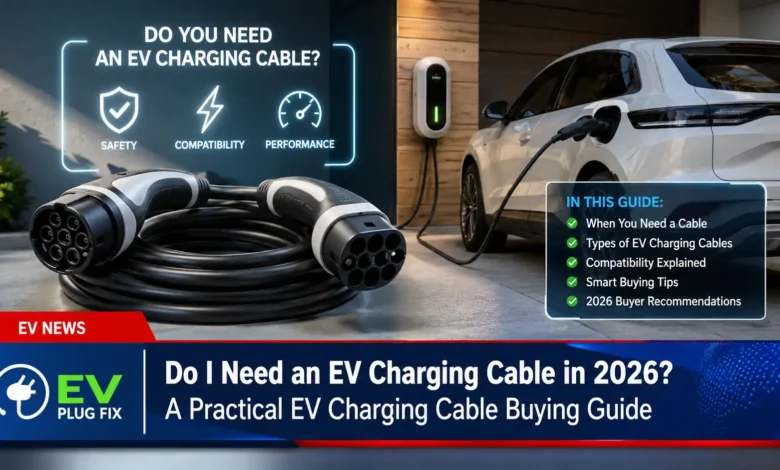
Do you really need an EV charging cable in 2026? If you are a new electric vehicle driver, the short answer is yes. Most home chargers require you to supply your own cable, and the majority of public charging stations are untethered—meaning drivers must connect their own cable to the charge point. If you do not have one with you, you simply will not be able to charge.
While it might seem like a simple accessory, this piece of equipment is the critical link between your car and its power source. As the global EV charging cable market expands from a $1.9 billion industry in 2025 towards $5.1 billion by 2035, choosing the right one is about speed, safety, and future-proofing. For a complete overview of setting up your home charging infrastructure, check out our Home EV Charger Guide.
Most EV drivers are discovering that home charging stations come without a cable, and public stations near supermarkets, gyms, and offices often require you to use your own. Here is everything you need to consider before making a purchase.
Understanding EV Charging Modes and Cable Types
To choose the correct cable, it helps to understand the four EV charging modes.
- Mode 1: A basic household socket with a standard plug and extension cord. This lacks built-in safety communication and is generally not recommended for modern cars.
- Mode 2: This is the portable cable that often comes with your car. It plugs into a domestic socket and includes a safety device called an In-Cable Control and Protection Device (IC-CPD). While safe, it is very slow—typically delivering under 3 kW of power. Learn more about EV Mode 2 Charging options for emergency use.
- Mode 3: The standard for home wall boxes and public AC charging stations. These chargers communicate with your vehicle to manage power safely. This is where you will need a dedicated Type 1 or Type 2 cable.
- Mode 4: This refers to DC fast charging. Cables are tethered to the charger itself (think Tesla Superchargers). You do not need to bring your own cable for these because the connector is permanently attached.
The cable you buy for home and public AC charging is almost always a Mode 3 cable, designed to handle AC Level 1 and Level 2 charging.
Choosing the Right EV Charging Cable in 2026
| Feature to Consider | Why It Matters | Pro Tip for 2026 |
|---|---|---|
| Connector Type | Type 2 (7 pins) is the European and UK standard since 2018. Type 1 (5 pins) is found on older cars like the early Nissan Leaf. | Check your car port. If it has 7 pins, you need a Type 2 cable. If it has 5, get Type 1. For more on connector standards, see our Cross-Brand EV Charging Compatibility guide. |
| Cable Length | Length affects convenience and reach. Most experts recommend a 5m to 8m cable as the “Goldilocks” choice. | For driveway flexibility, choose a 7.5m or 8m cable. Avoid extension cables for regular use. |
| Amp Rating (16A vs 32A) | Amps determine charging speed. A 32A cable supports up to 22 kW (three-phase) or 7.4 kW (single-phase), while a 16A cable maxes out at 3.6 kW. | Buy a 32A cable. It is future-proof, works with slower chargers, and charges faster if your car supports it. Understanding your EV Charging kWh Guide can help you optimize your charging setup. |
When Will You Need a Separate EV Charging Cable?
You will need a separate cable in two specific scenarios. First, if you choose a home charger with a universal “socket” type (untethered), you must supply your own cable to connect the wall box to your vehicle. Compare the benefits of different charger types in our Stationary vs Mobile Chargers analysis.
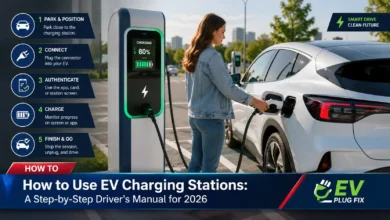
Second, when you visit public charging points that are untethered. This is common at supermarkets, office buildings, and standard (7kW) public bays. In these locations, the charger provides the socket, but you provide the plug. You can also use a 3-pin cable in an emergency, but it is incredibly slow and not recommended for long-term use.
There is good news for drivers who use rapid chargers. These Mode 4 chargers are tethered, meaning the charging cable is permanently attached to the station. You simply plug the connector into your car—no need to struggle with your own heavy cable.
Key Factors for Buying an EV Charging Cable in 2026
When searching for a cable, you might notice a wide range of prices. Here is how to ensure you get the best value without risking safety.
Check Your Vehicle’s Plug Type
Most modern EVs sold in Europe and the UK require a Type 2 to Type 2 cable. In North America, J1772 connectors are common, though the industry is moving toward the NACS standard. Always verify your car’s charging port before buying.
Select the Correct Amp Rating
Your cable needs to match or exceed your car’s maximum AC charge rate. Buying a cable rated for 32 amps is often the best strategy. It allows for faster charging and works perfectly with a 16-amp charger as well.
“A 32A cable allows higher charging speeds when paired with a compatible charger and vehicle. If you want future-proof charging, a 32A Type 2 cable is often the smarter long-term choice.”
Consider Cable Length and Weather Resistance
Length is a balancing act. A 5-meter cable is easy to store but may be frustrating if the charging socket is out of reach. A 10-meter cable gives you flexibility but is bulkier. For most users, a 7.5- or 8-meter cable hits the sweet spot.
If you plan to charge outdoors, look for UV-resistant and waterproof sheathing (IP ratings) to protect against rain and sun damage. Regular maintenance of your equipment is essential—refer to our EV Charging Maintenance Guide for best practices.
What the 2026 Regulations Say About Charging Cables
Regulations are tightening. In California, for the 2026 model year, new vehicles must be supplied with a charging cord at least 20 feet long with dual amperage capability for both Level 1 and Level 2 charging. Similarly, standards like SA TS 5396:2024 in Australia and EN 50620 in Europe are setting higher bars for safety, construction, and certification.
This means manufacturers are improving the quality of supplied cables, but it doesn’t change the fact that you still need a dedicated cable for public stations if your car only ships with a 3-pin domestic cord.
Final Verdict: Do You Need an EV Charging Cable?
Yes. Whether it is to connect your untethered home wall box, to charge at a public AC station, or to have a backup in your trunk, an EV charging cable is an essential investment for 2026. When buying, prioritize safety certifications, choose a 32A rated cable for future-proofing, and pick a length that suits your daily parking situation.
Buying a high-quality cable now prevents frustration later—and ensures your EV is always ready for the road. For more insights on home installation options, explore our Level 2 EV Charger Installation resources.