EV Charging At Home in 2026: Wallbox vs Emergency Cable Safety Guide
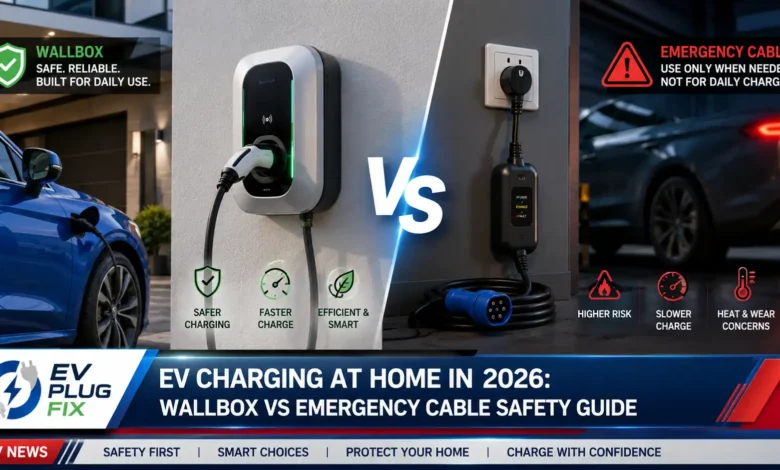
Charging an electric car at home from a standard household socket might seem like the most straightforward solution, but a closer look reveals a complex picture of safety concerns, slow charging speeds, and potential electrical hazards that make it a risky everyday practice . The 2026 reality for EV owners revolves around a critical decision: rely on the included emergency charging cable (ICCB) or invest in a more robust and safer wallbox solution. For a comprehensive breakdown of your options, see our Home EV Charger Guide.
Recent data indicates a significant challenge in the transition to electric vehicles, with nearly 45% of households requiring upgrades to their electrical infrastructure before they can safely support home charging . This statistic underscores that simply plugging in is not always an option and can be dangerous. The primary issue with standard outlets is that they were not designed for prolonged, high-current loads typical of EV charging, which can lead to overheating, circuit overloads, and fire hazards .
Safety advocates and fire officials are increasingly warning against the “emergency” charging approach as a primary method. Charging an EV through a standard wall socket, extension cord, or shared connection can increase the risk of electrical faults, overheating, and even localised power outages. Such issues not only reduce charging reliability but may also accelerate battery degradation over time .
Emergency Charging Cable (ICCB) vs. Wallbox: The Safety Verdict for 2026
The cable you use matters immensely. An emergency charging cable with an ICCB (In-Cable Control Box) is for… emergencies. The ICCB contains a control box that monitors the charging process and includes protective functions against overvoltage, overheating, and residual currents . However, its maximum charging power is often limited to about 1.8kW to 2kW, resulting in painfully slow charging speeds of 6 to 24 hours for a full charge .
The wallbox is a permanently installed, dedicated EV charging unit that connects directly to your home’s electrical panel. This is the gold standard for safety and convenience. A professionally installed wallbox requires a dedicated circuit, ensuring the home’s electrical system is properly equipped to handle the load and eliminating the risk of overloading a shared household circuit . For those considering a permanent installation, exploring Stationary vs Mobile Chargers can help clarify the best fit for your needs.
| Feature | Emergency Cable (Mode 2) | Mobile Wallbox | Stationary Wallbox |
|---|---|---|---|
| Safety | High risk if standard outlet not inspected; relies on ICCB for safety | Safe if used with a compatible, inspected outlet (EV-grade) | Highest safety; hardwired to dedicated circuit, meets NEC standards |
| Charging Speed | Very Slow (2.3 kW – adds ~10-15 km/hr) | Fast (up to 7.4 kW – adds ~40-60 km/hr) | Fastest (11 kW+ – adds ~80-120 km/hr) |
| Installation | DIY; no electrician required | DIY; requires an EV-grade outlet | Professional electrician required, often needs permit |
| Electrical Requirements | Standard 230V/120V socket, often on a shared circuit | Dedicated 240V circuit with GFCI breaker | Dedicated 240V circuit; no GFCI needed for hardwired unit |
| Best Use Case | Emergency top-up while visiting friends/family | Renters, flexible charging at multiple locations | Homeowners with a garage, daily charging |
| Cost (Equipment + Install) | Often free (included with car) | $300 – $600 + cost of EV-grade outlet installation | $1,000 – $2,000 + professional installation |
Is a Mobile Wallbox the Best Compromise for 2026?
For many EV owners, the mobile wallbox presents a compelling middle ground. As the name suggests, it offers the flexibility of portability while providing the faster charging speeds associated with Level 2 charging. It is essentially a charger that you plug into a high-power outlet, like a NEMA 14-50, rather than being permanently wired into your home .
The primary advantage of a mobile wallbox is its flexibility. You can install it yourself, provided you have a compatible and safe 240-volt outlet installed by an electrician. You can also take it with you on trips, offering a faster top-up at locations with the appropriate hookups . For renters or those not wanting a permanent installation, this is an ideal, cost-effective solution . If flexibility is your priority, you may also want to explore options like a go-e Gemini flex Comparison to see how different portable units perform.
“If you are on the road a lot and can charge at a private power socket during appointments or overnight, the mobile wallbox is a practical solution.”
However, the safety of this option is entirely dependent on the quality of the outlet. Experts warn that standard “range-grade” NEMA 14-50 receptacles can overheat and melt during extended EV charging sessions. The 2026 National Electrical Code now mandates using EV-grade receptacles for these installations, as they are built with more robust materials to handle the heat and frequent plugging cycles .
The Hidden Costs: Electrical Upgrades and Permits
One of the most overlooked aspects of home EV charging is the condition of your home’s electrical system. A 2026 report highlights that while home charging is the cheapest and preferred option, the need for electrical upgrades is a major barrier for many .
- Service Capacity: Your home’s main electrical panel may not have enough capacity (amps) to handle the additional load of an EV charger, requiring a costly service upgrade .
- Permits and Inspections: Most local jurisdictions require permits and inspections for new EV charger installations to ensure they comply with local building and electrical codes .
- Wiring Quality: Old or inadequate wiring can’t handle the sustained current of EV charging, posing a severe fire risk .
In some cases, the local utility grid may need upgrades to handle the added demand in a neighbourhood. This is particularly common in areas with high EV adoption, and the costs for these upgrades can sometimes be passed on to the homeowner . Implementing EV Load Shifting Strategies can help manage electrical demand and potentially reduce the need for costly grid upgrades.
Expert Tips: How to Choose the Right Home Charging Setup
⚡ Expert Tip: The Case for Hardwiring
For maximum safety and reliability, consider hardwiring your wallbox directly to your home’s electrical panel. This eliminates the plug and receptacle, removing a common point of failure for overheating and eliminating the need for a GFCI breaker on the circuit, which can cause nuisance tripping that halts charging .
Your choice ultimately depends on your driving habits, living situation, and budget.
Choose a Stationary Wallbox if: You own your home with a garage, you drive frequently and need the fastest and most convenient daily charging, and you want a permanent, theft-proof solution . For a deeper dive into the installation process, check out our guide on Level 2 EV Charger Installation.
Choose a Mobile Wallbox if: You are a renter, you frequently travel and charge at multiple locations, you want to avoid a permanent installation, or you want to utilise a portable solution for occasional use at different homes .
Avoid relying on an Emergency Cable for daily use if: You value your time and safety. Reserve it for road trips or emergencies when no other options are available . Understanding EV Mode 2 Charging can help you better appreciate the limitations of these cables.
🔥 Important Safety Notice for 2026
Fire officials and safety experts strongly warn against using standard extension cords, power boards, or uncertified chargers for EV charging. These practices are a leading cause of electrical fires in homes, particularly in densely populated areas .
As EV adoption surges, with electricity consumption from electric vehicles projected to increase from just 0.2% in 2024 to nearly 6% by 2035, the importance of a safe and robust home charging infrastructure cannot be overstated . Making an informed choice today will ensure your EV ownership experience is not only cost-effective but also safe for years to come. Regular upkeep is also crucial, so be sure to review our EV Charging Maintenance Guide to keep your system running smoothly.