IM L6 2026 Review: Tesla Model 3 Rival with Solid-State Battery & 776 HP
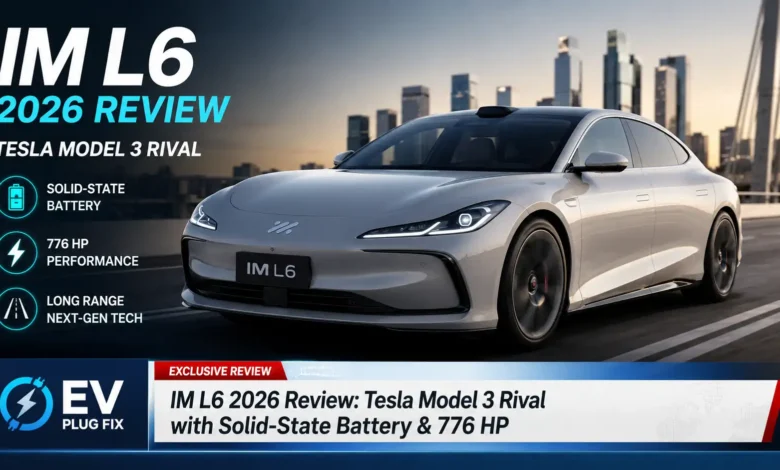
The IM L6 2026 is rewriting the rules of what an affordable performance EV sedan can deliver, directly challenging the Tesla Model 3 with a semi-solid-state battery pack, 776 horsepower, and a sub-$43,000 price tag that has the global automotive industry taking notice.
China’s electric vehicle market is evolving at a breakneck pace, and the latest salvo comes from IM Motors—a joint venture between state-owned SAIC Corporation, e-commerce giant Alibaba Group, and investment firm ZJ High-Tech. Formed in 2020 specifically to take on Tesla, Nio, and emerging domestic players, the consortium has unleashed the L6 fastback, and early impressions suggest it’s a game-changer for EV charging infrastructure adoption and consumer expectations alike.
IM L6 Battery and Range: Solid-State Innovation Meets Real-World Numbers
The most headline-grabbing spec of the IM L6 2026 is its 133 kilowatt-hour semi-solid-state battery pack, available exclusively on the premium trim. According to IM Motors, this SSB configuration delivers an astonishing 1,000 kilometers—or 621 miles—of range under the China Light-Duty Test Cycle (CLTC) standards. While CLTC figures tend to be optimistic compared to EPA ratings, even a real-world estimate of 500+ miles would place the L6 in a league of its own.
This isn’t just about range anxiety elimination; it’s about EV charging infrastructure evolution. Solid-state technology promises faster charging times, improved thermal stability, and higher energy density than traditional lithium-ion packs, potentially reducing the frequency of public charging station visits for daily commuters.
IM L6 vs Tesla Model 3: Performance and Price Showdown
YouTube’s Out of Spec Reviews, hosted by Kyle Conner, recently put the L6 through its paces in China, directly comparing it to the Model 3 Performance—its obvious rival in the local market. The numbers are compelling: The IM L6 Performance is priced at 305,900 yuan ($42,300), undercutting the Model 3 Performance’s 335,900 yuan ($46,000) price tag in China by nearly $4,000.
But price is only part of the story. The Performance variant rides on a 900-volt architecture with all-wheel drive, generating a staggering 776 horsepower and 590 pound-feet of torque. IM Motors claims a 0-62 mph sprint in just 2.74 seconds, edging out the Model 3 Performance’s advertised 2.9-second 0-60 mph time. Conner described the launch mode activation as feeling “faster than Tesla,” with a video-game-like user interface that transforms the sedan’s demeanor instantly.
| Specification | IM L6 Performance 2026 | Tesla Model 3 Performance 2026 |
|---|---|---|
| Battery Type | 133 kWh Semi-Solid-State | 82 kWh Lithium-Ion |
| Range (CLTC) | 621 miles (1,000 km) | ~350 miles (est.) |
| Horsepower | 776 hp | ~510 hp |
| 0-62 mph Time | 2.74 seconds | 2.9 seconds |
| Architecture | 900V | 400V |
| Price (China) | ¥305,900 ($42,300) | ¥335,900 ($46,000) |
Tech and Interior: Where Software Meets the Road
Step inside the IM L6, and you’re greeted by a cockpit that feels more like a command center than a traditional sedan. The optional airplane-style yoke steering wheel sits ahead of three wide screens spanning the dashboard, delivering seamless operation with rapid refresh rates that make navigation and vehicle controls feel instantaneous.
Under the hood of the infotainment system, IM Motors has spared no expense. The vehicle runs on the Qualcomm Snapdragon 8295 automotive processor paired with an Nvidia Orin X chip—the same caliber of silicon found in next-generation autonomous driving platforms. This hardware combination enables not just snappy UI responses but also advanced driver-assistance features and potential over-the-air updates that could keep the L6 competitive for years.
“From a software and driving perspective, the L6 is truly unique. With a simple button press, the car’s demeanor can change completely from a relaxed sedan to an unruly beast.” — Kyle Conner, Out of Spec Reviews
Unique Features: Crab Walk and Lidar on a Budget
One of the most surprising aspects of the IM L6 is its inclusion of premium hardware typically reserved for six-figure luxury EVs. The sedan features lidar sensors and a “crab walk” mode that allows for diagonal movement—a party trick that’s genuinely useful for tight parking spots and urban maneuvering. These features are almost unheard of in the $42,000 price bracket, especially in the U.S. market where even the Model 3 Performance lacks such hardware.
Conner noted that the interior materials don’t quite match the premium feel of the Xiaomi SU7, another Chinese EV sensation. However, he praised the overall packaging, ride comfort, and adjustable Track mode that lets drivers fine-tune power distribution between front and rear axles, along with adjustable traction control and dampers.
One area where the L6 falls short of the Model 3 is cargo space. Despite its dedicated EV skateboard platform, the frunk is minimal, and trunk capacity doesn’t quite measure up to Tesla’s class-leading storage. For buyers prioritizing passenger and cargo hauling, this could be a deciding factor.
IM L6 Driving Experience: From Commuter to Track Weapon
Conner described the L6’s ride as “extremely comfortable” during normal driving, with a suspension tune that soaks up rough roads without floating. But the real magic happens when you engage the launch mode. The interface, reminiscent of a racing simulator, allows drivers to activate maximum performance settings with a few taps. The result is a sedan that rockets from a standstill with urgency that pushes you into the seat—all while maintaining composure through corners thanks to the intelligent AWD system.
The 900-volt architecture also hints at future-proofing for EV charging infrastructure. Higher voltage systems can support faster charging speeds without excessive heat generation, potentially slashing charging stops on long road trips. While IM Motors hasn’t released official DC fast-charging curves, the hardware suggests the L6 could rival or exceed the 250 kW speeds of Tesla’s V3 Superchargers. For homeowners looking to maximize their EV’s potential, Level 2 EV charger installation at home remains the most practical way to ensure daily readiness, regardless of the vehicle’s advanced battery technology.
Inside the L6: A yoke steering wheel meets a video-game-like interface powered by next-gen automotive chips.
The Bigger Picture: Chinese EV Innovation and Global Competition
The IM L6 isn’t just a car; it’s a statement about the pace of innovation in China’s electric vehicle sector. With government backing, massive investment from tech giants like Alibaba, and a supply chain that’s increasingly vertically integrated, Chinese automakers are delivering feature-packed EVs at price points that Western manufacturers struggle to match.
For American and European consumers, the question is no longer if Chinese EVs will arrive on their shores, but when. The IM L6 demonstrates that China’s automotive industry has moved beyond copycat designs to original engineering that pushes boundaries in battery technology, software integration, and performance per dollar.
As EV charging infrastructure continues to expand globally, vehicles like the IM L6 could accelerate adoption by removing range anxiety and offering compelling alternatives to established players like Tesla. Whether the L6 itself makes it to North America remains uncertain, but its influence on the broader market is already being felt.
Key Takeaways from the IM L6 2026 Review
- Semi-solid-state battery: 133 kWh pack delivers 621 miles (CLTC) and faster charging potential
- Performance numbers: 776 hp, 590 lb-ft, 0-62 mph in 2.74 seconds, 900V architecture
- Tech-forward interior: Yoke steering, triple screens, Snapdragon 8295 + Nvidia Orin X chips
- Unique features: Lidar sensors, crab walk mode, adjustable Track mode
- Pricing advantage: Undercuts Tesla Model 3 Performance by ~$4,000 in China
- Caveats: Minimal frunk, smaller trunk than Model 3, interior not as premium as Xiaomi SU7
The IM L6 represents a new chapter in the EV wars—one where battery chemistry, silicon, and software converge to create vehicles that are smarter, faster, and more affordable than ever before. While it may not yet be available outside China, its presence is a clear signal that the future of electric mobility is already here, and it’s charging ahead at full speed.