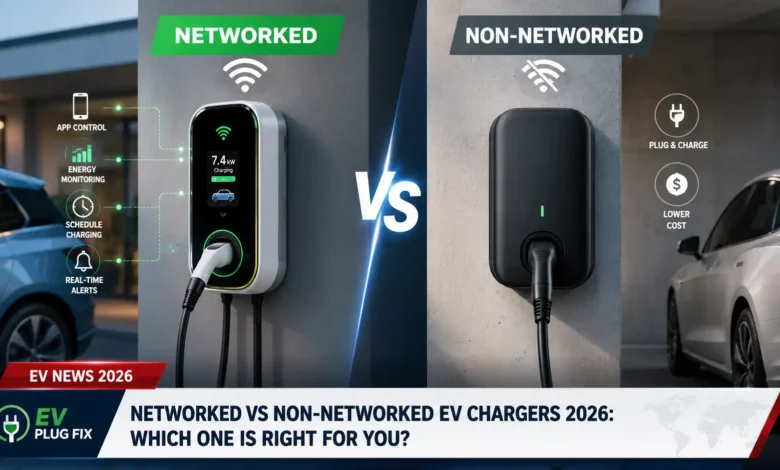
A networked EV charger communicates with an app, cloud service, local energy system or charge-point management platform. A non-networked charger primarily operates locally, providing charging without depending on an external network for its core function.
For a straightforward private installation, networking is usually optional. It becomes more valuable when you want remote control, charging records, energy integration or access management. Apartments, workplaces, fleets and public charging sites have stronger reasons to choose connected equipment because several users or chargers often need to be managed together.
The best choice therefore depends less on whether the charger is installed at a home or business and more on what you need it to do.
Networked and Non-Networked Chargers Compared
A networked charger may connect through Wi-Fi, Ethernet or cellular service. Depending on the hardware and software, that connection can support remote status and control, charging schedules, usage records, user authentication, remote diagnostics, firmware updates, load management and commercial billing.
Those features are not automatic. Wi-Fi alone does not mean a charger supports payment processing, third-party management platforms or every feature commonly associated with a “smart” charger.
A non-networked charger avoids most cloud dependence. It can be a sensible choice when the requirement is simply to connect a vehicle and charge it reliably without remote accounts or management services. Some standalone systems can still provide local configuration, access controls or load management, so non-networked does not necessarily mean featureless.
| Consideration | Networked Charger | Non-Networked Charger |
|---|---|---|
| Internet or backend connection | Used for connected functions | Not required for basic charging |
| Remote monitoring and control | Commonly available | Usually unavailable |
| Usage records | Often available | Usually limited or unavailable remotely |
| User authentication | Can support individual users or credentials | Usually limited, although local controls may exist |
| Commercial billing | Possible with compatible hardware and backend services | Generally unsuitable for automated per-user billing |
| Remote software updates | Common on connected products | Depends on the product and update method |
| Multi-charger management | A major advantage | Usually limited |
| Cloud dependence | Varies; some functions may require cloud services | Minimal or none |
| Recurring software or network fees | Possible, especially with commercial platforms | No conventional charging-network subscription |
| Typical fit | Smart homes, apartments, workplaces, fleets and public charging | Simple private charging without remote management |
Which Type Fits Your Installation?
For a single-car home, a non-networked charger is often sufficient if the vehicle already handles scheduling and you do not need charger-level data or remote control. A connected charger is mainly a convenience upgrade unless another energy or utility function requires it.
For a home with solar, dynamic load management or multiple chargers, networking can be useful, but an internet connection is not necessarily required for every energy-management function. Some systems coordinate locally with meters, controllers or other chargers. Check the architecture rather than assuming that dynamic load balancing must depend on a cloud service.
For an apartment or multi-unit property, connected equipment becomes much more attractive when residents need separate credentials, usage records, cost allocation or centralized administration. These requirements are central to multi-unit EV charging strategies.
For a workplace, the answer depends on how charging is offered. A small private site providing unrestricted charging to known vehicles may need little management. A larger workplace that needs access control, reporting or billing will generally benefit from networked equipment.
For a fleet, centralized charger status, energy information, remote diagnostics and coordinated charging can make networking an important operational tool.
For public charging, connectivity is usually fundamental because operators may need authentication, payment services, monitoring, remote support and integration with a charging-management platform. Applicable public funding programs can also impose specific communications requirements.
Connected Home Chargers: What Networking Actually Adds
Residential networking is useful even without commercial billing. Tesla, for example, states that connecting a Gen 3 Wall Connector to local Wi-Fi enables over-the-air firmware updates, remote diagnostics and usage-data tracking. Tesla also requires Wi-Fi for sites using authentication, billing and certain property-management functions.
Wallbox describes the Pulsar Plus as providing Wi-Fi and Bluetooth connectivity, with its app supporting functions including charging schedules, start and pause control, and charging-session and energy information.
These examples illustrate the practical value of residential networking: connectivity can add visibility and control without turning a home charger into a public charging station. If your vehicle already provides the scheduling you need and you have no interest in charger-level monitoring or energy integration, however, some of those functions may simply duplicate capabilities you already have.
Offline Operation Matters
A connected charger does not necessarily stop charging when the internet goes down. Many products can continue basic operation while cloud-dependent functions such as app control, remote monitoring or online authorization become unavailable. The exact behavior varies by charger, configuration and management platform.
Check this before buying rather than assuming that all connected chargers behave alike. For a homeowner, losing app access temporarily may be little more than an inconvenience. For an apartment, fleet or commercial charging site, losing authentication or management services can have much greater consequences.
Ask which charging functions remain available if Wi-Fi, cellular service or the manufacturer’s cloud platform is unavailable, and whether locally configured load management continues to operate.
When Connectivity or OCPP Is Required
Commercial buyers should distinguish ordinary connectivity from OCPP, the Open Charge Point Protocol. OCPP is used for communication between charging stations and charge-point management systems. A charger can have Wi-Fi and a manufacturer’s app without supporting OCPP.
If you expect to use a third-party commercial backend, check the supported OCPP version and confirm compatibility with the intended management platform before buying. OCPP support can provide greater backend flexibility, but interoperability still depends on the charger’s implementation and the functions supported by both systems.
U.S. infrastructure within the scope of the Federal Highway Administration requirements in 23 CFR Part 680 has more specific obligations. Covered chargers must conform to OCPP 2.0.1 and must be designed so that charging-network providers can be securely switched without hardware changes. The rules also address secure network communication, remote software updates, monitoring, diagnostics, control and smart charge management.
Part 680 also requires covered chargers to remain functional during a temporary disruption of communication with the charging network and to be capable of initiating and completing charging sessions at the required minimum power level during that disruption.
These requirements should not be generalized to an ordinary privately purchased home charger. They apply to charging infrastructure within Part 680’s scope.
Load Management Does Not Always Mean Cloud Management
Load management can prevent EV charging from exceeding the electrical capacity available to a home, building or charging site. Networked platforms can coordinate multiple charging ports centrally, but the underlying control does not always require an external internet service.
Some systems communicate locally with an energy meter, controller or other chargers. If load management is important, verify three things: what additional hardware is required, how the chargers communicate with it, and whether the function continues if internet access is lost.
This is more useful than relying on broad product labels such as “smart charger.”
Utility Programs and Incentives
Some utility smart-charging programs require a supported connected charger, while others obtain charging information through the vehicle or another service. Eligibility can depend on the utility, tariff, charger, vehicle and software platform, so connectivity by itself does not guarantee participation.
Check the utility’s current compatibility requirements before buying a charger specifically to qualify for a rebate or managed-charging program.
In the United States, buyers should also avoid relying on outdated information about the federal Alternative Fuel Vehicle Refueling Property Credit under Section 30C. Following the 2025 legislative change, the credit was unavailable for property placed in service after June 30, 2026. The post version also included location requirements involving eligible low-income or non-urban census tracts. State, local and utility EV charging grants and incentives may still exist and can impose their own equipment requirements.
Cost: Look Beyond the Charger Price
There is no useful universal price premium for networking. Some residential chargers include app and cloud connectivity without a separate recurring subscription, while commercial charge-point management platforms may impose software, communications, payment-processing or service fees.
For a home installation, the main comparison may simply be whether the additional connected features justify the hardware price difference. For a managed property or commercial site, compare the complete cost of ownership, including charging hardware, electrical installation, communications services, management-platform fees, payment processing where applicable, load-management equipment, maintenance and support. Operators should also account for ongoing EV charger maintenance costs rather than focusing only on the initial purchase and installation.
Also consider what happens if you later want to change software providers. A low initial hardware price can become less attractive if the equipment is tightly tied to a backend that no longer suits the site.
Before You Buy
A few questions usually reveal whether networking is worth paying for:
- Who will use the charger? A single household has very different management needs from an apartment building or public site.
- Do users need separate accounts or authorization? If so, connected or locally managed access control becomes more important.
- Will anyone pay for charging? Automated billing normally requires compatible managed equipment and software.
- Do you need remote records or diagnostics? If not, a standalone charger may cover the essential job.
- Will several chargers share limited electrical capacity? Confirm the specific load-management architecture and required hardware.
- What works during an internet outage? Identify which functions are local and which depend on external services.
- Are there recurring fees? Check software, cellular, payment and support charges rather than assuming connectivity is free.
- Can the management platform be changed later? For commercial projects, verify protocol, version and backend compatibility before committing to the hardware.
FAQ
Is a Wi-Fi EV charger automatically part of a charging network?
No. A charger can use Wi-Fi to communicate with a manufacturer’s app or cloud platform without belonging to a commercial charging network used for public access, billing or roaming.
Can a non-networked charger schedule charging?
It depends on the product. Some chargers have local controls, and the vehicle itself can often handle scheduled charging. If your EV already provides reliable scheduling, cloud-based scheduling in the charger may be unnecessary.
Is OCPP important for a home charger?
Usually not for a simple single-family installation. OCPP becomes more relevant when the charger must communicate with a third-party charge-point management system, when backend flexibility matters or when a particular infrastructure program requires it.
Can a networked charger charge without Wi-Fi?
Some can continue basic charging while offline, although connected features may become unavailable. Other installations may use Ethernet or cellular connectivity instead of Wi-Fi. Check the manufacturer’s documentation for the specific model and configuration.
Are networked EV chargers less reliable?
Not inherently. The greater concern is dependence on external services for particular functions. A charger may continue supplying power normally even while its app or cloud service is unavailable. Buyers should verify offline behavior rather than treating networking itself as a reliability problem.
Bottom Line
For basic private charging, you generally do not need a networked EV charger unless you value remote control, charging data, energy integration or eligibility for a program that requires compatible connected equipment. A simpler standalone charger can be the better purchase when those features would go unused.
Choose connected equipment when charging needs to be managed across users, vehicles or multiple ports. Apartments, larger workplaces, fleets and public charging sites have much stronger reasons to invest in authentication, monitoring, remote diagnostics, billing or centralized energy management.
Buy for the functions you genuinely need rather than the “smart” label. Before paying for connectivity, verify what happens offline, whether ongoing software or communications fees apply and, for managed commercial installations, whether the charger is compatible with the backend you intend to use and gives you a practical path to change providers later.
Source Transparency
This article distinguishes general EV charging concepts from requirements that apply only to particular products, programs or federally covered infrastructure. U.S. federal infrastructure requirements were checked against 23 CFR Part 680. Information on the former Section 30C Alternative Fuel Vehicle Refueling Property Credit was checked against current IRS guidance, including the June 30, 2026 placed-in-service cutoff.
Residential connectivity examples were checked against manufacturer documentation from Tesla and Wallbox. U.S. tax-credit information can be checked through the IRS Alternative Fuel Vehicle Refueling Property Credit guidance. Federal requirements for covered charging infrastructure are set out in 23 CFR Part 680.
Product capabilities, utility programs, software fees and incentive rules can change. Confirm current requirements with the charger manufacturer, utility, charging-network provider or relevant authority before purchasing equipment or relying on a particular program.