Tethered vs Untethered EV Chargers: Key Differences & Best Choice for 2026
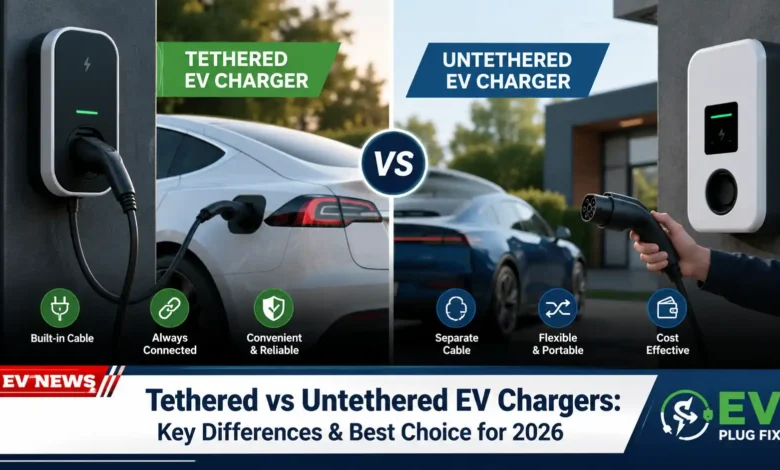
Choosing the right tethered vs untethered EV charger is a critical decision for any new electric vehicle owner looking to set up home charging in 2026. The choice between a fixed cable and a detachable one impacts your daily convenience, the aesthetics of your installation, and even your future-proofing against evolving EV technology. With more drivers than ever installing home chargers—with research indicating that 87% of EV owners have a home charge point —understanding this core difference is essential. For those ready to move forward, exploring a professional Level 2 EV Charger Installation is the first step toward a reliable home setup.
What is a Tethered EV Charger?
A tethered EV charger comes with a permanently attached charging cable. Think of it like a petrol pump hose; the cable is always there, fixed to the wallbox . The connector at the end—usually a Type 2 connector, which is the European standard—is ready to plug directly into your vehicle’s charge port . This design offers a seamless “grab and go” experience, eliminating the need to fetch and connect a cable before each charging session .
Advantages: The Convenience Factor
The primary benefit of a tethered charger is sheer convenience. You will never forget your charging cable, as it is permanently attached to the wall unit . For drivers who charge in the same spot daily, a tethered EV charger simplifies the routine, making it a quick, hassle-free process even in poor weather, as there’s no need to retrieve a cable from the car’s boot .
Considerations: Future-Proofing and Aesthetics
However, this fixed setup has limitations. The integrated cable cannot be swapped for a different length or connector type. If you change to a vehicle with a different charging port, or decide a longer cable would be more convenient, you would likely need to replace the entire charger unit . Furthermore, these units can look bulkier. The cable must be stored neatly—often wrapped around the unit—to prevent clutter and potential damage from traffic or the elements . Understanding different connector standards is key here; check out our Cross-Brand EV Charging Compatibility guide to see how plug types are evolving.
Key Takeaway: Tethered chargers offer maximum daily ease-of-use but offer less flexibility for changing vehicles.
What is an Untethered (Socketed) EV Charger?
An untethered charger, also known as a socketed or universal EV charger, does not have a built-in cable. Instead, it features a standard socket . The user must provide and plug in their own charging cable to connect the charger to the car . This design allows for a much sleeker and more minimalist look, as there is no cable permanently attached to the wallbox when it is not in use.
Advantages: Flexibility is King
The key advantage of an untethered charger is its incredible flexibility. If a cable is damaged, it can be easily and cheaply replaced without needing to service the entire charging unit . It also allows households with multiple EVs to use a single charger with different cables tailored to each vehicle. This flexibility makes it a truly future-proof investment, as you can simply use a new cable if you buy a car with a different connector type, without replacing the wallbox itself . Smart features can further enhance this flexibility; for instance, integrating with solar systems via PV Surplus Charging can maximize your energy savings regardless of the charger type you choose.
Considerations: The Cable Conundrum
The primary drawback is the need to remember and store your cable. If you forget it, you cannot charge . This adds a step to each session: you must retrieve the cable, plug it into the charger, and then into the car, potentially increasing wear and tear on the connectors over time .
A clean and tidy home EV charging installation is key for long-term convenience.
Head-to-Head Comparison: Tethered vs. Untethered EV Chargers
To help you visualize the differences, here is a direct comparison of the two types.
| Feature | Tethered Charger | Untethered (Socketed) Charger |
|---|---|---|
| Cable | Permanently fixed to the unit | No cable; requires a separate one |
| Convenience | High, plug-and-play, cable is always ready | Good, but requires remembering and connecting your cable |
| Aesthetics | Bulky; cable must be managed or visible | Minimalist, cleaner look when not in use |
| Flexibility | Fixed length and connector type | High; can swap cable lengths and connector types |
| Maintenance | Costly; cable damage may require full unit replacement | Easy and cheap; damaged cables are simple to replace |
| Best Use Case | Homeowners, single-car garages, fixed parking | Workplaces, households with multiple EVs, the forgetful |
Making the Right Choice for Your 2026 EV Charging Needs
According to experts, there is no universally “better” option; the choice depends heavily on your specific lifestyle and plans . Consider these key questions:
- How forgetful are you? If you frequently misplace items, a tethered charger removes the risk of being stranded without a cable .
- Will your car change? If you plan to lease or change your EV in a few years, the flexibility of an untethered charger is a significant advantage, allowing you to simply purchase a new cable for your next vehicle . For instance, if you’re considering a model known for its seasonal performance, you might want to check the Kia EV6 winter range data to see how different charging setups can impact battery health in colder months.
- What are your aesthetic preferences? For a clean, minimalist wall installation, an untethered charger offers a much tidier appearance .
- What is your mobility? For those with limited mobility or dexterity, a tethered charger simplifies the process and can be easier to handle, as there is no need to connect a separate cable to the wall unit .
Expert Tip: The Untethered Advantage for Multi-Vehicle Households
For a household with two electric cars, an untethered EV charger is often the more strategic choice. Instead of installing multiple tethered wallboxes, one charger can be used with different cables, accommodating various parking distances or vehicle connector types. This can significantly reduce the overall cost and complexity of your home EV charging infrastructure. To keep everything running smoothly over time, refer to our EV Charging Maintenance Guide for tips on prolonging the life of your cables and connectors.
Important: Seek Professional Installation
Before purchasing any EV charger, always consult a qualified electrician. They can assess your home’s electrical capacity—most homes have single-phase power, limiting charging to 7kW—and ensure a safe, compliant installation . For Level 2 chargers, a dedicated 240-volt circuit is often required . If you encounter any issues post-installation, our EV Charger Error Codes resource can help you quickly diagnose and resolve common problems.
Conclusion: Charging Your EV Should Be Simple
Ultimately, the decision between a tethered and untethered EV charger in 2026 comes down to balancing daily convenience against long-term flexibility. Tethered chargers are the master of simplicity for the single-car owner with a dedicated parking spot. Conversely, untethered chargers offer superior versatility, making them ideal for multi-car households, those who plan to change vehicles, or anyone who values a clean, future-proof installation. By weighing these factors based on your own needs, you can confidently select the charger that will power your EV journey for years to come.